
Category: Brand

  • @having Maggi

    A couple of days back, I happened to see the TVC made as part of Maggi’s 25 years in India celebrations, and the association with the brand was so strong that I had to check it out and write a post on it.

    Right from school, when I used to exchange part of my lunch gladly for a classmate’s Maggi, until a little more than a year back, when Sunfeast Pasta replaced it, Maggi noodles used to rule the category. And even now, it makes its presence felt in the household, in the form of sauces and soups.

    The TVC has been well made and features the Maggi moments in the lives of different consumers – “camping wali maggi”, “first impression maggi”, “hostel ki maggi” etc, and even a “mumbai flood maggi”. I hunted for the TVC on YouTube, couldn’t find it, but thankfully remembered the site url from the ad. So you can take a look at it here – meandmeri.in – unfortunately no permalink, so click on the watch, and then ‘Currently on air’.

    From a consumer’s perspective, Maggi has built its entire equity based on a great product (they actually lost market share when they tried to change the product taste) . From a marketer’s perspective, the positioning has been awesome, they’ve created some memorable campaigns (most of us would still remember the Maggi jingle), and all of this has led to much emotional connect.  There are a million Maggi stories waiting to be told. So, to me, the web provided some great opportunity for the brand to connect with its consumers.

    I wanted to start with this urban legend(?) of a research which I have heard in B school, about how market research had predicted that Maggi would bomb as a product in India. It was often cited as THE example to ridicule the MR loyalists. I couldn’t find it online, but what I did find were some very cool notes. For those interested in Nestle’s brand strategy, positioning etc, here are a few links – Growth Strategy, an interview with the Nestle India MD (2007), and a case analysis.

    So, what are they doing online? I checked out the Nestle India corporate site and couldn’t see any mention there on the campaign or the microsite. Thankfully I remembered the microsite url, though I wonder why Maggi does not figure in it. The microsite is built on the concept of consumers sharing their Maggi stories, pictures, videos, and even recipes. The interface for that is decent. But what I liked best was the Maggi time machine, which shows ads from years back!! I wonder what prevented them from enabling comments on them!! So, in essence, except for a few ‘stories’, I couldn’t find a lot of conversations there.

    Later in the day, I was on Twitter, and lo and behold – Maggi conversations.
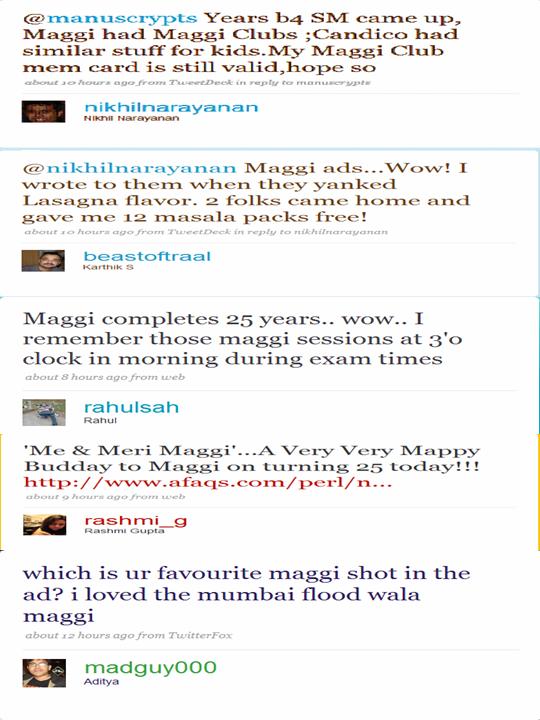
    maggi

    (click to enlarge)

    I also got to know from @additiyom that there was a Facebook fan page too. While I did get a couple of Maggi pages with 5 figure fan followings, they were the international versions, and I thought this one (found on page 3 of search) with close to 300 fans was the desi version. There are many Maggi groups on Orkut, one with almost 40000 members, and 4 others with more than 5000 members. In the first group, there are about 160 responses for ‘which maggi flavor do you like most?’

    It made me think once again, of how brands make a website and  forget about the internet strategy. I’d have loved to see a more well thought out web campaign – with the microsite also serving as an aggregator of content from places where the conversation is happening, for starters. By all means use mass media and promote the site, but if the idea is about getting in touch with consumers, it definitely helps to seed and maintain conversations over at the usual suspects – Facebook, Orkut, YouTube and even Twitter. The audience is already there.

    until next time, 2 minutes definitely makes sense in real time 😉

    PS: Remember the old Maggi joke when Sourav Ganguly was out of form? 🙂

  • “What will you do when the money goes?”

    Even as stories abound about a Google acquisition of Twitter, Adage had a story on how Google is already making money out of tweets. According to the article, Google is offering ad units that display the client’s five most recent tweets across the AdSense network. The link leads straight to the client’s twitter account, and the campaign is measurable by the increase in follower count. One could say that Twitter gets some publicity out of this, but its obviously not getting any money.

    The ad network Federated Media recently launched ExecTweets, a site that aggregates tweets from business executives. The site is sponsored by Microsoft. With a twitter account, you can join the conversation, receive tweets from the community and vote for tweets and execs. At least on this one, Twitter will make some money.

    Since we have mentioned two biggies, might as well mention the third too, though what they’re doing is different from the above. Sideline is the desktop app from Yahoo, that runs via the AdobeAIR platform. It can do custom search groups, advanced queries and auto refreshes by pulling in data from tweets. There are other services that offer similar features, but maybe there’s more coming. And it does promise 20% more awesomeness. 🙂 On a tangent, a service called Say Tweet, which I have used in my personal blog to display my Twitter status, does give a sense of what Yahoo could do with Flickr and Twitter.

    In addition to the biggies above who’re using Twitter, there are numerous applications and services being built based on Twitter, and several others inspired by Twitter. A few examples. Tinker, from advertising and publishing network Glam Media, allows users to track real time conversations (from facebook and Twitter) happening around TV shows, entertainment events, conferences, and so on. It gives information on events by showing most followed and most discussed streams, popular events, and on trends with charts and historical data.  It also has embeddable widgets, which can be used to view a feed as well as update. They already have advertising and featured events and have further monetisation plans. iList Micro, from the iList service that alllows you to broadcast your listing to friends across networks, is the Twitter version and uses the hashtags #ihave and #iwant to create a simple process of classifieds. I have already mentoned Yammer (which now offers integration with Twitter), and Blellow in earlier posts, which are renditions of Twitter for more niche/enterprise uses, there’s also status.net arriving in a couple of months time.

    In spite of the several ways in which business are using Twitter, and the potential, I actually get worried when such services pop up on a regular basis, because I fear that when each service figures out a revenue model, one door could possibly be closing for Twitter itself. For instance, recently Jeremiah Owyang had a good post on social CRM being the future of Twitter, and within a few days, I read about Salesforce adding Twitter analytics to its CRM offering, and about CoTweet, a part marketing-part CRM tool.

    Twitter hasn’t been idle. From experimenting with advertising on profile pages (for third party and own apps, free for now) to tweaking title tags for better Google results, to hiring a concierge for celebrities (yes, really!) a lot is being done. And there’s also a new homepage design (limited roll out) which gives more prominence for the search function and increases homepage stickiness. It will also display popular trending topics (like in the current search homepage). (Hmm, perhaps one ad every 5 items, I wouldn’t mind that when i search)

    With the new funding, perhaps they have enough money in the bank to wait, watch new services, and incorporate the popular ones into their own functionality, in order to provide a diverse and robust service to all kinds of users.  Twitter is so open ended that it is different things to different people, but I wonder if identifying a few areas that they’d want to develop for revenues is of prime importance now. What I’m worried about is other services staking out potential revenue models, and whether addition of features towards no particular intent might result in everyone else but them making money out of these very features. But hey, maybe they have a plan. 🙂

    until next time, tweet dreams

    PS. the lyrics of the song mentioned in the title 🙂

  • Just Business?

    A few days back, LinkedIn added a feature that I’d asked for the last time I wrote about the service – the ability to add RSS feeds to groups. Depending on the functionality enabled by your group manager in any group, you could add a site/feed that fits the group profile and all the members could benefit. From the comments on the page, there seem to be a few implementation issues. Vijay, who manages the Digital Marketing India group on LinkedIn (the one I most actively participate in) has added a few feeds, but we’re yet to play with it much 🙂

    He also pointed me to this interview with Allen Blue, a LinkedIn co-founder. Allen mentions in the interview that ‘groups’ is the most exciting thing they’re working on now, though they seem to be doing things to limit the functionality of the groups. He also says that (among others) he’s impressed with Ning and Facebook. Will come back to that in a bit.

    I am wondering if this feeds functionality will also be made available to company webpages. For now the pages are pretty impressive, with a whole lot of data being provided. But there are possibilities – like allowing page managers to create an RSS feed of news about the company, which any user could subscribe to and be updated. (a Google alert approach). They could also allow multimedia uploads (haven’t seen any yet) and more interactivity. In short, become the second interface of the company, right after their corporate site – what brands are doing with Facebook fan pages, only on LinkedIn it will be more of a serious interaction.

    Ning has been making waves and I have been seeing a lot of people utilising it to make networks. As of Sep 08, it had 2955000 users and a YOY growth rate of 251% (LinkedIn was right behind at 193%) (via StartUp meme) But (at least) for now, I don’t see it operating in the same space as LinkedIn, since Ning is more on building groups around common interests, and that’s only one of the things LinkedIn does.

    The real action will happen when Xing, the European business network will start deriving some synergy from its recent acquisition – SocialMedian. Towards the second half of 2008, Xing had 7 million users as against LinkedIn’s 12 million, and was making profits. Though I’ve not come across a lot of Xing users in India, even LinkedIn is not an ancient phenomenon here. So there’s definitely time to catch up. Xing has most of the functionality that LinkedIn has, but more importantly has a brilliant resource in Social Median, and its implementation of Facebook Connect. During its acquisition, the then CEO had said that Social Median, with its news gathering (from 19000 sources) and custom filtering was a perfect fit for Xing. I couldn’t agree more. The value it could add to the individual and the groups he/she is part of is tremendous. This is an area that LinkedIn has not fully tapped.

    Meanwhile, the service that I thought might be a good buy for LinkedIn – Yammer, recently announced that Twitter updates can now be imported into Yammer. When I had written about Yammer first, I had mentioned a ‘bridge’ between Yammer and Twitter. This move has solved part of it, for me the more important part is the (filtered) Yammer updates going into Twitter, and come to think of it, LinkedIn. But of course, this is connected a lot with an organisation’s levels of transparency.

    And if all this wasn’t enough, we now have a new player – Blellow. TC called it a Yammer meets LinkedIn meets Twitter entity. Blellow describes itself as a productivity microblog, that  allows users to collaborate, find jobs and solve problems via a Twitter like interface with ‘followers’ and ‘following’, private messaging, @ replies, (the question here is ‘What are you working on?’) Where it differs from Twitter is that updates can go upto 300 characters, users are organised into groups, and there are threaded discussions. One can create a profile, form groups based on projects or interests, ask questions in groups and give ‘kudos’ for answers that help (a rating mechanism), post jobs (for a price), plan meetups..  From the looks of it, its a great niche package for freelancers and people looking for quick help in specific fields, maybe LinkedIn could acquire and scale up? 🙂

    With the personal-professional lines blurring, the Xing-SocialMedian-Facebook Connect association is something LinkedIn should be looking closely at. It either has to get an equally strong partner or develop features and data portability by itself, and perhaps acquire services that complement its own services.

    until next time, mind your business 😀

  • The new media owners

    A few days back, I read a very interesting piece by Jeff Jarvis on ‘The Great Restructuring’, in which he talked about fundamental changes happening in the economy and society. He also talked of an economy (at least in part) built on the abundance of knowledge, which then led to the subject of replanting business models.

    It took me back to a discussion I once had with a friend on the role of newspapers, and the new forms of media. The role of newspapers, and ‘tangible media’ in general was a hot topic of discussion then. Steve Rubel had the “The End of Tangible Media is Clearly in Sight” post which put 2014 as the year of demise (in the US), and got quite a few responses, including some folk who disagreed with it, and some who agreed a bit but disagreed mostly. There wasn’t much of disagreement on the subject of newspapers, and it was generally agreed that Digital was indeed a great disrupter. Newspapers have  been accused of trying to replant their offline model on their web. Perhaps rightly so, since it clearly doesn’t seem to be working.

    In that conversation, we’d used ‘new media’ a little differently from the platform based (internet and mobile) approach. We discussed three forms of ‘new media’ –

    • some entities about whom the media writes about – people and  organisations . The net population already shares a lot of the content they produce on the web platform – via blogs, social networks, platforms like YouTube, Flickr etc, and lots of organisations are using the web as a broadcast medium – Marketing as media
    • social networks and other services which consolidate a lot of the content generated above in one location, and web only news sites (anything from Rediff to Instablogs and niche news sites)
    • some entities who’re already in the communication/network business – these could be companies like Nokia (handset manufacturers who are an access point to the web), telecom operators like Vodafone (who also act as an access point), or even companies like Cisco, who I think will go further than just provide media solutions

    While there’ve been a few setbacks – Nokia shutting down Mosh, its content sharing service as a result of dubious content posted, Vodafone playing bully to opt-in-SMS service MyToday and various lawsuits against Google (YouTube) on copyrighted content, I’m hoping these are nothing more than teething problems of a radical overhaul.

    Depending on various factors, like socio economic conditions, technology penetration, to name a few, ‘The  Great Restructuring’ would happen differently in different places. Like other restructurings before, some parts of the population would remain unaffected.

    Meanwhile, as mentioned in the post, it indeed is a time of opportunity, and definitely for newspapers too, at least in this part of the world. It only depends on how much they’re willing to shed their old ways of doing business (especially when it isn’t making the revenue it used to be) and how willing they are to listen to the collective consciousness. Even with the ‘new media’ and the proliferation of content producers, newspapers could still find ways of delivering value. (excellent debate happening here)

    Earlier, everyone read a newspaper and therefore it was the place for a product to be seen by its potential consumers. Since the first part changed, the second has too. If increasing media fragmentation is the future, then what newspapers could be doing wrong is seeing their product/s as the only media/destination. Instead, they should perhaps (at least) listen to the Chaos Scenarioexplore a few options, utilise their resources to be preferred content choices in as many fragments as possible, irrespective of the platform, and fight battles in each fragment separately. This would also mean that basis the dynamics of each fragment, different revenue models might evolve for each fragment.

    until next time, for now its Calvinball rules 🙂

    PS. Must Read – IBM’s study – Beyond Advertising

  • Sizing up

    Quite sometime back, Chris Brogan had written a small post on ‘Small is a weapon’ with its many advantages like the ability to experiment more and respond faster (than big companies).  Before going further, let me clarify that this is a broad generic view, and I’m sure there might be large companies that manage all this. But perhaps smaller companies have a better chance. The comments on the post reinforced these advantages – internally, a flat structure that makes effective decision making easier, a willingness to change, the importance given to ideas, and externally, faster turnaround for customer issues, a personal touch, and so on. These characteristics struck me as very important ones from the perspective of social media interactions.

    Is social media a better tool in the hands of small companies? In a small organisation, would the qualitative metrics of social media be appreciated much more? Would the community – external and internal be connected because of the passion they share for what they’re building together? An idea, (via dina) which binds the audience?

    As organisations become bigger, ideas become products/services and then become brands?  And as brands grow in stature, does this size dictate everything else? Is that why mass media seems appealing? Because somewhere along the line brands picked up larger audiences and found that one way communication to this audience was easier? Does the focus of the brand move on to marketing communication, monetisation of the audience etc, because the  brand cements itself in terms of its attributes and perceptions in the mind of people and all it wants to do then is reinforce?

    Can larger organisations handle the expectations of social media users – both from an internal perspective (empowerment, for example) as well as from a customer standpoint – (speed, personal touch, conversation). Do they feel limited by  the number of interactions that can be handled? Are they too used to conveying the single brand message irrespective of context, and do they find ‘scalable intimacy‘ difficult to handle? Do they then try to dictate the kind of ‘official’ use that their employees find for social media? After reading Mashable’s post on a similar topic, I had another thought – would an international brand be able to make sure the cultural differences and sensibilities across geographies are handled in the right manner always, in a medium that’s not limited by geography?

    Perhaps the solution is to move back from the narrow confines of the brand’s architecture to the original generic idea space, because there will be the old audience with new experiences who can help the brand connect with a new audience? New ideas would emerge leading to a new lifecycle?

    I guess its not quite easy to answer since the phenomenon of social media has been making its presence felt only recently, and its difficult to figure out organisations that have been using it for a long time and also scaled up at the same time. Meanwhile, McKinsey Quarterly has a great read on 6 ways to make web 2.0 work. (for companies)

    until next time, scale the walls