Category: Brand

  • Next.org

    A few days back, I happened to receive some understanding on the difference between an ‘organisation’ and an ‘institution’. As is my wont, I immediately came back from the event and googled it. All the Q & A forums, however, just sent me to Wikipedia, and to be fair, it did confirm what I had understood. So, the definitions

    An institution is any structure or mechanism of social order and cooperation governing the behavior of a set of individuals within a given human community. Institutions are identified with a social purpose and permanence, transcending individual human lives and intentions, and with the making and enforcing of rules governing cooperative human behavior.

    An organization is a social arrangement which pursues collective goals, controls its own performance, and has a boundary separating it from its environment. ..There are a variety of legal types of organizations, including: corporations, governments, non-governmental organizations, international organizations, armed forces, charities, not-for-profit corporations, partnerships, cooperatives, and universities.

    I think somewhere between the two lies the organisation of the future – where the collective intent of the workforce is more than the sum of the parts. I liked the ‘social purpose’ part of the institution which to me, made it superior to the organisation that has a boundary that separates it from the environment. I felt that this boundary had become an increasingly impervious wall, something that affected intent, culture and even ideas. But I’m not so sure of the ‘permanence’ of the institution.  Is it just the idea that’s permanent or the manifestations too?

    Let’s quickly bring back that ‘where is this going’ thought into a brand perspective. When i wrote about appification and multiple platforms a fortnight back, I wondered what was the structure that could hold the identity of a brand together. Logos, mission statements, and even the experience – all of which have been used to define ‘brand’ seemed unworthy. Even my favourite – ‘promise to the consumer’ seemed barely there.

    The bad news – I don’t have an answer yet. The good news – out there, (at least) a couple of razor sharp brains,  armed with much more experience and knowledge, are piecing together the principles that would guide the functioning of the enterprise. The organisation is after all, a means to an end, and the brand is one of those means. So from that, I’m sure, clarity will emerge for brands too. 🙂

    until next time, to boldly go where no enterprise has gone before 😉
  • While on contextual reputation…

    Though I don’t answer much on Quora, I am quite a gawker and vote up answers too. One feature of Quora that I found extremely interesting and useful (and tweeted about) is the way Quora gives contextual ‘reputation’ (while reading answers) using the person’s topic bio. The interesting coincidence (because he also RT ed this tweet) is that I noticed it thanks to Mahendra‘s answer to a ‘Google Reader’ based question, and right next to his name was “Daily, dedicated user. Subscribed to over 200 feeds, followed by over 700 people on Reader/Buzz”. I must admit, before I realised that it was a topic bio, my first thought was why Mahendra was ‘wasting’ his Quora bio on Reader when he had such a huge list of phenomenal things he could say about himself. 🙂

    But yes, coming back to ‘contextual reputation’, I liked it because it gives a lot of relevance and credibility and adds a layer to an answer – you can better understand where this  answerer and his response is coming from, for example. Another nuanced way of helping the reader weed out noise. I also thought this was a good way for brands/organisations to develop credibility in their domain, and involve their users, using function specific spokespersons, (brand, HR, operations etc) since “brands are currently not supported on Quora“.

    And now we can go off on a tangent and check out a few brand experiences I had last week, all with oblique connections to contextual reputation, though lycra like they might seem 🙂

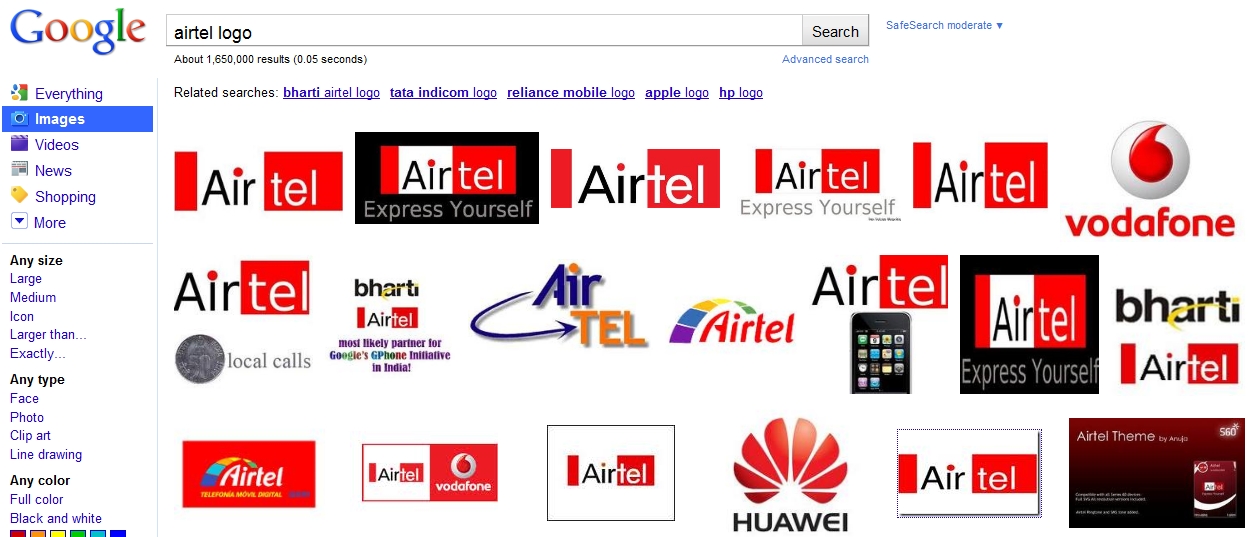
    When Airtel changed its logo sometime back, though there were infinite debates on the need and quality of the new logo, their on ground management of the logo change was almost unequivocally appreciated. However,

    To their credit, the ‘everything’ search, though has the old images, has the first link pointing to the new logo. But from an image perspective, ‘contextual reputation’ for logo change online gets a thumbs down.

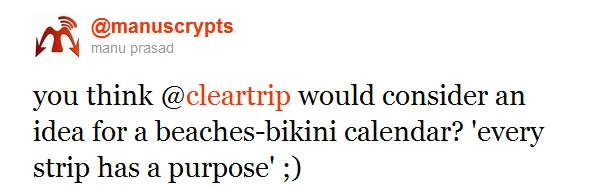
    Cleartrip, quite a favourite brand for their ‘no nonsense. clear talk and action’ way of managing their product and online presence, has a new campaign ‘Every trip has a purpose‘. But favouritism unfortunately doesn’t stop me from wordplay and I tweeted

    Just as i was chided for provoking a brand, and was replying that I trusted Cleartrip to have a sense of humour, they replied with a ‘laughing hard’. Contextual reputation thumbs up. Hopefully they weren’t being sarcastic.

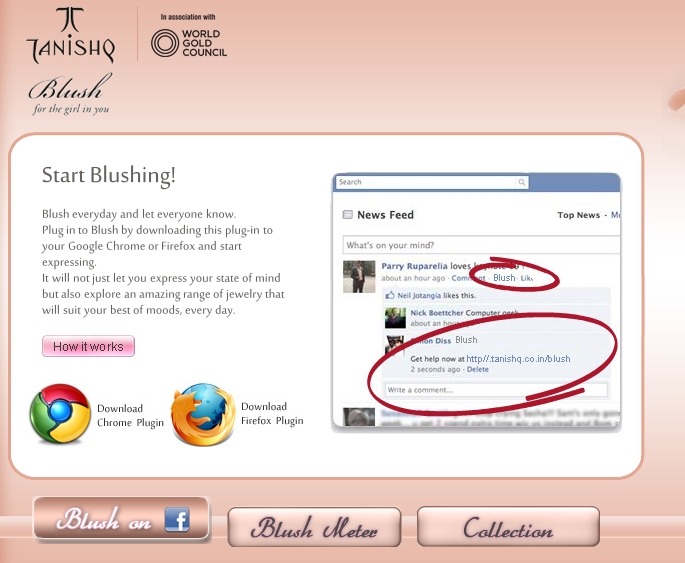
    The last experience was from Tanishq, whose new Blush campaign I came across last week. Like I tweeted then, immediately after the Quora tweet, I found it quite interesting and worth an applause that a brand was experimenting with a Firefox/Chrome plugin. Instead of me explaining how it works, I will, in my new found enthusiasm for imagery, give you a screenshot.

    As you can see, the plugin gives you, in addition to the ‘Like’, ‘Comment’ options you see after a Facebook status, a ‘Blush’ option, which when clicked, adds a comment with a link to the ‘Blush’ page. Hmm. I won’t get into a ‘app within FB vs outside website’ debate (there must be some reason, I assume). But unfortunately, boring that I am, I’ve never seen a jewelery that has made me blush. I can’t even see it in the Tanishq collection, assuming that I have the ‘where to wear it’ right. Maybe girls/women see it differently. So, why didn’t Tanishq just have a ‘Gold’ button, which would actually add to their ‘contextual reputation’ more than blush, and tie it to some sort of action that would actually get something tangible for all involved.

    For example, I install the plugin and start using it just because of the ‘show off’ value. What if they tied in an offer linked to the number of “Golds” I gave/received on statuses, and then communicated that in the comment that appears after I have ‘Gold’ed a comment. Or how about virtual gifts, a way to showcase the gallery, and then an easy app to add the virtual gift to a profile pic? I have an inkling that women are likely to have a “nice earrings/pendant. where did you get it from” conversation. They could even make this Like based contest i.e. if you virtually gift someone and get them to add it to their profile pic, and they get maximum likes (make a leaderboard) we’ll let you actually gift them for free. Do that on Valentine’s day, and it just might work.

    Meanwhile, I have a ‘reputation’ for longish posts, so I’ll just stop here.

    until next time, add to the context?

  • Appeasing consumers

    Last week, I had asked on twitter whether Indiatimes should consider buying/building a GroupOn clone and use its other media platforms to scale the business, especially since its also proxy advertising for their clients. In response, Shahid had wondered what prevented an Airtel from getting into it. The point (simplistically) being that, any platform owner with a ‘captive’ audience could get into the business.

    It made me think about the mobile as a platform, especially considering the app talk I’ve been doing on the blog for a while now. While appification across platforms is what I’d discussed last week, for the purpose of this post, I shall restrict my thoughts to mobile platforms. Even before I read and wrote about the appification across platforms, I had asked a question on qoura “Has any Indian bank considered a smartphone app?”  (http://qr.ae/GETp) I got 2 answers, and though I was looking for Android, they were still helpful – Robin Samuel pointed me to ICICI (I think Gopi had also mentioned it on Twitter) and Aditya Sengupta mentioned a Nokia Money + YES Bank pilot.

    Citibank, whom I bank with, had a few Android apps, I noticed. The Citi Hong Kong app was specially interesting, since in addition to location of ATMs, they also display offers nearby. I’d obviously like an app which will also help me transact, and they have that too, elsewhere. (they are by no means, the pioneers or only ones, as a google search would tell you). The idea here, though is a ‘commodity’ service (banking) increasing user convenience, and making a shift to another bank less appealing. This isn’t an ad vs app debate, but spreading this information would be simple enough (without mass media) during consumer acquisition, as well as later through digital and social platforms. Maybe even tie up with a mobile manufacturer and offer to subsidise the handset for the consumer in return for publicity. The point, platforms are exploding and brands need to think of new ways to associate and partner. These apps could itself evolve into a branding vehicle.

    And since that point is made, we can broaden the scope beyond mobile as a platform. Just in case you thought brands might be constrained with that as the only option, how about TVs, kitchens, laundry rooms, cars, tables? Check it out.  (via Avi Joseph)

    until next time, Applying minds 🙂

  • All hands on deck

    Since tis still the season of predictions and ‘looking forward to in 2011’, and because I brought up the subject of brand agencies reshaping themselves for the future, I thought I’d share with you three of my favourite decks of insights from the many that I managed to scan in the last few weeks.

    We’ll begin with JWT’s ‘100 Things to Watch in 2011’. (via Surekha on Reader) While there are many things in this that you might already think is a trend, what I liked about it is its thinking outside of any specific prisms – brands, technology etc, but still managing to capture the  essence of trends in human behaviour, culture, consumption, the shifts happening therein, and thus, a good reckoner for marketers.

    The second one I’d like to share is Edelman’s ‘Digital Trends to Watch in 2011’. Though there are a few commonalities with the JWT deck, this seems more focused. While this is definitely quite a sensible thing to do from a client perspective, I missed the “completely out of the blue, but damn, why didn’t I think of it?” moments that I usually associate with its creators. But that’s just a testament to my high regards for Armano and Rubel, more than anything else. What I liked most about this was the trend + best practice combining, that layering gives excellent perspective.

    The last one I’d like to share is Rohit Bhargava’s ’15 Marketing & Social Trends to watch in 2011′ (via Gauravonomics). There might be some overlap with the other two, but again, the idea of examples with each trend makes it a must-read, in addition to the overall quality of insights.

    While its easy to see that there are commonalities in these, I also noticed an interesting thread of thought that  resonated most with me.

    ‘There’s an app for everything everywhere’ is perhaps the underlying theme in #3 (Apps Beyond Mobile), #7 (Ubiquitous Social Computing, more specifically its best practice) and #9 (Appification of the web) in the JWT, Edelman and Rohit presentations. We then move on to ‘production of consumable content and experiences across platforms’  that connects #93 (Transmedia Producers – faint connection), #4 (Transmedia storytelling) in the JWT and Edelman presentations respectively. And at last, we move on to how it can scale which is brought out through #3 (Developer engagement) in Edelman’s presentation and #7 (Crowdsourced innovation) and #11 (Employees as heroes) in Rohit Bhargava’s presentation.

    While I may not endorse a brand strategy only basis tools, the ‘appification’ across platforms actually throws open the door for marketers to not just satisfy their ‘short head’ consumers in better ways, but explore the ways to reach the ‘long tail’. It allows them to blend or distribute their ‘story’ across platforms and if done well, raise the interest level of their consumers. And an agency or brand manager cannot do it alone. While the idea of crowdsourcing is looked down upon by many, there are enough examples to show that if targeted well and executed with clarity, it can deliver results. More importantly, here, the ‘crowd’ is not consumers, but developers who can re-create the brand’s experience on multiple platforms, and employees who can create a human story that will resonate with others.

    If these possibilities for 2011 don’t excite you, I’ll try again next week, but I really don’t have any more of these awesome presentations to back me up.

    until next time, slide rules!

  • Brand agencies redux

    One of the ways to measure brand communication is to view it through the prisms of effectiveness and efficiency. I sometimes get the feeling that with time, mass media became more of an efficiency game. Then social technologies came along and forced the marketer to acknowledge (the forgotten) effectiveness criterion. That would explain the resistance to adoption, since communication strategy would have to change to accommodate it.

    A brand manager would ideally like a balance of both though. Meanwhile, somewhere on planet Quora, I voted up our friend Gautam Ghosh’s answer on ‘influence’. Apparently, an old HBR article (2005) had defined influence as a factor of two aspects – visibility and credibility. Considering that a brand is also aiming for influence, I found the connection between visibility/credibility and efficiency/effectiveness very interesting.

    I think the ROI debates are also a manifestation of seeking efficiency, though very few distinguish between cost and investment (I). The good news is that once tools are developed to address this, (I hope) brand custodians will focus on effectiveness too. I was very happy to read Jason Falls’ post about tools that are beginning to address scale too. (Expion and other social media tools to manage franchisee operations) While these tools would most likely scale themselves to accommodate new platforms and technologies that arise later, the bad news is that effectiveness is still something that can be judged only by someone who understands the brand as well as the platform in question.

    A quick detour. I recently started playing ‘Restaurant City’ just to get a feel of social games, and found Coke doing a pretty decent branding exercise there, that integrated well with the game mechanics and experience. The entire social gaming arena is already exploding. Farmville is passe, and Cityville is king. And that’s just one platform. How does a brand manager keep himself in the loop on all this, and experience enough to have reasonably good perspectives? So the idea of filtering experiences in multiple platforms to get perspectives on effectiveness is something I think only an agency can scale. And the more I think of this, the more I feel that this is the opportunity area for agencies – both communication (PR, Advertising) and media buying. I will state the obvious by saying that this is not likely to happen in their current avatars though. Your thoughts?

    until next time, agents of change