
Category: Brand

  • Brands and Curation

    Content and the need for brands to get into the space of creating it has been a subject discussed here several times. So, when I read about MTV's tumblr voyage, (via) I thought it would serve as a good handle to revisit the subject.

    I thought the choice was platform was in itself a great step. Tumblr, for now, seems completely clued in on how networks, sharing and community work and as MTV notes, is focused on web culture, which can be seen in the way they have designed the service. It also explains why there's nothing new about everyone from media companies to fashion brands hopping on to it.

    Brands as storytellers is also nothing new though new and interesting stories are hard to come by. That's where a crowd can help. Mostly, when brands say they've tried crowdsourcing, it means asking for a caption or a photo or a video that has something to do with their current campaign. There are exceptions like IdeaStorm, Dewmocracy, My Starbuc

    ks Idea etc but that's a small list in the large set of attempts.

    What I liked about MTV's approach was that it is not asking for anything specific. It is establishing a culture of conversation around its domain and with its trademark edgy approach (F*ck yeah!) – internally and externally, making it comfortable for a community to develop. Once that happens generating interesting stories (content) will slowly stop being a constraint. Brands can then chose to play curator, aiding discovery, surfacing interesting ideas, starting a line of thought, and streamlining conversations. And when it feels there's sufficient excitement, scale these up to a larger audience via other distribution channels. Right now, the reverse is how it works – a “come one, come all and quickly contribute to our newly launched endeavour” shout out on traditional media, instead of an organic approach.

    On a different track, this doesn't mean that if the crowd generates everything the agencies will be defunct. On the contrary, and in addition to the implementation, the agencies are probably best suited to play the role of meta curators, moving beyond one way advertising platforms and processes, and using their understanding of the brand to explore new platforms and communication protocols being developed, so that they can advise the brand on every frontier that comes up.

    until next time, tumble along

    Update: Just read that Tumblr hosts more blogs than WordPress now. (via)
    zp8497586rq
  • Social’s Next Frontier – $ocial Commerce

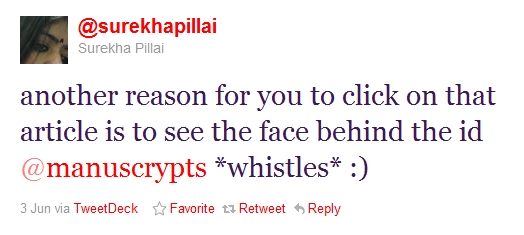
    1970 words is long even by my copious post standards, and that is the size of my article on afaqs, on social commerce. That, and a fortnight trip to Kerala meant that I was too lazy to write up something new here. I have shared the article on all the networks, but in case you haven't read it yet, now is a good time. Click right here.

    Apparently, there is another reason to click it too, go

    ing by the response to this tweet 🙂

    But since the face isn't much to look at, I'm hoping you'll focus on the article 🙂

    zp8497586rq
  • Brands & Niche Networks

    For a while now, I have believed that one of the inevitable consequences of the sprawling social networks we see around today, would be niche networks. This is not something we don't see around already – in fact, most of the networks or users address it in their own ways – groups/pages on Facebook, LinkedIn, lists and cliques on Twitter.

    But I see niche networks as an evolutionary phase because currently, the popular networks seem to have been designed for mass, with features evolving when there was a demand – from the users or clients for more segregation. Users, because, sometimes even for the infovores, (apparently the term was the title of a book by Tyler Cowen – HT @uglybutbearable) the deluge of information without efficient filters meant that they were losing out on information they'd have liked to have, and businesses, because without more customisation options, social would just be another media/distribution platform. But social and mass seem to go intuitively together, so the usual way is to aggregate and then segregate.

    (Bonus: Great read on filtering by JP Rangaswami on his blog)

    However, there are many manifestations of niche networks that I can already see emerging. Ashton Kutcher, whom I'd consider a personality brand, has built his own custom Twitter app with the help of Ubermedia

    . A new service called MyCube, still in private beta, is offering users the ability to monetise their information. (via) Raptr, a social networking service for gamers is customising users' news streams extremely well using the information it has on its users. (via)

    The only commonality here is that all these seem to be moving away from a mass design to one that's meant for smaller/more specific user sets. Of course, the existing large networks can always figure a way for users themselves to be filters and recommend appropriate things to their own network, (eg. Facebook's new feature) but that's a rewiring.

    But I believe that the rise of the niche networks provides an excellent opportunity for brands to get into the thick of things and 'own' the domains they operate in. Nike+ has always been a favourite. I also think Toyota's approach to social networking, built with help from Salesforce is a good first step. The challenge, as always, will be to find ways of how a user need can be satisfied with a new offering that is synced enough with his familiar territory (existing networks) for his experience to be as frictionless as possible. If brands can do that well, they will have built something that's not utterly dependent on the vagaries of current and emerging media platforms.

    until next time, admoniche 🙂

    zp8497586rq
  • Button Mania

    Since the Skybags driven conversation on Twitter a few weeks ago (related posts by L.Bhat and Karthik) I have wondered about the presence of Facebook/Twitter icons in print ads. So I decided to do a little research on my own. For a week – from 13th – 19th May, I tracked the ads in Bangalore Times, particularly those which had mention of a social media presence. The results are in the presentation below.

    Brand – Social Iconography

    View more presentations from Manu Prasad

    I would estimate that only about 25% (or less) of the ads carried these logos, so I can understand why brands would want to use this as a differentiation tactic, but doing so with just buttons (sometimes without a url/handle/name) and no worthwhile presence to showcase, defeats the purpose. Or maybe we can wait for the day when Augmented Reality will allow me to use that button and automatically go to the url. 😉 Meanwhile, I await the introduction of the Foursquare button into the mix. 🙂

    until next time, button up for the social media ride

    P.S: I'd like to make this an infographic, if you know someone who can volunteer, please pass the word.

    zp8497586rq
    zp8497586rq
  • Brands – real and virtual frontiers

    A few months back, I had written about the Balkanisation of the internet, in which I had asked how a  brand could deal with the surge of not just new services, but new platforms too. A few days back, I thought of this from a (slightly oblique) user point of view and remembered incidents spread across years – a few years back, one morning, when I was thankful on seeing a CCD in Colva, Goa while I was hunting for breakfast options because I knew exactly what to expect in a CCD menu; last year, when I visited a mall in Cochin, and realised that I could more or less predict the brands that would be present there; on television, the increasing popularity of US TV shows and how channels seem to be working to sync a global audience in terms of seasons; (forget torrents for now) and how, a meme on Twitter or Facebook is many a time global in appeal and interesting apps on iPhone/Android platforms are discussion points across geographies and in general, an increasingly growing population is 'in touch' and having similar sensibilities.

    The themes here from the real world experiences to virtual ones are homogeneity, and of a user's preference (in many cases) for familiarity. Which makes me turn back the question on balkanisation

    lectronic Repair Information'>Electronic Repair Information

    . Despite the balkanisation, do new platforms accelerate a homogeneity within a certain demographic?  The rate of upward mobility notwithstanding, do you think, at some point, popular culture and preferences will become homogenous globally? eg. say Angry Birds, Dexter, Bieber hatred…

    Meanwhile, since the time I switched to Android – a few months ago, I have noticed that services like Facebook, Twitter, 4sq and the Google range, are working hard to ensure that users can move seamlessly across different platforms – web, mobile web, apps, tablets. While that doesn't absolve the brands from having to understand the workings of different platforms, consumption patterns and how they could provide the user an interesting experience in these contexts, it does provide some relief.

    Few brands have been known to get regional nuances right in communication. Now, along with location and location based marketing becoming center-stage, there is an added challenge. Not only do they have to get the nuances right in their communication, but they also have to provide consistency in the value offering (not the same as being static) in experiences across platforms. That is a long stretch from blasting messages across traditional media platforms.

    until next time, brand-owned platforms?

    zp8497586rq
    zp8497586rq