Category: Brand

  • Influence, Decision Making & Data

    It’s been just over a year since my last post on influence, but a couple of very interesting articles, and a few advances and observations makes this a good time to visit the subject. I am in touch with both the custodians of my influence these days – Klout and PeerIndex, and like to experiment with them. (the rise in Klout a few days back is the result of one such 🙂 ) They are obviously in early stages, which is probably why I think they can be gamed, despite their stout denials, and also why Klout considers me ‘influential’ on the topic of lottery. (thankfully Pakistan has been removed now)

    What I did find a bit disconcerting was the usage of these scores in brand strategy/promotions. (relevant link at the end of the post) The basic thought here is to identify ‘influencers’ and engage them for various purposes – from product design to communication, advocacy etc. Not a bad thought in itself, but I wonder if it is way too early in the evolution stage to try this out, because there are way too many variables, including trust, involved and many of them have probably not even been acknowledged, let alone tracked and measured.

    The consumer decision making process is itself undergoing massive shifts thanks to an ever increasing slew of communication platforms and services, which allow consumers to speak to brands, and other consumers, and has mechanisms for rapid and wide spread. For example, I saw an interesting perspective, which replaced the traditional funnel with a ‘consumer decision journey’ and discussed the need for changes in the brand’s approach so that different functions can be better aligned.

    For a different perspective, take a look at this presentation (via Vijay Sankaran)

    It makes a good case of why algorithms and ready made dashboards may not be the best solution possible to even finding the ‘right’ ‘influencers’. The way I see it, the current social platforms are only portion of the data, and there are going to be many more layers and sources. (earlier post ‘Data beyond Social‘)

    But even though many, including myself, would agree to the observations in the presentation, the ways to scale it are still blurred because I’d say the human component still has a major role. But that might be something that will change in the longer term. In the short-medium term, considering the $ spent on many a media blitz, a better allocation of $ resources – into collecting and then converting the data deluge to actionable information – is what is warranted.

    until next time, influence shell

    The promised link: Involver is a platform that has partnered with Klout to allow brands to “interact with and reward fans on Facebook based on their Klout score” (via)

    Bonus Reads: Resolving the Trust Paradox, and Prem’s post on ‘social’ in the buying process.
    zp8497586rq
  • Insignificance

    I remember writing this post about 4 years back, with an insight on why I didn’t particularly like to travel. Things have changed since then, and I do travel as much as possible these days. The odd discomfort of viewing masses of humanity still persists, but the reasons are more nuanced.

    What reminded of that post was this article that beautifully expressed the discomfort with the title “The Sad, Beautiful Fact that We’re All Going to Miss Almost Everything“. The article uses this in the context of books, films, music, television and art. But I relate it more to places and people. I still remember that the saddest part of leaving Leh was that it was perhaps my only visit to the place and I had not seen everything that had to be seen. In the case of people, the rise of the statusphere (Facebook and Twitter) has only added to the feeling that one is constantly missing something significant.

    It is probably going to get worse, unless of course, we manage to do the Matrix-USB type thing of instant information absorption. Even then, it would probably go the way things are headed to these days anyway- consuming without experiencing. The real time challenge of being updated about people would still exist. And perhaps it will end up the way the line goes, “we will increasingly be defined by what we say no to”. But, as the author of the article I linked to, above, notes,

    It’s sad, but it’s also … great, really. Imagine if you’d seen everything good, or if you knew about everything good………That would imply that all the cultural value the world has managed to produce since a glob of primordial ooze first picked up a violin is so tiny and insignificant that a single human being can gobble all of it in one lifetime. That would make us failures, I think.

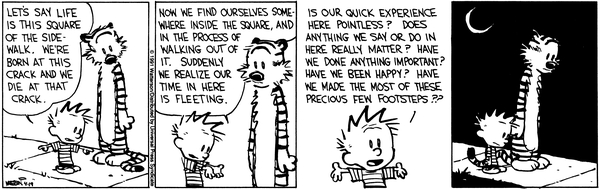
    If I had to adapt that to places and people, I could say that the creator might feel insignificant if we could discover all of it in a lifetime. However, the collective advance of humanity is not a complete solace when it comes to the individual’s existential angst. As one of my fave Calvin strips go

    until next time, insignificant choices too?

  • A Brief for Agencies

    Will.i.am, musician at Black Eyed Peas, and Director of Creative Innovation at Intel, speaking at the Cannes Lions International Festival of Advertising Creativity (to be noted), said, “Ad agencies are yesterday. But ad agencies that can turn consumers into agents that add value to community and life, that’s what it’s about right now.” (via)

    A couple of weeks back, I had remarked on the role of agencies in future in the context of brands and curation. I found this post titled ' Why Ad Agencies Should Act More Like Tech Startups' very interesting. The contention was that in these dynamic times, with new services appearing/disappearing faster than ever, the definition of the 'idea' needs to go beyond the traditional creative domains and start looking at technology as a major player, 'leveraging it in creative ways'. Mashable had a post couple of days back on how the advertising industry is preparing for a digital future.

    Despite the slice-and-dice that marketing functions have gone through, I still have quite some affection for full service agencies especially if they adapt to changing scenarios and pick up specialised skills and knowledge that would help them tell brand stories better. But I'd agree that understanding not just specific technology, but the landscape itself is indeed something agencies should look at as a priority.

    And then I happened to read another post on a blog that I have recently discovered, but is one of my favourites now. The post, titled 50 Secrets Of Blissful Relationships.

    .digitaltonto.com/2011/3-blind-marketers” target=”_blank”>3 Blind Marketers, (based on the blind men-elephant tale) is on the subject of marketing shifting from the earlier dichotomies of ATL/BTL and analog/digital to the paid, owned and earned media model, and is essentially about how specialists corresponding to each 'silo' have few perspectives outside of it. Later in the article, he makes a case for the full service agency, as succinctly as “When you’re trying to make sense of an elephant in the dark, it helps to have extra hands around.”

    I think that the biggest advantage that incumbent agencies can have with a client is trust, and the reason why many clients seem to bring aboard new specialist agencies is because they are losing the trust in their agencies to deliver on those fronts. But what that also means is that if agencies can build and leverage their understanding of the client's brand figure out a platform/domain agnostic process to generate ideas, and find the best ways to execute them from the diverse options that this dynamic era provides, they can still be of much value to the client.

    until next time, a case for briefs, but that's a different post 🙂

    Bonus Reads: David Ogilvy on Creating The Ideal Agency Culture

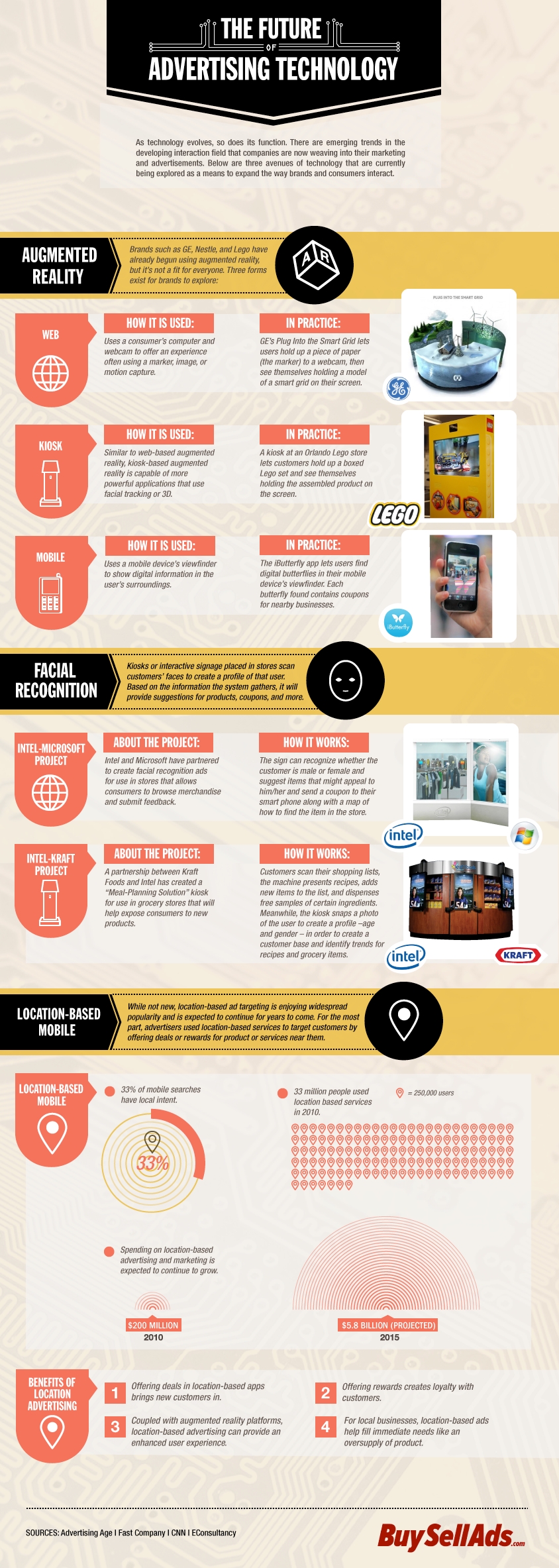
    and The future of Advertising Technology (via) (click on image to enlarge)

    zp8497586rq
  • Cause and Effect

    My fandom relationship with the Pepsi Refresh Project has resulted in a few interesting conversations on this blog, this CSR one being the pick. As Surekha's comment says, this is the longest disagreement we've had. 🙂  That being said, I do agree with Surekha's point of sustainability, but my conundrum remains on another front. Aligning social responsibility with existing strategy/processes will make it sustainable and give it context, but would it create a perception that is not fair to its (assumed) good intent?

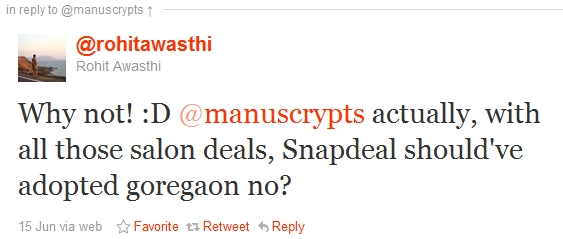
    I was reminded of this last week when the news of Snapdeal's adoption of a village hit Twitter. Snapdeal was trending for 2 days of twitter on account of it. None of the comments on my timeline were flattering. I am guilty of contributing a couple myself, one of which was gamely retweeted by Rohith Awasthi, Head – User & Communities at Snapdeal.com. (as I have said on Twitter on an earlier occasion, the intelligence and maturity he displays when dealing with 'crowds' is something I respect)

    Snapdeal has also written about their intent behind this exercise on their blog, and it is heartening indeed to see that it also happens to be the village that one of their employees belong to, and that the entire idea started there. I also have to wonder why that never made it to the PR machinery. Meanwhile, as their blog says, their commitment is something that time will show. Ef

    order cialis online

    ficacy is another thing about which time will have an opinion.

    I thought about this from the perspective of the earlier post – sustainability, alignment with strategy etc. Even if this were a marketing gimmick, I'm fine because the village gains. As Snapdeal says, maybe other companies will follow suit too. Now, if good intent is the only thing at work here, how is it measured with regards to their strategic objectives? As I've repeatedly said, it's the deal that drives my relationship with the brand, anything else is of little consequence, including this effort.

    On the other hand, what if Snapdeal had tied up their CSR with their deals? It could have happened in many ways – a bottom up approach, polling people on what they should do as CSR and taking the story further, or perhaps a commitment based on the number/value of deals sold, or promising a certain part of the revenue towards a CSR initiative (both of which can use a wiki like meter to show transparency), or a matching grant scheme for a cause (you pay Rs.x, we put in an equal amount). All arguably aligned to strategy, helps build community, and can be counted as CSR. But as a user, I wonder if I would then have said they are doing it to increase their deal counter. Note that even for a seemingly unrelated deed like adopting the village, some of the reactions were pretty nasty.

    So, dead if you do, killed if you don't, and that's my conundrum. Am I missing something here? If not, perhaps the only way is to organically grow a community that supports you, communicate clearly with them and show them through actions over time – not just in terms of CSR, but overall strategy as well,  that in  the commitment to a larger cause, you mean business. In a future era, when social business hopefully becomes more mainstream, and people see brands whose purpose ties in with the larger context of their lives, this won't be as difficult as it seems now.

    until next time, cause tick or Groupgaon? 😉

    zp8497586rq