
Category: Brand

  • Death of an echo chamber

    The BBH Labs Blog has a very interesting post based on a research that reexamines one of the most debated topics even in the hyper-connected era – the echo chamber. From the research abstract “We propose a trade-off between network diversity and communications bandwidth regulates access to novel information because more diverse network structure increases novelty at a cost of reducing information flow” I am yet to read the research completely, but the post gives me enough fodder for now, because it asks “where does one find the most novel information per unit time?

    For a lot of people that I know virtually, the answer would be Twitter. My relationship with Twitter has had several kinds of highs and lows over 4 years. For the last few months, it has been a constant though, and is a very limited relationship. Somewhere in the journey, Twitter became too crowded for me.

    Thankfully there was another ‘social network’ that has been my bedrock for a long while now, and that is my answer for the question asked earlier – Google Reader. Reader is not a network that has grown exponentially for me. My network there does not exceed a dozen, and without referring to it, I can name the people I connect with, and why.

    I rely on Mahendra to give me the latest news and best perspectives in tech. Ditto with Prasoon, whose “Share with note” gives me the money-shot notes in posts I should, but am too lazy to read. 🙂 Surekha keeps me up-to-date on media and PR news that I wouldn’t otherwise know about. Balu – despite being an NRI now – unearths India-specific tech posts I’d ordinarily have missed, and gives me vicarious experiences of the world of gaming. Gautam John provides mouth-watering food posts and news/views on India/Wiki that everyone should know about and have a considered view on. Vedant gets quoted in many blog posts that I write – on this blog and the personal one – as the source of the work that started a thought in my head. There’s Josh Rutner, who must be reading a zillion posts to discover the insane stuff he shares. Rahi is a relatively new connection, and I have to thank her for some of the best blog posts get to read these days. Anand somehow has a way of bringing to my notice posts that I missed in their first run, and I silently thank him each time. Just when I think Patrix has gone away from Reader, he shares an excellent post that grabs my attention. My network on reader would notice a name that’s conspicuous by its absence – and that happens to be my favourite Reader buddy – Roshni. If she has shared it, it has to be read, because one way or the other, the piece will deliver! That, ladies and gentlemen, is my Reader network, and that long paragraph would explain why I was shattered when Google decided to get evil with Reader.

    The BBH Labs post, and the research has this to say about strong ties – those who know you well know what type of information is novel for you. Over a period of time, the network and I have grown to know each other very well indeed. Once upon a time I had a theory that once everyone figured out everyone else’s sources on Reader, shares would become unimportant and I’d never discover anything new. I was obviously stupid, and guilty of hugely underestimating my network because they were constantly filtering and building new sources to learn, and help me learn. It made Reader the best echo chamber I ever had, and this post is so that I, and the web, remember it, always. “Oh oww, Oh oww, Oh oww.”

    until next time, MAAR – Mark All As Read
  • Gamification – Level 3

    I ended last week’s post comparing the previous season’s buzzword ‘social media’ with gamification, and the need for brands to evolve their own way of utilising it. Though it’s easy to find a huge number of case studies that have been generated on the use of social media by brands to interact with consumers, the amount of material available on how the internal organisation has been wired to implement this, is relatively less.

    At a broad level, both consumer facing social media and gamification are ways to interact with consumers and engage them better. But though a single function in the organisation might be handling this interface (I think the vast majority of organisations have not evolved to the advanced social media frameworks), its effectiveness depends on coordination between functions.

    I read JP Rangaswami’s excellent post on Gamification and the Enterprise, on how the consumer and  the enterprise are changing and that new problems require new approaches and advocates a look at game design to solve these. I also read a counter-post by Sigurd Rinde which argues that gamification, dashboard and search are signs of enterprise failure. The disagreement seemed more to be on semantics, if you check the comments on Sig’s post.

    Both agree that extrinsic rewards based gamification is not the way to do it. Not that my agreement much in the debate, but I do agree. 🙂 To me, extrinsic rewards seems like a way to reward a process for its own sake, but intrinsic rewards might significantly work better to ensure that the intent is the bigger focus.

    Which brings me to implementation. Usually, social media outposts happen first and then organisations scramble to make processes and frameworks out of it. This is probably because the social networks enable customers to have a conversation about the brand anyway without its having any say in the matter. In the case of gamification, though, there is a requirement to build game dynamics, mechanics and aesthetics and it seems that this would have to be done by the brand. That leads to a choice.

    So should an enterprise first use gamification on the consumer side, finding ways to marry customer intent and business objective and then attempt this in the enterprise to ensure that employees work towards achieving these ‘ways’? Or should they identify business objectives and gamify the enterprise to ensure they are met and then attempt this on the consumer side, so employees can work on making the ‘ways’ smoother to execute? Or build both in parallel? I am swinging towards the first option. You?

    until next time, end game, for now

  • Fake my life

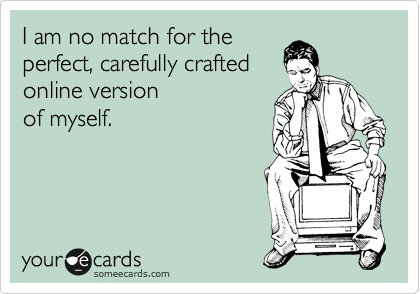
    Funny Confession Ecard: I am no match for the perfect, carefully crafted online version of myself.The perfect life, that’s what I called it – the phenomenon that has spread across the two social networks I frequent. Facebook Photos is nothing new and has come up here as a subject for discussion earlier. But its rise has been meteoric, just like the social network. The best vacations, the coolest friends, the hottest parties, the snazziest gadgets, seems everyone can haz it. 🙂 Twitter is not far behind. People, almost like brands, out to show their best side. Made for Facebook/Made for Twitter/ Lies of Life, call it what you will. Of course condolences would pour in if someone had a distressing update. Either outrage against the wrongdoer if any, or at least a +1 to show solidarity. Unfollow, unfriend you’d say, but these are not bad people, they just have a perfect life. 🙂 Unfortunately, the networks work as emotion aggregators too, forcing me to vent once in a while. [image source Check it out for more awesomeness :)] And yes, I generalise. 🙂

    I have wondered about the motivation. Maybe we like to share happiness more than sadness by default. Maybe sadness is a private thing we choose only to share with dear ones. (do you think there’s a social network idea there? A mutant version of Path) Maybe the algorithms ensure I see only the happy ones. Or maybe it’s indeed true that our vanity stops us from showing that we have been humbled, beaten, saddened by a human hand or a twist of fate.

    A few minutes after I tweeted about the perfect life, I got a message on the blog (deleted now) from an old dear friend S, who had gotten in touch after quite a while. In the long years before a virtual home, when a real diary was a lifesaver, hers would probably be the name that was mentioned most, before the rise of the  thenceforth omnipresent D. 🙂

    S isn’t on twitter, so she would have no idea of the coincidence. She was happy about the progress I was making, doing the things I love to do and generally having fun. And that led me to wonder if I, in my own limited way, was also feeding the perfect life network. So here’s setting the record straight. In case you see my vacation photos, restaurant visits and general attempts at humour and think that the story begins and ends there, you couldn’t be further from the truth.

    As many of my posts would indicate, I have multiple ‘missed life crises’ – singer, author, theatre actor, h3ll, even cricketer, and perhaps a few more too, all skills I have either displayed to some degree or think I possess. 🙂 I think way too much for my own good and am forever irritated at the inequity of life (in terms of those more unfortunate) and not being able to do much about it. I am constantly trying to shed baggage and sometimes failing miserably. My feelings of insecurity would be legend if they were a published work. Thankfully D exists. There is more, but that’s enough fun at my expense. The silver lining is that I’m learning through it all. Meanwhile, all I’m trying to say is that the grass on the other side is probably photoshopped. If it’s not, they’ve probably worked hard to make it this way. And we can too, if we try. Please smile now, and mean it. Or I’ll have to ask you to Like the post 😉

    until next time, open source happiness

    PS: It was only recently that I gave off my fakemytrip.com domain to mygola. I had bought it thanks to an irritating status on FB, and had a 4sq based idea around it. 😀

  • Gamification – Level 2

    I’ve spent quite some in the last week exploring gamification – going through documentation and perspectives that have been shared online. While there’s a simplicity in the basic concept, application is a totally different story. So as with all games, I’m going to navigate step by step, until a larger picture reveals itself over a few posts.

    One of the things that I have thought about is where one would start. Since I’ve operated mostly on consumer brands, my thoughts were skewed in that direction. Most of the white papers outline a fairly simple approach that consists of defining goals, identifying users and rewarding engagement. Of course, it’s only the outline that’s simple, and application design is the real challenge. As games designer Sebastian Deterding (creator of the ‘Gamification and its Discontents’ presentation I shared last week) has written “Games are not fun because they’re games, but when they are well-designed”

    One of my favourite posts on the subject is Kathy Sierra’s “Pixie Dust and the mountain of mediocrity” (this is the original post, for some reason it wasn’t opening, hence the FB link) It underlines the point about putting lipstick on a pig, and is applicable to every buzzword that appears on the horizon. Marketers (I generalise here) have been guilty of taking the easy path and focusing on the what (tools and frills) and not focusing on digging deeper and understanding the why. That probably explains why Kathy is “passionately against ‘gamification’”

    Every brand – consumer or enterprise, serves a purpose for its user. In Kathy’s words, “make people better at something they want to be better at.” If they don’t do that yet, then they might want to get around to doing it. Brands wants users to do certain things, and it invariably boils down to a sale, and repeat sales. Every interaction in a marketing funnel is most likely a step towards pushing the user in this direction. Once upon a time, brands achieved this through one way communication on mass media, and other available means like Direct Mails and Ground promotions. The rise of social platforms allowed brands to listen more closely and gave them an avenue for understanding user motivations, reacting accordingly, having a conversation with consumers and taking word-of-mouth to levels hitherto unexplored. But rewarding this, especially if working on monetary premises, is not likely to be economical. Nor is ‘share with friends’ a great ploy because it does amount to spam. I think what gamification does is help marketers link the brand’s purpose in the life of the user to his journey in getting there, all the while utilising user motivations to create a different ecosystem of rewards that help the brand as well as the user. It then continues to give the marketer means to make the user ‘stick’ – retention.

    Just like the previous season’s buzzword – social media – this too cannot afford a ‘one size fits all’ approach. Nor can it work by adding meaningless points and badges to an ill conceived process/product. Brands would have to align their own purpose, the role it plays in users’ lives, understand personal, group and social motivations and make their own game mechanics, dynamics and aesthetics that accommodates instant gratification as well as long term purposes.

    until next time, level up

  • Gamification – Level 1

    Yes, it is quite the shiny new object in the marketing/enterprise conversations around the web. One of the positives is that there are always new and updated resources in addition to some well thought out perspectives from advocates as well as naysayers on its applications on the consumer facing side, as well as the business side. For starters, I quite liked this ‘Gamification and its discontents’ deck (via Tom Fishburne’s post on gamification) that is meant to serve as a primer before marketers set out to apply ‘gamification’.

    But though it’s very early days in terms of a structured approach to the concept of gamification, I’m quite upbeat on it. One of the primary reasons for that is its inherent application that has been happening throughout my life so far. The education system’s ranks and grades (performing x task well earns you y points) not only decide entry into schools, colleges, universities and the progression there abut also gets to dictate a lot of ‘real’ social experiences within (standing among peers, popularity) as well as without. (the varying reactions to the answers to ‘Where/what do you study’? in a social gathering) Many systems have even learned how to factor in different kinds of activities – say, sports and academics, as well as types of pedagogy. A constantly evolving ‘rank’ is built over time and the badges earned and the places they’ve been earned at also have a hand in the work stage that happens immediately after education.

    From landing the first job to designations that happen later, we continue living in a world of points and badges. In fact, I had tweeted some time ago that gamification already existed in the enterprise in the form of designations. The badges also continue to affect real life through the other reward -the salary we get, which is a function of what we have done so far as well as what we are doing. Other acquisitions from that (car, house, vacations, contacts in the phonebook) decide social standing and open further ‘game’ opportunities. I can visualise life as one gigantic gameplay with said and unsaid rules. The badges and rewards were a system unto itself, until our own evolution made us rethink this. The result has been a linkage to a larger life purpose for many of us. Some of us do this within the existing structures, while others make their own niche/walled structures and rules. But that’s a different post. Meanwhile, unlike most other games, there’s only one life, and that’s what probably makes it more exciting. 🙂

    When social networks came into our lives, we first had fun connecting with friends and potential friends, and then immediately sought to apply gamification by comparing number of friends and followers, #ff, recommendations, lists, circles and so on. Also arrived continually evolving systems to measure our activities – as a factor of presence, reach and credibility across networks – Klout, PeerIndex and Kred, for example. Increasingly, they will impact and even integrate with our ‘real’ game. My point is that we seem to inherently understand gamification and more often than not accept this. Hence, my belief that well thought out applications – consumer or enterprise, have a good chance of succeeding.

    I just realised that the ‘introduction’ itself has been a long drawn one. So I’ll wait till next week to share my thoughts on application.

    until next time, game on