
Category: Brand

  • All ideas are equal, some more equal than others…

    (via Threadless)

    A conversation in office on an unrelated topic led me to ask this question on Twitter.

    ..and @atulkarmakar gave me his perspectives


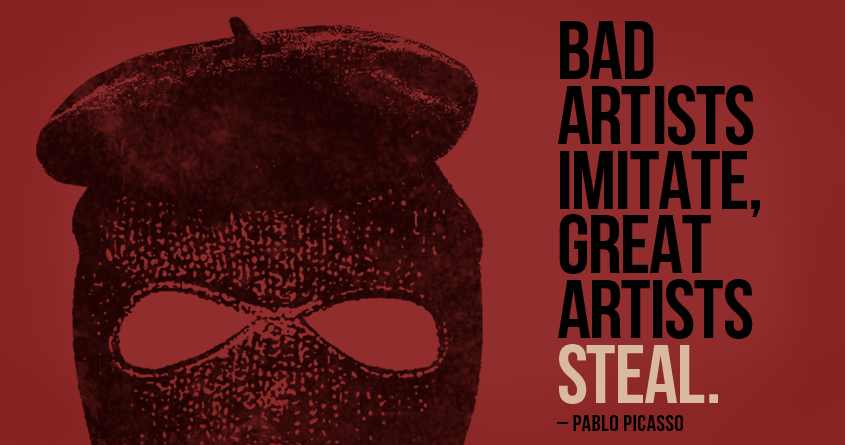
    Just like Atul mentioned, I had first considered whether it was because creative ideas were considered more personal  and a business idea/model an impersonal, corporate entity. But my starting point had been advertising, to which this does not really apply. Compare the reactions of Company A replicating Company B’s business model/idea versus them being ‘inspired’ by their advertising. In the case of advertising, both agencies might get paid and both clients might benefit. But in the case of a business, the second player could benefit from the mistakes (strategy/execution) of the pioneer and build a more successful business. That would be really unfair to the first guy whose business idea might have been a really creative solution to some need. And yet, it’s more likely that the aping of ads would spark a larger debate and the business cloning would be ignored. Am I missing something? Any perspectives you want to share?

    until next time, game of clones

  • The more things change….

    Just a couple of weeks back, I’d written about influence and context, and last week the twitterverse had some excitement delivered courtesy Disney. I couldn’t experience it first hand, but got quite a lot of perspective thanks to Karthik’s post and the comments that followed.

    Personally, instances such as Disney serve as a great filter for keeping track of the trust quotient. I don’t expect agencies/brands/celebrities to be unbiased or disclose, but once upon a time, it was natural for regular twitterati to do that. But times have changed, and all of this is personal philosophy, so I’ll move on.

    On hindsight, and when comparing the patterns of evolution of traditional and social media, the current scenario seems inevitable! Platform – Community – Audience -Brand – Ads (hashtags) – and when ads became noise, brands differentiate by bringing in a fresh voice. (celebrities/micro celebrities) Where we are now is with an army of mini TOIs, relatively more genuine-sounding, and significantly less costly. There are quirks, of course. For instance, brands don’t have to pay the platform to be present, and can incentivise the community to provide publicity. On the flip side, brands are also ‘being held to ransom’ (previous post) by ‘influencers’ and we’ll probably see guns for hire being used by rival brands pretty soon. [Just last week, we saw a tweet from a person working at a competitor stating that she liked shopping at Myntra. One of the various scenarios we considered was a #conspiracytheory – that the moment we used the tweet in some way, the person would prove to be a non-employee and we’d be accused of playing dirty]

    At one point, I really thought (or hoped) social would be new wine, but it has more or less ended up a new bottle. If we continue the evolution pattern, the future is easy to imagine. Context will disappear, and noise will magnify, until the next disruption. But I still have some hope, because the nature of the platforms (and the tools that are getting built) are such that a user can, at least to an extent, mould it according to the way in which he wants to consume it.

    That does take me back to what I said in the last post – people will actively build their own trusted sources. And the real opportunity for brands is still to become a trusted source. Yes, I do think it’s possible, and we have a relaunched buzzword on cue – social business. In fact, there are probably brands doing it already, spending resources to build the foundations so that the hashtag (or its equivalent in the future) is not manufactured for its own sake, but is organically and genuinely built by contextually relevant influencers who can be publicly rewarded for helping the brand meet its business objectives.

    But wait, that was where social platforms started too. Which leads me to wonder if the future of brands and media will always work in cycles, and end up near square one!

    until next time, the more they remain the same…

    zp8497586rq
  • What have I been up to?

    The nice folk at Social Samosa gave me a chance to describe exactly what I do for a living currently. You can read about Myntra’s strategy on social platforms in an interview here. 🙂

    In other news, I just got back from a Philippines vacation. More about that on the other blog.

    PS: Added a Media page since there have been a few quotes happening lately 😉

  • Influence & Context

    Last week, I read two stories on influencers on sites that influence me. 😀 Since that’s a topic that has been seen here before (1,2,3) and it’s been a while since I’ve written about it, a couple of cents.

    YourStory’s post, I cheered, despite failing on their influencer scale, (of 5000 twitter followers) because it asked a very pertinent question – “Are brands being  held at ransom by Social Media Influencers?” I completely agree with Mekin’s tweet (cited there) on how it takes the twitterati only a few minutes to demolish years of hard work. Anyone who handles a brand account would relate to that. Expecting ‘influencers’ to mature and watch what they say is like expecting, say, a response from the nation’s leader. The other way to handle it is to be really good at what you do as a brand, be sure of yourself, be transparent, so that you can back up your tweets (no, not that kind of backup) with facts. (more)

    LHI’s post was about brands leveraging social influencers. Prasant (of LHI, but didn’t write this post) had commented in the YourStory post about contextual influence, and I quite agree with his views. In fact, my stance remains the same as when I wrote this. To sum it up, (in general, there are of course exceptions including whole domains) brands tend to treat influencers just as they treat traditional media. The more reach, the better, who cares about context? No offense meant, but I am not really influenced by the gentleman in the LHI story. Mercedes needn’t care about that because I’m not really their audience. But the entire episode makes a very good story, so if that was the intent, and not necessarily the person’s influence, opportunity well spotted, and a PR job well done!

    But if brands do treat influencers as media, how long will this party last, especially when people are already trying to correct their filter failure? (noise in the stream) Mass media’s  indisputable role in creating perception have been blunted in the web and social eras. Arguable, but I think, in a while, we’ll see a kind of flip. Folks would start figuring out their go-to people, when making consumption decisions. I already do that – in fact, I realised that with a few exceptions, everyone on this list is a go-to person for me! Not all of them have 5k followers, but in their domains, they’re #likeaboss. What has social contributed here – 90% of them were unknown to me before blogging/twitter, but if I am asked for a recommendation in their domains, I don’t have to think twice. I trust them, and this has been built over various interactions across time.

    In essence, using influencers would boil down to the intent of brands – mass reach or targeted reach (in this context) – for each activity. There are tons of ways to get reach on social media, in many ways it has already begun to resemble its media predecessors, but trusted sources remains a precious commodity. If brands earn and retain the trust of influencers in their domain – and they could only do that if they are really good at what they do – think of how it could help them when it comes to responding to those ransom calls.

    until next time, an affluence of followers 🙂

  • Project Lead

    My earlier post on media consumption fragmentation also made me think of the other side – the creation perspective. Despite the hubbub of “integrated campaigns”, some platform, more often than not, plays the lead. In earlier eras, choices were easier – until televisions came into the picture, it was limited to newspapers, events, radio; even after TV made its inroads, things like objectives, costs, geographical reach of the brand etc could be used to make decisions. In general, I’ve seen TV trumping print more and more as time passes, taking on the role of project lead.

    After the advent of social, and despite the low internet penetration, the above parameters have increasingly started working in favour of social ‘media’. Of course, there’s always the beginning of the curve when everyone wants in because of the shiny new object syndrome, but I do believe we are crossing that stage now. I still see “let’s do this on social media too” (after the entire campaign has been conceived and produced) or the single slide on social rampant, but that’s also part of the learning curve. As always, some brands are moving faster than others.

    We already have brands, internationally, that are experimenting (and successfully) with ideas that are inherently social, and using traditional media for say, additional reach. Just as TV took over from newspapers, it is possible that social will take the seat at the head of the table at some point. It is also possible that it would go the way of digital – relegated to performance campaigns, and belying its potential. That is even more so if social is measured in the same ways as the media before it. However, I think this time the story would be played out differently. But then again, I also think there will be a fragmentation of the brand story, understanding each platform’s nuances, using its inherent strengths, making frameworks that have tailored measurement indices, and in the process, providing a cohesive perspective to the consumer, and cohesive metrics for the brand.

    until next time, leaderboards 😉