Category: Brand

  • The IoT battlefield

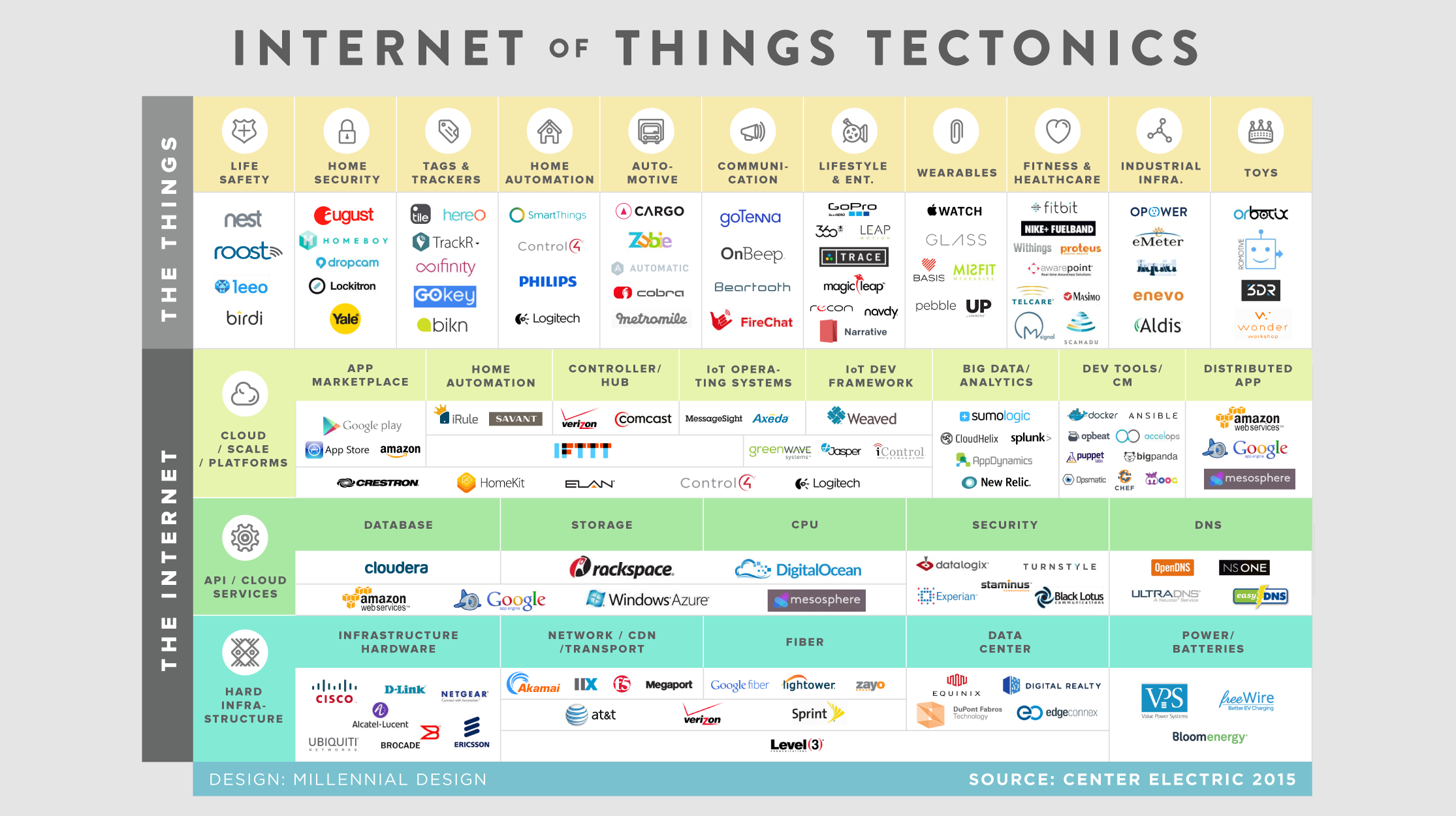
    The last time I wrote about the Internet of Things, I hoped for an application layer that could sense and collect data and convert it into use cases. In fact, the title of the post was Interweb of Things, the nuanced difference between them being connection (IoT) and interoperability. (WoT) (read) In the few months since that post, there has been quite some activity in the space. I saw a very useful classification a few days ago that illustrated both the ‘things’ as well as the infrastructure and showed the possibilities of interoperability. (via)

    IoT

    (more…)

  • Time, Chaos, and Organisational Change

    The first chapter of The Age of Spiritual Machines, by Ray Kurzweil, is titled The Law of Time and Chaos. The law has two strands- The Law of Increasing Chaos and The Law of Increasing Returns, and together they dictate that in a process, the time interval between salient events (i.e. events that change the nature of the process, or significantly affect the future of the process) expands or contracts along with the amount of chaos.  In the book, this is used to explain evolution. Evolution draws upon the chaos in the larger system in which it takes place for its options for diversity, and evolution builds on its own increasing order. Therefore, in an evolutionary process, order increases exponentially, time speeds up, and the returns accelerate.

    It becomes very interesting when I put this in the context of organisations and the business environment they operate in. The business environment consists of various other organisations (exactly like life forms in evolution) and therefore the time interval between salient events (a new ‘disruption’) is becoming shorter. On the flip side, the organisation (akin to evolution of a single organism) is becoming more complex, and thus the time interval between salient events (their own breakthrough developments/innovations) increases. (more…)

  • Wallet Wars

    Recently, thanks to Uber having to comply with RBI regulations, I was forced to introduce myself to Paytm. The entire signing up episode reminded me of a post I had written in early 2014 – “The overhaul of currency“, though that dwelt more on the broad changes and implications rather than the functional aspects. Mobile payment systems have been on a fast evolutionary path for a while now. (a bit dated, but I found this infographic to be a good primer)

    I also remembered a Seth Godin post from 2009 that called Twitter a protocol. On the web, the subsequent discussion then was that just as we were transferring links and messages on the platform, we would soon be transferring money too. That took a while coming though – it was only in late 2014 that Twitter released a payment service.  A week before that, a hacked screenshot had begun rumours of Facebook’s Messenger having the wherewithal for money transfer. But they were both late entrants in a market that was already crowded with the likes of Paypal, Google, banks, credit card companies and so on. Apple Pay would join later. (more…)

  • Change Strategies

    It was mid last year when I wrote The Change Imperative, which was as much a note on massively changing business dynamics as it was a note to self. I thought the new year was a perfect time to revisit and explore how brands and business can use change as an opportunity. The new year sees a glut of predictions, trends, insights etc, but the one I look forward to is the JWT Future 100. This year too, it impressed me with unique insights and potentially far reaching consequences. But in the change’ context, I found slides 33 and 52 most interesting. Both of these were related to brand strategy – 33 (Third Way Commerce) was about how millennials were looking for brands with clear values, and 52 (The Long Near Game) was on brands taking a dualist approach to balance short and long term goals.

    In my mind, they are related, as brands are making efforts to maintain/create business models that are buffered from current and future shocks and can remain relevant now and later. I found an intersection of the two thoughts in a couple of places. The first was in this post by David Card on new models of  disruption. The first model brought up in this is “Adjacency Platforms”, which is about platforms migrating into new markets or industries. Apple’s iOS moving to payment is the example given here. This thought is also echoed in slides 24-28 of this trends presentation – the phrase used was Startups going ‘Full Stack’. I particularly liked this framing of the thought – It’s not like a brand like Virgin diversifying to follow an audience, it’s diversifying to follow an expertise. Both fantastic approaches, I must say, because they’re based on consumers who believe in the brand’s values. [I believe that Uber is a brand with much potential in this respect – check this]

    (more…)

  • An Interweb of Things

    Since the time I wrote An Internet of Things narrative, its trajectory and pace has seen tremendous acceleration, to an extent where TC has claimed that it has reached escape velocity. Indeed, there is a whole lot of activity happening that would back this claim – startups, larger companies getting interested in the space, geographic expansion and so on. In fact, the article has what seems like a comprehensive chart on applications, platforms etc.

    In my earlier post (linked above) I had pointed to the distinction between the Internet of Things and the Web of Things. What was then a nuance seems much more wider now and is even more relevant. Another article on TC, titled The Problem with the Internet of Things is actually about this. One of the products that has fascinated me for a while is Mother, from Sen.se. To me, it aims to solve this problem, and the last two points in their ‘Creating the Internet of Life’ document is proof of it. (Like wearables in 2014, I plan to get a consumer IoT experience in 2015, and this is most likely going to be my preference) Another simplistic but potentially very useful product I have seen is Flic. The last example is Signul, which uses a beacon system to automate things used in daily lives. (both on Indiegogo)

    (more…)