
Category: Brand

  • Algorithms, the institution of the future!

    Tom Goodwin’s precise summing up of the shifting business environment is now legend – Uber, the world’s largest taxi company, owns no vehicles. Facebook, the world’s most popular media owner, creates no content. Alibaba, the most valuable retailer, has no inventory. And Airbnb, the world’s largest accommodation provider, owns no real estate. Something interesting is happening. 

    Institutional realignment is now on an accelerated path. In this superb, nuanced post titled ‘Uber and AirBnB make the rules now – but to whose benefit?“, Vili Lehdonvirta brings up very interesting perspectives. (To paraphrase)

    – If buyers switch to a new market, sometimes sellers have no choice but to follow, irrespective of whether it brings them gains or losses (eg. if there is very little business outside of Uber to be had)

    – Even if everyone participates with interests intact, the collective effects on society may not always be positive (eg. AirBnB rooms causing nuisance to neighbours)

    – These conflicting interests are usually reconciled by political institutions, but they face the challenge of siding with incumbents or upstarts.

    And towards the end of the article, this very important thought – these new platforms appear to provide access to those who have been denied it by the institutions and processes thus far, but is it that simple? In this context, the new jobs being created are quite different from the typical ‘job’ description. That brings me to a key institution – the traditional workplace.
    (more…)

  • Brand Storytelling

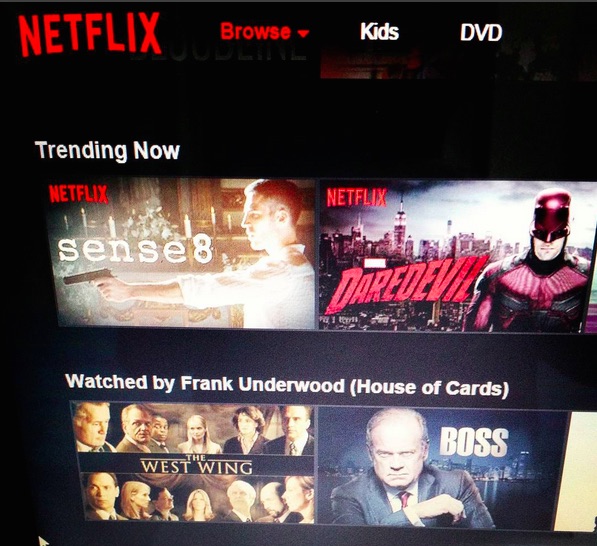
    Recently, on Netflix, I caught something that I had read about almost a year back – an easter egg of sorts. On my feed, I saw shows ‘watched by Frank Underwood’. For those who haven’t watched House of Cards, that’s the name of the show’s protagonist, played by Kevin Spacey. (fantastically, I’d add) The shows selected seem absolutely true to (his) character, which is manipulative, scheming, and truly Machiavellian!

    Netflix (more…)

  • The Future of Work : Complex & Chaotic

    A couple of weeks ago, I discovered the writings of Taylor Pearson. I first came across “The Retirement Catch-22: Why Those Who Want to Retire Most, Can’t” and through that “The Commoditization of Credentialism: Why MBAs and JDs Can’t Get Jobs“. The reason it resonated with me is that it provided the larger context of what I had written about in The Entrepreneur & The Professional and Re: Skill.

    The first (Pearson) post notes how the industrialisation of education makes us take a finite game approach to career, but how, in the entrepreneurial economy, approaching your career as an infinite game is not only more fun, but safer and more profitable. In his other post, he introduced me to the Cynefin model, (image via) as he applied it to one’s career. I thought it made for a fantastic framework of the future of work.   (more…)

  • Of destinations and feeds

    In An Ambient Future, I had written about how Google was potentially poised for something really interesting because technically, it had things in place to harness mobile, social and sensor data and overlay it with machine learning and AI. An early version of how this data could be surfaced contextually and be shown in an interface would be Google Now, as Christian Hernandez had pointed out. And that was why I was quite surprised and dismayed when I read that most of the team that had been working on Google Now had left!

    The larger context though is about content discovery and two possible approaches to it – destination (platform?) and feed. I remember reading Neil Perkin’s post on the subject last year (it’s a fascinating rabbit hole of related reads, you’ve been warned!) and it has had me thinking ever since, especially in recent times, with apps increasingly replacing the traditional website as a destination. So far, the feed largely served as a distribution method to destination, but I believe it is no longer that simple on the web, let alone mobile.  (more…)

  • The immortality of time

    Thoughts on immortality and its implications on personal and societal aspects of life have long been a favourite subject here. It has also been an area of interest from a philosophical standpoint. For instance, if we could live forever, what would be the relevance of time? Would our current existential questions be rendered irrelevant?  There is also an understanding that it is a process – our lifespans would progressively increase – as we replace our bodies (and later, minds) with mechanisms (augmented human) even more robust than the ones nature gave us.

    I found an excellent post on Quartz which dwells on the evolution of time management and makes the point that time management is actually making our lives worse. It also brings up something I had written about recently in the context of work, money and AI – the never ending race for efficiency. The article argues that the idea that managing time would get one back in control is a fantasy that only works in a finite world and that our to-do list is actually like the mythological Hydra!  (more…)