
Category: Digital

  • The path to mediocrity

    Seth Godin wrote a post on the masses vs great design, and how the brands we love refuse to become democracies. Yet, on an everyday basis, and across product offerings – from web design to entertainment, I see brands clearly pandering to the ‘masses’. And they’re not going to disappear in at least the medium term, because they spend resources in wooing and keeping consumers, though these consumers are hardly ‘loyal’. The undemocratic approach that Godin mentions is for the rare breed of confident, gritty, focused brands which have answered their why, what, how and when very well.

    On HBR Blogs, I found an article by Bill Taylor – “Bad Service can be good business” a very interesting read. It showed two different scenarios where the headline is applicable -companies who try to keep the costs down to the barest minimum and charge a premium for anything but the basic (the author quotes Ryanair as an example) and companies whose offerings are so compelling, and whose reach is so vast, that making the investments required to deliver high-touch service would be making a big strategic mistake. He cites new media companies like Facebook, Twitter etc as examples.

    Most of the companies I was referring to in the first paragraph are trying to be one of the above. But they play an in-between game, starting at some point and thinking that they’ll figure out a way to get to their destination. But IMO, it can’t happen that way, because once you set expectations, you fall into the ‘trap’ of fulfilling them, without really figuring what your brand stands for. You’re forced to play the reactive game, watching your competitive landscape and fencing with them. As you progress, you’re drawn further away from the active game of pursuing a goal with focus. The trap, hence, is mediocrity, and it is surprising to see it these days because the web and social platforms specifically are a great way to find that slice of audience which will give the brand a chance to deliver that focused product/service. I’m not talking of superficiality here, but the DNA of the brand, and the organisation, the strand around which everything is built. I’m also not saying that all mass brands are mediocre. In the purpose that they have defined for their brand, Ryanair is anything but mediocre. Despite the seeming difference in the two scenarios from earlier, they are bound by a commonality – clarity of thought, which inspires clarity in everything that the brand does.

    until next time, clear blue ocean
  • Data: Growing up

    The Facebook story might be facing rough weather, but that hasn’t stopped the social network from pushing out new and interesting things. It launched “Page Post Targeting Enhanced” – features that make it a media platform offering sharper slices to marketers (easily) by allowing filters based on gender, interests, relationship status etc. It has also rolled out Facebook Stories that highlights “people using Facebook in extraordinary ways”. Venture Beat has a very smart take on how this can be the future of news by intersecting two of the most interesting contexts – location and interest. As a media platform, one can imagine the advertising potential.

    Twitter already has local (city specific) trends, though, from experience, many people seem to think that they’re viewing national trends when Twitter is actually showing them local trends. Twitter already has Promoted Tweets and is enhancing features that allow better targeting.

    Media buying in the age of traditional media consisted of a plan being prepared (and negotiated) after evaluating the reach, cost and other parameters of various options across platforms – print, OOH, TV, Radio etc. The (reach) data has always been contested, and the (post) measurement is more of a myth than reality. New media platforms, on the other hand, are significantly better in terms of transparency and in addition, have better native and 3rd party tools for self publishing, distributing and measuring. The data is one click away from the marketer. After a certain tipping point of reach that these media achieve, traditional media would be forced to provide this level of accessibility, and then, IMO, the value provided by media agencies would be reduced significantly, as tools would make it easier for the marketer to plan real time and measure too, across platforms.

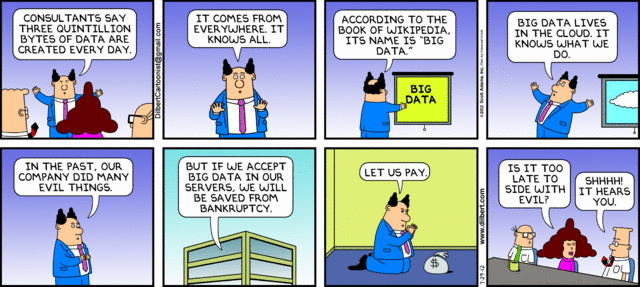
    In essence, data that the marketer needs, to make informed choices on the why/what/how/when of platforms, is easily becoming available.  The data that really needs to be converted into information is now flowing in the reverse direction – from the consumer and his actions across platforms to ______. And this data is not just for marketing, its use is across the board and affects product, customer care, operations, technology and so on. It is Big Data, the players are evolving, and the next stage in this ever changing game has begun.

    until next time, don’t worry, it’s already a buzzword. 😉

  • In trust we trust

    Karthik recently wrote a post on a subject I’ve been thinking about for a while now – “How should brands use public information you share on social media“, on British Airways’ “Know Me” scheme to personalise their service by providing iPads to their staff and “giving them instant access to customer data, including passengers’ travel history, meal requests and details of any previous complaints. They will also use Google Images to search for pictures to link with passenger profiles, helping staff to identify them next time they fly” (via) It has already been met with disapproval from some, but Karthik believes there is value if there is intelligent use of context to delight a consumer. I’d tend to agree.

    Any user of Rapportive would be familiar with the thrills it offers thanks to rich profiles provided as you read/write a mail from/to a contact. 🙂 At an enterprise level, any social media practitioner would also agree that it’s sometimes useful to butt into conversations where an @ has not been used, if you can provide value to a consumer. A Capgemini infographic, based on 16000 interviews in 16 countries, shows that 61% of digital shoppers want the store to remember their personal details, 54% want to receive persoanlised offers, and 41% actually want to be identified through digital devices when they enter a physical store! But when Orbitz starts showing Mac users different and costlier options as compared to Windows users,  I’d really wonder if the business is providing value to consumers in personalised offers!

    At paidContent, I read “Big data and the changing economics of privacy“, which discusses how easy it is to get info on people, and debates a ‘Do Not Collect’ law, especially in the context of new technologies like face recognition. Another suggestion I read at AdAge is to let consumers build their own tracking profiles – What consumers might prefer, if one were to actually ask them, is the ability to build, manage and get useful things from their own profile and data. Let consumers remain entirely anonymous and in control.

    As this Econsultancy report succinctly points out, personalisation is ultimately a trade off, and businesses need to learn to provide tangible value to consumers who share their data. But before that, they also need to make the consumer comfortable by using even freely available data intelligently in a way that shows their intent, asking consent when applicable, building trust and allowing users to retain control.

    I personally believe that if you’re putting any information out on the web, you should take responsibility for it – that includes what you share and who you share it with. From experience, it can give you great lessons in trust, and I think that applies to the relationship between people and businesses too.

    until next time, trust worthy

  • Deconstructing a viral

    Google’s Project Glass demo was the best product demo I’d ever seen. The sheer possibilities with such a device was amazing, but in essence, it was the theatrics that impressed. Everyone I shared it with shared it on.

    It made me think of the concept of a viral. From many murmurs I have heard around me, “Let’s make a viral” has only evolved, not died. The question of what makes a content viral is also asked when 2 or more marketers/social media practitioners are present. I find it a bit ironic that sometimes when ‘virals’ are named, I can’t recollect them. I first thought this was just me, until I figured out otherwise from other blank looks. But that’s not surprising, considering our increasingly fragmented consumption patterns across media platforms.

    I realised lately that if reach were the only parameter, then every TVC/newspaper ad, by sheer consumption, is a ‘viral’. So, a necessary caveat is that the reach has to be through peer sharing. But what good is an eminently enjoyable creative if it does zilch for the business? The viral is thus walking that exact balance between entertainment and brand objective. But would our current definition of a viral deem the Project Glass demo a candidate? I don’t think so. Nor would flipping on the Open Graph on a website and allowing multiple contextual actions to go across newsfeeds and Timelines.

    And that’s where the evolution is interesting – because technology is slowly moving from being an ‘enabler’ (euphemism for cheap means of distribution – YouTube/Facebook, I always felt) to being the best tool to weave in the brand story, and an inherent part of the experience. It goes beyond just social platforms and into Augmented Reality, NFC and other legacy/new technologies. I saw quite a few examples (via) – Buy the World a Coke, Red Tomato Pizza’s fridge magnet, even Amex-Twitter and one of my favourites for quite a while now – Nike+. Would we call these virals? I don’t know, but they were shared, seen, and tied in neatly with the brand experience. So probably what needs to evolve now is the marketer’s mindset on what he/she defines as a viral. The opportunity and the challenge is that when everyone’s a publisher, the marketer’s real job is to make it more share-worthy – conceptually and practically. That hasn’t changed. 🙂

    Since we’re on arguable territory here, do chime in.

    until next time, viral ‘producting’ as opposed to viral marketing?

  • Human Brands

    Trendwatching’s trend for March 2012 is quite an interesting one – ‘Flawsome‘, driven by brands becoming more ‘human’ and the fast rise of transparency. It’s quite an irony – this ‘fall out’ of the era in which people are trying to be brands and making sure that (even) their Facebook Timeline (in addition to LI, Twitter etc) showcase them at their best/ a perfect life. Yes, I’m generalising.

    I think, more than anything else, this trend is forced on brands by the sheer volume of conversations that are generated in/by social media. Even the best, most conversational and favourite brands/organisations – from Coke to Google to Twitter to Apple etc have their flaws. These cause different challenges for different brands eg. web centric companies generate conversations because of their ‘location’  and more is expected of them because they are digital natives; ‘offline’ brands are forced to engage and include this in their brand DNA. Since bad experiences are expressed more than good ones, ‘flawsome’ is an inevitability.

    The excellent opportunity in this, if brands get the communication right, is to not just being able to involve consumers in correcting the flaws, but in also evolving a league of customers who will actively speak for the brand, because of a sense of ownership they can be made to develop. The other opportunity is to target better and build a set of consumers who can identify with the brands’s attitude and philosophy. This would not just have an effect on communication, but also on vision and processes across the board – product design, customer care, hiring and so on. ‘One size fits no one’ is something that brands could take more seriously now.

    As a brand marketer, and one who is active on social media, I’d love the freedom to say ‘Damn, that was a #fail. But hey, we tried” 🙂

    until next time, winsome brands