
Category: Digital

  • Book Values

    Three mails in my inbox, all relating to an interest of mine – reading, but at three levels of engaging me. The easiest one to discuss is Rediff Books, which in a very matter of fact way gave me a list of books, including a 10 day MBA, how to save Income Tax, and ‘The Chronicles of Narnai’ (sic). It informed me that I had expressed an interest in receiving such information. I did? Reading, I’d say is a great vertical for a social network, but Rediff Books doesn’t seem to think so.

    The second mail was from Shelfari, which gives me a status on what people in my network are doing. Now, I had signed up on Shelfari a while back, and had updated it for quite a while. My old blog even had a shelf I’d found cute. But somewhere down the line, its interface and utility ceased to interest me. I got quite irritated with their search which never managed to find my friends for me, only for me to get a mail from them later, not by them finding me, but on how they found this an interesting site, and wanted me to join. That was around the time that i became a Facebook fan, and found Visual Bookshelf. And why was that? Because Shelfari’s app on Facebook refused to work for me inspite of several tries. Now, to be fair, I might have been a rare case since I see a lot of people using it.

    The interesting news last week, was Amazon’s acquisition of Shelfari, which leads to a strange relationship with its competitor, Library Thing. I noticed from the second link that the UI has been improved considerably, but they’d lost me way before I could experience that.The effects of such a partnership would be beneficial to both parties, as Shelfari gains from the scale of Amazon and its users, and Amazon gains a community that it couls scale up and synergise very effectively with its current services. Amazon is doing some interesting stuff, most prominent of which would be Kindle.

    And that brings me to my favourite utility in this vertical – Visual Bookshelf. The biggest advantage I have is that I get to share it with all my friends on Facebook, and it automatically adds the friends who use the same app. It also means that I get to share a review on my newsfeed, so even those who don’t use the app can read it. VB’s mails to me are pretty simple – it tells me the status of the books I have added, and gives me an option to change it, it lets me know what my friends have added, and in a way I found very appealing, lets me know what the team is working on, and that’s some pretty interesting stuff.

    But there is another app I’m considering to give a spin, and that’s ‘Books iRead’, from weRead, a team based in Bangalore. Its page on FB informs me that it has more than 6.5 lakh users, 25 of whom are friends. I read recently that it had been acquired by Lulu. Not exactly the Amazon kind of deal, although I couldn’t help but wonder whether the guys who should’ve actually done a tie up with weRead long ago should’ve been another Bangalore based online bookstore start up – Flipkart. It could’ve been perhaps as simple as me reviewing a book on Books iRead, a friend reading it and deciding to buy it, and Flipkart offering an option to buy. Now, Flipkart is doing some reasonably good work, and I loved the way they  first caught my attention, but this would be a good context to remind them that they haven’t gotten back to me on Dublin, a book I’d asked for! But don’t worry, none of the online guys in India have, so there’s reason to cheer. Sigh!! 😐

    until next time, Read India
  • Virtual Fourth Estate

    A few articles that have to do with newspapers caught my attention in the last couple of weeks. One was the fact that Instablogs, is doing something I desperately wished it would do – opening the network for external blogs. I personally consider Instablogs a good benchmark for what online news sources should be,  going forward. If you haven’t checked out Instablogs yet, now would be about time!!

    The second was an article on whether we need editors anymore. That question would be quite controversial in any case, but it helps when The Guardian asks this. It is quite a compelling read, and makes some telling points, on how editors should evolve in the digital era. I think that it also points to a mindset change in the newsroom and the presentation of news, because the way news is consumed is also changing. “Reporting becomes a process more than a product” and thats a fundamental shift in the way newspapers approach the business. Here’s a great read on the subject. It is sad to see how newspapers, with some of the best resources, are not able to channel it to better use on the internet. This is a perfect example for what I’m trying to say. Now, once you’ve thought about all this, check out Instablogs’ tour. It might explain why I find the site awesome.

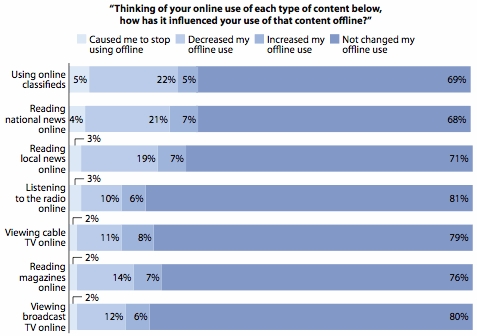
    Why is it important for newspapers to address the digital mindset issue? This data, (via here) though pertaining to the US shows how blogs and the online medium in general is making inroads into what was till now, the newspapers’ domain.

    While, with a 4.5% penetration, newspapers aren’t exactly on a ‘near-death spiral’ in India, I believe it still might be just a matter of ‘when’ rather than ‘if’. Speaking of which, the last article I wanted to discuss was one on WATBlog about Indiatimes’ launch of Hotklix, a Digg like service. Like I commented there, it would’ve been a great way for TOI, ET and all the publications of the Times Group to showcase the loads of content that they possess. How about seeding articles on a daily basis? Where is the integration of the TOI, ET websites with Hotklix, where I can bookmark an article immediately after I read it?

    On an aside, there are traditional news networks doing some pretty cool things on the web. CNN, for example, is allowing users to embed videos in blogs social media etc. No, that’s not a newspaper, I know, but it does come under ‘traditional media’. But even CNN received some flak a couple of weeks back. CNN is present on Twitter, and I happened to see this article, where a few users got pissed off with them for spoiling their Olympic fun. But that doesn’t stop the mashups. Take a look at Dialogg, their collaborative effort with Digg.

    Given that newsprint costs are rising, all over the world, and people are increasingly raising an uproar over cutting down of trees, I think its about time that newspapers took a long hard look at how the digital medium is transforming the content landscape. After all, we even have sanskrit newspapers going online. By digital, I don’t mean just the web, it could be the mobile too. 9.22 million subscribers have been added this month. I would like to compare it with the circulation additions for newspapers. Meanwhile, just read about an effort – MeraMobi, by the Dainik Bhaskar group in association with Pitroda Group LLC.

    Traditional media, especially newspapers, world over, have painstakingly created an equity and trust factor that’s extremely relevant in a transparency and trust led digital era, it would be sad to see it wasted. After all, with increasing global warming fears, newspapers might soon occupy the space that furs occupy now, so it might make sense to hunt for some virtual fourth estate.

    until next time, read….online? 😉

  • Its just getting bigger…

    A big news earlier this week was the launch of Big TV, with 20 channels to be launched – music, movie, lifestyle, regional..according to this article from some time ago.  (via medianama) Right at the bottom of the article is a paragraph on their internet plans. I, for one, am always intrigued by the BIG plans, since Reliance has a way of upsetting the entire setup, irrespective of the category, and using it to their advantage – whether its through scale, pricing or whatever disruptive means they can think up. This article says that a budget of Rs.100 crore has been earmarked for the marketing and communication of this entity, and also gives the pricing. With that budget, they can afford the tagline “Ho to Big Ho” 🙂

    I remember writing a BIG post, quite a while back touching upon the synergy that could be derived out of all the BIG entities – FM, Adlabs, BigFlix, Mobile, Music, Adda, and I had mentioned DTH too. With existing providers scampering about to announce who got a matrimonial tie up faster, reliance, with their content and distribution options could really muscle their way in. Adlabs and Big Adda, for example, are working quite well together, by promoting new movies with a Big Adda site. But what I missed out in that post was the stuff I’m more interested in now – BIG’s IPTV venture, in partnership with Microsoft, about which I’ve been hearing about for quite sometime now. Coincidentally, I also read this article today, which talks about the government approval for IPTV being on the way. For those who are wobbly on IPTV (like me), I’d suggest reading up here and here, though the latter is a bit dated.

    As is always the case when I think BIG, my thoughts end up usually on the potential synergy. IPTV brings all the content that you’ve traditionally on TV, but with an interactive and customised aspect. And its not just TV, but also Video On Demand (Tata Sky Showcase). How well BigFlix and Adlabs could be made to work in tandem here. Move over, all those silly games that are showcased on DTH, how about playing some Zapak based cool MMORPG s. Maybe they can even use Big Adda to create a social networking generation of Indian housewives, who’d be gosipping online while watching their favourite saans and bahus. (Tell me when I go overboard) And if their websites have some online shopping options, with the improved targeting  and context that the Internet offers, they could make a killing. I just saw a Big Adda TVC promoting social networking on mobile, so even a ‘quadruple play’ mentioned in the IPTV wiki article might be possible. Also in context, Adlabs-> Reliance Big Pictures -> Big Cinemas.

    So, in essence, all the current developments are just about to make BIG bigger.

    Meanwhile, a tangential big news is Yahoo’s tie up with Intel to launch an interactive TV channel. Read a good post on it here. And if you thought all of that was big, spend the weekend contemplating these futuristic interfaces.

    until next time, just the biginning 😉

    BIG update: The TVC is out, and check out the synergy in ‘Rock On’ – Big Pictures, FM, Music, Adda. Now we’re talking!!

  • Organisational Chats

    There was a very interesting post over at WATBlog, on whether Indian companies should provide employees the freedom to engage online. The advice to organisations is to at least listen to the conversations happening about them, since these conversations will happen anyway. The solution the post offers is to use prolific users of social media as brand evangelists. It reminded me of an earlier post on the evolution of the brand manager. And I agree almost completely to the WAT post.

    Almost, because, I lean quite a bit towards extreme transparency, and am of the opinion that it’s not just the evangelists who should be online and doing their bit, it should be the whole damn system.  Why not only the evangelists? Evangelists, to me are slightly utopian styled creatures, who love transparency, and organisations, which are just giving this whole conversation idea a customary spin, might have a problem dealing with it. There are two options then – the evangelist gets ‘corrupted’,  (I’d hate compromised use of social media) or he refuses to conform. In the second scenario, the organisation will strive for ‘control’, and the evangelist will be sacked, but what if the whole system is doing it? Which is one of the reasons why I think organisations will fight this thought. But there might be hope yet, check out Unilever’s efforts in this direction.

    There’s a great argument here on candour at the workplace, it also gives some interesting links. That last link looks at a ‘getting to know you’ level before complete transparency. The article calls this tact, and I have a problem with that too. It is precisely these kinds of convenient gray areas that led to white lies, which in turn spawned the complete opacity that we see around now.

    Meanwhile, there’s something else that might be forcing organisations- Users/Customers. Because once the conversation about the organisations, which will happen with or without their assistance, reaches a deafening pitch, it might force them to listen. To quote from this neat post on Enterprise 2.0, “when the irresistible force of social media hits the immovable force of a traditional enterprise, it makes a loud noise”. The last part of this post also throws light on this.

    And hey, its not any favor that the organisation is doing. In the long run, this will only help the organisation’s equity from an HR and Brand perspective. As talent sourcing becomes even more difficult, this might be the edge that an organisation can get.

    The earlier generation of organisations did not  ban the water cooler though it was reputed to be the source of a lot of conversations. Lets hope today’s organisations can look at the internet in a similar way, recognise that their employees are simultaneously part of not just their workplace, but a larger world outside, in which reside the organisation’s stakeholders and think carefully on how it makes sense to let their employees talk to the world at large.

    until next time, break the walls down

  • e-Tales

    An India e-commerce study done late last year by IAMAI-IMRB pegged the industry to reach Rs.9210 crores by the end of 2007-08. In this, the etailing market is expected to have a share of Rs.1105 crores. The study also gives the things going for and against etailing. More recently, the JuxtConsult India Online report states that 80% of all regular online Indians ‘shop’ online  they either search or buy online, though I dare say that this would be driven a lot by online travel bookings than by etailing.

    So, perhaps, the timing could be just right for Storrz. I first came across the site when i read the coverage of Proto last month, and have been wanting to check it out ever since. But the immediate stimulus were recent articles in Headstart, and Mashable. I signed in, and was given an option to invite my friends too from the different email services, with a reward possibility too. A small query here, why not friends from my social profiles too, the reason being, my conversations there are so much more contextual. It would work great, for say the tees brands like Xtees, Youthcode, Nitrotribe etc. In general, aren’t those networks better places to find existing social crowds who can add quite some value to a social shopping network? (more…)