
Category: Digital

  • Algorithms of wealth

    Some strange quirk in the cosmic order of things led to Landmark shipping me Piketty’s ‘Capital in the Twenty-First century’ instead of Rana Dasgupta’s Capital! I kept the book (yet to read it though) because economic disparity has been an interest area for a while now, I had touched upon it in the context of AI and job loss in Artificial Humanity. Reading The Black Swan has only accelerated this interest.

    Taleb divides the world  into Mediocristan and Extremistan to point out the extent of predictability in the context. Mediocristan can safely use Gaussian distribution, (bell curve)  but in Extemistan, that’s dangerous. From what I understand, given that there’s no real limit upper limit of scale, individual wealth will increasingly behave in a more Extremistan way. To quote his own example, “You randomly sample two persons from the US population. You are told that they earn jointly a million dollars per annum. What is the most likely breakdown of their income? In Mediocristan, the most likely combination is half a million each. In Extremistan, it would be $50,000 and $950,000.” He states that almost all social matters are from Extremistan. (more…)
  • The IoT battlefield

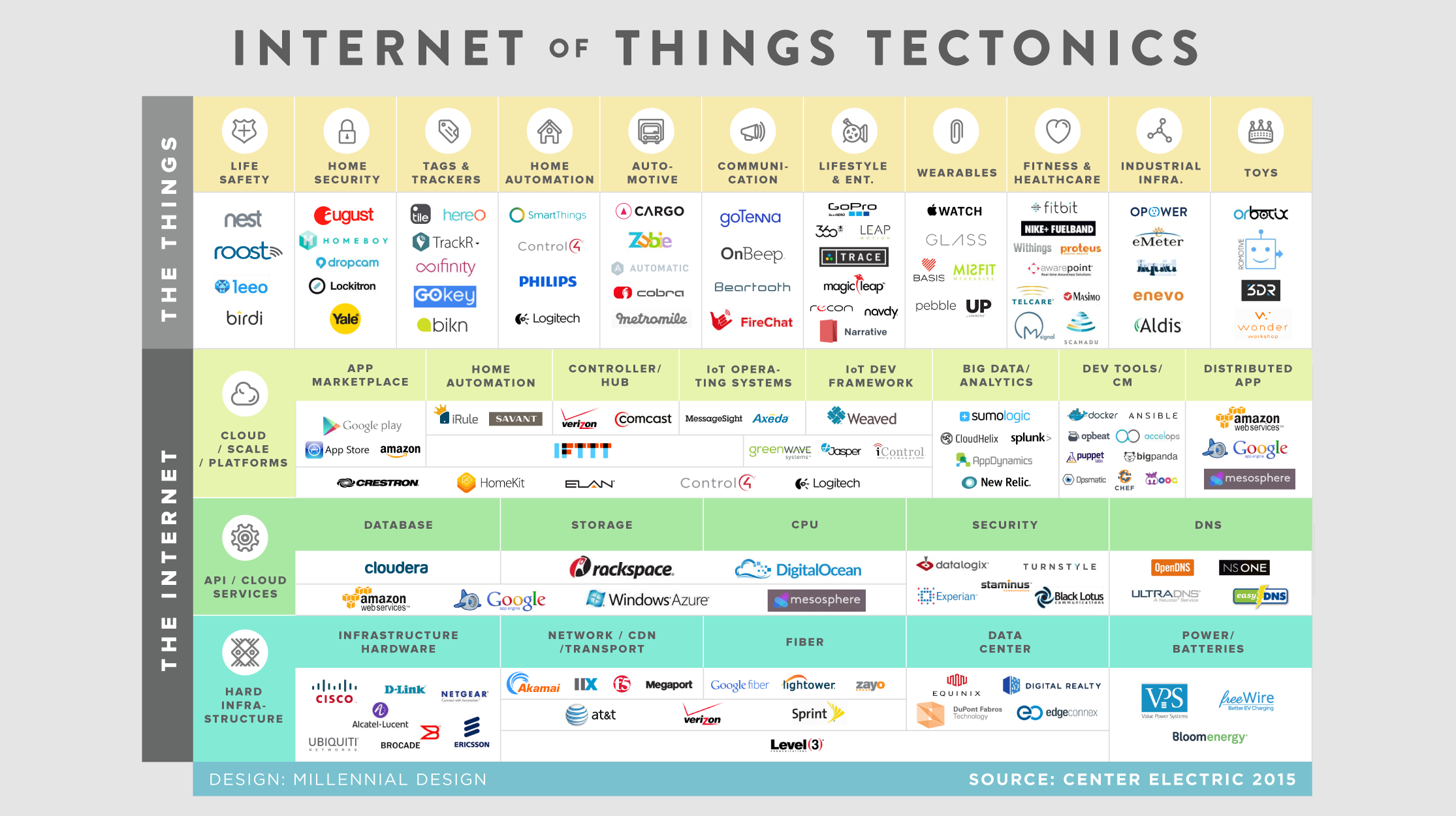
    The last time I wrote about the Internet of Things, I hoped for an application layer that could sense and collect data and convert it into use cases. In fact, the title of the post was Interweb of Things, the nuanced difference between them being connection (IoT) and interoperability. (WoT) (read) In the few months since that post, there has been quite some activity in the space. I saw a very useful classification a few days ago that illustrated both the ‘things’ as well as the infrastructure and showed the possibilities of interoperability. (via)

    IoT

    (more…)

  • An Interweb of Things

    Since the time I wrote An Internet of Things narrative, its trajectory and pace has seen tremendous acceleration, to an extent where TC has claimed that it has reached escape velocity. Indeed, there is a whole lot of activity happening that would back this claim – startups, larger companies getting interested in the space, geographic expansion and so on. In fact, the article has what seems like a comprehensive chart on applications, platforms etc.

    In my earlier post (linked above) I had pointed to the distinction between the Internet of Things and the Web of Things. What was then a nuance seems much more wider now and is even more relevant. Another article on TC, titled The Problem with the Internet of Things is actually about this. One of the products that has fascinated me for a while is Mother, from Sen.se. To me, it aims to solve this problem, and the last two points in their ‘Creating the Internet of Life’ document is proof of it. (Like wearables in 2014, I plan to get a consumer IoT experience in 2015, and this is most likely going to be my preference) Another simplistic but potentially very useful product I have seen is Flic. The last example is Signul, which uses a beacon system to automate things used in daily lives. (both on Indiegogo)

    (more…)

  • Changing brandscapes

    Recently, I was part of an interesting round table discussion organised by afaqs and IBM around “Technology in Marketing“. While we did stick to the subject, in my mind, I was also wondering about the impact this (topic) was  having on the idea of brand. It has been only 4 years since I had last held a brand job, (I left TOI in 2010) but I can safely say that the landscape has changed massively. A few thoughts –

    Time: The cycles of brand building have been massively reduced. This is not a 2010 phenomenon, but to give you some perspective, in that year Flipkart was just venturing beyond books and hardly the well known brand it is now. Zomato was a ‘promising startup’ according to a list made by the Smart Techie magazine and had just expanded beyond a single city. The flip side is that some of the other startups in that list no longer exist. AlooTechie, which reported this, also does not exist. I had a Nokia E series phone then, and they are pretty much a non entity now. In short, that word – change, and it’s faster than ever! It is said that brands get built over time, but do business cycles allow that liberty now?

    Geography: A cliche used frequently is “Geography is history”, but a little incident reminded me that it may not altogether be true. One of the regular conversations these days is around taxi rentals and Uber is a favourite among many of my friends. I casually asked them whether they knew of the heavy rap Uber was getting in the US for remarks allegedly made by a senior VP. (alternate perspective) They didn’t, and it isn’t as though they don’t consume news online. They missed it amidst all the ‘noise’. While a brand may be global, how much does its international stature impact regional preferences, even in this hyper connected era?

    (more…)

  • @ Social Media Week 2014

    The role of content in a brand’s narrative is an oft appearing topic on this blog, so I was glad for the opportunity to discuss the subject with various entities who have a stake in this new ecosystem. I’ll be moderating a panel titled “The New Content Ecosystem – Evolution & Design” on Sep 25th, 2-3 PM during Social Media Week.

    A fantastic mix of folks makes up the panel – Asit Gupta, founder of Advocacy Asia, Abhishek Chatterjee, founder of Tookitaki, Arunabh Kumar, founder of  The Viral Fever, Akash Deep Batra, Regional Digital marketing & eCommerce Manager APAC at Nestle, and Kalyan Karmakar, food insights consultant, blogger and columnist – it’s bound to be an interesting chat.

    If you happen to be around, do drop in and participate in the discussion that follows. If you’d like me to ask questions on your behalf, use the comments section below, give me a shout out on Twitter.  #SMWMumbai