
Category: Digital

  • What do you recommend?

    One feature that helps add weight (generally) to a LinkedIn Profile is ‘Recommendations’. I’m not getting into debates on how it’s used etc, that’s a subjective thing, but someone else acknowledging that the concerned person has certain skills does help. Facebook recommends friends, Twitter recommends users to follow. These are three layers – in LinkedIn its a human, in Facebook its an algorithm basis the user’s location, friends etc, and as for Twitter, well, Twitter just decides – no algorithms. But its ok, we recommend links to each other on Twitter. 🙂

    A few activities recently made me think of recommendations. Two from Google and one from Facebook. A TechCrunch article from a few days back states that Google Friend Connect now has a widget that can help publishers know (and display) which parts of their websites their visitors like best. So it helps both parties. I’m guessing it should also help Google figure out a little more data on who reads what where, and therefore some thing that can be used to improve Ad Sense’s effectiveness. 🙂

    One of Google’s services that uses a recommendation mechanism is Google Reader. Google has now added a feature on Reader that lets you know which of your friends are still worth following on Reader, basis your consumption of their shares. I wonder if they’ll utilise this data for new users – eg. if A and B are existing users and C joins the service, will Google use the A’s and B’s data to help C start off? I also think users should have the option of sharing their own trends data with each other, tools can be used to enhance utility – eg. if i know that 90% of my friends are following TC, then I might share less of TC items.

    Meanwhile, RWW thinks that Facebook has to be working on some recommendation technology. With those thumbs up and down signs on ads, I won’t be surprised if Facebook uses that on friends – ‘Manu liked this ad’ (so we’re serving this to you, since you’re his friend) and one more ‘rebellion’.

    Also, from RWW, a related topic, for a larger perspective – Linked Data. “Sir Tim Berners-Lee, the inventor of the Web, gave a must-view talk at the TED Conference earlier this year, evangelizing Linked Data. He said that Linked Data was a sea change akin to the invention of the WWW itself.” We are moving towards a web that’s increasingly inter connected.

    That made me think – we’ve reached a state where you can now login to Facebook with your GMail id (not vice versa yet), thanks to its working with OpenID. There are tools on existing social networks (and new services) for location based social networking. Made me think of the potential of a larger recommendation based web experience, that can then spill over on to real life. Recommendations are already being used, even in online commerce.

    But what it actually made me think is about a larger system where say, Facebook, the ad publisher and I will all share revenue if the friend does some positive action on the ad served to him, thanks to me. And of course, Google will then use this info to serve ads to me later, or utilise this on its own Friend Connect + iGoogle+ AdSense . 😉

    Virtually connected lifestreams and real money. The friends of friends of friends connection utilised upto a huge degree (with privacy controls) – its not a real social connection, only an algorithm that would calculate relevance basis the degree of separation and the history of activities. Recommendations of ideas, links, ads, people, jobs, music, books and any kind of products, services etc.. an algorithm boost to ‘serendipity’, if you will 🙂 It even works the other way, so  if you say, log in to a site to check out products, it immediately searches to see if there’s a recommendation it can push at you. Trust automatically plays a key role, and how well past recommendations have worked for you.

    Meanwhile, let’s hope that Google doesn’t make a social algorithm to top the one they’re working on now – to identify which of its employees are likely to quit. A recommendation feature that allows one employee to suggest another would be a Google killer. 😉

    until next time, ahem, some social advertising -I’d recommend watching this space – for a virtual interview 😉
  • ‘What are you doing’ needs an @ reply ? 🙂

    And every so often, we hear about how brands screw up on Facebook and Twitter, these days we even regularly hear how Facebook screws up on itself, and finally we heard about how Twitter ‘screwed up’ on Twitter. In case you missed it, the chronology can be read here.

    And in case you were too lazy to follow the link, Twitter suddenly yanked off an @replies option — a non-default setting to monitor a conversation between someone you follow and someone you don’t, which was only used by 3% of the Twitter universe. In an initial blog post Twitter addressed it from a product design perspective and as a ‘small settings change’. The response from users was whale disproportionate to the 3%, resulting in the trending of #fixreplies . Poor Twitter was actually doing just that, because the 3% users were straining the servers, since each time someone sent an @reply, Twitter had to scan people’s settings to figure out which tweet could appear in whose timeline. The fun part is that we anyway got to hear only half the conversation.

    Let me try to explain quickly A and B follow each other, B follows C, A does not. In the earlier system (where A was one of the 3% who had changed the default option to ‘see all @ replies’) A could see B’s @replies to C. With this change that Twitter made, A stopped seeing it. The ‘fun part’ I mentioned earlier was that A anyway couldn’t see C’s updates, or specifically C’s @replies to B. Anyway, the 3% considered this option as an aid to ‘serendipitous discovery‘ of new people. But I think the trending happened simply because Twitter didn’t tell anyone before they made the change. As one of the 3% (I think, since I clearly remember finding people based on the @replies of those i follow. Shefaly, correct me if I’m wrong, but I think we started following each other thanks to our individual conversations with @dina) I think its a  mistake if the Twitter blog was updated without studying all the aspects, a bigger mistake if Twitter chose not to tell users the real reason.

    Twitter then blogged once more emphasising that the technical aspects, more than the product design flaws, were the chief reason for removing this option. And later, gave a consolation gift which now means that A could now see those updates of B, which does not begin with @C. eg.  wondering what @C is smoking. To me, that solves the problem, because its just a format change in a way. And who knows, maybe users will take more initiative in helping connect people now – a human touch to serendipity. Or more power to ‘recommended users’. Meanwhile, there are at least five of us who can have the pun fests we enjoy, because (only) we all follow a particular id we created only for this. So I’m sure users will figure their lives out without the option. 🙂

    Like Twitter, I too learned a few lessons from this entire exercise. That it is important to be transparent and communicate your complete perspectives, especially if you exist largely because of the community’s efforts. There might be disagreements, but its better to make your stand and reasons clear before the event. That it’s very easy for users to lose the perspective that Twitter is a free service that was never meant to be scaled so much, and a lot of what they’re doing now could be to ensure they can scale up. I’m quite glad that even unbridled mobs have  limits of ‘justice’ they can get. That it’s still an ecosystem about which very few (if any) people have a  clear long term objective about – on one side we complain about noise, and when Twitter removes an option that in many ways added to the noise, we complain about that too. That hashtags are increasingly becoming an end to themselves than a means. That it’s the real time issues that matter – most users wouldn’t know that its quite a difficult task (if not impossible) to get their first tweet, after they cross tweet # 3200.  Another example of how Twitter is so many different things to different people.

    until next time, And I will cut you off from the peoples..”

  • Search Advances

    So, Twitter seems to be getting serious about its real time search capabilities. According to various reports, all of which seemed to have emerged from this source, Twitter’s new VP of Operations, Santosh Jayaram, has said that Twitter Search will soon be doing two things in addition to what it does now

    • it will crawl the links that people tweet
    • it will sort results by its reputation ranking system

    The ranking algorithm is going to be very interesting, because unlike, say, Google’s search algorithm, this would have to work at two levels – one, similar to Google’s Page Rank to ascertain the site quality, and two, the reputation of the person sharing the link. So, it’d be interesting to see which one would come on top, assuming the same story – me, sharing a TechCrunch link, or Mike Arrington sharing a link to this blog. 😉 Mashable had earlier written about an alternate  Twitter search service called Tweefind that uses various parameters to rank a person. The eternal debate about what should make a better twitter rank just got more interesting. 🙂

    RWW has connected the above happening to an interesting change that happened at Twitter recently – Twitter replacing tinyurl with bit.ly as the default url shortening service. According to an earlier article on the same site, bit.ly does more than just shorten a url, it “analyzes the page being linked to, pulls out the key concepts discussed on that page, and then provides real-time statistics about where the link is being shared and how many people are clicking on it.” Now, isn’t that interesting??!! When talking about the crawling of links, its hard not to think about the various services I’d written about earlier, (Krumlr, Fleck etc) which work on a delicious+twitter principle – use the delicious method of tagging and then share to twitter. I wonder, if at some stage, this is the kind of semantic association that Twitter would want to build on top of the crawling spiders, or will the machines take care of this too?

    The impact of all this on Google remains to be seen. Google is also looking over its shoulder to another hyped up participant in the ring – Wolfram Alpha, which is yet to make a debut. But there are speculations that they are on top of that situation. Anyway, Google must be doing something, they always do, that’s what makes them so dangerous. Since it already indexes tweets, adding real time shouldn’t be a big deal. A greasemonkey script does that for me!! But with the addition of Search inside GMail, the possibilities of that + Google Profiles + Friend Connect (and Gtalk status sharing) in creating a human layer  on top of the existing search is interesting. Their Searchology event has brought out a lot of new stuff  –

    • Search Options – a collection of tools that help you wean out the information you are really looking for, and view it in the way you want to. Essentially you can now tweak Google Search some more to your preferences.
    • Wonder wheel – it clusters search information
    • Rich Snippets – In addition to the info that currently gets displayed in a search item, there will be a line that sums up the result – eg. ratings for restaurants. It has asked publishers for their cooperation in adopting microformats to create this structured data.
    • Google Squared – As per the post, it “doesn’t find webpages about your topic — instead, it automatically fetches and organizes facts from across the Internet.” Its description does remind me of a certain yet to be launched search engine 🙂
    • Search will also indicate whether a site is optimised for mobile devices, and will consider location when delivering search results. (Google Suggest bringing in results from local places for say, restaurants)

    Some excellent live coverage happened at Search Engine Land.

    Meanwhile, a small detour for Microsoft and Facebook. Microsoft claimed recently that its going to become “more disruptive in search.” Facebook recently opened its stream API but also cut off the RSS feed for the updates. I used to make use of it in at least a couple of places. 🙁 It also acknowledged Indian users by making itself available in 6 Indian languages. I wonder where Facebook figures in these search battles. Does the opening of the stream API mean that we will soon have a real time status search mechanism? But how useful will that be when a lot of users prefer to keep their profiles walled (like FB itself)? But its interesting to note that many geeks also auto update their FB statuses with their twitter ones thanks to many available services. FB is quite an aggregator too, in its own way, so I wonder if we’ll get to see a search that shows Twitter + FB statuses, and the videos, pages, shared links and comments content on FB. Meanwhile, on real time, alerts now happen as pop ups. 😐

    The last couple of days also saw new versions of a couple of existing players – One Riot now indexes and groups link shares on Twitter and Digg. It also allows you to dig further into the data- numbers, who shared it first etc  and then share it on the two services. Tweetmeme is launching an enhanced search version which lets you filter results by age, category, channel and also shows how many times result has been tweeted.

    To me, real time is only one of the things that makes Twitter’s foray into search interesting. After all, when I search for real time links to a story on Twitter, I don’t think an Ad Sense like mechanism will work for revenue. So it is the combination of semantics, sentiment analysis, and real-time data that makes this Twitter development seem like a huge leap (when it happens). Google seems to be working on making more sense of data, than real time, or semantics. Can that be taken as actually walking the talk when they claim that search is still in its infancy and there’s a lot of room for existing and new players? Twitter and the new services don’t have the scale of indexed pages that Google has, and Google doesn’t have real time. For now, its interesting how all of these services actually work out complementing each other, as shown by the comparison here.

    I have to admit, with all the connecting that was happening on Twitter, I was hoping that a revolutionary model (of revenue and web behaviour) would evolve. The current developments, though a lot of it is still conjecture, are not as over whelming as I’d hoped for. Its an organic evolution of sorts – semantic, real time, social web. Perhaps it is only the beginning.

    until next time, the search is on…

  • The evolution of Content Marketing

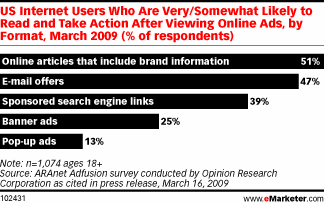
    A few weeks back, the eMarketer released some statistics about the kind of web advertisements that elicit reactions from readers.

    emarketer

    Clearly, the crowd likes to see ‘advertisements’ within content – I think advertorials would be a subset of that. This trend is all the more prominent in the younger audience, when the demographic profiles of the respondents are considered. (check out the statistics here)

    The graph shows that advertising in content is also ahead of sponsored search links, perhaps because the human writer would obviously have a larger sense of context than the ad serving Google. More importantly, there is a trust factor involved when the ‘advertising’ comes from a ‘known’ blogger/writer. There have always been debates about bloggers ‘selling out’ and plugging products/services, but sponsored posts are a reality, and so long as the disclaimers and the disclosures are in place, I am quite okay with that. I’m quite sure that if the concerned blogger gets greedy, the crowd will straighten him out in time.

    Content marketing is definitely different from traditional marketing/PR and raises interesting scenarios for all three parties involved – advertisers, publishers and consumers. Before you go further, I’d suggest reading up Chris Brogan’s (slightly old but) informative post about content marketing.

    The advertisers could range from large brands – products or services, to those serving niche sections. Trendwatching had written recently about sellsumers

    SELLSUMERS: Whether it’s selling their insights to corporations, hawking their creative output to fellow consumers, or renting out unused assets, consumers will increasingly become SELLSUMERS, too. Made possible by the online revolution’s great democratization of demand and supply, and further fueled by a global recession that leaves consumers strapped for cash, the SELLSUMERS phenomenon is yet another manifestation of the mega-trend that is ‘consumer participation’.

    Advertisers would have to figure out if they want to establish and maintain their own content marketing platform, or rely on on a network of entities like sellsumers – that could be individuals or a content marketing service that aggregates independent websites/bloggers, or encourage their regular consumers (/prosumers) to speak about a brand they use, or just support activities/communities and hope for good word of mouth. Perhaps it could be a combination of any or all of the above, with a different objective (a brand goal or a sales goal),  and different measurement criteria for each. In any case, this could prove a great way for brands to explore their long tails of products/services and communication too. It would also mean that brands would have to work harder to ensure that they reach the desired audience in the desired way, in an increasingly fragmented media landscape.

    Publishers, as mentioned above, could be the brands themselves or sellsumers  – individuals or a network. Perhaps newspapers could explore this as a revenue stream, since they’ve always been content aggregators with specialist columnists. The existing social networks are trying to evolve a revenue model out of this. Celebrities could build up an audience across social networks and create an endorsement 2.0 version. For any of the above, the key would be to establish and maintain a set of users, with whom they have an equity- a social capital, to whom they can provide a value, even when they’re doing content marketing. In essence, while the old publishers used their reach for any advertiser who could pay the required price, the new publishers would have to be focused and would have to live with the involvement of consumers in who they sell the reach to, and how.

    The end consumers will seek out networks they can trust, ones which can provides non intrusive ways of connecting them to the product/service they might have an interest in. They would play an active role in creating and maintaining relevant publishers and networks, by ensuring that they are trustworthy sources of information.

    Going forward, it is possible that all the entities we see on the web now, including us, will play all these roles at various times. Unlike the clearly demarcated advertiser-publisher-consumer system we have now, the new systems would be more fluid, with flexible options for all parties. The standards and norms of content marketing need to evolve. Perhaps the disruption we are seeing now, with the decline of traditional media and rise of social web is a prelude to this flexible system.

    until next time, role play

  • Social Connectivity

    Just yesterday, I read about AOL launching Social Thing for websites. Adding the service to your website gives you a navigation bar at the bottom of the page, users can sign in with their AIM/AOL/Bebo/ICQ ids and comment. They can also chat/IM, check out what their buddies are doing, and share stuff with them. According to Mashable, “Authentication goes through AOL’s Open Authentication API, which is being extended to include support for a single sign-on from Facebook, Google, Yahoo, OpenID and other services.”

    As TechCrunch mentions in its article which talks about Facebook opening its stream API to developers, the conversation wars are heating up. Facebook Connect and its potential is something I’ve written about several times before. Broadly, as a site owner, the implementation of FB Connect allows me to broadcast my content to my Facebook audience, and if they comment using FB Connect, it gets added to their stream thus multiplying the reach. As a commenter, I can share my activities on other sites on my FB stream. The opening of the API enhances the potential for FB stream conversations to happen outside FB.

    Meanwhile, a few days back, there was also a news about Twitter Connect. Obviously, since Twitter has very less profile data as compared to FB, it need not be seen as a competitor to FB Connect, but seen from a “conversation  platform choice” perspective, i’d say it still is. For those interested in how each of these Connect services work, this is an excellent detailed read.

    And what Connect conversation can be complete without the omnipresent Google. Before we get to Friend Connect, a detour. Google recently decided to give us more control of how we would be seen in a search result page – Google Profiles will now be part of search results and we can edit it. In addition to regular data, you can showcase links to your profiles on services like Facebook, LinkedIn, MySpace and so on. While Google claims its just responding to users’ needs, its obviously aimed at getting more user data. However, the profiles will only be shown at the bottom of the search pages, and will not ‘save’ you if you’ve been making news otherwise. 🙂 I assumed that the Profiles so created would be in sync with what gets displayed on Google Friend Connect, but apparently its not so. But you can have a vanity url (google.com/profiles/your name) so long as its connected to your gmail id. You can get a detailed report on the new Profiles here.

    Back to Google Friend Connect, once implemented on your site, it allows users to log in using GMail/Open ID/Yahoo/AIM . Users can comment, rate etc (depending on the gadgets you’ve added), engage with other users, and invite their friends from other networks to check out the site. There are many related things I am thinking of – will Profile and Friend Connect be made to work in sync, and is Google doing the opposite of what FB has done? FB created a social network first and then decided to connect other sites with it and thus enhance its own lifestream. With Google’s many services, it has a ‘disaggregated’ social network in place – YouTube/Picasa/Blogger/(even) Reader. At some point will Profile be just the equivalent of the ‘Info’ tab on Facebook and something like iGoogle (or God forbid Orkut) serve as the aggregator of one’s conversations across the web, not just across Google services, but the sites in which one logs in using Friend Connect. Google is always hungry for more data on users, so it can build more (and truth be told, sometimes better – like the proposed new Google News) products and get more data and obviously find more ways of making money.

    Of the four, Facebook is now using its Connect on popular sites to add more layers to its existing user data  and increase the conversations on Facebook. The opening of the stream API should get us some interesting apps. We’ll have to see what AOL does with its new service, how it ties it with Bebo etc. Twitter Connect is in many ways a different animal altogether, its simplicity and existing third party applications throw open many possibilities (as always) The data just goes back to Twitter, and it can be argued both ways whether Twitter Connect can be used effectively to increase a site’s visibility in the open yet ‘noisy’ stream, but the commenting using Twitter login would be useful to quite a few people  (a wild thought – maybe Twitter should just buy Friendfeed and make that its base social network). Google Connect is easy to implement and interesting gadgets are sure to happen. The possibilities of aggregating  it into a network remain. Now I wonder if Microsoft will find new ways to connect, or will they just Vine? As for Yahoo, maybe they’ll connect with Microsoft finally!! What will be interesting is what handle you would use to connect.

    until next time, connecting people ain’t just Nokia’s job no more

    PS.  6 years of blogging. A week’s break. 🙂