
Category: Digital

  • Paper Capers

    Almost 2 months since we last discussed newspapers, so I thought its a good time to update. Rumour is that Murdoch plans to sue Google and Yahoo over news services. Fact is that he’s going to charge for news, something he’s been doing for a while with WSJ, and the ‘experiment’ is going to start with The Sunday Times. Others are set to follow his example.  “Quality journalism is not cheap,” said Murdoch. “The digital revolution has opened many new and inexpensive distribution channels but it has not made content free. We intend to charge for all our news websites.

    I, for one, am happy, because the keywords for me are ‘quality journalism’. Its perhaps a prelude to a shakedown, and the survival of only those who can adapt to a world with internet. With the width and depth of content available, the debate of ‘free vs paid’ has been going on for a while now. But perhaps the time has come to end it. Build the wall, and let’s see if people want to pay to enter. (that link is an excellent read, detailed and thought through, check it out) Opinions are bound to vary – and to be in extremes. Most people feel that it is flawed. Chris Anderson feels that at some point in the future, “maybe media will be a hobby rather than a job“,  Vivian Schiller, former senior vice president and general manager of the NYTimes.com, believes that “people will not in large numbers pay for news content online“, but there’s still space for an NYT to cut expenses and survive. Murdoch obviously believes he can get the audience to pay.

    Meanwhile, the Associated Press is planning to charge $2.50 per word if 5 words or more are quoted from its articles, with the help of a microformat. Not surprisingly, it has been widely criticised in several tones all over the web. Jeff Jarvis even has a post on ‘How (and why) to replace the AP‘, and illustrates the interesting concept of ‘reverse syndication’. Chris Ahearn, at Thomson Reuters, implores entities that are declaring war on the link economy to stop whining, and stands ready to help those who wish for an alternative to AP.

    Interestingly, Google had recently quadrupled its newspaper archives. (Locally, Dainik Jagran is now part of Google’s News Archive Partner Programme, and has a strategic deal with Google to help the group archive its bilingual daily, Inext) The average newspaper’s stance on Google is understandably ambivalent. On one hand, it is happy to get the traffic from Google, but its not happy that its only one among the websites shown, and the amount of content that Google shows. (that might prevent a reader from visiting the site) Sometime back, Google had posted its views and how, any publication can block search engines with a slight change in code.

    The reactions to this obvious ‘transition stage‘ for the newspaper industry has been taking many forms. Paywalls are boycotts are only one kind. Alternate methods of news collection like crowdsourcing+crowdfunding, public collaboration, (an interesting case, for more than this reason), nichepapers and ways in which journalists can use tools like Facebook and Twitter, are being discussed, as well as radical ideas like making the newspaper a gateway for particpative experiences, even as technological developments – touch screen ‘intelligent plastic’ roll up reader, and experiments from NYT (‘What we are reading‘) continue.

    While it would be easy to say that these are trends in the West, that are not very relevant to India at this stage, I’d still say that these are trends that media in India, especially newspapers, should be closely watching and learning from. A good read from Pradyuman Maheshwari at e4m on the same subject. While the Nielsen Online Global Survey on trust, value and engagement in advertising shows that newspapers are the most trusted form of paid advertising (in india), the TCS study on Indian urban school children show that they are extremely technology savvy and totally at ease with the web and social media.

    As stated in the TCS study “This societal trend has important implications for parents, educators, policy makers, as future employers as well as companies and brands that want to sell to tomorrow’s generation.” Some understand this, and have started experimenting with new forms of distribution. I just got  a mail asking me to check out Star Player!! The point is that one can never be sure whether the trends in the US will be replicated in India, though I’d say its more a ‘when’ question than an ‘if’, even though India’s version of the trends would be mutated, thanks to its own socio-cultural and economic pecularities. But it helps to be prepared. I read at Medianama, a few days back that the Hindu is taking Ergo, its 5 day a week publication aimed at young professionals in Chennai, online. Though the motive might have been cost saving, I’m sure it will be a great learning in understanding consumption patterns and figuring out revenue streams. I quite liked the site, powered by WordPress, with a very casual ‘About’ page, and covering some interesting stuff. It looks like an online news site, not the website of a newspaper.

    On hindsight, the collision was bound to happen. Newspapers, which subsidised news to the reading audience by making advertising pay for it. Google, which aggregated content, and served ads in context. They had to meet somewhere, and disagree on who makes how much. The concern areas for newspapers are manifold – news consumption has changed – quantitatively and qualitatively, modes of creation and distribution have changed, and Google has developed a much better advertising model. In essence, all entities in the publishing business have changed – producers, consumers, advertisers. Isn’t it inevitable that the publisher has to find a new business model? Newspapers in India still have some time on their hands, and some good tools too. With most publishing houses having multiple products that cater to specific audiences, they can actually experiment in different directions. It does cost money to create good content, the trick obviously is to figure out ways to minimise the cost and work out how much each stakeholder – reader and advertiser, is willing to pay for it. Now would definitely be a good time to start, unless you want to sound like the (as usual) hilarious Onion story – “Why did no one inform us of the imminent death of the American Newspaper industry” 🙂

    until next time, think about the link economy
  • Social Office

    A couple of days back, I happened to read this report by Jakob Nielsen (via RWW) on social networking on intranets, that throws light on the enterprise use of 2.0 tools. From the RWW article

    Neilsen’s 168-page report includes case studies from 14 companies in 6 countries, including Sprint, Sun, Intel, IBM, and Johnson & Johnson. Several times throughout the summary, he points out that when he asked these companies about their enterprise 2.0 strategy, they told him to come back in a year.

    The report, a result of research done across 14 companies in 6 countries, highlights the pitfalls of both the quick adoption as well as slow track methods of using web 2.0 in the enterprise – risk to corporate culture and loss of employees who expect quick adoption respectively. The study points out that while the tools are important, it is what it lets people do and how it helps them solve business problems that actually matter, an emphasis on the sometimes forgotten fact that the new shiny object on the www need not be of use to the organisation and even the reverse – an old tool might work best for the intent/objective. It also highlights the different aspects that need to be taken care of, while implementing the tools in the enterprise – content, training, encouraging the community, speed of integration, open communication, the need for corporate communications to adapt to the reality of real-time and so on.

    And in the end, were raised two things that I thought were the most important components in this discussion – the change in corporate culture it entails (especially the ‘knowledge is power’ tenet) and the time the implementation would take, precisely because of that (and hence the need to start right now).

    The social media strategy (if any) of many companies is either the brand’s Twitter/Facebook presence and the ROI discussions for the same, or the use of these and networks like LinkedIn for actual sales (yes, broad generalisation). When compared to the corporate culture change discussed above, these are tactical uses of social media – utilising tools, for (usually and unfortunately) broadcast or direct selling. Yes, in some rare cases, the channels are used for two way communication too. (a story on Indian IT firms)

    While many efforts are commendable, in many ways, the tactics resemble a building with a gleaming facade whose insides truly reflect the state of affairs – peeling paint, bad plumbing, poor service etc. These are bound to come out. As the Ad Contrarian wrote a couple of years back in his post titled ‘Brand Tinkering‘,

    ……………tinkering with the brand is way more fun than solving real business problems. Solving problems requires unpleasantness. Floors have to be swept and walls have to be painted. People have to be fired. Systems have to be changed. Products have to be redesigned.

    The need for a more comprehensive approach to social media, and the need for internal change is something we often discuss here. On one of the LinkedIn groups I am part of, Pallavi Bhardwaj asked a question recently. It happens to be quite pertinent to this post, albeit in a tangential way. The question was ” Do you keep a track of employees’ personal blogs?” And its not just blogs these days – microblogs, social/business networking sites, and a tribe of self expression and sharing platforms that grows daily.

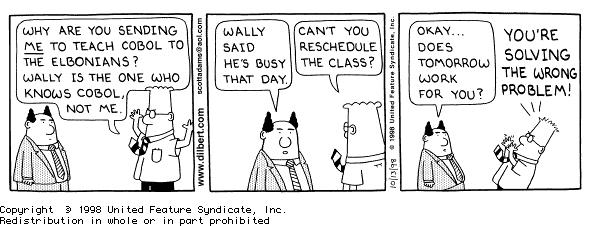
    It made me wonder if this is related to the enterprise not keeping pace with the evolution of the web and its tools? Assuming that a company monitors employee activities, does it then (in addition to/instead of) ‘deal’ with the employee or question why something was posted/shared, and address that? Does it again show the need for control, rather than understanding the need for a change in the way business is done? A short term view instead of real strategic vision? I’m not saying that the immediate ‘fire’ does not need to be handled, but is a thought being spared for what lies ahead? Maybe, if the enterprise had a thriving communication and sharing network, and an efficient response mechanism, the need for ‘policing’ would be drastically reduced? As one of my favourite Dilbert strips says,

    wrong-problem

    (meanwhile, down with the syndicate!!)

    Perhaps, the brands who are just listening on the tools like Twitter, and using the information to change the fundamentals of how they do business are the ones who stand to gain more in the long term. As part of this, they could also be creating a culture, where each person is aligned to the organisation’s goals, rather than only the narrow focus of the department he works in. We really need more like Zappos, and more ‘culture creators‘.

    until next time, enterprise..start the trek 🙂


  • Reading beyond the obvious

    As a regular user of Google Reader, I was happy to see that a couple of weeks back, Google deemed it important enough to carry out a few changes – a ‘like’ button, the ability to follow specific people (using Reader Search), and friend groups (with customisation options of who sees what content). The public nature of the ‘Like’ button meant that sharing on reader got a lot more social, though it had its share of detractors too.  Many complained about not wanting to see “likes from the unwashed masses”, Google corrected it by adding an option in the Settings, so that if you so desired, you could only see the ‘Likes’ by people you followed.

    As a regular user, I’d say that people who give only partial feeds stand to lose out a bit on the ‘Like’ part. It would also be great if the time lag between publishing and the post appearing on Reader could be reduced. As a publisher, I wish Google would tie these social features in Reader with Google Analytics, so that I can know who shared/liked my posts. One way to know the number of ‘like’ is to subscribe to your own blog, but I’m sure that Google can make it easier if they want. Then maybe a plugin that can show these details on my post (at the site). Much like the Tweetmeme plugin I have installed on my other blog.  Speaking of Tweetmeme, according to Venture Beat, the button is now shown more than 50 million times a day across the web. It has its share of competitors, and is even threatening to sue one.

    That number gives a rough idea of why Google want a piece of the sharing pie. In fact, this chart, created by AddtoAny (the same guys who gave us that awesome widget at the bottom of my posts) shows how sharing happens on the web. Facebook leads, followed by email and Twitter. Google, though dominant in search, would be looking closely at specific competition – the Yahoo-MS deal and how Bing’s interesting games shape up. But more importantly, it also has to keep an eye on how generic search and sharing (social) are changing and shaping each others’ future. Twitter just got itself a new homepage, and ““Share and discover what’s happening right now, anywhere in the world”  clearly shows the intent. I thought it even answered, to a certain extent, the oft heard question – “But what do i do on Twitter”. Call it discovery/recommendation/trend, but it is just a different perspective on search. And its not just Twitter, Friendfeed recently added a feature – ‘recommend friends’. No, silly, not the Orkut/LinkedIn type, if you feel your subscriber would also like the feed of someone you subscribe to, you can share it easily. Though its nothing radical, its helpful for new folk.

    The Nielsen Global Online Consumer Survey shows recommendations (from known people) as the most trusted source of advertising, at 90% and consumer opinions posted online at 70% next. Among Indian audience, recommendations top, but editorial is placed second. A post on Six Pixels of Separation blog talks about how the next ‘Google’ will be a referral engine, which ranks website not basis text optimisation, but basis what people have said and done there, and how the information there has been used by people. But there are challenges there too as such a system needs to incorporate relevance, immediacy, trustworthiness and have an interface that will display it in the most intuitive, easy manner possible. This post on RWW discusses the concept of Social Relevancy Rank, with five layers, where search results on streams (like Twitter, which already have real time) will be arranged basis relevance to your social graph. Friendfeed does this and provides more options in Advanced Search. The post also suggests ‘friends of friends’ as the next layer of results, and a concept of ‘taste neighbours’ (a mining of ‘people who liked this also liked’) after that. The last two layers are made of influencers and the crowd aggregate. In fact, I thought, maybe a possible visualisation would be to actually have all five layers arranged vertically side-by-side and a thumbs up/down button by the side of each search result, so that each user can contribute to filtering. Is this a perfect method? No, but then neither is Google’s Page Rank, as the author says. Which perhaps is why Google, while it is master of the algorithmic search, needs to experiment with Reader and see if it can create a social layer on top of its Page Rank search system. A new system that also incorporates the data from likes and shares beyond the optimised keywords, and is able to operate in real time too. Possible? That would be fun, and would even take Ad Sense to a whole new level. 🙂

    So what does this mean for brand and marketing? Beyond mastering the algorithm, optimising all the queries, mining all the data and connecting it, how does differentiation happen, other than the obvious product possibilities? This very interesting article (via @vijaysankaran) discusses the battle between art and algorithm. Amidst the quest for perfect targeting, and the smoothing out of our search experience, we might be losing out on serendipity. The  author goes on to say that in this ‘end of surprise’ is the opportunity for marketing – to deliver revelation along with relevance. The perfect  of left brain analytics and right brained creativity and emotions, which seemed to have been lost somewhere in between.

    until next time, search and socialise 🙂

  • Bridge over troubled water

    In ‘Tin Fish‘, there is a wonderful speech given by the school captain, which goes (edited a bit)

    …..I am not what I’d have liked to be. The school is aiming to prepare me for others. I want to be for myself. But it is growing increasingly difficult for me to prepare myself for myself as my expectations grow greater. A reformed, open-hearted school can help me. Till then, I shall stand on the beaches, look towards the sea and wait for a solution to be washed ashore.

    The novel is set in a boarding school in Rajasthan, deals with peer and parental pressure, and has the chaotic politics of the 70s as the backdrop. As a late 70s born, I could identify with the book because though the cultural icons had changed (rock bands/actresses etc) societal changes seemed to have moved at a much slower pace. The value and belief systems as well as the prejudices – caste, religion, income are a part of the 80s too.

    I could also identify with the above excerpt on two counts. ‘Preparing me for others’ ..the pressure to conform – on the kind of education one should have, the kind of career one chose, the kind of person one could get married to, one’s conduct with family, boss, and one’s behaviour in society in general, all had their own sets of conformity. ‘Prepare myself for myself’..when I wrote this post sometime back, I had mentioned the conformity that the blog imposes on the blogger, it is something that happens in real life too – we create an image of ourselves, consciously or more likely, sub consciously, and try to stick to it. In either case, more often than not, objectivity will be lost.

    Sometime back, I also came across this wonderful piece in the New York magazine, titled ‘Say Everything’. It talks about how as the young population gets increasingly used to the net, there are many among them, for whom, sharing their ‘stuff’ online is the natural way to be, and for whom, privacy has an entirely different definition. In fact they consider the extreme caution of the earlier net generation to be narcissistic and are prepared for the implications that the shared stuff might have on their lives decades later. The author sees this as the biggest generation gap in a long time, perhaps since the hippie generation. She even wonders whether in this era of surveillance cameras and tracked card transactions, their belief that privacy is an illusion might be the sane approach. The article outlines a series of changes that are happening with this generation –  “they think of themselves as having an audience, they have archived their adolescence, their skin is thicker than ours”

    Now, one could say that they are conforming to an online audience (like my blog example), but as the author points out, over a period of time, will this generation, which has been growing up with the net, move towards such degrees of comfort that they are totally un-self conscious? And perhaps, to quote the extreme example used by the author, a Paris Hilton level where what could have been the worst humiliation possible, was used as a stepping stone for fame? A generation so transparent that any ‘forced’ conformity would be easily detected and would be undesired. And moving on, to use the words I had seen in a totally different context (link), would transparency be (or subsume) objectivity?

    At this stage, we are of course, smack in the middle of these changes, but unlike the above generation, technology (more specifically, the web) entered our lives relatively much later. We perhaps have the baggage of not just peers/parents/society but also the ones we have created for ourselves earlier on in our lives. We might struggle to adjust, but yet we are perhaps the bridge generation, across the cultural changes wrought by the www or even liberalisation (in India). Did every generation have to play similar roles? 🙂

    until next time, stage fright

  • Brands – Maturity, Transparency, Objectivity

    On the day that gay sex was made legal in India, I had wondered aloud on Twitter, whether condom brands like KS, Moods or even a deo brand like Axe – whose communication is all about attracting people (the female gender so far, since its a deo for men) – would use the occasion to provide a bit of a twist in their standard advertisements. As expected, none of them did. Which led me to wonder on the maturity of audiences and those of brands. (‘maturity’ for the lack of a better word, a more elaborate description follows)

    From an experience in an earlier place of work, when we had played on the visuals of Sai Baba and Jimi Hendrix and talked about music and religion, I have seen the fear that marketers have about how the consumer will react to a communication that could be taken as offbeat. In the case above, one could argue about hurting sentiments of followers (Sai Baba’s, according to the client, Hendrix’, worried the copywriter 😀 ), but there really wasn’t anything derogatory. Now that may be a subjective reaction, so let’s go back to the initial example. I’m reasonably sure that even if KS/Moods/Axe had thought of this, they might have decided not to pursue it.

    Is that because of a simple positioning mismatch that they perceive, or is it a fear to push the boundaries, of what they perceive as acceptable to their audience? Something that goes against the image they have created. But, as we keep discussing here, consumers are moving on. They talk to each other, and share their experiences about the brand, which may or may not work in advantage of the brand.

    Meanwhile, I recently read an article in the New York magazine, which got me thinking quite a bit on this subject. The article was titled ‘Say Everything‘, and talked about what the author perceived to be the largest generation gap since the hippie generation. While the extreme scenarios outlined in the article- of the kind of photos and complete transparency, of thinking of themselves as having an audience, of archiving their adolescence, of having a thicker skin than earlier generations- may not be what the average youth indulges in in his community, it does point to a generation which is growing increasingly uninhibited with sharing more and more of themselves with others on the net. The author points out that with surveillance cameras, transaction tracking etc becoming the norm, this complete transparency approach might be a saner route.

    In fact aren’t FB/Twitter status updates, and even online journals that many in my generation indulge in, also cases of living for an audience? The details of what they share might vary when compared to a younger user set, but this seems to be a trend that may not be scaled back, and in all possibilities, would increase. With the social tools that keep improving the ways to communicate, and share, can brands afford to cling to the kind of communication that they are used to delivering to the audience?

    In another article I read, YouTube blogger Kristina Horner, who was criticised for working with Ford Fiesta, makes a wonderfully simple, yet passionate argument that for “both bloggers and brands to be successful they need to accept that traditional advertising is not-effective (and even rejected) and that publishers like Kristina can find a win-win situation where a brand supports their work without compromise.”

    Would being completely transparent (yes, that is a bit of a redundancy, i guess) ensure that brands get a fair deal from the people they communicate to? Like I read in another context, would transparency fulfill the function that objectivity is supposed to?  But as always, transparency is not something that can operate only in communication, it moves to product, and many other functions within the organisation. So, as more and more consumers realise what Kristina has articulated so well, shouldn’t brands also take some initiative in changing themselves, and collaborating with their consumers?  That would take some maturity, i guess. 🙂

    until next time, audible audiences

    PS. For those missing the Tool Aid that is the blog’s staple diet, here are a few interesting reads

    The Sysomos in depth Twitter study that places India in the top 10 countries in which Twitter has been growing.

    The Razorfish Social Influence Marketing report.

    The Wetpaint/ Altimeter list of the world’s most engaging brands, and how there might be a link between engagement and financial performance