
Category: Digital

  • Social evolution, at least?

    Judging by the number of responses to his article in ‘The New Yorker’, Malcolm Gladwell seems to have ruffled quite a few feathers, especially in the Twitter loving community. Not surprising, since he has torn apart at least a couple of Twitter’s poster children revolutions – Iran and Moldova. His grouse seems to be that we have forgotten what activism is, and are perhaps doing the word disrespect by using it for activities that happen basis the ‘weak ties’ of social media. The benchmark he sets for activism are indeed high – the Civil Rights Movement, which happened before and without the internet.

    I could give you quite a few links that offer rebuttals to this argument or try to put in context – Evgeny Morozov’s post in NYT, Maria Popova’s vehement retort, Gaurav’s 6 point reasoning of why Gladwell is wrong, Anil Dash’s more nuanced approach, and even cite say, a Pink Chaddi campaign (in a country which has a single digit internet penetration) to attempt a contra view. But there’s no denying that armchair activism/slacktivism exists.

    However, as Maria explains in her post, different generations face different societal challenges. They also have a different set of tools that enable them to achieve changes in the status quo. And that’s probably why I think its unfair to dismiss the influence of social platforms in combating the issues of our time. The issues can be across domains – from water crises (check Mashable’s post on Blog Action Day 2010 – Water) to changing the ‘unhealthy’ business models of several traditional media outlets. It is challenging individuals to create and collaborate and break out of  work/life mindsets. I am able to be part of say, a micro finance venture and spread the word on social channels. Such changes can’t be deemed worthless. In any case we’re perhaps too early to postulate what these tools would achieve. Precisely being in the middle of this would take away our objectivity.

    Despite this hilarious Maslow’s hierarchy of internet needs, I’d like to think that we are moving through a hierarchy as web technologies evolve. From a general source of information, the web has moved on to being able to connect us in context. It has allowed the rapid amplification of signals. We have only started with location as a context of networking. There would be a tremendous difference when we start addressing civic issues, using social tools as a means to aggregate locality based communities.  In essence, tools are just that, and we have to define contexts to make them more useful. And we have to evolve to that level.

    Maybe there will never be massive revolutions, just small uprisings across time and place that subvert what could’ve been a great crisis if it was allowed to grow without checks.

    until next time, rebelution it is 🙂
  • Culture Bridges

    There was much excitement when I saw that much talked about presentation that somehow seemed connected to Google Me and Google’s approach to social. But the sounds made recently by Darth Scmidt don’t really give cause for delight.

    While it doesn’t make sense to talk ill of something even before launch, the ‘social layer’ does sound underwhelming. It doesn’t help that Mark Zuck recently hinted that ‘social is not a layer you can add’. ( What is interesting though is he also said in the interview “We’re trying to build a social layer for everything”) He should know about what works in ‘social’, because whether you love or hate Facebook, it is definitely a creation (and creator) that demands respect, on various parameters.

    Somewhere towards the end of his post titled ‘The Forever Recession‘, Seth Godin, while talking of the ‘recession of an industrial age with its imperfect market communication’ paraphrases Clay Shirky and states that ‘every revolution destroys the last thing before it turns a profit on a new thing’.

    I thought about this statement in the context of Google and Facebook, and also remembered an earlier post at GigaOm which showed the difference  between the way Facebook and Google work. And that prompted me to wonder whether every age has a unique organisational and workforce culture that best fits it, and the entity that grasps it, succeeds.

    This is not just a Google-Facebook question, but one that I’d consider across domains and categories. The leader in an earlier era would try to capture that culture mojo and would most likely fail because it tries to add to what it has been doing so far, where a start from scratch is what is warranted. The interesting part is also that the time between ‘revolutions’ seems to be consistently decreasing, so how do brands and organisations carry their success across?

    until next time, a revulsion for revolutions?

  • Internet and People States

    The Economist has an excellent read titled ‘The Future of the Internet‘, where it details the possibility of a Balkanisation of the internet, by forces such as Network Operators, countries, and closed platforms. Quite an irony, as they point out, since the internet was supposed to be a great unifier.

    I realised that so far we had been dealing with entities that had a geographical constraint – all forms of media, languages, culture etc. When brands entered alien markets, they adapted to suit the needs of the local population – sometimes in terms of communication, sometimes in terms of the product/service itself.  So I guess, it would be futile to expect that we would solve a challenge of this magnitude soon, considering that the internet has been around for only a relatively short amount of time. (cool infographic)

    But what struck me was that though the factors mentioned above are indeed distinct and relevant ones, what about users? Thanks to the long tail of content, people are able to get content tailor-made to their requirement, more often that not. They are also able to create content and share it with specific people. When I see e-groups, closed blogs, newsletters, and increasing privacy options on existing networks, I wonder how much of Balkanisation already exists thanks to users, who control a lot of the where, what and to whom content is shared. I connect with different people on different networks and share different relationships with them basis different contexts and interests, and except for minor overlaps b/w Facebook – Twitter and Twitter – Foursquare, they are all almost separate worlds. And its not just the where and the what, its also the when – I have Orkut friends discovering Facebook, Facebook and LinkedIn friends/connections discovering Twitter, Twitter followers discovering Foursquare, GReader friends discovering Quora, when my usage and behaviour on these networks would be completely different from theirs thanks to relatively early adoption.

    The other question is how would brands be affected by a Balkanised internet. Would all their users exist in the same place and time? How does it affect communication? Product, or service, how many brands can be like Apple, who are the nearest to being a ‘state’ in themselves? How many can actually build and sustain that? How much of it depends on the nature of the product and how much of it on the people connections (or social gestures)? Would integration and consistency of communication matter then?

    But then I realise that despite the user Balkanisation, we have our means of communication and transportation open. When push comes to shove, perhaps it will be too unprofitable for any entity to remain Balkanised, irrespective of their own vested interests? We live in hope. 🙂

    until next time, 800th post at the other blog 🙂

  • Multi purpose content

    This post over at GigaOm, titled “Apple doesn’t target markets, it targets people” sparked a tiny debate between Mahendra and me, on the effects of ‘antennagate’ on Apple fanboys, though the article itself had little to do with this line of thought. I wondered, like I’d written here earlier (last two paras), whether the continuous dissing in the media and the product flaw itself would create skepticism among the fanboys and affect future purchases, Mahendra didn’t think so.

    The subject of influence has cropped up here earlier, but the focus was on new media platforms and people. The above conversation made me think about the challenges that brands face on content that’s created on multiple media platforms.

    Even as traditional media platforms are being unfavourably compared to new media thanks to their constraints, the abundance of content – the media tsunami, on the latter does make one wonder how much of consumption by the intended crowd really happens. Meanwhile, despite the constraints,  technically, the reach of the traditional media platforms is still significant. A brand’s consumers exist on/consume these media.

    That really poses interesting questions on the notions of brand imagery, consistency etc, which have been holy cows of a previous era. Take this video, for example. Its a massive hit on Facebook and YouTube

    httpv://www.youtube.com/watch?v=cTl3U6aSd2w

    “Where’s the Gillette logo?!”, if this were a traditional TV spot, and what’s the message here? A close shave? 😉 But at 5 million + views, surely this must count for something. But what? This fuzzy nature of social media content and the media on which its propagated is exactly what raises difficult  but important questions on brands’ participation in social media.

    The answers are obviously not simple ones, and would have to be adapted to each brand’s needs. But as these lessons from Old Spice would suggest,  an important requirement is to understand objectives and define roles for each platform. The challenge then would be to create a content strategy that not only uses the inherent strengths of the different media, but also understands the motivations, consumption habits and preferences of the different kinds of people who use them. Instead of blind adaption across various platforms, exploring content options and finer segmentation is perhaps the order of the day.

    Perhaps Apple’s success is because of what the original post says “It focuses on users. And Apple lets them decide how and where they’ll use its products.” I wonder how many brands use that kind of understanding in their communication and brand strategy.

    until next time, iWash 😉

  • Jump with a crowd

    ‘Jumping the shark’ is a phrase that has been jumping on to my face regularly, but something that got lost in the rigours of speed reading and processing. Thanks to Tom Fishburne’s excellent post on the subject in the context of brands, products and organisations, I got to think about it a little more. The quick definition would be (from the post), “the moment of downturn for a previously successful enterprise.” The problem with it? “The risk of jumping the shark isn’t getting eaten by the shark. It’s leaving your loyalists behind.”

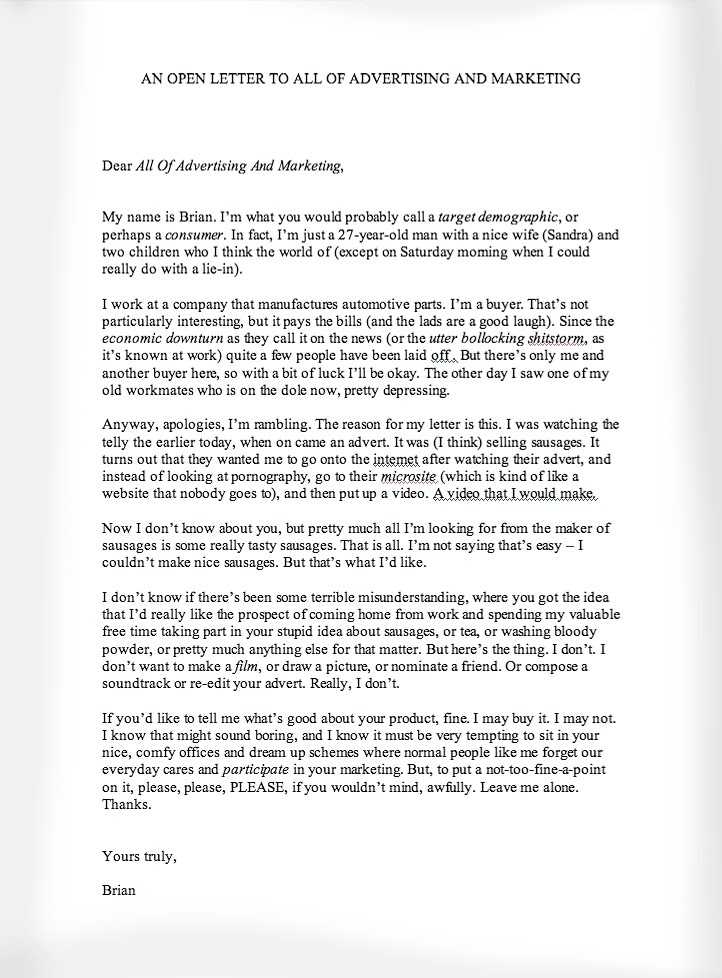
    I thought about it a bit, not in the context of brands or businesses, but more in terms of brand communication as a field, advertising specifically, and brands’ usage of the social web. Consumption patterns, media platforms available etc had pretty much created templates for creative agencies over a period of time. But the arrival of the web, social platforms and the democratization of media have managed to disrupt the ways of the one-way communication age. This post is a good one to read in that context, and talks about the change digital has made to campaigns, and the ‘role of the consumer’. But desperation, hype and the eagerness to get on board makes everyone concerned ‘jump the shark’. And unfortunately, the way I’ve seen many agencies and clients execute it (purely as a consumer), I’m quite inclined to agree with the author of this hilarious letter. (via PSFK)

    Clipboard01

    (click to enlarge)

    The job of the brand manager/creative agency is obviously a more difficult one now, and is made even more so thanks to the approach – of tool strategy. Like this (old but) excellent post states, ‘the technology that underpins social media is changing fast’, but its ephemerality ‘is a feature, not a bug’. It made me wonder whether brand communication/advertising, as a process (the way we see it now) had ‘jumped the shark’, mostly because the thinking process still sees  social platforms in the same light as traditional media and has not changed to be in tune with the former’s dynamics. In other words mistaking social media marketing for social media.

    Maybe they have to dig deeper, figure out the value that people are willing to pay for, and then find their ‘purpose idea + social object‘, and consistently. But that would mean a sea change in the way brands and creative agencies operate. Is adaption possible, or is complete disruption inevitable?

    I juxtaposed this thought with something that Seth Godin wrote recently, about the ‘red zone‘ – the joyless part of the learning curve. His graph also has a green dot, which represents ‘someone on the other side.. rooting us on, or telling us stories of how great it is on the other side’. Perhaps if brands can find from the existing consumer crowd a few who believe enough to play the ‘green dots’, they can adopt a more holistic approach to social platforms and carry the loyalists without it seeming like ‘jumping the shark’?

    until next time, safe jumping.