
Category: Digital

  • Social Induction

    ‘Disparate’ perhaps wouldn’t describe it best, but definitely 3 different posts in terms of scope and point of focus, but which I thought were in their own way, circling one of this blog’s favourite topics – how organisations can fundamentally become more social – not just from a usage of tools across its ‘silos’ but more from an ‘adding meaning to the individual and society’ perspective.

    Stowe Boyd’s post titled ‘Are you ready for social software‘ not only gave me perspectives on the subject of the post, and title – social software, but also gave me a way to connect these three posts. He starts of with challenging the belief that Sherlock Holmes used deduction to solve the mysteries.

    It turns out he (or better, Arthur Conan Doyle) was using induction, which is, according to Webster’s, “the act or process of reasoning from a part to a whole, from particulars to generals, or from the individual to the universal.” In working from a paltry collection of clues to a full understanding of the actions and motives of the butler and his victim, Holmes/Doyle was, basically, developing a picture of the universe surrounding the crime from a few hints.

    He goes on to distinguish social software from software built for several purposes taken to mean ‘social’.

    Social software is based on supporting the desire of individuals to affiliate, their desire to be pulled into groups to achieve their personal goals. Contrast that with the groupware approach to things where people are placed into groups defined organizationally or functionally…..Traditional groupware puts the group, the organization or the project first, and individuals second….. Social software reflects the “juice” that arises from people’s personal interactions. It’s not about control, it’s about co-evolution: people in personal contact, interacting towards their own ends, influencing each other.

    Its a fascinating read and he quotes Kenneth Boulding, the economist, humanist and social scientist,“We make our tools, and then they shape us.” I thought that was an amazing way to look at it, and if you think for a moment on how tools have changed the way you behave, interact, consume, I’m sure you’ll appreciate it too.

    Amazingly, even without getting into software or technology, I saw an application of this thought process in Tom Fishburne’s Wiki Wall, a symbol of organisational creativity that could prove more useful than the traditional ‘brainstorm’. The wiki wall (a real whiteboard/surface)  allows ideas to be shared, collaborated on, and evolve over a period of time beyond the silos that the organisation might have. Shared belief systems and thoughts around which people could group together.

    Which then brings us to the ‘larger purpose’ that an organisation exists for. This purpose is something that has popped up here many times in the recent past, the last being ‘A Social Culture‘. I found it expressed extremely well in Umair Haque’s post on the way ‘social’ needs to evolve.

    Social is significance. The real promise of social tools is societal, not just relational; is significance, not just attention. You’ve got to get the first right before you tackle the second — and that means not just investing in “gamification,” a Twitter account, or a Facebook group. It means thinking more carefully how to utilize those tools to get a tiny bit (or a heckuva lot) more significant, and starting to mean something in enduring terms.

    For now, most organisations are looking at social tools (including software) to meet their business ends, and not looking to make the business’ ‘reason for existence’ itself something people – both employees and consumers- would associate with. Hopefully, by the time they deduct the importance of this, it won’t be too late.

    until next time, elementary? 🙂
  • A different social circle

    The ‘inefficiencies of scale’ in a social business scenario is something I keep writing about – wrote about it recently in the context of Google vs Facebook too. So I found this article, which was about the demise of Facebook in 5 years, very interesting. Though predictions are dime a dozen and are many a time used as traffic boosters, this one comes from a person who predicted the decline of MySpace four years back. What interested me even more was that he said the single social networking platform concept will give way to smaller networks.

    Meanwhile, after all the hype Google Me generated, and expectations of launch in Fall 2010, our knowledge remains at a ‘social layer’ level and its internal project name – Emerald Sea. So, when i saw Google’s foray into fashion – boutiques.com, and its working, I wondered for a moment whether this could be another rendition of Google Me. After all, a common interest is a great context for social interaction too. And over a period of time, search would be honed better and be social too, with a curation (like shown in Boutiques’ case) that goes beyond algorithm and crowd.  This interest could be a place (say hello to Google Hotpot), or an interest that aggregates people, like books. (yes, Google’s store is coming soon) That would be changing the social landscape quite a a bit. Add to it shopping and say, a GroupOn integration by context/location and Google will have fun, not to mention local advertising revenues. It would also have a better grip on aspects like privacy, influence, and would be smaller networks rather than an all encompassing one. Its a bit of wild and far fetched thought specially when we know that Google Me is now slated for Spring 2011, but interesting, you think?

    until next time, off for a fortnight 🙂

  • Content, Media, Distribution

    I read an interesting post at Social Media Explorer titled ‘Is content marketing the new advertising‘. More than the specific subject itself, which I write about occasionally, it made me wonder about the various entities that seem to be vying for the marketer’s attention. So even if we do limit ourselves to the thought that brands (and businesses) would create their own content, how does the distribution work?

    I remember writing about this a few weeks back, and asking whether content is merely a titular king and distribution is the real power. Its ironic because much of the power of the web’s second wave is in the ability to create content and distribute it fast. But over a period of time, the platforms we use for sharing have undergone a consolidation. The presence of traditional media outlets and brands on these platforms validate this.

    Now if we zoom out further and consider the various other things that are making their presence felt – social gaming, location based services (check out the Foursquare-Pepsi and SCNGR-Coke deals, and the new contexts of advertising they’re creating), group buying; apps on iPhone/ iPad (Murdoch and Branson are making a newspaper/magazine specifically for iPad) and Android. (do add on) This is in addition to the terrains that the incumbents – Google, Facebook, Apple, Twitter will discover and develop at least for some more time, and the technological possibilities that will arise. (eg. Augmented Reality, and the return of QR codes) Each of them are building their own distribution systems, and its difficult to bundle all the ‘content’ that appears on them under one umbrella. And that’s only the digital world.

    All of this also makes me think of destination sites. I can count mine on one hand. Every other consumption is via Reader/Twitter/Facebook and occasionally email. When the web (and its consumption) is rebuilt around people and their connections, what value does a destination site (belonging to a brand) add? How does the brand deal with fragmentation? The good news for the brands is that there are many more options than ever before. Not every campaign needs to be a TVC, radio spot, newspaper ad, site banner. There are smaller, more scalable and more flexible options. The challenge is to find them, and develop things that enable them to connect with the consumers. We live in interesting times indeed.

    until next time, many kings and many thrones

  • A social culture?

    Even as I write this, Titan is looming on the horizon – not Saturn’s moon, but Facebook’s purported mail service, which can (potentially) stake claim on another front that Google has made much advances in, though its still only #3. And so the thoughts from last week’s post continue – on whether culture is the key differentiator that sets apart the dominant player in an era and everything else from superior technology to better marketing evolves from it.

    The two posts I had linked to last time remain relevant in a Google vs Facebook  discussion – “Google’s real problem – GTD” at GigaOm and “Facebook and Google” at Piaw’s blog. Meanwhile, Robert Scoble wrote an excellent post last week titled ‘Why Google can’t build Instagram‘, which brought out a whole lot of other perspectives on what prevents Google from innovating at a rapid pace (also probably the reason why Facebook is stealing its thunder regularly) – organisational size (something we keep discussing here), controlling the scope of products/services, an infrastructure that’s not built for a smaller social scale, the necessity to support all platforms (because they’re Google, that’s expected of them, thought this holds true for FB too), the inability to use a competitor’s graph (in this case, Facebook), the need to ship a product/service that’s near perfect (because they’re Google!) and so on. Scoble also throws in a few pointers on how Google could still innovate, and I thought some of Android’s success could be attributed to one of those – sending it out and allowing developers to build on top of it. You can get another interesting perspective on Google and scale here. (via Mahendra)

    The other understanding I developed was that with scale, even the organisation’s vision could change, (though the reverse is what we see regularly) and that would affect everything from competitor landscape to culture. So the challenge is to keep people hooked on – employees and users.

    I’ve come across excellent posts on both these. The organisational aspect is the core theme of Gautam’s blog, and so its not surprising that I’ve seen two posts in the recent past that tackle this subject – Inspiring People, and Making Work Meaningful. The other must read in this context is the 2010 Shift Index, specifically the ‘Passion and Performance’ part. From a consumer perspective, few people can articulate it better (especially since a toon is usually more popular than a 1000 words) than Tom Fishburne, and again, two relevant posts – App  of dreams (as a devout Angry Birds player, I identify completely) and The Antisocial Network.

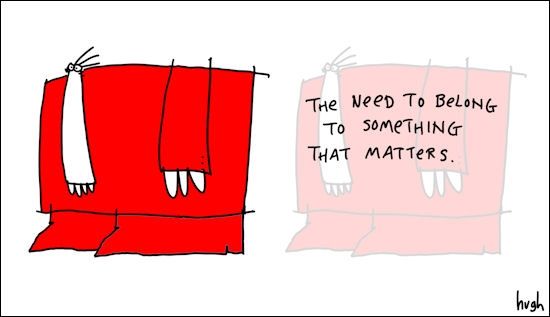
    Despite approaching it from two different sets of stakeholders, the common thread is easy to spot – that brands/organisations need to figure out a reason for existence that goes beyond their business mission and balance sheets. This would then help them identify the ‘something’ that people – both employees and consumers  can identify with and would want to belong to. Coincidentally, this is the drawing I got on my Gaping Void subscription today. 🙂

    (Hugh credits Mark Earls for first voicing this thought)

    Not very long ago, Google spearheaded a revolution of sorts, by creating an algorithm that connected a web user with the information he sought. The only thing that topped it was the business model they built on it. Many have attempted it before and after them, but there was only one Google. The world changing mojo seems to have been transferred to Facebook these days, and even to Twitter to a certain extent, as, in different ways, they connect us to people we know/want to know in various contexts. Information sharing then becomes one of the applications of this connection. This phenomenon is called (by) many names, including social media. 😀

    Perhaps brands and organisations fail to understand the philosophy of social platforms/interaction and get lost in the applications. A bit like wanting to build a social layer on top of everything you have created so far and meanwhile, firing an employee for telling the world he got a bonus and raise 😉

    until next time, titanic shifts 🙂

    Bonus read: The Heart of Innovation via Dina

  • Chief Social Media Officer then?

    I remember writing about the ‘technopologist’ about a year back, in the context of businesses only looking at social platforms through a brand/marketing prism and not sparing a thought on the other implications/potential – organisational culture, business policies, to name a few. The technopologist -a hybrid of marketer, technologist and social anthropologist was a hot topic of discussion then, in the wake of P&G’s move in that direction. I realised I was late for that party when I read a WSJ post from 2008. (it still holds true) 🙂

    I didn’t hear much about the technopologist after that, but a related shiny new animal is now the butt of several jokes. Social media experts are now everywhere, and there’s no dearth of brands wanting to ‘do the social media thing’. It is a generic label used without considering the expert’s domain of expertise (strategy/execution/tool specific). But what about the organisations who hire them without sparing a thought on what their core principles are, and how they could re-engineer themselves for new forms of usage. (in this context, do read ‘There is no new media, only new consumption‘) Expertise in a situation when neither the internet nor the brand manager are sure what they will morph into.

    What reminded me of all this? The recent buzz about the Chief Marketing Technologist. Another term that was apparently coined in 2008, thanks to Scott Brinker. The case for it is strong enough, and I did nod in agreement several times while I viewed this deck, and , but I couldn’t help but wonder whether this too will become a buzzignation (buzz+designation – hey, I can try too) that made sense but couldn’t actually fructify.

    From my (limited) experience in dealing with those aspiring to use social platforms in their organisations, I’ve noticed that the actual challenge is not in realising that this direction of technology and marketing is perhaps an inevitable future, (they either know it or the slideshare ppts will convince them), but in evolving a perspective that is not weighed down by someone else’s experiences of social platforms, their own notions of what their brand/organisation is, how their stakeholders view them, and therefore, what they should do on social platforms. A new designation can only help so much in this.

    until next time, cornered offices.