
Category: India

  • A plus cases on Twitter

    Last week, @aplusk beat @CNNbrk in the race for one million followers. In plain English, Ashton Kutcher, an actor, challenged CNN on Larry King Live – who would get to a million followers first – to prove a point that an individual could have a reach equal to a large network on Twitter. Twitter joined in the fun, because unlike the norm, users couldn’t unfollow either of the parties, of course smart tweeps found a way out anyway.  Point taken, AsKu, though the irony was that until a  week back, the CNN account was not run by them, though for sometime they’ve been managing the account through the person who created it.

    For more than two years, the CNNBrk account (for breaking news) had been created, maintained and run by a 25-year-old British Web developer who just wanted a way to beam short news alerts to his cellphone.

    And that’s the beauty of this user driven service. Something that I fear might change with the ‘mainstream’ spotlight and the rush of real celebrities. Its only a matter of time before a new celebrity thinks of a new stunt. But it is to be noted that  Kutcher is donating 10000 mosquito nets worth $100000 to a charity. In fact, one week before that, I’d read about Hugh Jackman’s donating AUS $100,000 to charity via Twitter, the charity to be selected via Twitter pitches.

    Now, I’ve always maintained that users should figure their own comfort levels and use the service accordingly. But I also feel that a sudden influx of people with no intent other than rooting for a celebrity might be the kind of inorganic growth that will work against the service and its more regular users. This could range from a disruption of the service due to the load to a change in the ‘culture’ of the service.

    Kutcher’s point was about getting a reach higher than a media giant. I’ve always had a problem with numbers – followers, updates etc as a means of measurement on Twitter. I find it a paradox for a place which became popular because of a qualitative measure – conversations. CNN will deliver breaking news regularly, and (as someone suggested on Twitter) Kutcher followers will just have to wait for those occasional Demi photos. Reach has been an index to sell traditional media space, is that the benchmark Twitter wants to take forward?

    There was a very interesting post on Tech Crunch on whether Twitter should remove its follower count. Like I tweeted, I’d agree. Once upon a time, it was a medium to share an instant – something you thought/read/saw/felt to make others smile/think/share their own expressions. With growth came the ‘how a tweet might cost you a job’ and ‘5 ways to increase sales with Twitter’ theses, and the instant was lost. Perhaps you will ignore that as a subjective grumble. But think of the times you see the ‘need 5 more followers to get 500. please RT’ and what you feel then. What happens when that’s the norm and the service changes to accommodate and encourage that culture because that’s what helps them make money. [Note: I’d love for Twitter to make money, but I’m sure they’ll find better ways]

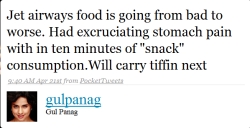
    While on celebrities and Twitter, closer home Gul Panag has been quite active on Twitter the last few days. The Twitterverse has had its share of imposters and has been trying to ensure there’s no ‘identity crisis’ this time, so much that poor GulP might have one soon. This tweet of hers caught my attention. (Oh, okay the dimples too!!)
    gulp1

    Spicy Jet news. Poor them. It reminded me of a post I’d written sometime back on ‘Social Ambassadors‘ – what would happen when the transparency of social media met celebrity bloggers? In this case, micro bloggers. In fact, micro blogging is even more ‘dangerous’ since the interaction is real time, and not like a PR draft that can be posted on ths site, and replies given in a few hours or even days. This becomes all the more important if celebrities use social media as a personal broadcast medium to their fans. Of course, brands can use the media to their benefit too – for example, create conversations between celebrities (a Twitter conversation between Aamir and Gul basis their Tata Sky TVC would be fun), use celebrities to communicate beyond the obvious advertisement etc.

    The challenge is for celebrities too. Perhaps it will also make celebrities more responsible when making endorsement choices. (It would be fun to ask SRK/Aamir why they switched soft drink brands in between.) Also, can celebrities retain their ‘interestingness’ when they are in touch with the fans all the time, unlike a traditional system when news about them was less abundant?

    On an aside, when celebrities move to direct-to-crowd platforms, what happens to the go-between media for whom they were the news makers, and we were the news consumers? And what happens to the micro celebrities on Twitter? 🙂

    until next time, when twitter streams meet mainstream
  • “Bridging the Social Media Divide”

    There’s this hashtag on Twitter – #bsmd, which stands for “Bridging the Social Media Divide”. The first meeting was hosted by Pinstorm, and discussed (according to the Pinstorm blog) “how marketers and social media enthusiasts can work together and forge ways of advertising via Social Media that are not intrusive while being RoI driven”. Again, quoting from the post

    While the social media enthusiasts believed that the medium required a change of mindset on the part of the marketers, the latter believed the medium needed more metrics and case studies to highlight that it was RoI driven.

    Here’s another post that captured the entire discussion. My earlier post on Maggi and the social media opportunity compelled me to write this.  Let’s start with the disclaimers – the following are IMHO, as a brand manager and a reasonably zealous social media user. I have linked to a few earlier posts because these points have been made before,  no sense detailing them again. 🙂

    • The concept of internet itself wasn’t sold to marketers in a day, how old is social media? Just because social media is real-time now, does not mean the buy in has to be.
    • With the single digit penetration that India has, at a basic internet connectivity level, there’s bound to be skepticism, especially when the concept does not adhere to the principles of RoI which have been followed religiously so far
    • Its only with the kind of penetration that the US has, that it’s been able to provide the kind of social media examples it has – and that’s across multiple services – YouTube, Facebook, Twitter
    • As the cliche goes, India is a very different market. Case studies from the US can at best, offer us perspective. What works in that market quite likely will not find acceptance here, unless there is some basic commonality
    • Perhaps the sellers should attempt to show Indian examples of how brands are being talked about in social media, with a context that the marketer can relate to – it may be the same category, same audience demographic, or if its possible, his own brand.
    • The sellers should also realise that the internet is still being sold as a commodity with measurement criteria that the industry has agreed upon. Unfortunately, its difficult to separate social media and internet.
    • Perhaps 0.0/1.0 to 2.0 cannot be a single leap, and has to have at least a 1.5 in the middle, since it might even shifts in organisational culture. (earlier post)
    • Even social media enthusiasts are still grappling with the media. Besides, increasingly, all of social media is becoming a one-to-one, real time conversation mechanism. The contexts differ, and each conversation is unique. So, shouldn’t each marketer should have different metrics, basis his requirements rather than hope for  generic spoon fed criteria.
    • The seller should monitor not just talks about the brand in social media, but what the brand is (and has been) doing across media, and figure out how social media can fit into these plans, then the measurement criteria might emerge more easily.
    • Social media might be a revolution, but the ‘mindset’ that the enthusiasts speak of is an ‘evolution’. How many times has a marketer been encouraged to use/increase his usage of Twitter, Facebook, YouTube etc by the agency? For a ‘full contact sport’ medium whose understanding is usage based, isn’t that a must before a social media sales pitch happens?
    • The social media sellers could try to work with not just the marketer but also the ad agencies, MR firms, PR firms, and any other entity associated with the brand
      • How about ad agencies being able to use social media and the precise demographics it offers to do pre  testing of campaigns, and have consumer feedback while presenting to the client – helps them make a better case
      • How about PR firms adding ‘conversations in social media’ as part of their targets?
      • How about brand tracks having an internet component? Online brand salience and equity? Or separate brand tracks online if the brand’s target demographics warrant it? After all, isn’t everyone claiming to be a youth brand now?
      • This also comes from my view that social media is a strategy, and not a campaign or one that fits into Brand/PR slots. It can fit into all parts of the product life cycle, and be used for various , if not all sub domains of marketing. Where, and to what degree is useful depends on the brand and its internal and external dynamics.
    • Marketers, look closely at the metrics you follow in other media, and you can barely count those where you’re not just basing the entire spend on reach.  (my earlier rant on the subject)
    • Social media might be a good way to test out the long tail of brand communication. (my post, and the  link to the original paper here)
    • Social media works if it is an investment, not a spend. There is a difference, think about it. (an earlier related post) Once the difference is established, the perspective on returns might change
    • While on the subject of spend, we all know how much it ‘costs” to make a FB/Twitter/YouTube account, a WP blog etc, the actual costs are for maintaining a lively interaction. So sellers, please bill accordingly. 🙂
    • Finally, what is the value that a seller brings to the brand manager who handles these accounts perhaps with the help of other evangelists in the organisation?

    until next time, keep the faith

    PS. A good read – Social Media ROI.

  • @having Maggi

    A couple of days back, I happened to see the TVC made as part of Maggi’s 25 years in India celebrations, and the association with the brand was so strong that I had to check it out and write a post on it.

    Right from school, when I used to exchange part of my lunch gladly for a classmate’s Maggi, until a little more than a year back, when Sunfeast Pasta replaced it, Maggi noodles used to rule the category. And even now, it makes its presence felt in the household, in the form of sauces and soups.

    The TVC has been well made and features the Maggi moments in the lives of different consumers – “camping wali maggi”, “first impression maggi”, “hostel ki maggi” etc, and even a “mumbai flood maggi”. I hunted for the TVC on YouTube, couldn’t find it, but thankfully remembered the site url from the ad. So you can take a look at it here – meandmeri.in – unfortunately no permalink, so click on the watch, and then ‘Currently on air’.

    From a consumer’s perspective, Maggi has built its entire equity based on a great product (they actually lost market share when they tried to change the product taste) . From a marketer’s perspective, the positioning has been awesome, they’ve created some memorable campaigns (most of us would still remember the Maggi jingle), and all of this has led to much emotional connect.  There are a million Maggi stories waiting to be told. So, to me, the web provided some great opportunity for the brand to connect with its consumers.

    I wanted to start with this urban legend(?) of a research which I have heard in B school, about how market research had predicted that Maggi would bomb as a product in India. It was often cited as THE example to ridicule the MR loyalists. I couldn’t find it online, but what I did find were some very cool notes. For those interested in Nestle’s brand strategy, positioning etc, here are a few links – Growth Strategy, an interview with the Nestle India MD (2007), and a case analysis.

    So, what are they doing online? I checked out the Nestle India corporate site and couldn’t see any mention there on the campaign or the microsite. Thankfully I remembered the microsite url, though I wonder why Maggi does not figure in it. The microsite is built on the concept of consumers sharing their Maggi stories, pictures, videos, and even recipes. The interface for that is decent. But what I liked best was the Maggi time machine, which shows ads from years back!! I wonder what prevented them from enabling comments on them!! So, in essence, except for a few ‘stories’, I couldn’t find a lot of conversations there.

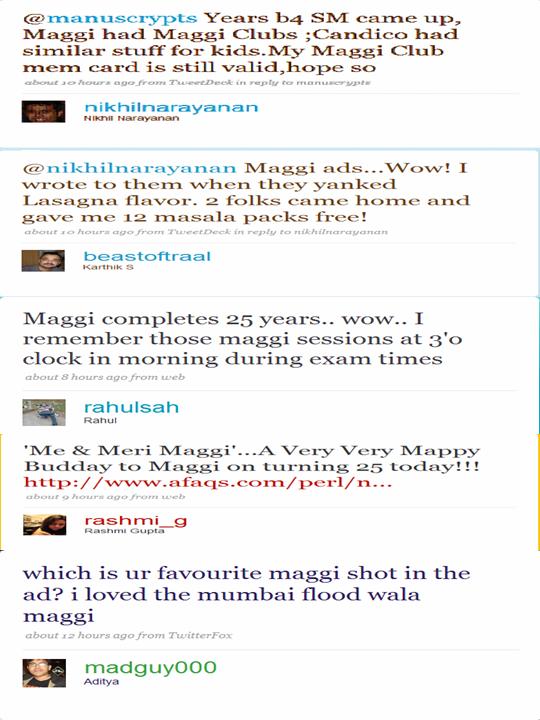
    Later in the day, I was on Twitter, and lo and behold – Maggi conversations.

    maggi

    (click to enlarge)

    I also got to know from @additiyom that there was a Facebook fan page too. While I did get a couple of Maggi pages with 5 figure fan followings, they were the international versions, and I thought this one (found on page 3 of search) with close to 300 fans was the desi version. There are many Maggi groups on Orkut, one with almost 40000 members, and 4 others with more than 5000 members. In the first group, there are about 160 responses for ‘which maggi flavor do you like most?’

    It made me think once again, of how brands make a website and  forget about the internet strategy. I’d have loved to see a more well thought out web campaign – with the microsite also serving as an aggregator of content from places where the conversation is happening, for starters. By all means use mass media and promote the site, but if the idea is about getting in touch with consumers, it definitely helps to seed and maintain conversations over at the usual suspects – Facebook, Orkut, YouTube and even Twitter. The audience is already there.

    until next time, 2 minutes definitely makes sense in real time 😉

    PS: Remember the old Maggi joke when Sourav Ganguly was out of form? 🙂

  • The new media owners

    A few days back, I read a very interesting piece by Jeff Jarvis on ‘The Great Restructuring’, in which he talked about fundamental changes happening in the economy and society. He also talked of an economy (at least in part) built on the abundance of knowledge, which then led to the subject of replanting business models.

    It took me back to a discussion I once had with a friend on the role of newspapers, and the new forms of media. The role of newspapers, and ‘tangible media’ in general was a hot topic of discussion then. Steve Rubel had the “The End of Tangible Media is Clearly in Sight” post which put 2014 as the year of demise (in the US), and got quite a few responses, including some folk who disagreed with it, and some who agreed a bit but disagreed mostly. There wasn’t much of disagreement on the subject of newspapers, and it was generally agreed that Digital was indeed a great disrupter. Newspapers have  been accused of trying to replant their offline model on their web. Perhaps rightly so, since it clearly doesn’t seem to be working.

    In that conversation, we’d used ‘new media’ a little differently from the platform based (internet and mobile) approach. We discussed three forms of ‘new media’ –

    • some entities about whom the media writes about – people and  organisations . The net population already shares a lot of the content they produce on the web platform – via blogs, social networks, platforms like YouTube, Flickr etc, and lots of organisations are using the web as a broadcast medium – Marketing as media
    • social networks and other services which consolidate a lot of the content generated above in one location, and web only news sites (anything from Rediff to Instablogs and niche news sites)
    • some entities who’re already in the communication/network business – these could be companies like Nokia (handset manufacturers who are an access point to the web), telecom operators like Vodafone (who also act as an access point), or even companies like Cisco, who I think will go further than just provide media solutions

    While there’ve been a few setbacks – Nokia shutting down Mosh, its content sharing service as a result of dubious content posted, Vodafone playing bully to opt-in-SMS service MyToday and various lawsuits against Google (YouTube) on copyrighted content, I’m hoping these are nothing more than teething problems of a radical overhaul.

    Depending on various factors, like socio economic conditions, technology penetration, to name a few, ‘The  Great Restructuring’ would happen differently in different places. Like other restructurings before, some parts of the population would remain unaffected.

    Meanwhile, as mentioned in the post, it indeed is a time of opportunity, and definitely for newspapers too, at least in this part of the world. It only depends on how much they’re willing to shed their old ways of doing business (especially when it isn’t making the revenue it used to be) and how willing they are to listen to the collective consciousness. Even with the ‘new media’ and the proliferation of content producers, newspapers could still find ways of delivering value. (excellent debate happening here)

    Earlier, everyone read a newspaper and therefore it was the place for a product to be seen by its potential consumers. Since the first part changed, the second has too. If increasing media fragmentation is the future, then what newspapers could be doing wrong is seeing their product/s as the only media/destination. Instead, they should perhaps (at least) listen to the Chaos Scenarioexplore a few options, utilise their resources to be preferred content choices in as many fragments as possible, irrespective of the platform, and fight battles in each fragment separately. This would also mean that basis the dynamics of each fragment, different revenue models might evolve for each fragment.

    until next time, for now its Calvinball rules 🙂

    PS. Must Read – IBM’s study – Beyond Advertising

  • Social Deluge

    The last time I’d written about Bebo was a year back, in the context of AOL buying it, and a tongue-in-cheek suggestion of getting Kareena Kapoor (whose nickname is Bebo) to be the brand ambassador when they launch in india. Recently,Medianama reported that they were launching this month.  According to ContentSutra, they will be talking to content producers in India to further their strategy of ‘conversations around media content’. The Social Inbox also sounded interesting – “a utility that combines Yahoo Mail, Gmail, AOL Mail and Twitter feeds, and also helps users discover content they’re interested in”. I can’t help but remember Rediff’s attempts at Orkut and Facebook integration.

    AOL recently said that it was confident about Bebo doing well in the long run, and was for now, concentrating on getting users, more than revenue. In an interview with Paid Content, Joanna Shields, President, AOL People Networks, talked about the AIM client based strategy that gives it a wider reach than say, a Facebook. By aggregating feeds from various networks onto AIM, AOL allows people to be connected with friends’ activities in   sites like Flickr, Twitter etc, even without them being on it. Bebo has been busy with quite a few things recently – Lifestream – a basic Friendfeed like aggregator; Social Discovery Engine – which leverages profile data  to recommend related music, videos and people; Lifestory – puts uploaded photos, events, and (soon) videos into a scrollable, chronological series of postage stamp icons at the top of members’ profile pages. In the long run, Bebo is also planning to allow its users to subscribe to updates from other users, brands, bands, and celebrities, whose updates will then appear in their LifeStory timelines. (via TechCrunch) This could provide revenue opportunities.

    In the US, AOL has migrated all its AIM user profiles to Bebo, thereby doubling Bebo’s presence in the US, thanks to AIM’s massive popularity. The Lifestream is now one gigantic feed that will have updates from you and all your friends on Flickr, Twitter and Delicious, Facebook, MySpace and YouTube, and the moment you link a service to Bebo, it keeps track of  your new friends there too. And with Social Inbox, the lifestream updates, AIM updates and emails can all land up there.

    Now, how good are bebo’s chances in India? The last Comscore report on social networking in India shows that Orkut is far ahead of Facebook, which has BharatStudent, hi5 and Ibibo following it relatively closely. I’m a bit familiar with Ibibo, thanks to their properties that are heavily publicised on TV, but since I’ve never been the target audience of any of those properties, I have never tried out the site. I don’t know about their revenues, but I am not sure if building properties which are quite tactical in nature is a good way to build long term equity for the site. During the tenure of the property, there will be heightened interest and traffic surges, but sustainability is a big question. I also read recently that Bixee, owned by Ibibo has ventured into several verticals – finance, shopping and auto. I’m really not sure where this is heading especially with web 18’s presence in these spaces and several other independent entities who are strong in these verticals. The way Ibibo’s traffic is declining (-50%) I think they need to relook.

    There’s definitely a space for another social network, even in what some would call a  cluttered space, provided it differentiates from the existing ones, and gives the user a reason to try it out. I’m really not sure how random invites like the ones from hi5 work. They don’t, for me. While the AIM strategy for Bebo works well for the US market, I don’t think it can work that well in India, (inspite of the GMail connection) though it will give Bebo a start, along with the existing AOL users.

    From a product standpoint, the lifestream goes where Facebook still really hasn’t (despite having copied commenting on status messages and the ‘Like’ feature from Friendfeed, and the real time stream from Twitter) – updating friends’ activities on other services in your lifestream. Will that be too much of a deluge for users, we”ll have to see., the Facebook redesign response will give a clue. It also remains to be seen whether Facebook will tear down the ‘walled garden’ and integrate these services quickly, or will only pursue the internal activities+ Facebook Connect way of adding activity feeds. If it does not, the more social version of Friendfeed could prove an irritant for Facebook. The difference maker, however, could be the content tie-ups (Medianama reports this to be the start) and what Bebo will do to ensure that conversations happen around it.

    until next time, a new socialite 🙂