Category: India

  • Beyond run-of-the-mill

    ..and I took a look at the last few posts and realised, that the excitement of the Facebook -Google- Twitter three way fight was making me obsessed, and I figured you guys would like a break from that too. Thankfully, I came across two activities, that I thought showed a fundamental way of approaching the internet as a medium.

    At a basic level, the internet (and mobile) differ from say, print, OOH, television and even radio (in spite of call ins) simply because it allows two way expression. And if we go meta on that, even the internet, like other media, is after all a tool, as far as brands go. Its just that in many cases, its a much better enabler than the others because of its features. So, Facebook, Twitter etc are only tools – I have to keep reminding myself of that. The two examples below have shown how to use the web to increase the utility and value they are offering consumers. I liked these two all the more, because while they have presence on the usual suspects, these activities do not use the services.

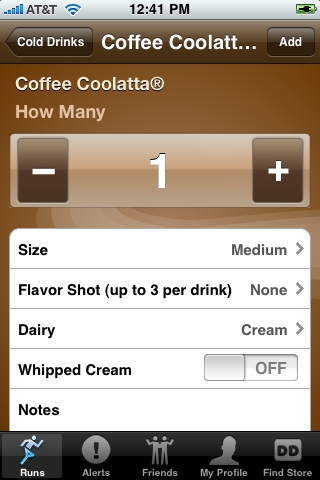
    Some of you would’ve read about the Dunkin’ Run iPhone app and website by now. For those who haven’t here’s the gist. Going out for coffee? Want to get your friends something too, but can’t be bothered to remember their order? You become the ‘Runner’, and use the app/website to initiate a group order. Your friends/colleagues ( a list you’ve made, and you can make different ones) get an interactive alert, and they can place the order online/app. If they’re registered users, they can even pick from their favourites/ previous orders. Once the list is made, take a print out/show it on the phone. Oh, okay, you can display the run status on facebook too. This is how the app looks on the phone

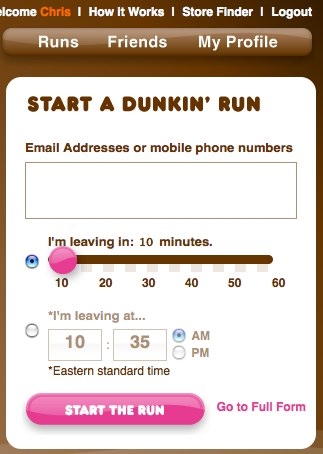
    dunkin dunkin1

    (Thank you, Chris Brogan, Mashable)

    ‘Run’ seems to be the operative word since the second example is to do with a product and activity right in that space. Nike. On Wired, I read about this excellent service called Nike+, which is now helping users track personal metrics and thus adding value. By using a sensor, and syncing an iPod to the website, (after the run) users can now track distance run, time taken, calories burned, weight lost etc and over a time period. These are displayed visually, on their profile, and it can be shared, and for extra motivation, users can even take up a challenge or set individual goals, and if that’s not enough, you can even create a list of people who could motivate you for completing it. They are updated about your progress. When i visited the India site, I could see a ticker that showed updates about various runners.

    According to Wired, “Nike has attracted the largest community of runners ever assembled—more than 1.2 million runners who have collectively tracked more than 130 million miles and burned more than 13 billion calories.” It has not only helped the users, but think about all that data Nike has, which it can use to provide even more value for customers and build better products. Amazing, I think I just might end up doing this stuff!!  Oh, okay, there’s a twitter app too – Twiike.

    Two ideas, which use the concept of sharing without needing the tools that I keep discussing here. A good reminder that while the tools race for users, and web domination, brands can quietly use the philosophy of web 2.0 and build communities around users through simple ideas and wonderful execution.

    until next time, Just Donut it 😉

  • Inside Intel

    A video that was shared yeterday on Facebook by a friend got me to check out Intel’s latest global campaign – Sponsors of Tomorrow. I then remembered that a few days back I’d seen a half jacket (a page takeover on pages 1, 2) in TOI, which talked about the same thing though it seemed a cobranded effort with TOI called Innovators of tomorrow. [Disclosure: I work for the Times Group.]

    The campaign videos on YouTube were quite interesting. In addition to the ‘Rock star’ and ‘Oops’ TVCs, there are also videos of real employees at intel (is that the same Ajay Bhatt referred to in the Rock star video?) and an interactive ‘In the future i want..‘ which featured random people interviewed at the Times Square, and billboards which displayed these ‘ideas’. I was a bit intrigued by the campaign, and a Google search took me to the press kit and the official site.

    While the tagline is ‘Sponsors of tomorrow’, the campaign’s communication strategy seems to be two pronged – one, to expand on the line, and show what happens behind the scenes and how through innovation, they aim to be the ‘sponsors of tomorrow’, and two, to promote the people behind the technology. What got me intrigued was the execution.

    The single line take outs from the videos were – “Our big ideas aren’t like your big ideas”, “Our rock stars aren’t like your rock stars”. While the videos are indeed funny and convey the perspective clearly,  I wonder if those are the kind of statements, that will really inspire people to send in ideas. From the Innovators of Tomorrow effort and the website, there seems to be an agenda of interactivity, since it calls for ideas.

    On innovation and technology. Somewhere, hidden in the press release, I saw a sentence that amounted to “Its not technology, its what technology can do for them that’s important to people”. It’d have been great to see Intel expand on this and show consumers what Intel technology has made possible and what it is attempting to make possible. The global site wasn’t very impressive. “You on tomorrow” is the interactivity effort there and I promptly filled up “in the future I want__________” with “websites that load faster” and that wasn’t being frivolous. Maybe I’m reading too much science fiction, but even the 2128 Delhi video wasn’t very futuristic – holography and body scan after 19 years isn’t exactly the kind of advancement a bleeding edge  technology giant like Intel should limit its imagination to, IMHO.

    People behind the technology. Funny videos and self deprecating humour is great, the point is made. But if they wanted to showcase the people behind the efforts, this seems to be a better thing to have promoted – employee blogs. (the first comment is worth a read) And better ways using different platforms to get the people working on the technology to share how the technology they work on helps improve consumer experiences, lifestyles etc. That might generate a little more involvement than ads showing how Intel’s rock stars are different, and interactive games that deal with suiting up an engineer!! As a consumer this just made Intel geekier for me. What happens inside Intel is  definitely important, however, what it does to life outside could’ve been a more effective communication from an interactivity perspective. What do you think?

    until next time, I don’t think Intel will sponsor tomorrow’s posts 😉

    The views expressed here are solely mine, that really should go without saying. But we live in an evil world. 🙂

  • Zoozoology..and more

    The jury is still out (and perhaps permanently so) on who actually won the IPL – the fake IPL player or the Zoozoos. Both massively popular, they even have conspiracy theories built around them – the identity in case of  the former and the inspiration(cached) in case of the latter. There is even a minority who claim that actually the Deccan Chargers won, but that really isn’t relevant. 😉

    I thought the Zoozoos were adorable. The usage of Mallu food terminology in the International Roaming ad added to the fervour. I remember starting at least 2-3 conversation threads on Facebook and Twitter, the ‘people behind the zoozoos’ image i shared on Twitpic got more than 250 clicks, and I saw quite a number of online and mainstream articles on them. Yes, there were many real conversations as well across age bands. There is no doubt in my mind on the amount of buzz that was created.

    As per the afaqs article, the Vodafone brief seemed to be very clear – increase the awareness of VAS services among new acquisitions in a manner that would really stand out.  A small number of people I spoke to managed to remember the VAS services associated with each ad. I felt that the lateral interpretation of the services, or rather the rendition of that, made me try to connect before the ad ended, so it worked for me.  I even started seeing them in unrelated contexts. But a lot of people just remembered the zoozoos. Just like they remembered the pug. Now the association betweenthe Zoozoos and Vodafone would be established easily, I think, since the competition was Madhavan and Vidya Balan.

    But then, there are these little things that happen outside advertising and in the consumer experience space. Like the ‘Hutch’ that appears as the network on my phone screen. Last week, I got this call from a Vodafone customer care executive, who informed me that I could pay my bill by ECS, and that was more convenient than my current way of paying by cash. Nice, but the only snag was, I’d been using ECS for more than 3 years now. I now wonder how my billing happens smoothly.

    All of this made me think about two things. One, whether brands are thinking about segmenting their existing and potential user base, and then further evolving strategies and communication basis this. So, while the Zoozoos were extremely entertaining and informative, I really wondered about relevance. Did the Zoozoos change my perception of Vodafone? Would there have been a difference if Airtel or Reliance brought out the Zoozoos? Not just to me, who is often irritated by the Vodafone service (like many others in Bangalore) thanks to coverage and call drops, but other user segments as well.  Is this way of communication just a function of the media vehicles that are in use now, which allow very limited ways of segmentation? Will the internet and mobile really change this thinking?

    Two, from a slightly larger perspective, will buzz marketing become an end in itself? Somewhat like the trending topics on twitter, which earlier gave an indication of what the ‘happening’ conversations on Twitter were, but now are just self fulfilling memes. The Twitter reference indicates unhappiness but the original query is in all earnestness. Buzz marketing with no trackback to the brand strategy? Is this more tempting when we’re dealing with a real time way of connecting and communicating? How does this stack up against building brand equity over large timeframes? Does it matter anymore? Or is a positive history of buzz marketing sufficient? In the case of Vodafone, they succeeded in creating so much buzz that editorial space in mainstream dailies were devoting space to them. Online, there were FB groups and Twitter mentions and posts after posts. I could write about engagement and conversation in social media, but where does all that lead to? Where do the Zoozoos go from here? Do they continue to be brand mascots, or are they good enough only for a buzz? Good enough to increase TOM and therefore affect sales in a tactical way?  So, is frequent buzz marketing + good consumer experience = brand strategy? Meanwhile, if the buzz has been generated, can we put up a few more towers and spruce up the data centre?

    until next time, omnibuzz

  • What’s on TV? The Internet

    The confluence of web and TV has been a topic of discussion for quite sometime now. The initial version of Web TV- with a set top box and keyboard, didn’t work out well, but that hasn’t stopped the next generation from making attempts, and with all the components required for access built into the TV now, things are showing some promise.

    Yahoo’s TV widgets, with Flickr, news, finance etc integrated onscreen in Samsung TVs had created quite a stir at the CES 2009 event earlier this year. Yahoo and Intel have also co-developed a range of products that lets users access pages and tools while watching a program – around 20 widgets (scaled down versions) from the NYT to MySpace and Twitter. Yahoo will also release a toolkit for developers to make new content.Yahoo is not the only player here. Netflix has tied up with LG for a new line of broadband high-def TVs with Netflix built in to it. More on that here.  Verismo Networks has a PoD device – VuNow that can stream web content onto your TV without a PC or connections. (via Bangalore Inc) On another front, there are gaming consoles and DVD players etc with built in broadband access abilities.

    Meanwhile, the convergence is happening on the reverse direction too. With the net becoming a competition to TV channels as a source of entertainment, the reverse is also happening as a lot of television content is now finding its way into the net, legally. 🙂 Comcast, Time Warner Cable etc are now entering the fray with a two fold objective – to take more content online, and make the TV experience more web like. Closer to home, Star TV had tied up with nautanki.tv earlier this year to watch shows online. A couple of months back, the Times Audience Network added Big Adda as a video content partner. More about that here. Hmm, Bigflix + Big Adda?

    It is also interesting to see web based entities going beyond their current territories. Portals, like Sulekha creating Web TV. Internet video site Hulu getting into social networking. Will expand on that in a bit.

    Meanwhile, television content (shows) have started using social media to add a layer to their interactivity. MTV recently announced plans to launch a show that will also include real-time conversations taken from Facebook and Twitter, allowing users to interact with the show as it airs.  Users will be able to upload videos (their favourites and even self generated ones) through a RockYou application.(via TC) Mad Men’s tryst with Twitter, though fan generated is also a case study.

    An interesting concept I came across on TCDelivery Agent, which helps TV networks make use of their content by being an online marketplace for products and merchandise that are seen on television shows. It pays the network a royalty for this. According to the TC article, they have gone step further by checking the index of products scheduled to appear on the show, before the show airs, and then approach the brands concerned to buy an ad package. It seems like a win-win-win concept. With even a partially enabled web on TV, this concept could be easily integrated and made into real time purchases. Absolutely measurable for brands. Imagine saans – bahu saris, wedding costumes and even office and casual wear that can be bought online. The Jassi look, or the more recent Ballika Vadhu look, anyone? 😉

    TVLoop, which started out as a Facebook app that allowed users to have view TV show episodes on their profile , has now gotten itself a website of its own.If you comment on an episode of the show on TVLoop.com, TVLoop users on Facebook or any other social network can reply directly from their respective site. (via Mashable) The Hulu social network I mentioned earlier encourages Hulu users to connect with one another and share their video preferences. The new features are expected to help Hulu better track viewing preferences, which helps further target ads. It also helps monitor conversations around videos and therefore provides more data on viewer behaviour. In both cases, the key take out is collective feedback – on content, ads served etc. From tweaking storylines and characters to embedding products better, having conversations around them and making purchase decisions easier, there is tremendous potential.

    Web on TV, TV on web, web TV and social networking, TV and social networking, at the end of it, the point is about content on demand- across platforms, a rapid increase in interactivity, and the potential to increase the relevance of a product/service to consumers and encourage purchase almost instantly.  In an era when vanilla product placements are becoming increasingly unpopular with viewers, this content integration across platforms could be the kind of tonic that’s needed for a system that currently thrives on sponsored (and usually non related, random) advertising and  insipid product placements. From the other side, the web’s current major advertising mechanism – contextual advertising just got more content to play with, and this could spawn an entire new way of advertising.

    As for me, I’m waiting for the time when I can watch the YouTube videos, Flickr photos and Twitter updates and the TV news on the same screen, and then real time reality TV, when I use my Twitter handle to eliminate participants and generally decide their fate 😉

    until next time, users, from publishers on the web to broadcast producers

  • Google noose?

    The A.P. will work with portals and other partners who legally license our content and will seek legal and legislative remedies against those who don’t. We can no longer stand by and watch others walk off with our work under misguided legal theories.”

    That’s what Associated Press Chairman William Dean Singleton said, in what is obviously a salvo against news aggregating services like Google. The ‘misguided legal theories’ here refer to the ‘fair use’  legal doctrine that news aggregators and search services have been using to use snippets of articles. AP’s concern is that many of these services have been making revenues out of packaging these stories. Also, while AP does have deals with Google and several other engines for some of their content, apparently search throws up material not covered by these agreements.

    Interesting to note that AP had sued MoreOver (Verisign) for snippeting and linking to its news, and Google had signed a deal with AP 2 weeks prior to that. That case was settled, though I have not yet been able to get details. AP now has plans to launch own news site – a “new search pages that point users to the latest and most authoritative sources of breaking news”.  It suggests a system to track content – one that would create, in effect, “fingerprints” of content that could track usage and links. Journalism Online is another entity that wants to help newspapers and magazines charge for their content online.You can read the interview with Steven Brill, who has started it with two others, here.

    Google’s contention is that they’re directing a lot of traffic to the news sites, and any newspaper that doesn’t want to be part of Google News can do just that. Scott Karp says at Publishing 2.0, Google has played to its strength and wrested control of the distribution of news. Interesting comments too. Google allowed users to find content that they wanted, and became the start page when people wanted to find something on the web. That’s something media companies still aren’t doing right, and in between, Google managed to push in the ads, and make a few dollars. Erick Schonfeld, at TechCrunch has an interesting take on this – he points out that (in the US) Google News is behind Yahoo News as well as the sites of the NYT, and Google is actually exposing news, and helping other sites make money too. He argues that while Google does play a part in getting traffic to sites, ultimately it is the content that gets readers and sets the price. Jackie Hai explains how the “The AP syndication model works in an economy of information scarcity, whereas the web represents an economy of abundance.” I recently read about Google Web Elements, which allows Google products to be added to any website. That includes Google News and takes distribution to a whole new level.

    Though the AP issue is mostly an American one, there are similar sentiments being echoed in Europe too. According to NYT, Belgian Danish and British newspapers want Google to reach agreements with them before using their content. Though each country will have its own dynamics as far as news distribution and maturity of media platform goes, these cases are sure to set precedents.

    The media landscape is changing. Its not just that old media is changing rules to figure out revenue models. Its about an airline becoming a content ‘publisher‘, individuals becoming advertising mediums, services like TwitterGrep popping up to utilise the instancy of Twitter… and so on. As Jackie Hai mentioned in his article, the participatory web has blurred the lines between content producer, distributor and consumer. We play all three at different times.

    The measures that newspapers have or are making to earn revenues on the web seem to be insufficient. That includes online advertising, micro payments etc. I increasingly feel that a repair might not be enough. Perhaps a complete overhaul is the ask. The fingerprinting does spark a thought about the role of individual journalists, and the importance they should have in the new system. The web is increasingly becoming a relationship based medium where personal equity and trust are currencies. Perhaps the corporate newspaper needs to be replaced with a more human and humane network, perhaps it should create a core competency on the web in specific news sections – these could be geography based, maybe there is an opportunity for an aggregator in the challenges of hyperlocal news.  Perhaps it can even be category or genre based. Traditional concepts, but built with a social web perspective. Perhaps they should build a legion of citizen reporters who are paid according to the quality of their contributions . After all there is always a need for quality driven and trustworthy news and analysis. The need remains, but the readers’ wants of delivery platform, timing etc have changed.

    The recent (and sometimes) drastic measures taken by Indian newspapers shows that its not as impervious as it was considered. That gives more reason to prepare for a changing landscape. To start figuring out consumption patterns ,  multimedia possibilities, cost implications, distribution dynamics and revenue streams on digital platforms. Maybe they’re all waiting for PTI to fight Google, or is it Yahoo Buzz 😐

    until next time, a new sprint