Category: India

  • (Non) User Generated Content

    World AIDS Day – a humble contribution

    condom

    Much to the brand’s credit, they RT ed my work, on Twitter.

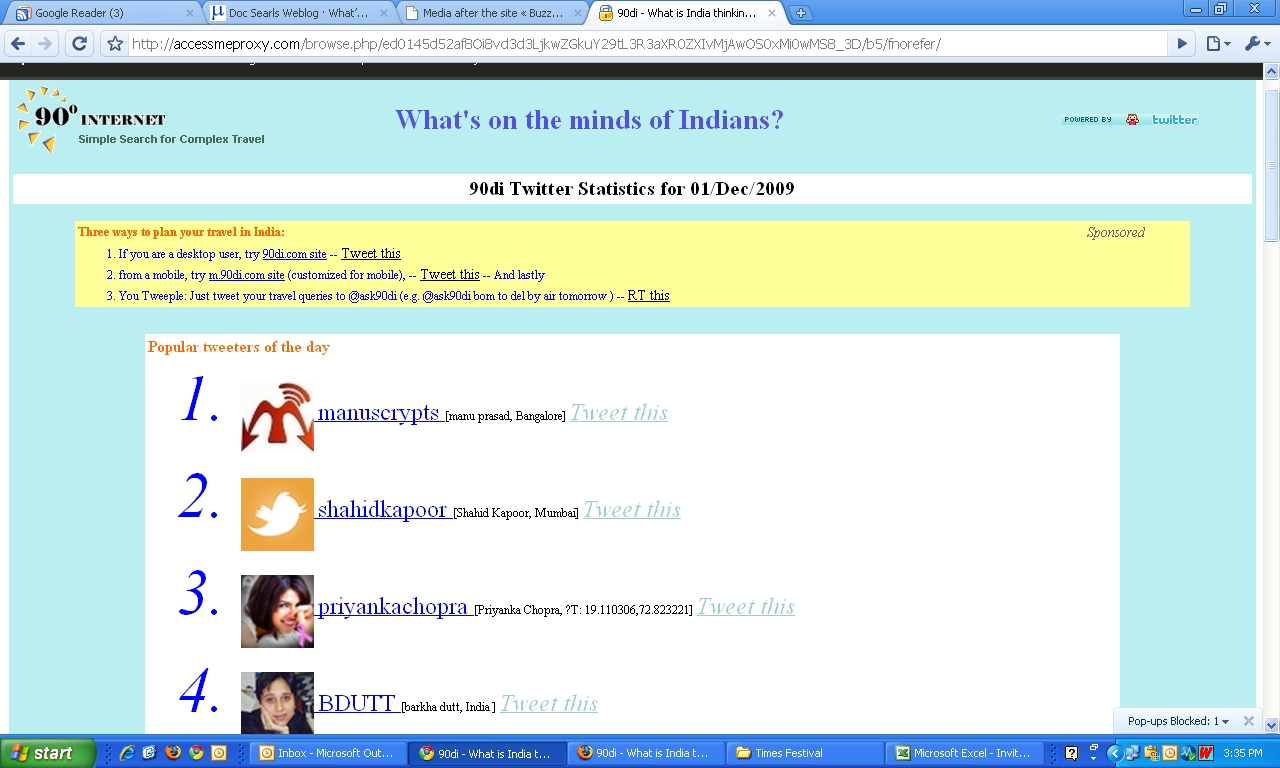
    And that little stunt led to the image being viewed some 2000+ times and my 15 seconds of fame as India’s most popular twitterer for a brief few hours, thanks to more than a 100 RTs from the twitterati. I also got a Samsung Galaxy from Tata Docomo. Ok, I made that last one up. :}

    Twitterer #1

    Yes, yes, don’t worry, I’ll still be posting here :p

  • Brand equity in real time

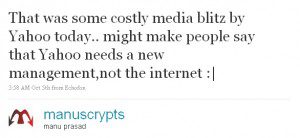
    Media Post reports that Yahoo’s latest campaign caused its perception among U.S. adults to fall steeply – apparently, YouGov’s BrandIndex, which tracks daily consumer perception of brands, found that Yahoo’s buzz score had tumbled from 35.4 on Sept. 22 to 25.5 as of Monday. Acknowledging India’s growing significance, the $100 million (global) “It’s Y!ou” campaign was rolled out in India too – y!ou couldn’t have missed the “disruptive” frontpage takeover of multiple mainstream dailies or the TVCs. My views on it were expressed in <140 characters

    Clipboard02

    Before you take me for some kind of Yahoo hater, I’m not. (Actually, I’m quite a fan of the Carol Bartz style of no-nonsense management – typified by the last few lines here) In fact my irritation with them stems from their relative disinterest towards a few tools that were original pathbreakers and that they’ve had for a long time – most importantly ‘delicious’, but I’ve written about that earlier, and some work on that service has happened since. So, anyway, Yahoo, this is not about you, you were simply a prolongued prologue, and a good example.

    A couple of weeks back, when writing about Wave, I’d wondered  “is brand equity an excuse/surrogate for thin value, and exist only in theory, or until the last good product?” This entire activity above somehow reminded me of that. Brand equity, and the lord knows there’s no shortage of definitions. (ignore the newspaper brand references)  So why did I think brand equity is now a surrogate/excuse for thin value?

    Every brand that enjoys good equity now must have provided ‘thick value’ at some point of time, to its audience. At some point though, did the ‘brand’ take over, and the focus become more on perception management, rather than as an aid to retaining/attracting customers. Is that the reason why brands in many industries cannot find a way past the disruption they’ve been facing – because they’ve been focused on creating brand equity basis communication and superficial value additions, and sticking way too close to the specifics, like competition, and not bothering about the generic fulfilment of a need?(classic example, newspapers and news delivery) Somewhere did brand and marketing communication start dominating the proceedings, at the cost of the basics – a product solving a need/a distribution that increases convenience/the factor that built the equity in the first place? And then did they shortchange consumers by putting a premium on the brand’s equity without delivering value? While trying to build the emotional connect and create a value perception beyond the commoditisation, did the means become the end?

    Take Yahoo for example. By an unfortunate coincidence, last week, GMail replaced Yahoo Mail as the most popular email service in India. I can imagine why. Like many others, I have multiple Gmail ids, and a Yahoo id too. While I open Yahoo because of a couple of e-groups, GMail is my primary communication centre. It has never been static, features and tools have been added to a point where I wonder how I worked without them. (try operating in basic HTML for a while) I checked Yahoo out again, with as fresh a perspective as i could, and didn’t find anything that could make me consider a shift. I still use Delicious a lot, and it still has a lot of equity (in my mind) going for it. Yahoo’s brand campaigns have nothing to do with it.

    Maybe the concept of brand equity had some merit when the audience didn’t talk to each other, but as WOM keeps getting bigger,  push brand communication is bound to become more meaningless. As consumption patterns change, needs change, distribution systems change, as real-time becomes the norm,  and exit barriers and costs for consumers come down, relying on a static and uni dimensional concept of brand equity is bound to be harmful. Also, with fragmenting media, fragmenting audiences, and an increasing importance for ‘my experience’, brand equity will be different things to different people at different times, and even the hazy setof objective measurements in vogue today, would be rendered ineffective. (Yes, it might have been the same before, but in an earlier era, consumers did not talk to each other, and it was easy to push the brand’s equity on to consumers). (Generalising, but) Take a look at the communication and taglines adopted by brands, their superficiality, the efforts that go into forcing the tagline’s emotion/value into the actual value provided, and thereby build/increase brand equity and you’ll see what I mean.

    Clipboard02

    Perhaps, product equity will be the only measure that matters, and brand equity will be earned and burned real time, as consumers share feedback and rely on their trusted sources for updates, and historic performances will decrease in significance. (when the Fail Whale comes out on Twitter, evangelists become bloodhounds, or whatever..you know what I mean) And so perhaps, from a brand perspective, its about time that meaningless communication took a back seat, and we went back to the basics of brand equity, that may mean redefining the roles and responsibilities of everyone associated with ‘brand’ as a function. Because if you’re good, they’ll talk about you, and if you’re bad, they’ll talk more about you 🙂

    But you know what, I had more fun when i thought about a parallel. Thought leaders. Replace ‘brand equity’ with ‘thought leaders’ (or personal brand equity) and tell me what you think. 🙂

    UPDATE: Yahoo hires a new agency, tells Ogilvy “It’s not Y!ou”.. Damn, that was fast!!

    UPDATE 2 Meanwhile, a homepage redesign gives them 9% more page views and 20% more time spent.

    until next time, equitable solutions..

    Bonus Reads:

    Braggarts take over the web

    Almost unrelated, but an excellent read – Jerry Yang’s Advice in Interesting Times (via @mukund)

  • Social Inside

    There’s quite a funny video that has got almost 50,000 views by now on YouTube. It is titled ‘The Social Media Guru’, and in case you haven’t seen it by now, you should take a look, though you might want to keep the audio levels down thanks to the language

    httpv://www.youtube.com/watch?v=ZKCdexz5RQ8

    While the video does generalise and could cause some heartburn among some who work on social media and do good work, the reason I found it funny was because I see around me, a lot of what is shown in there – a preoccupation with the tools/platforms in vogue, and the lack of something as basic as an objective. As always, the tools are less important than the philosophy of sharing, collaborating, and 2 way communication that’s happening not just on social media sites, but across the web, though the former, because of their inherent nature, have taken it to a different level altogether. The combination of a client who has decided his brand needs to be on twitter, thanks to some article he read somewhere (or an even more vague reason) and the social media guru whose answer to any client is a templated Facebook page + twitter account + you tube, is quite lethal – to two sets of people – the agencies/individuals who are doing/interested in some genuinely useful work on the social media platforms and the brands who decide not to take the plunge basis the results of the poorly thought through/executed programs of other brands. It doesn’t help that the medium is still in its nascent stages and everyone is still learning.

    While social media practices and practitioners might be fewer in India, as compared to the US, the challenges faced show very little such skew. I read two posts recently on the subject. Karthik wrote about ‘selling social media engagement in India‘, where, with the experience of working in a PR firm and pitching social media, he looks at the changes he’s seen in the acceptance of social media among clients over the last couple of years, and the key attributes for making the sale. He mentions how an existing communications partner has a ‘door opener’ advantage as compared to say, an exclusive social media agency, which helps them get the right  people from the client side involved in the pitch, and the need for proper articulation and simple guides which could be used by the client team to sell to their bosses.

    In another extremely interesting post, Sanjay writes about “Advertising Agencies and Social Media: The Challenges“. He notes fundamental differences in the way an advertising agency looks at communication, and how communication actually happens in social media. The observations on ‘campaign’ focus, the obsession with perfection (copy), the mechanics of how communication is rolled out, are all spot on, and something that I too have experienced several times while dealing with creative agencies. He ends by mentioning that in the current scenario, agencies keep treating these platforms as broadcast media. That last thought is something I keep deploring regularly here, so I completely agree.

    Now the thing is, while these are all perfectly valid points, I was looking at it from a different perspective. I wonder if, in the entire spiel, social media’s proximity to marketing/communication/brand as a function completely overshadows the cultural transition required by the client organisation. Does it get discussed at all? Even in my post rant some time back, I had only emphasised the usage of social media in the PR, research, advertising disciplines and the different stages of the product life cycle – including sales, customer care etc, and barely mentioned the culture change.

    The subject of a shift in culture is something I have written about in several contexts – from basic thoughts on transparency in organisations and controlling employee communication internally and with the outside world, to the need for organisations to understand themselves and the value they provide before going overboard with listening and acting on consumer feedback, to whether the size and scale of the organisation dictates its culture and its internal and external communication processes,  and the necessity to tackle business problems and look at it as something that needs to be addressed at an enterprise level too and not just at a brand level. The Dachis Group presentation – ‘Social Business by Design‘ illustrates this extremely well.

    I examined it further in the framework of the Awesomeness manifesto, which i regard as an excellent set of fundamentals for organisations, if they want to operate profitably in the evolving business scenario, and in all four of its pillars, I could see the need for a more holistic approach to social media. Its obviously easier said than done. It involves a vision, the zeal and guts to translate that into internal and external business practices- from environment to employee friendliness, training of personnel, readjustment of business goals, hiring people who understand this new design – like say, P&G’s technopologist, who can operate across functions to evangelise it and help apply it in different contexts. And that’s just a few things. Look at an application of this across your organisation, and you’ll see how massive an endeavor it is. Maybe only a few organisations are thinking about it now, but I think it might become an imperative very soon, decided by external forces beyond the organisation’s control. Whether this is spearheaded by the organisations themselves or an external agency would be a decision based on several subjective parameters. Maybe then, organisations will be able to figure out the ‘gurus’ better. 🙂

    So while, it is good to see great social media efforts from brands, I wonder whether more needs to be done to integrate it more fundamentally within the organisation.

    until next time, social nirvana 🙂

    Bonus Reads:

    Customer Twervice by Social Media Explorer (10 examples of companies using social media for customer service)

    Social Media Policy Database (Via Six Pixels of Separation)

    Why its time to do away with the Brand Manager 🙂

  • Flipping news models

    Google’s Fast Flip has been receiving quite a lot of attention these days. Based on the Google News model of aggregation and categorisation, Google has partnered with quite  few sources including BBC, BusinessWeek, Washington Post, New York time, to name a few, which shows previews of their pages on Fast Flip, but looks exactly like they would on the source site, almost. We’ll come to that in a bit. The stories can be accessed basis sources, sections and the other parameters we are used to – recent, most viewed, recommended etc. Oh, yes, much of it is the user interface, that lets you ‘flip’ through the content, ‘like’ stories, and you can click through to the source site, if you want to read the full story. It has its rough edges, and is far from being any sort of killer to anyone, but its a damn good start, much better than any interface that any publication has brought out so far. On the revenue front, there are contextual ads on Fast Flip itself, and Google will be sharing revenue with newspapers. It is interesting to note that the previews of the source sites do not include ads. So if I am able to read a story completely in the preview, (which in many cases I am), I wouldn’t go to the source site, nor would I see/click the ads there. This is potentially an area of conflict, since the (shared) revenue from the one ad that’s displayed on Fast Flip cannot compare with the revenue from the source site. Meanwhile, I’m looking forward to a time when perhaps, Google Reader will have a similar interface. 😉

    In the last few weeks, this is the second instance of Google engaging with publications and ‘helping’ them create a revenue stream. The first instance was Google sending a proposal for micropayments, in response to a request for paid content proposals from the Newspaper Association of America. As per an NYTimes blog, this would be an extension of Google Checkout. Google is only one of the companies that have sent a proposal, and the list includes Oracle, IBM, and Microsoft. The system is of course in its early planning stages, and the business model has a 30-70 split (Google-publisher). Though Google still doesn’t believe that paying for content will be the remedy for newspapers’ woes, it  still has a vision of a premium content ecosystem, which includes five key features that combine the Google’s e-commerce, search, and advertising platforms.

    While Google is described by many as the single largest threat to newspapers, its definitely not the only one. From new hyperlocal community sites (eg. Patch) to remnants of old giants (AOL’s Digital City, Yahoo Local) and from new age media entities like Huffington Post to new and varied kinds of aggregators (Guzzle.it, OurSignal, MeeHive, Thoora) different services are catering to the different needs that newspapers used to satisfy. The important aspect is that the new entities are well versed in leveraging the latest tools and collaborating with those who can add to their utility value. A good example would be the tie up between Huffington Post and Facebook for HuffPost Social News. Social sharing, real time are changing the way news is being consumed. I recently read about The Twitter Times, which creates a customised ‘newspaper’ by checking the links from people you follow, and the popularity of those links. Even while massive changes are happening online, and affecting the lifestyle of individuals and society at large, newspapers are still grappling with how to evolve new business models. (a good, albeit dated read on battle plans)

    There was a short but interesting discussion on Twitter a few days back, where Surekha brought up the example of PressDisplay’s business model (aggregation of various newspapers and consumers pay for access) to ask whether a DTH kind of model would work for newspapers. I didn’t think it would. The only other distribution network for television content is the local cable guy (ignoring the web for now). But ‘news’ and even the ‘features’ content can find its way to the consumer through multiple sources and media – TV, web, mobile, and multiple sources within that.  The entry barriers have fallen drastically. Scarcity model vs Abundance model. Keeping in mind the cost that newspapers incur in creating the content and the incremental value that they give the consumer, how much would a consumer pay a newspaper aggregator, and how much would the newspapers get out of that. Yes, Press Display will make money, but ask newspapers to survive only on that revenue or even that plus web advertising, and it would be a tough task. This is why newspapers are finding it hard to negotiate this transition stage (discussed earlier) because its not one answer and its definitely not a common answer. Again, as I’ve discussed here earlier, there are inherent differences between news gathering processes in the print and online space – batch processing vs real time processing. It calls for a (albeit cliched) leaner meaner structure, not just for operations’ sake, but also perhaps from a profitability perspective.

    The more I think about it, the more I realise that its not just processes, there is a cultural angle to this. As Terry Heaton points out in “The Web’s widening stream“, the knack of creating and facing disruptive innovations. We’ve discussed David and Goliath before, David becomes version 1.0, 2.0, 3.0 faster and faster, each version better than the other (because he fixes the bugs in 1.1, 2.5 etc) while Goliath reels because it can’t even figure out the answer to 1.0.  His strength has become his weakness – scale, and he doesn’t have a culture that encourages moving fast, learning from mistakes, being open to changes amongst other things. In fact, newspapers have been lazy and guilty of doing the exact thing that Seth Godin warns about in “Flipping abundance and scarcity” – putting free on top of a business model, and now rapidly trying to change it.

    I don’t think India is impervious to these changes, the time frame will vary because of several factors – technology adoption delays, vernacular content to name a couple, but as I keep repeating, its no time to be complacent. From Rediff and Instablogs which have evolved their own news collection systems to hyperlocal players of different kinds – governance based like Praja, Citizen Matters, local businesses review based like Burrp, and several other niches, the different domains of newspapers are being challenged. More importantly we’re increasingly getting used to ‘streams’ – FB, Twitter etc. The principal revenue model of newspapers has been advertising (as opposed to circulation), they have been the medium to reach audiences, with the most basic of audience filtering. The radical change (as Heaton points out) is that advertisers can be part of the stream themselves, with such filtration techniques that they can target an individual if necessary. So, for newspapers, if the advertiser won’t pay, the reader has to. The reader , meanwhile has figured out that on the web, he has an abundance of choices.

    until next time, stop press?