Category: India

  • Influence Cycles

    The term ‘influencer’ is a recurring one in social media. Mahendra had a tongue-in-click post last week on the subject, and Surekha and I ended up taking it on a tangent, and it reminded me once again of the way ‘influence’ is changing, for all parties concerned – influenced, influencer, the object that links them and the medium that connects them.

    It was relatively easy when the medium was one way – mass media. The number of influencers were limited and there was really no way to locate or measure the individuals who made up the long tail of influencers. Or at least few were interested in doing it. The web disrupted it. The influenced found an abundance of content, the influencer saw his power being diminished by millions of publishers. The object (including the service provider/brand/organisation/group etc) figured out that it wasn’t at the mercy of limited influencers, but discovered a huge list which had its own quirks, but had the power to influence a multitude. Yes, known stuff, just summing up for context.

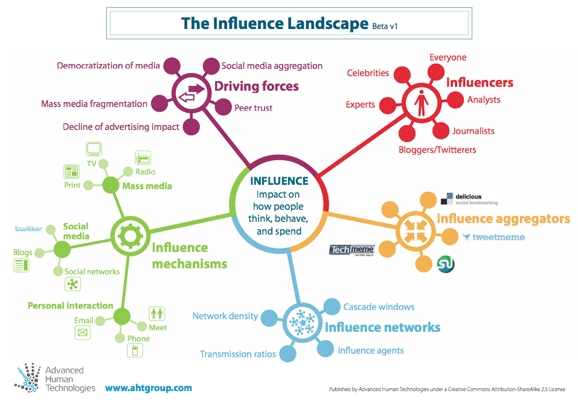
    I remember touching upon ‘social influencer relationship management’ (yes, there is actually a term for it) late last year, and the importance of trust. Influence, for me, has been a difficult thing to wrap my head around. There are so many factors erm, influencing it – time (specific and relative), context, trust (and objectivity) and the fast changing content platforms- each of which seems to add yet another layer. The complex structure has been well illustrated well in the chart below
    Influencer

    via ( a post similar to Mahendra’s, but more serious in tone 🙂 )

    At least in the medium term, I think its only going to get more complex, primarily because the platforms are only evolving – Quora, the service I mentioned in the comment to Mahendra’s post, for example, can help in establishing context specific expertise and therefore trust. Facebook, when its QnA service starts, will try to establish it within a known network. Twitter has already tried it too, but I agree with Surekha. I’ve noticed that with web platforms, after a certain scale is reached, the culture starts resembling that of mass (media) and the ‘influencers’ as well as ‘influenced’ begin a relationship that’s familiar from a mass media era. What also complicates is that the ‘object’ of the relationship sometimes discovers that it too has a voice or can hire a ‘voice’ and attempt influence. This is one of the ways it is trying to adapt to new platforms. But while there might be flaws in each approach, I do feel the direction is right.

    At this point in time, as a user, I’m still evolving in terms of the platforms I use to establish networks of trust. The tools available still don’t allow me the freedom to aggregate and disaggregate at will in different contexts. That’s probably something brands can identify with too, thanks to the plethora of platforms and influencers across networks. Its perhaps the difficult transition state when brands have to manage traditional communication outlets, new media barons, their own content management systems that need to evolve, and a long tail full of influencers. More importantly, brand processes (like advertising, PR etc) had evolved in a mass media milieu and a struggle to adapt to the disruptions brought around by a two way communication mechanism is what we see around now. We’ll keep that for another post, and quickly jump to an aspect that intrigues me from the four influence factors I mentioned earlier- that of time.

    Long back, I wondered how we could juxtapose product and consumer life cycles. Let me address it in this context. Different consumers will ‘reach’ the product/service at different points in its lifecycle. There is a ‘time divide’ that separates the different sets of users. The motivations of this set would differ and therefore , its influencers will also be different, as will their motivations. Brands (using it as a blanket term, includes services too) these days are constantly in the hunt for early influencers, which is why I found this article, which discusses why gadget manufacturers should target late adopters, very interesting. This could apply to platforms as well. I wonder how this thought can affect when and how brands try to influence on new media platforms. Does it make sense to wait till platforms evolve to an extent where they can work better for the brands or is technology moving way too fast and lifecycles of all concerned behaviours becoming too small to wait?

    Meanwhile, what if the millions who have never used Facebook are influenced by the movie? 😉

    until next time, in flux

    Bonus Read: I plan to riff on this soon, but in this context, you could check out pages 147-173 of this amazing document. (via Pluggd.in)

  • Go-to-social media

    A few weeks back, I’d mentioned Tac Anderson’s ‘3 types of social media strategy‘ . To quickly summarise, the first is the ‘toe-in-the-water’ approach (not really a strategy), the second is ‘optimising social media for business’ and the third is ‘optimising business for social media’. That happens to be the decreasing order in terms of current practices, probably because its also the increasing order, in terms of thought, effort and time required.

    I am quite a fan of the third approach and saw this excellent presentation by David Cushman, a few days back, which showed why ‘optimising business for social media’ is perhaps the best way in the long run. In fact, it does it in such a way that it almost seems like an afterthought. On the way, it addresses the much maligned combination of words – ‘social’ and ‘media’, and the subject of ROI.

    Like I said, I don’t require any convincing on the third approach too, but the more I interact with clients, I begin to understand that with all the hype, the expectations of social media are akin to the other forms of media, and the stereotyped Facebook page and Twitter account are much sought after in the strategy presentation. And that forces me to think whether we can start with approach 2, and move towards approach 3.  The feedback from open social channels slowly creating a change within the organisation and making it view everything with a different perspective. That’s quite a change from asking for perfect products and services which could ‘withstand’ social media. 🙂

    Meanwhile, I looked at it from another perspective when I chanced upon the new IndiGo Airlines ad, thanks to a post by L.Bhat. The spunky ad, which you can view here, is shot extremely well and showcases IndiGo’s dedication to being on time. Bhat raised a valid point that this punctuality might actually be beyond their control, in some cases. I completely agree, but like I commented, I’ve used IndiGo several times, and have never had a reason to complain. All the people who’ve commented on YouTube seem to agree.

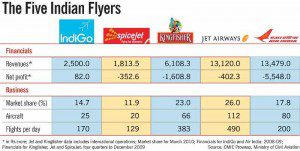
    I have to confess, there’s a style to Indigo that I’m quite a fan of. Right from the way they have communicated this data  below (do note the revenues, number of flights, market share, and compare)  inside the flight, to the menu items to their stickers and even their barf bag, they are quite unique, they have an attitude and are not afraid to show it.Check this out. (thanks @gkjohn)

    Clipboard01

    (Source: Outlook)

    DSC03160 DSC03161

    (Can’t remember other airlines, I know Spicejet has quite plain stuff, anyway I liked these enough to keep a copy 😀 )

    No, i wasn’t digressing. From what I read, IndiGo is hardly a major player in the social media space. But I think the TVC is a good way of approaching what would have been ‘strategy 2’, with a conscious design of reaching strategy 3. All that, without social media. A purely communication  (internal and external)+ organisational culture based approach to  creating a social business. That may not be Indigo’s strategic intent, but it does make me think. Is it possible? 🙂

    What can be done to this with social media, is a different discussion altogether.

    until next time, thoughts in the air

    Bonus: “Culture eats strategy for lunch” via Gautam Ghosh.


    httpv://www.youtube.com/watch?v=kiFMJfrCO_0

  • Early Bird Rewards

    At least two major virtual happenings, one that has massive implications on the future of the web, and the other, slightly more subdued, but not lacking in potential. The latter – Twitter Annotations, announced at Chirp, allowing developers to “add any arbitrary metadata to any tweet in the system.” You can take a look at the various possibilities here, here and here. The former – Facebook’s  Open Graph, unveiled at the f8 conference, and aimed at making itself the centre of everything that happens on the www. A  combination of  plugins, developer tools, new markups which can make the user experience on any site that plays along increasingly personal, social, semantic, from plain hyperlinks to layered information. Already, one small manifestation can  be seen at the bottom of this post – a Facebook ‘Like’ button, which will carry your liking of this post into your activity stream on Facebook. More and more data, not just what you do on FB, but outside as well, across the web. From what I read, smells like Google, perhaps worse, because the flow of information seems possible only through the Facebook conduit. A good round up of implications here.

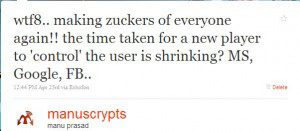
    When I returned from he break, and read up on these developments, my first thought, which i also tweeted was

    1

    And that’s the point of the post. During the break, the only network I was hooked on to was Foursquare. One of the things that happened, thanks to long waiting times in the Kolkata airport was that I became mayor of the neat CCD outlet just outside the airport complex.

    CCD has completed the re-branding at this outlet (unlike the one inside the airport) and has done a decent job at establishing ‘conversations’ as the prime focus area, in terms of in-store design. The feedback posters, ‘snippets’ at each table and the ‘quotes’ design on the roof were nice touches. When I got back, I found a CCD account following me on Twitter. Seemed like a more synergistic effort after the earlier snafu.

    It made me think once again about how alert brands need to be in such a dynamic scenario. If CCD were an early adopter, would they have braved the earlier storm better? What if they become active on Foursquare now, experiment with the new services being built on top of it – friendticker, snacksquare etc, still in their nascent stages. Or at least acknowledge their outlets on Foursquare and engaging the users. “@xyz congrats on becoming the mayor of our abc outlet”, and then build on top of that relationship. Won’t that help them gain some crucial evangelists in a new medium? If not evangelists, at least someone who will listen to their side of the story when something nasty happens? Wouldn’t they get a headstart on ‘authority’ by being an early bird?

    Even the era of quick responses being a reasonable expectation seems to be blurring by fast. Perhaps brands are now required to have an advance scout mechanism, to test out new services, features, changes, understand the implications and see whether/how business and objectives needs to be realigned. Page Rank, Social Platforms at consumer and enterprise level, Social CRM, Location based services, tools and platforms keep shifting. Early adoption and balancing objectives with diverse ways and platforms of engagement may become an imperative. Multiple options, two way communication manifestos, its all changing real time. Hold on tight.

    until next time, service level disagreements

  • Whereabouts : The next social play

    Like I mentioned in the last post on the subject, ‘Location’ is back in a social avatar. A few days back, Foursquare celebrated its first year of existence, and now has more than 500000 users, 1.4 million venues, and $1.35 million in VC funding. I celebrated it with only my fourth mayorship. 😉 But there are a few more reasons why I decided to do a post. Both Foursquare and Gowalla had been launched at SXSW last year, and this year, location based services (LBS from now) are expected to be the talking point, much like Twitter 3 years back. 🙂

    In my last post, I had mentioned the specific competition in the space – Loopt, MyTown, Gowalla, Yelp, developments happening there, as well as the tie ups that Foursquare has managed with HBO, Warner, Zagat. Since Foursquare is arguably the poster child of LBS, and since there haven’t been any dramatic game changing developments from other players, I’ll focus on Foursquare and a couple of players you would know from earlier.

    Foursquare recently announced that it was launching a few business tools, which include basic statistics like total check ins, unique visitors, sharing to Twitter/ Facebook, gender split, time breakdown etc.  More importantly, it gives business establishments real time information that can help them plan promotions, take care of customer complaints, keep track of customer loyalty etc. There’s also a page where staff can interact with customers.  Though these might seem basic now, more detailing is bound to happen very soon, which will perhaps allow quick polls on menu items, service, allow optimisation that will cut things like waiting time etc. Indeed, Starbucks, which has been very active in the ‘social’ space, is now linking Foursquare to its rewards program, for instance, allowing users to earn a ‘Barista’ badge when they check in to 5 separate Starbucks outlets.

    According to Alexa, India contributes to 2.4% of Foursquare’s traffic, and is the 8th largest contributor. Maybe not the surest of sources, but its an indicator nevertheless. With rapidly increasing mobile penetration, net access costs are likely to come down, and this could mean good news for players like Foursquare. Imagine the implications on the CCD controversy if the Foursquare implementation had been done. 🙂

    (Interesting Read in context : Why “Where Are You Doing It?” Trumps “What Are You Doing?”)

    But wait, there have been other developments too. Twitter, still my favourite service out there, has turned on geo location. The API has been around for a while now, but it wasn’t really anything that anyone seemed to be taking an interest in. The first time I saw the implementation, was on a tweet from LBhat. Check out that tiny pin at the end, and you’ll see where he tweeted from. With the kind of development that happens with Twitter’s open API, there are bound to be some interesting apps very soon. Not to mention that Foursquare is already integrated with Twitter. (All this reminds me of an app called CitySense that I wrote about almost a couple of years back)

    Meanwhile, it has also been pretty clear that Facebook would make a play for local very soon. There was speculation recently that Facebook was showing an interest in Loopt, but nothing has been confirmed yet. What has been revealed is that it will unveil its location based features in April at its developer conference, f8. (location is shown on a Google Map 😉 ) Facebook has been pushing its mobile interface a lot recently, check out your logout page, or the ads on the right side of your home page telling you how many friends are using it. The article states that its more a play for local advertising (against Google) than against services like Foursquare. Business pages + location features for users + tools built from API will be interesting.  But it will also be interesting to see what they do about privacy. Something that remains a challenge for Google too, especially when Buzz and Latitude are integrated.

    Meanwhile, there are other interesting players emerging. Check out Miso, a Foursquare style app for TV and movies, RateItAll, that now wants to help businesses build their own Foursquare, Pelago’s Whrrl, which tries to connect social networking with real social activity – real places where ‘regulars’ meet up. Location based services are interesting because they integrate the real and virtual worlds. When I look at these and other  interesting developments like say, Google Street View (have you seen Hong Kong yet?!), and Augmented Reality experiments, the ‘Internet of Things‘ I think we haven’t even scratched the surface of the possibilities.

    until next time, now for vocation based services 😉

    Update: Just read that we now have a check in Aggregator – Rummble. Read about it here.

  • People, Organisations, Media

    Shashi Tharoor. Sachin Tendulkar. The connection is not just the initials, but also VISA. Get it? 😀 So, anyway, Tharoor’s tweets (again) created a minor ‘controversy’ and I observed a few interesting tangential stories.

    Tharoor’s boss commented that such issues ” should be sorted out within the four walls of the two ministries”. So there was a good debate online and offline on how, as an elected representative, his responsibility was to the public, and whether the government, like many private organisations, might have some sort of non-disclosure norms. Tharoor, while having to go by official policy, had a view on his own and was expressing it. It reminded me of communication policies in organisation and a post recently on gaping void titled “If your boss tells you ‘our brand must speak with one voice’, quit.” The point to note is that SM Krishna is not a stranger to Twitter, but his usage of it was as a platform during the elections. A bit like an organisation using social media as a broadcast platform with least strategic intent. Tharoor, on the other hand, uses it in a completely different manner, and uses it well, IMO.

    I doubt that this is the last ‘Twitroversy’ that Tharoor will find himself in, because I sense his larger agenda in this – forcing transparency on a system which clearly lacks it. (Generalising) In some ways, the similarity (of the government’s functioning) with organisations is quite evident. So, you could say that Tharoor is a pioneer in India’s version of government 2.0. But the internet with rife with stories, usually with bad endings, of employees talking about their employer. Facebook and Twitter have contributed largely to  this too. No, that’s not a warning of any sorts, I think this trend will only increase, and the endings will have to change. Employees would have contractual obligations, but as organisations move towards social business design, the nature of these also would have to change. In India, where the net is yet to achieve (mass) maturity, a member of the government working towards transparency in what can be called ‘THE system’ is bound to have an effect on culture. The other effect of transparency I am looking forward to is accountability. As Seth Godin says ‘Put a name to it’. I think accountability will have a huge role to play in Social Business Design, and the faster organisations adopt it, as opposed to seeing employees as army ants following a diktat, the better it will be for all concerned.

    I also saw a debate on Times Now, which, to me,  exposed the difference in the way bureaucrats and even old journalists see Twitter, as opposed to the users of the service, in this case represented ably by Prem Panicker. Someone commented on Twitter that the media creates these controversies around Tharoor because he has moved a layer between the government and public. I’d agree to a certain extent, because though India’s internet penetration is still in single digits, even media houses realise its the future. The media, print or television has seen itself as the ‘middle man’ and services like Twitter are just ripping away that fabric. Meanwhile, Vir Sanghvi (on Twitter) commented that “If Shashi Tharoor said same things to journos he would be hailed as frank. When he tweets he is called irresponsible” To me, this is another manifestation of the same sentiment.

    Ironically, Tharoor, a few minutes before the controversy started had tweeted about the future of journalism – about the influence of stringers and bloggers, but the need for educated and knowledgeable editors as well. I read recently about the rise of TMZ, and the new form of reportage. The way I see it, along with transparency and accountability, there will be a variable trust factor in the reader’s mind for every source. The source might be an individual, a group, an organisation, a company, the trust factor and context will dictate the relationship. Even as individuals like Tharoor become ‘media’ in themselves thanks to (in this case) Twitter, newspapers and organisations will have to work out very quickly on how to adapt to this change in status quo.

    until next time, mediators 🙂

    PS. Shorter posts and an announcement – next week 🙂

    PPS: True to style, Jyoti Basu virtually ‘died’ yesterday, on Twitter.