
Category: India

  • Coffee and brand stories

    One of the best Indian brand stories I have seen in recent times is Chetan Bhagat. He has pretty much nailed the product, price and promotion, and gets better with each release cycle. Place? Bookstores, Twitter, Newspapers…… He has loyalists and haters, online and offline, and most people I know have an opinion on him. I religiously read every book that he brings out, not because I think he is a literary genius, but because he’s a reasonably good storyteller, and like it or not, he has the pulse of the nation’s youth, or at least a significant portion of it. I do avoid his columns because I can’t handle that brand of humour on Monday mornings.

    I read his latest work Revolution 2020, and though it wasn’t quite the ‘Revulsion 2020’ that many made it out to be, I didn’t think it was a great piece of work either. (my review) But that’s not the story here. On page 108, a Cafe Coffee Day wove itself into the story, as the protagonist tells his father, “There is a Cafe Coffee Day opening in Sigra. It is a high-class coffee chain…..” I wouldn’t have thought more about it if I hadn’t remembered a story last year on how Chetan Bhagat had become CCD’s special friend, as part of their rebranding strategy. CCD makes another appearance in Page 116, and then several more later, as it becomes a routine rendezvous.

    Inserting a product into a story is not a new thing.ย Product placements in movies are now taken for granted. I still remember the time I worked on a project in the early days of this phenomenon – WorldSpace (my employer then) and Lage Raho Munnabhai. But these days they are mostly a force fit and all the brands involved try to one-up each other through their own promos. No one wins.

    But I haven’t seen a product placement in a book yet. To be fair, a few other brands like Frankfinn, Ramada, Taj also make appearances, but CCD gets top billing in Revolution 2020. Ah, billing. Maybe I’m reading too much into it, and it’s the author’s way of making the reader identify a little more with the story. CCDs are now, after all, ubiquitous. But if this is indeed an official tie-up, I think it’s quite a neat job by CCD. In the era of storytelling, when every brand tries to engage their audience via everything from TVCs to social media platforms, getting themselves into a guaranteed bestseller is a coup. CCD has always relied on its own stores than media campaigns for its storytelling, so this fits in. But if it’s indeed an official tie-up, and not a “what’s a few mentions between friends” arrangement, I’d have liked a disclosure from the author. It would’ve done his brand story’s credibility a world of good.

    until next time, a plot can happen over coffee…
  • A Brand’s new story

    Brands have always been storytellers, but new platforms bring with them opportunities and complexities that warrant a tweaking of the craft. Welcome to transmedia storytelling. And you can read the rest of my article on afaqs. ย (Just this once, don’t mind)ย ๐Ÿ™‚

  • Cause and Effect

    My fandom relationship with the Pepsi Refresh Project has resulted in a few interesting conversations on this blog, this CSR one being the pick. As Surekha's comment says, this is the longest disagreement we've had. ๐Ÿ™‚ย  That being said, I do agree with Surekha's point of sustainability, but my conundrum remains on another front. Aligning social responsibility with existing strategy/processes will make it sustainable and give it context, but would it create a perception that is not fair to its (assumed) good intent?

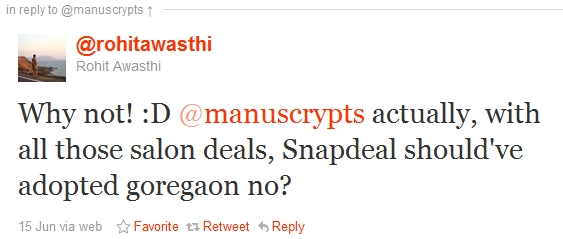
    I was reminded of this last week when the news of Snapdeal's adoption of a village hit Twitter. Snapdeal was trending for 2 days of twitter on account of it. None of the comments on my timeline were flattering. I am guilty of contributing a couple myself, one of which was gamely retweeted by Rohith Awasthi, Head – User & Communities at Snapdeal.com. (as I have said on Twitter on an earlier occasion, the intelligence and maturity he displays when dealing with 'crowds' is something I respect)

    Snapdeal has also written about their intent behind this exercise on their blog, and it is heartening indeed to see that it also happens to be the village that one of their employees belong to, and that the entire idea started there. I also have to wonder why that never made it to the PR machinery. Meanwhile, as their blog says, their commitment is something that time will show. Ef

    ficacy is another thing about which time will have an opinion.

    I thought about this from the perspective of the earlier post – sustainability, alignment with strategy etc. Even if this were a marketing gimmick, I'm fine because the village gains. As Snapdeal says, maybe other companies will follow suit too. Now, if good intent is the only thing at work here, how is it measured with regards to their strategic objectives? As I've repeatedly said, it's the deal that drives my relationship with the brand, anything else is of little consequence, including this effort.

    On the other hand, what if Snapdeal had tied up their CSR with their deals? It could have happened in many ways – a bottom up approach, polling people on what they should do as CSR and taking the story further, or perhaps a commitment based on the number/value of deals sold, or promising a certain part of the revenue towards a CSR initiative (both of which can use a wiki like meter to show transparency), or a matching grant scheme for a cause (you pay Rs.x, we put in an equal amount). All arguably aligned to strategy, helps build community, and can be counted as CSR. But as a user, I wonder if I would then have said they are doing it to increase their deal counter. Note that even for a seemingly unrelated deed like adopting the village, some of the reactions were pretty nasty.

    So, dead if you do, killed if you don't, and that's my conundrum. Am I missing something here? If not, perhaps the only way is to organically grow a community that supports you, communicate clearly with them and show them through actions over time – not just in terms of CSR, but overall strategy as well,ย  that inย  the commitment to a larger cause, you mean business. In a future era, when social business hopefully becomes more mainstream, and people see brands whose purpose ties in with the larger context of their lives, this won't be as difficult as it seems now.

    until next time, cause tick or Groupgaon? ๐Ÿ˜‰

    zp8497586rq
  • Button Mania

    Since the Skybags driven conversation on Twitter a few weeks ago (related posts by L.Bhat and Karthik) I have wondered about the presence of Facebook/Twitter icons in print ads. So I decided to do a little research on my own. For a week – from 13th – 19th May, I tracked the ads in Bangalore Times, particularly those which had mention of a social media presence. The results are in the presentation below.

    Brand – Social Iconography

    View more presentations from Manu Prasad

    I would estimate that only about 25% (or less) of the ads carried these logos, so I can understand why brands would want to use this as a differentiation tactic, but doing so with just buttons (sometimes without a url/handle/name) and no worthwhile presence to showcase, defeats the purpose. Or maybe we can wait for the day when Augmented Reality will allow me to use that button and automatically go to the url. ๐Ÿ˜‰ Meanwhile, I await the introduction of the Foursquare button into the mix. ๐Ÿ™‚

    until next time, button up for the social media ride

    P.S: I'd like to make this an infographic, if you know someone who can volunteer, please pass the word.

    zp8497586rq
    zp8497586rq
  • Plead Blue

    <context> I missed the Twitter debate, but it was still interesting to see the two perspectives shared by Karthik and L.Bhat on Nike’s ‘Bleed Blue’ campaign. Bhat’s initial post was a good summing up of the campaign, and what made it work. Karthik’s contention was that Nike did not deserve credit primarily because it was “tightly associated with the team’s performance” – an external occurrence. There were other reasons too, but I gathered that this was the crux of it. The contrasting example was Pepsi’s Hoo Haa – Blue Billion effort during the 2006 Champions Trophy. In a second post, Bhat also acknowledged a correlation (between the campaign’s and India’s success) and rightly (IMO) stated that the campaign’s intent centred around ‘garnering support for Team India….’ and ‘portraying a positive, confident attitude about Team India…’ Also, as he points out, it stayed away from any ‘player superhero’ association or a ‘we will win the cup’ stance. </context>

    This debate was also interesting from the perspective of what I wrote last week – brand identity and real time. But before we get there, my 2 cents on the debate. I would also credit Nike for the same reasons Bhat stated – strategy, product integration and ease of participation (execution). That is what separates it from say a ‘Pallu scoop’, which is fun and pure recall, or a ‘Get Idea’, which still hasn’t given me an idea of how it’s keeping cricket clean.ย  [yes, they aren’t apples, but they were the other hugely visible campaigns]

    Big ticket result-based events (including movies, which Karthik has mentioned) is a risk-reward game because there really isn’t any data that allows you to place sure-shot bets. But the way I see it, you can place a successful bet, and still not gain enough mileage (bad erm, ideas, bad execution etc). Nike got it right, and there was some hard work involved.

    Come to think of it, I wonder if there’s any other approach Nike could’ve taken, especially since they were the official apparel sponsors. Look at the competition – Adidas had a Tendulkar ad and Reebok had nothing. It was a ‘once in 4 years’ opportunity and they seized it. India winning the cup was a key factor in the campaign’s success, but not the only one. Also, I don’t know if they had a back up plan – a “we’ll be back in 2015”, “thank you for giving it your best shot”, “bled to death”. Ok, not the last one, but you get the idea. Maybe they did and would’ve come out smelling like roses anyway. In any case, the efficacy of the campaign is probably best decided after it ends. In this case, it made Nike the buzz brand with other heavyweights in the fray, including the mighty Zoozoos. (Loved them though)

    Meanwhile, by design or not, Nike’s approach was also quite a “Just Do it” one. (hindsight/retrofit) From the last post’s perspective, I wonder how much/whether that identity played a part in the design and success of the campaign. But on big events, celebrity endorsements etc, going forward, real time management of campaigns will increasingly become a requirement, thanks to the instant feedback tools that exist. Perhaps brands should formulate ‘what if scenarios’ and corresponding approaches when they plan large scale campaigns, especially when it’s linked to events that don’t offer much support in the form of data. The other way is to scale after the relevant data comes in, but that would involve quite an execution effort.

    until next time, blue positive ๐Ÿ™‚

    PS: Nike, next time, stadium checkins and a Bleed Blue 4sq badge too please ๐Ÿ™‚