Category: India

  • Trust they’re connecting people

    I just realised that I totally missed this one – The Brand Equity Most Trusted Brands Survey, at least writing about it. Unforgivable, but let me try to redeem myself by attempting a post now. Bottomline, Colgate has been dislodged from the numero uno position by Nokia, no mean task, that, and it is a testament to the inevitability of this medium (not the brand)  reaching the top of the media chain in a future that’s closer than it appears now.

    Since I have been lax on the topic and enough has been debated on it, I did some epaper reading and have focused on a few things I thought would make an interesting read. For those who missed the entire top 100 list, here it is

    I think Nokia’s climb to the top has been mainly because unlike the poor toothpaste, its not a single product or even single service/utility (oh come on, it easily transcends  a pure play communication device, its also a camera, a music player and so on). This not only heps it give different USPs to different kinds of people, but also helps them in communication (to appeal to different kinds of audiences across SEC categories).

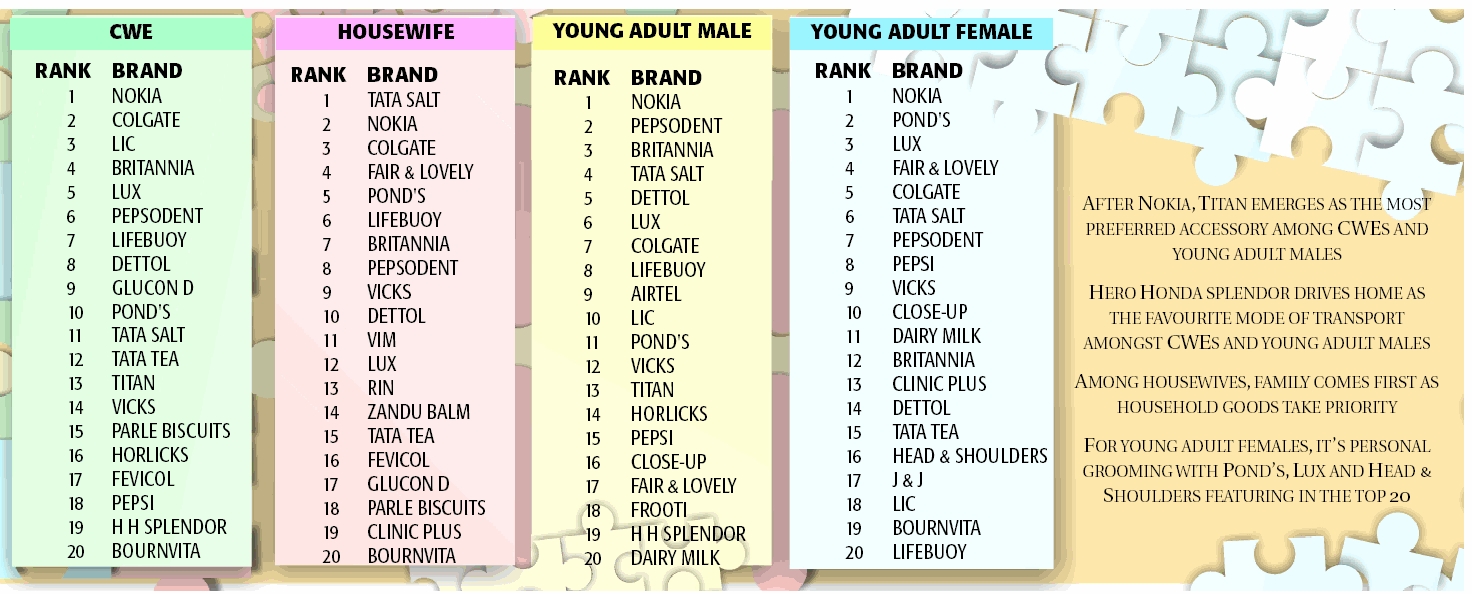
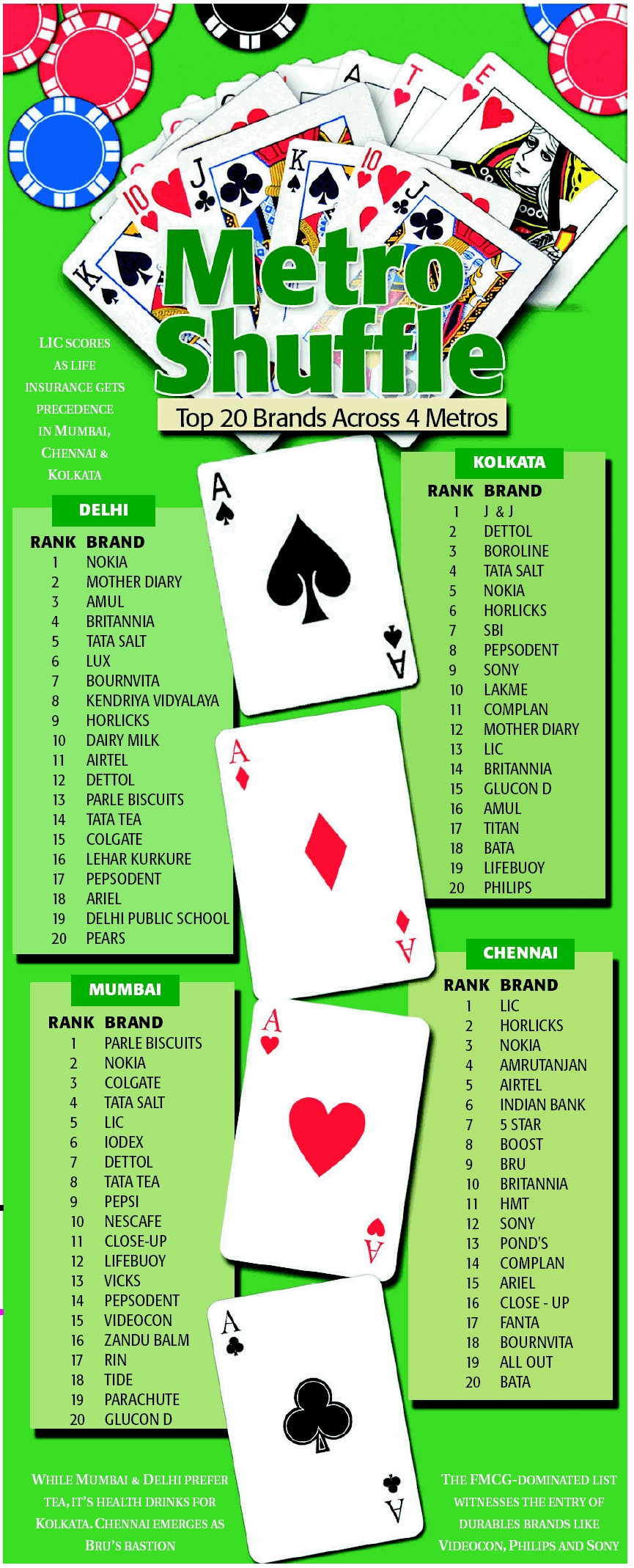
    Speaking of SECs, here are the results based on income, SEC and respondent type, and by metros
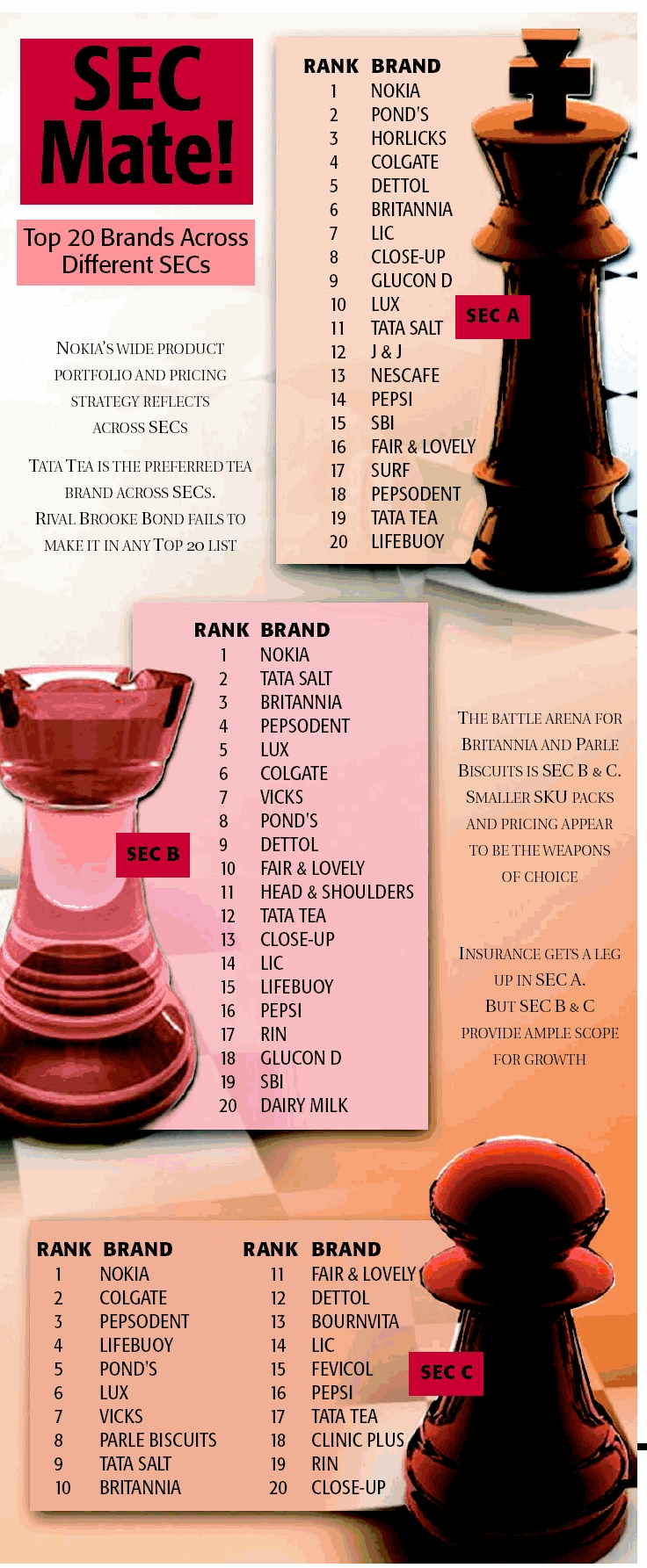
    Other than trivia like the fact that Fevicol doesnt have a mazboot jod with SEC A and the ones mentioned in the image itself, the lists in the SEC split seem to be just a reworking of the top 100 order. As far as the income split goes, quite understandingly the income class below Rs.2500 are in a lot of pain. What else explains Crocin’s jump from #81 in the top 100 list to #10 (okay, bad one 🙂 ) You know, these lists would make one think that this is one of the most hygienic and healthy countries in the world, look at the number of personal care and cleaning products and health+ food brands out there. Sigh, now if only trust would lead to usage 😉 In the ‘respondent type’ list, its amusing to see ‘Fair and Lovely’ at #17 in the young adult male list. 🙂

    Its interesting to see education occupying two spots in the Delhi list, the top three brands in Kolkata having something to do with the skin, Mumbai having a cleanliness fetish, and Chennai not having it (must be the water problems). Yes, I am glossing over, but a detailed look will take time 🙂

    Meanwhile, Brand Equity has also given the methodology in selecting brands. A couple of thoughts on this. Considering that we’re hunting for the most trusted brands, shouldn’t we also have a media category (all media, or is it a problem because of possible bias allegations?) When do things like retail chains (CCD, Big Bazaar, FoodWorld), familiar brands like say, Levis and gang, India Post, Indian Railways, IRCTC etc make an entry? And i know this won’t happen any time now, but will computer (hardware manufacturers as well as things like Windows/Linux and entities like rediff) make it into the top 100 list in at least 5 years?

    Meanwhile, I really don’t see anyone being able to challenge Nokia, unless simultaneously, a telecom brand (service) really becomes a pan india player (is already there) with excellent service and other mobile manufacturers give Nokia some really tough competition. The other possibility is when public utilities like power, water supply etc start having private players (not in an infrastructure capacity, but as a branded utility). Whatcha think?

    until next time, in brands we trust

    All images are courtesy Brand Equity, the Economic Times dated 11th June 08

    Update: Guess who makes it to the top in the US.

  • Local Portals

    I came across this today – a local site for Kolkata – I Love Kolkata.com, powered by the ABP group. The site for Kolkata Mirror had been launched a while back, though the paper itself has not been launched in the market. The first two pages of a google search threw up only one other contender for a complete city portal – that was Calcutta Web.

    As far as design goes, ILK is quite ahead of the other two. I also liked the ILK usage, which also means ‘people of a specific kind’, in addition to being an acronym for ‘I Love Kolkata’. The site has the regular news coverage, and blogs as well as city info. In comparison, the KM site does look a bit haphazard, but as per the WAT article, this is only a ‘primitive avatar’. The Calcutta Web site is way down on the design parameter, and is an aggregator of news from all the city’s newspapers and has city info.

    But wait, this is not about design. What i want to discuss is the content. While its a given that a newspaper site should have the news stories it carries in its print edition, does it always have to try to be a city portal and a blog platform. In its print version, the newspaper is a one stop shop for most readers and their first source of info on most things to do with the city. For the newspaper too, classifieds are a big source of revenue. But, will a net user rely or expect the news site to carry information like say listings or dine out options, or will he rely on a vertical like eventsbangalore or burrp for that? Yes, it does dependent on the maturity level of the user, but thats a dynamic thing.

    User generated content. Will only discuss blogs for now. Will an existing blogger switch to a newspaper blogging platform? Will the new user stick on to it after he discovers that there are platforms for whom constant improvement of services is a competency, unlike newspaper sites that lets you create blogs. The other point to note before taking a decision on this is an informal but very informative research done here. While the figures are the result of a lot of mashups, and may not be spot on, the fundamental logic is right. According to this, the percentage of creators is a dismal 4%. India seems to be a country of spectators. At this stage of the internet in India, is is wise to waste pixel space on a non core competency?

    Yes, in evolved internet landscapes, it is possible to have excellent user blogs like this, on a newspaper based site, or even something as ‘adventurous’ as this. But in india, is it better for media websites to stick to a CNN IBN model? That would give some exclusive content, with a built in quality control. Once the net evolves, UGC can be scaled up accordingly. For now, isn’t it better to use the web as a base to build solid equity and credibility on a digital platform and figure out ways to use the interactivity factor that the net provides to showcase different perspectives on existing content?

    Now, you might say that in a news overloaded internet space, why would anyone want to visit a newspaper site for news. I guess, traditional media still rides on a credibility factor.

    until next time, click to print, no its the other way 🙂

    PS. Saw another local portal in the making for Bangalore – mybangalore.com

  • Mobilisation

    For those in India who look forward to the internet taking a major stake in ad spends, this (via PluggdIn) cannot be music to your ears. While the internet spend has grown by over 90% in 2007, as far as absolutes go, its a mere 2% in the overall media spend. And with the total figures increasing for all media, its a case of the rich getting richer, and the poor getting much lesser than what they deserve. Ironically, The Times Group finds a place among the top spenders on the net.

    In this report, mobile has been included under digital which has internet, search and mobile. I think its only a matter of time before it becomes a separate category altogether. Like i have written earlier, the mobile is poised to become the internet’s saviour in India. Which is one of the reasons why I’d consider this news very significant – Yahoo has announced a tie up with Idea and MTNL for mobile advertising as well as One search. The SMS search was launched late last year. And if we go by the interesting stuff that Yahoo has been doing globally, the space is bound to throw up some fun stuff considering that Yahoo can leverage all its content from mail to messenger to social media on this platform. (Remember the Reliance-Yahoo Messenger ad?)

    Meanwhile, their friends at Google have not been idle either. Their SMS search was launched just before Yahoo. Their deal with Airtel was also well hyped and they have also launched a voice based local search earlier this year. (while on that, this one – Ubona is an interesting service in Bangalore)

    Also, its not just the web giants who are fighting for the mobile advertising pie. One example would be Nokia’s acquisition of Enpocket, which already services a few clients in India. And in this context, one cannot afford to ignore the major happening in october (hopefully) and the impact it would have on internet access via mobile.

    until next time, net losses

  • Driven

    Its been a while since 1983. 25 years, and as the car maker which transformed the Indian automobile scene with their very first car in that year, its reason enough to celebrate. And the new TVC does justice to that. From the now almost extinct original Maruti 800, which was a bestseller till 2004, to the Swift, the car with the highest sales figures in 2006, its been a long road, with Omni, Maruti 1000, Zen, Baleno, Alto, Esteem, Gypsiy, SX4, Versa, Vitara and a divestment all packed in between.

    While i partially agree with this – the ‘local’ all encompassing big brand concept that has been used by many other brands succesfully has been used here too, I think the timing could not have been better. With Chevrolet, Ford, Skoda, Toyota, Honda, Renault etc and the other desi Tata, coming out with models and talking about everything from fuel efficiency to attitude, it was time to hit India with something that rarely fails – an emotion packed family drama which would trigger bouts of nostalgia.

    And it does well, with some excellent camerawork that takes you from the modern jet setting India, to a typical, traditional Kerala temple procession scene, complete with elephants, to the timeless ‘papa impatiently waiting at the gate for the daughter who’s late’ and an armed forces mountain terrain scenario, from the usage as the proxy school van to a hitchhiker asking for a lift to reach home in time for Diwali, all with the different brands that have got it a 6.5 million customer base; a really hummable theme music, that I hope they will retain for some time, and a powerful line ‘India comes home in a Maruti Suzuki’.

    In essence, a stance that befits a market leader of ethnic origin with the best distribution and service chain in the country, which has consistently worked on its products and has decided to use a communication that took me back to some wonderful times and trips in a Maruti 800, one that I’m sure would have the same effect on millions of Indians, and who in their next car purchase decision, are sure to remember an old companion.

    until next time, a Capital idea

  • First Life

    MMOGs have always fascinated me, but I have never managed to get hooked on to Second Life. And I’m yet to read Neal Stephenson’s Snowcrash, though its been on my shelf for sometime now. But yes, I insist that I am interested nevertheless and still play a browser game set in the middle ages. 🙂

    So, when Wipro became the first Indian brand (or is it VR1? ) to get into Second Life, to me, it was a kind of defining moment. But then, Wipro, to me is a very tech organisation and less connected to a normal consumer inspite of the bulbs and oils. So i wasnt surprised with a “Offshore Development Center (ODC) model campus with facilities like Client engagement center, Learning Center, 3 floor ODC setup with cubicles….Admin, Data center and Library.” presenceon the virtual world. But it was also mentioned that resumes could also be submitted at the virtual campus, wonder what stage that is in.

    And a few days back, Amul also decided to get a life.. a second life. The popularity of Amul’s hoardings is legendary, which is why it was surprising when Amul’s presence was stated to be “…a simulation of its production and distribution facility.” But thankfully, there also seem to be plans for having ice cream parlours which, other than the products, would also feature communication.

    But honestly, I’m still not convinced. Amul is a consumer brand- the taste of India. Also, its no secret that the ‘utterly butterly’ babe on the hoardings played an integral part in building the brand. Isn’t it logical to carry the two components into a virtual platform? Billboards on Second Life showcasing the unique Amul perspective on issues. Isnt it perfectly placed to be a sort of spokesperson for India on global issues? For example, when Bush makes his trademark absurdities (like how India’s prosperity led to a global food shortage) Amul can be the champion of India’s cause, with a trademark oneliner. While I understand that the Bush channel is soon to be closed, and there need not be an Indian perspective on everything, the perspective can be on anything – sports, movies, politics. All of this and more interest the Indian audience. By doing this, Amul becomes the ‘Voice of India’ (not the show, though that can also be done virtually..after all the world does go gaga over Eendian music 😀 ) and is able to showcase itself as a vibrant brand.

    Ah well, for the second life to be good, there should be clarity on the first life. Most brands are yet to reach there. I, for one, would love to have Amul play a much larger role on Second Life, not strictly related to its product range, but more as a brand, with an utterly butterly babe avtar to boot. Whatcha think?

    Meanwhile, this one’s a must read, especially for those of us who are hooked on to 2.0

    until next time, life’s like that?