A couple of months ago, I wrote an article for afaqs on the challenges for brands trying to remain relevant by stepping into “woke” territory. To summarise, being selectively woke is not an option. Every action by an organisation is scrutinised, and sometimes, scored! Both McDonald’s and P&G were in the “danger zone” of being viewed as more exploitative than empowering. The former even got called out by NAACP for not supporting workers. However, this post is not to belabour that point, instead I’d like to hypothesise on the long term impact on consumption and brand building. (more…)
Category: India
-
Mind your language?
Aachi Masala’s ad – Malayalam transliteration from Tamil – has been providing unintentional humour for a while now. It reminded me of Karthik’s post on Quartz a while back- “How brands are hurting themselves with pan-India “Hinglish” ads“.
The crux of the post is marketing effectiveness and how, by not communicating in the language the audience uses every day, the communication is losing its effectiveness and its ability to persuade. “Advertising is not mere communication. It’s persuasion” is a reasoning that’s hard to argue with. The common justification given my marketers are apparently “everyone knows Hindi” and “cost”. I wondered though – can marketers be that callous? Could there be other reasons? A brief thought exercise followed. (more…)
-
Old bottles, new wine
I recently contributed a column in Pitch on the role of mass media in building ecommerce brands. You can catch it here.
-
Mentoring Startups @ Microsoft Ventures’ Accelerator Program
When I come to think of it, my sales/brand jobs have all been on startup mode, though the organisations themselves were quite established – Dishnet DSL in 2002, WorldSpace in 2003, MidDay Bangalore in 2006, Bangalore Mirror in 2007. Myntra was still a startup when I joined in 2011. I really can’t remember when I first became interested in startups – perhaps Bangalore’s culture of entrepreneurship affected me soon as a landed here – in 2003. But it really started manifesting itself only during my stint at The Times Group. Muziboo was probably among the first I actually interacted with (in 2008) and I still remember sending feedback to Deap for Burrp’s mobile site in 2009.
It was in 2010, when I started writing the startup column for Bangalore Mirror that I understood why I probably had such a fondness for startups – in them I see individuals who have in some way connected to their purpose in life. That gives them a passion and energy that is amazingly infectious. After the column’s run ended in 2013 (at 97 Bangalore based startups!) I had no official reason to associate with them any longer, though the connections I’d made early on – Zomato, for example – gave me an occasional opportunity to indulge my interest.
(via)
All of this would explain my immense happiness when I was invited to be one of the mentors at the Accelerator Program of Microsoft Ventures last year. The Accelerator is part of a global establishment and helps entrepreneurs launch/scale their startup through a 4 month intense program that begins in January and July every year. At the accelerator, the entrepreneurs get access to quite a few things – a pool of mentors with expertise across various domains, (design, brand, technology, to name a few) office space to work from, and a ton of connections to help them gain funding and scaling opportunities. (FAQ) The other crucial factor they get, and I’ve seen it not getting the attention it deserves, is the Accelerator team itself. I have seen their diligence and their interactions, and they add an enormous amount of value in shaping ideas into executable plans.
I’ve now been part of the last two batches, mentoring a couple of startups in each batch – TommyJams and Tookitaki in the previous batch, and Imly and Voonik in the current. Respectively operating in the domains of entertainment, advertising, food and fashion, these four by themselves are enough to give you an idea of the diverse kind of startups that make up each batch. Though I’ve worked closely with these, I’ve also had multiple conversations with other startups and have been impressed by the sheer quality of ideas behind many of them, their willingness to learn and reinvent if necessary, and the tenacity with which they execute their plans.
My role may be that of a mentor, but I’ve learned quite a bit too. My learning has been in many forms – watching the startups in action, understanding at least a part of the intricacies of the domain they operate in, their approach to the challenges they solve, and most importantly, conversations with other mentors. Many of the mentors belong to the investor community and bring with them fantastic perspectives on a wide variety of things.
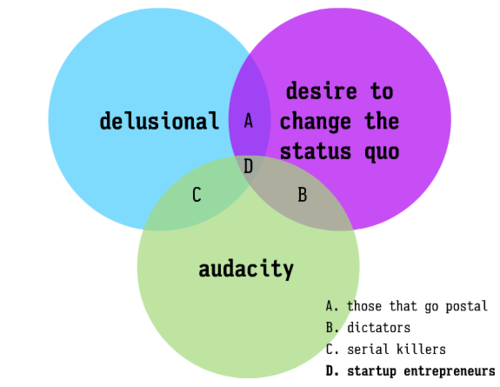
It has been an exciting experience for me thus far, and I’ve been planning to write about it for a while now. The immediate trigger came last week in the form of an invite for the Demo Day of the current batch. I also learned that the Accelerator had started taking applications for the next batch. In my own selfish interest, I’d like to play a role in the life of some entrepreneur out there. If you think you are ‘D’ in the figure below, apply away!

(via. Check the superb original deck here. Thanks @m3sweatt for p0inting out )
Disclosure: In case you’re wondering, mentors don’t get paid, not even to write this! 🙂