Category: Strategy

  • The purpose of brand

    The Guardian had an interesting post recently, titled “Brand is becoming meaningless“, it (brand) is being replaced by a company purpose that the organisation can rally around. Yes, there is a study that this is linked to, and quotes. To paraphrase, brand is the effect, not the cause, and that has made it lose its fashionable shine.  Someone should tell Maggi this, they just lost $200 mn in brand value, even as the corresponding goods value is ‘only’ $50 mn! (via) Now, just so we are clear, I am not completely against this thought, all the more because this is something I have been writing about for a while now.

    131028.brandpurpose

    (via) (more…)

  • In an ambient future…

    Digi-Capital claims that by 2020, Virtual and Augmented Reality combined would have hit $150 bn, eclipsing mobile. What is interesting is that a recent Juniper report predicts an $80 bn market for wearables by 2020. (via) If I read that together, by 2020 we would have witnessed three interface cycles – mobile, wearables and AR+VR. The shelf life of interfaces is shrinking, much like other business cycles. In fact, in Trendwatching’s No Interface trend brief, you can get a preview of this. I’d think that by 2020 web access would be much better than what we have now, and with other technology like IoT advancing sufficiently, we would be poised for ambient interfaces to consume and create what we do on the web and mobile now.

    It is widely believed that Google is only a challenger in the  mobile and wearable domains – to Facebook and Apple, despite Android. With Facebook’s Oculus move and Glass’ demise, it would seem that the interface that follows the two above would also see a fight. In an insightful post, Ben Evans asks “What does Google need on mobile?” He notes that all of Google’s play is about reach – to collect and surface data. Mobile, and specifically apps, challenge this and create a world of perfect complexity. He ends with saying that Google needs to win at search,  whatever that means and wherever and however far from PageRank that leads you. Christian Hernandez goes further in his post ‘Into the Age of Context‘. He points out that the glue that connects mobile, social and sensor trends is data, but to take it to the next level, it needs machine learning and AI. He sees Google Now as the perfect example of The Age of Context. (more…)

  • Re: Skill

    In The Entrepreneur and the ProfessionalI brought up the challenges at work faced by my generation. The focus was on an approach to work and the changes that have been forced on it because of rapidly shifting business environments. In addition to the business’ external dynamics, another factor that has been changing the organisation is the entry of a different kind of workforce.

    How the Millennial Workforce is Changing Business” calls this a revolution, and writes further that they will prepare the organisation for the future by making them Digital, Clear, Fluid, Fast. PwC’s layered report on the same subject brings out this workforce’ motivations, acknowledges the generational tensions and suggests what the organisation would need to do to attract, develop and manage millennials.  (more…)

  • Old bottles, new wine

    I recently contributed a column in Pitch on the role of mass media in building ecommerce brands. You can catch it here.

  • The IoT battlefield

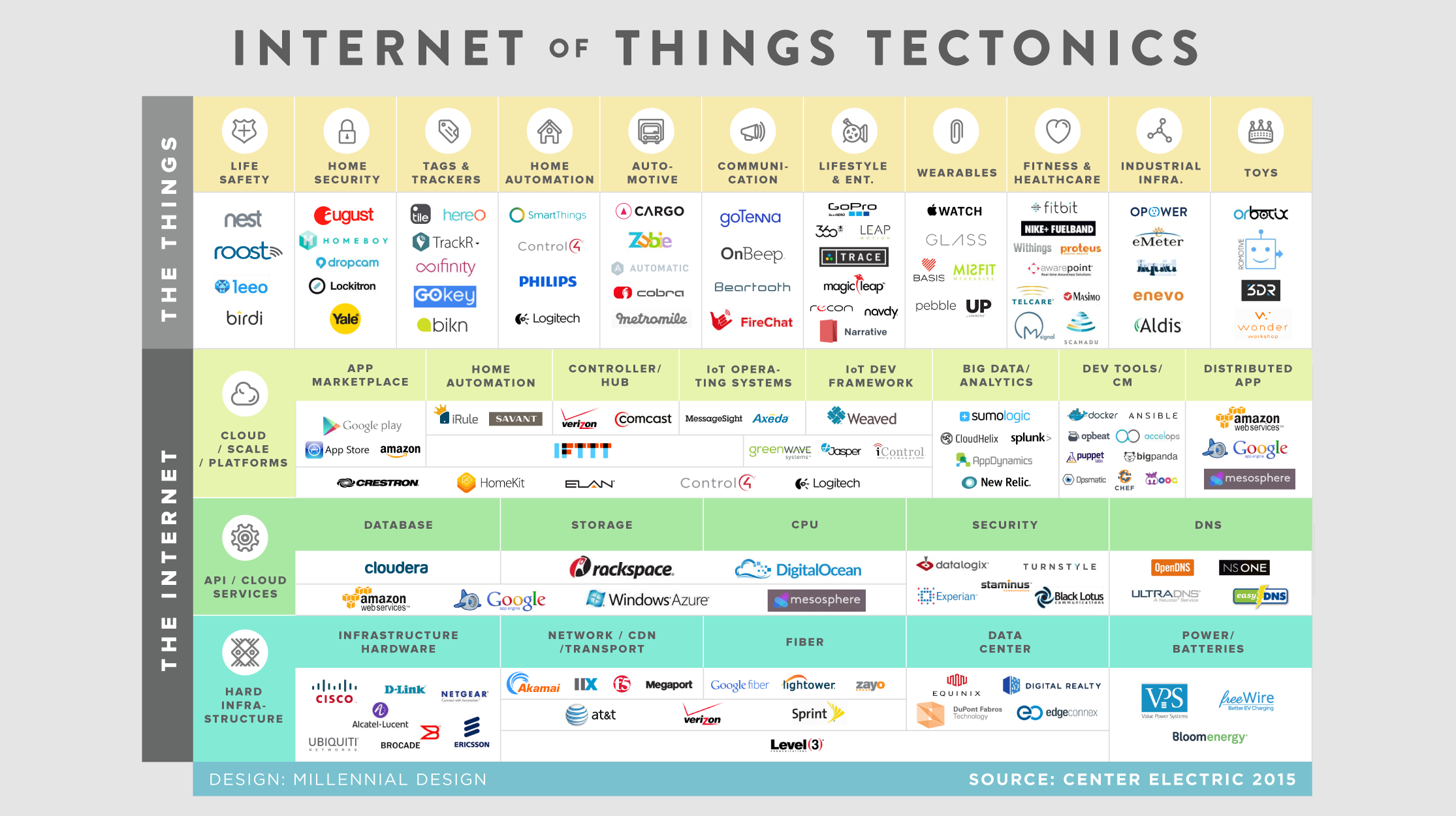
    The last time I wrote about the Internet of Things, I hoped for an application layer that could sense and collect data and convert it into use cases. In fact, the title of the post was Interweb of Things, the nuanced difference between them being connection (IoT) and interoperability. (WoT) (read) In the few months since that post, there has been quite some activity in the space. I saw a very useful classification a few days ago that illustrated both the ‘things’ as well as the infrastructure and showed the possibilities of interoperability. (via)

    IoT

    (more…)