
Category: Strategy

  • Inside Intel

    A video that was shared yeterday on Facebook by a friend got me to check out Intel’s latest global campaign – Sponsors of Tomorrow. I then remembered that a few days back I’d seen a half jacket (a page takeover on pages 1, 2) in TOI, which talked about the same thing though it seemed a cobranded effort with TOI called Innovators of tomorrow. [Disclosure: I work for the Times Group.]

    The campaign videos on YouTube were quite interesting. In addition to the ‘Rock star’ and ‘Oops’ TVCs, there are also videos of real employees at intel (is that the same Ajay Bhatt referred to in the Rock star video?) and an interactive ‘In the future i want..‘ which featured random people interviewed at the Times Square, and billboards which displayed these ‘ideas’. I was a bit intrigued by the campaign, and a Google search took me to the press kit and the official site.

    While the tagline is ‘Sponsors of tomorrow’, the campaign’s communication strategy seems to be two pronged – one, to expand on the line, and show what happens behind the scenes and how through innovation, they aim to be the ‘sponsors of tomorrow’, and two, to promote the people behind the technology. What got me intrigued was the execution.

    The single line take outs from the videos were – “Our big ideas aren’t like your big ideas”, “Our rock stars aren’t like your rock stars”. While the videos are indeed funny and convey the perspective clearly,  I wonder if those are the kind of statements, that will really inspire people to send in ideas. From the Innovators of Tomorrow effort and the website, there seems to be an agenda of interactivity, since it calls for ideas.

    On innovation and technology. Somewhere, hidden in the press release, I saw a sentence that amounted to “Its not technology, its what technology can do for them that’s important to people”. It’d have been great to see Intel expand on this and show consumers what Intel technology has made possible and what it is attempting to make possible. The global site wasn’t very impressive. “You on tomorrow” is the interactivity effort there and I promptly filled up “in the future I want__________” with “websites that load faster” and that wasn’t being frivolous. Maybe I’m reading too much science fiction, but even the 2128 Delhi video wasn’t very futuristic – holography and body scan after 19 years isn’t exactly the kind of advancement a bleeding edge  technology giant like Intel should limit its imagination to, IMHO.

    People behind the technology. Funny videos and self deprecating humour is great, the point is made. But if they wanted to showcase the people behind the efforts, this seems to be a better thing to have promoted – employee blogs. (the first comment is worth a read) And better ways using different platforms to get the people working on the technology to share how the technology they work on helps improve consumer experiences, lifestyles etc. That might generate a little more involvement than ads showing how Intel’s rock stars are different, and interactive games that deal with suiting up an engineer!! As a consumer this just made Intel geekier for me. What happens inside Intel is  definitely important, however, what it does to life outside could’ve been a more effective communication from an interactivity perspective. What do you think?

    until next time, I don’t think Intel will sponsor tomorrow’s posts 😉

    The views expressed here are solely mine, that really should go without saying. But we live in an evil world. 🙂
  • ‘What are you doing’ needs an @ reply ? 🙂

    And every so often, we hear about how brands screw up on Facebook and Twitter, these days we even regularly hear how Facebook screws up on itself, and finally we heard about how Twitter ‘screwed up’ on Twitter. In case you missed it, the chronology can be read here.

    And in case you were too lazy to follow the link, Twitter suddenly yanked off an @replies option — a non-default setting to monitor a conversation between someone you follow and someone you don’t, which was only used by 3% of the Twitter universe. In an initial blog post Twitter addressed it from a product design perspective and as a ‘small settings change’. The response from users was whale disproportionate to the 3%, resulting in the trending of #fixreplies . Poor Twitter was actually doing just that, because the 3% users were straining the servers, since each time someone sent an @reply, Twitter had to scan people’s settings to figure out which tweet could appear in whose timeline. The fun part is that we anyway got to hear only half the conversation.

    Let me try to explain quickly A and B follow each other, B follows C, A does not. In the earlier system (where A was one of the 3% who had changed the default option to ‘see all @ replies’) A could see B’s @replies to C. With this change that Twitter made, A stopped seeing it. The ‘fun part’ I mentioned earlier was that A anyway couldn’t see C’s updates, or specifically C’s @replies to B. Anyway, the 3% considered this option as an aid to ‘serendipitous discovery‘ of new people. But I think the trending happened simply because Twitter didn’t tell anyone before they made the change. As one of the 3% (I think, since I clearly remember finding people based on the @replies of those i follow. Shefaly, correct me if I’m wrong, but I think we started following each other thanks to our individual conversations with @dina) I think its a  mistake if the Twitter blog was updated without studying all the aspects, a bigger mistake if Twitter chose not to tell users the real reason.

    Twitter then blogged once more emphasising that the technical aspects, more than the product design flaws, were the chief reason for removing this option. And later, gave a consolation gift which now means that A could now see those updates of B, which does not begin with @C. eg.  wondering what @C is smoking. To me, that solves the problem, because its just a format change in a way. And who knows, maybe users will take more initiative in helping connect people now – a human touch to serendipity. Or more power to ‘recommended users’. Meanwhile, there are at least five of us who can have the pun fests we enjoy, because (only) we all follow a particular id we created only for this. So I’m sure users will figure their lives out without the option. 🙂

    Like Twitter, I too learned a few lessons from this entire exercise. That it is important to be transparent and communicate your complete perspectives, especially if you exist largely because of the community’s efforts. There might be disagreements, but its better to make your stand and reasons clear before the event. That it’s very easy for users to lose the perspective that Twitter is a free service that was never meant to be scaled so much, and a lot of what they’re doing now could be to ensure they can scale up. I’m quite glad that even unbridled mobs have  limits of ‘justice’ they can get. That it’s still an ecosystem about which very few (if any) people have a  clear long term objective about – on one side we complain about noise, and when Twitter removes an option that in many ways added to the noise, we complain about that too. That hashtags are increasingly becoming an end to themselves than a means. That it’s the real time issues that matter – most users wouldn’t know that its quite a difficult task (if not impossible) to get their first tweet, after they cross tweet # 3200.  Another example of how Twitter is so many different things to different people.

    until next time, And I will cut you off from the peoples..”

  • Social Media – beyond strategy

    Unilever CMO Simon Clift, at Ad Age’s Digital Conference, spoke about the increasing role of social media in brand management, and said that the internet allows consumers to hijack conversations inspite of the huge money spent on advertising. From Unilever’s experience with Dove also comes the understanding that its not just the communicated parts of a brand that comes under scrutiny, but also the corporate’s entire set of credos – sweatshops, impact on environment are a few things he mentioned. Unilever has prominent corporate signatures in its advertising in UK. He also spoke about the increasing penetration of mobiles, of “marketing program with social benefits”, and a product centric approach.

    In essence, it reiterates the decline of one way communication, consumer participation, of brands being ‘deeper’ than the marketing that is done for them. But it was good to hear it from a leading FMCG corporate. The most interesting part of the article for me, however, was this, from the author of the post

    Social media is not a strategy. You need to understand it, and you’ll need to deploy it as a tactic. But remember that the social graph just makes it even more important that you have a good product. Put another way: The volume and quality of your earned media will be directly proportional to the impact and quality of your product and ideas.

    I think that nails it. All this while I was considering social media as strategy. Now I think its more than that – its something that will make the organisation really focus on what they’re delivering to their consumers, how they are doing it – not just from a delivery platform/operations pov, but also from how socially and environmentally conscious and responsible they have been. In Mr.Clift’s words “enlightened self interest”. The ways and means of communication – brand advertising, promotions, PR etc, will follow much later.

    Meanwhile, the Marketing Pilgrim asks an interesting question – does social media really have the pulse of the people? It cites the Johnson & Johnson Motrin ads that had raised the hackles of mom bloggers a while ago, and caused them to remove the ad. Apparently a research was done later that threw up some interesting stats – 90% of women had never seen the ad, and when they did see it, 45% liked it. It also speaks of the Skittles – Twitter experiment, and a research in which only 6% of 300 people sampled had heard about it. Those on Twitter would’ve heard about both these, but the Pilgrim asks whether these voices resemble those outside at all, and how much of influence do they have outside.

    I, for one, still think social media is a good microcosm of the real world. It does give varied perspectives, and the key is in evaluating the perspectives, digging further where required, and deciding on a course of action that fits larger objectives, and not knee jerk reactions. Wonder if there would have been different results if J&J and Skittles had attempted to carry the community along in their efforts.

    But the bigger opportunity, I have always felt is that it allows brands to experiment with segmentation. On one hand, the net allows extremely targeted communication to a core segment, and on the other hand, cheaper distribution allows the brand to also communicate with different segments of the long tail of consumers. It means that brands can play different roles according to the consumer’s interests, and varying with the context, by tweaking its communication, even while sticking to its core objectives. There are new monitoring tools being developed that will aid of this.

    Most importantly, it allows brands to find evangelists in each segment and work with them to improve and communicate. Consumers who find a product interesting and appealing will communicate it on their own, adding their perspective and giving a human touch of ‘interestingness’. I’m increasingly seeing posts about marketing ideas that have differed from the norm – Penguin India’s ‘Blog a Penguin India Classic’, which I wouldn’t know about if Karthik didn’t mention it on Twitter or his blog (though I do think they could’ve done it better by using social reading lists like Visual Bookshelf – on Facebook as an app too, Shelfari etc to reach Penguin readers – can easily find that through book titles), product placement ideas for Nestle evolving from the “Mad Men” on Twitter. Cisco’s comic book experiments via Chris Brogan’s post (Webex in Marvel Comics), and Kara Swisher on All Things Digital ( The Realm, an entire comic series). All appealed to me as a marketer, and one as a bibliophile too. Social media is not one thing – the channels vary in audience, kinds of interaction etc – Facebook, Twitter, You Tube all allow new ideas ( I thought Volvo’s Twitter stream inside a YouTube banner ad was very interesting) and fresh engagement rules, and ways to break advertising and brand communication stereotypes.

    I wonder about the role of strategy in a social media landscape where many things are still unfamiliar. The standards, processes and even objectives are in most cases, hazy, and evolution is happening on a regular basis. In such a scenario, perhaps organisations should first take a long look at themselves and their customers – current and potential, and start by setting goals that go beyond social media.

    until next time, lab time

    Bonus Reads: Social Media tools popular among marketers (via Digital Inspiration)

  • Google noose?

    The A.P. will work with portals and other partners who legally license our content and will seek legal and legislative remedies against those who don’t. We can no longer stand by and watch others walk off with our work under misguided legal theories.”

    That’s what Associated Press Chairman William Dean Singleton said, in what is obviously a salvo against news aggregating services like Google. The ‘misguided legal theories’ here refer to the ‘fair use’  legal doctrine that news aggregators and search services have been using to use snippets of articles. AP’s concern is that many of these services have been making revenues out of packaging these stories. Also, while AP does have deals with Google and several other engines for some of their content, apparently search throws up material not covered by these agreements.

    Interesting to note that AP had sued MoreOver (Verisign) for snippeting and linking to its news, and Google had signed a deal with AP 2 weeks prior to that. That case was settled, though I have not yet been able to get details. AP now has plans to launch own news site – a “new search pages that point users to the latest and most authoritative sources of breaking news”.  It suggests a system to track content – one that would create, in effect, “fingerprints” of content that could track usage and links. Journalism Online is another entity that wants to help newspapers and magazines charge for their content online.You can read the interview with Steven Brill, who has started it with two others, here.

    Google’s contention is that they’re directing a lot of traffic to the news sites, and any newspaper that doesn’t want to be part of Google News can do just that. Scott Karp says at Publishing 2.0, Google has played to its strength and wrested control of the distribution of news. Interesting comments too. Google allowed users to find content that they wanted, and became the start page when people wanted to find something on the web. That’s something media companies still aren’t doing right, and in between, Google managed to push in the ads, and make a few dollars. Erick Schonfeld, at TechCrunch has an interesting take on this – he points out that (in the US) Google News is behind Yahoo News as well as the sites of the NYT, and Google is actually exposing news, and helping other sites make money too. He argues that while Google does play a part in getting traffic to sites, ultimately it is the content that gets readers and sets the price. Jackie Hai explains how the “The AP syndication model works in an economy of information scarcity, whereas the web represents an economy of abundance.” I recently read about Google Web Elements, which allows Google products to be added to any website. That includes Google News and takes distribution to a whole new level.

    Though the AP issue is mostly an American one, there are similar sentiments being echoed in Europe too. According to NYT, Belgian Danish and British newspapers want Google to reach agreements with them before using their content. Though each country will have its own dynamics as far as news distribution and maturity of media platform goes, these cases are sure to set precedents.

    The media landscape is changing. Its not just that old media is changing rules to figure out revenue models. Its about an airline becoming a content ‘publisher‘, individuals becoming advertising mediums, services like TwitterGrep popping up to utilise the instancy of Twitter… and so on. As Jackie Hai mentioned in his article, the participatory web has blurred the lines between content producer, distributor and consumer. We play all three at different times.

    The measures that newspapers have or are making to earn revenues on the web seem to be insufficient. That includes online advertising, micro payments etc. I increasingly feel that a repair might not be enough. Perhaps a complete overhaul is the ask. The fingerprinting does spark a thought about the role of individual journalists, and the importance they should have in the new system. The web is increasingly becoming a relationship based medium where personal equity and trust are currencies. Perhaps the corporate newspaper needs to be replaced with a more human and humane network, perhaps it should create a core competency on the web in specific news sections – these could be geography based, maybe there is an opportunity for an aggregator in the challenges of hyperlocal news.  Perhaps it can even be category or genre based. Traditional concepts, but built with a social web perspective. Perhaps they should build a legion of citizen reporters who are paid according to the quality of their contributions . After all there is always a need for quality driven and trustworthy news and analysis. The need remains, but the readers’ wants of delivery platform, timing etc have changed.

    The recent (and sometimes) drastic measures taken by Indian newspapers shows that its not as impervious as it was considered. That gives more reason to prepare for a changing landscape. To start figuring out consumption patterns ,  multimedia possibilities, cost implications, distribution dynamics and revenue streams on digital platforms. Maybe they’re all waiting for PTI to fight Google, or is it Yahoo Buzz 😐

    until next time, a new sprint

  • A plus cases on Twitter

    Last week, @aplusk beat @CNNbrk in the race for one million followers. In plain English, Ashton Kutcher, an actor, challenged CNN on Larry King Live – who would get to a million followers first – to prove a point that an individual could have a reach equal to a large network on Twitter. Twitter joined in the fun, because unlike the norm, users couldn’t unfollow either of the parties, of course smart tweeps found a way out anyway.  Point taken, AsKu, though the irony was that until a  week back, the CNN account was not run by them, though for sometime they’ve been managing the account through the person who created it.

    For more than two years, the CNNBrk account (for breaking news) had been created, maintained and run by a 25-year-old British Web developer who just wanted a way to beam short news alerts to his cellphone.

    And that’s the beauty of this user driven service. Something that I fear might change with the ‘mainstream’ spotlight and the rush of real celebrities. Its only a matter of time before a new celebrity thinks of a new stunt. But it is to be noted that  Kutcher is donating 10000 mosquito nets worth $100000 to a charity. In fact, one week before that, I’d read about Hugh Jackman’s donating AUS $100,000 to charity via Twitter, the charity to be selected via Twitter pitches.

    Now, I’ve always maintained that users should figure their own comfort levels and use the service accordingly. But I also feel that a sudden influx of people with no intent other than rooting for a celebrity might be the kind of inorganic growth that will work against the service and its more regular users. This could range from a disruption of the service due to the load to a change in the ‘culture’ of the service.

    Kutcher’s point was about getting a reach higher than a media giant. I’ve always had a problem with numbers – followers, updates etc as a means of measurement on Twitter. I find it a paradox for a place which became popular because of a qualitative measure – conversations. CNN will deliver breaking news regularly, and (as someone suggested on Twitter) Kutcher followers will just have to wait for those occasional Demi photos. Reach has been an index to sell traditional media space, is that the benchmark Twitter wants to take forward?

    There was a very interesting post on Tech Crunch on whether Twitter should remove its follower count. Like I tweeted, I’d agree. Once upon a time, it was a medium to share an instant – something you thought/read/saw/felt to make others smile/think/share their own expressions. With growth came the ‘how a tweet might cost you a job’ and ‘5 ways to increase sales with Twitter’ theses, and the instant was lost. Perhaps you will ignore that as a subjective grumble. But think of the times you see the ‘need 5 more followers to get 500. please RT’ and what you feel then. What happens when that’s the norm and the service changes to accommodate and encourage that culture because that’s what helps them make money. [Note: I’d love for Twitter to make money, but I’m sure they’ll find better ways]

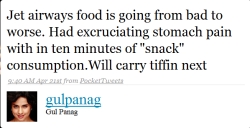
    While on celebrities and Twitter, closer home Gul Panag has been quite active on Twitter the last few days. The Twitterverse has had its share of imposters and has been trying to ensure there’s no ‘identity crisis’ this time, so much that poor GulP might have one soon. This tweet of hers caught my attention. (Oh, okay the dimples too!!)

    gulp1

    Spicy Jet news. Poor them. It reminded me of a post I’d written sometime back on ‘Social Ambassadors‘ – what would happen when the transparency of social media met celebrity bloggers? In this case, micro bloggers. In fact, micro blogging is even more ‘dangerous’ since the interaction is real time, and not like a PR draft that can be posted on ths site, and replies given in a few hours or even days. This becomes all the more important if celebrities use social media as a personal broadcast medium to their fans. Of course, brands can use the media to their benefit too – for example, create conversations between celebrities (a Twitter conversation between Aamir and Gul basis their Tata Sky TVC would be fun), use celebrities to communicate beyond the obvious advertisement etc.

    The challenge is for celebrities too. Perhaps it will also make celebrities more responsible when making endorsement choices. (It would be fun to ask SRK/Aamir why they switched soft drink brands in between.) Also, can celebrities retain their ‘interestingness’ when they are in touch with the fans all the time, unlike a traditional system when news about them was less abundant?

    On an aside, when celebrities move to direct-to-crowd platforms, what happens to the go-between media for whom they were the news makers, and we were the news consumers? And what happens to the micro celebrities on Twitter? 🙂

    until next time, when twitter streams meet mainstream