Category: Strategy

  • Effective Cause

    The Pepsi Refresh project is something I keep bumping into, inside this blog, as well as conversations outside. I admit to a bias towards it, because I somehow sense a sincerity in its approach. Some time back, Surekha shared with me a document on which we debated a bit. From what I’ve been reading, Pepsi hasn’t given (at least clearly) this project a CSR label, so the debate over whether CSR money has been spent well or not is a little pointless. Besides it was more on crowdsourcing CSR .

    But thankfully, the national animal ensured that we continued the debate. Aircel’s ‘Save the Tiger’ has also not been given a label, but it does give a good handle to convey my thoughts on CSR, especially since there are at least a couple of good posts on it already, by L.Bhat and Karthik. Harish’s ‘Branding with a cause‘ is a more general, but very relevant read in this context. Aircel’s high decibel campaign ensured that most of everyone knew there were only 1411 tigers left. If awareness was the objective, as stated, it’s been done, especially since the slacktivist generation has retweeted and facebook-fanned it so much that even the tigers must know now. They haven’t been asked whether they want to be saved in a planet full of us, but that’s a different debate. So is the debate whether Aircel should complete the loop, after all why can’t we? (and maybe there’s another phase anyway) But I digress, and generalise. Sorry.
    Clipboard02

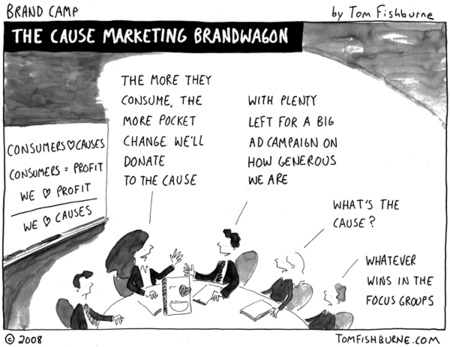
    (Image Courtesy: Tom Fishburne)

    The questions I have are these. Should CSR be related to the business domain or not? Aircel’s was not, but as Surekha rightly pointed out, they chose a topic that would connect with their target audience. My problem with that, though it helps stand out from the clutter in a commodity category, is the lack of context. With Pepsi, though one could say the project has nothing to do with sugared water, there was always a ‘youth’ context, which was established long ago. Now, if it were connected with the business, and it is possible with say, the pepsi project (surekha gave me at least 2 excellent ideas) I would turn around and say, vested interests, and doubt the sincerity of their efforts. ‘The big corporate giving us eyewash’ view. It would also bring in ROI measures etc, which I find hard to associate with CSR. Roshni put it succinctly when she said ‘sort of like proclaiming, hey, we did charity’.

    In trying to find a solution, I remembered a post by Umair Haque on ‘Great to good, which, perhaps unwittingly, made me think of a similarity between social media and CSR. As mentioned in my last post, the piecemeal approach to social media is something I dislike. Its as though it exists stand alone inside a box, I think I have a similar problem with CSR as a label. So, (simplistically put), what if the label were to be taken of and every process was carried out with an inbuilt csr approach – from creating environmentally friendly, sustainable products/projects and choice of partners/vendors to eco friendly packaging and everything in between? Oh yes, practical business considerations. I forgot. 🙂

    until next time, with great responsibility comes great power?

    Relevant Read: Cause Effect

    PS: JK cement deserves appreciation for its support of an unrelated, but worthy cause – bikinis 😉

    PPS: While on tigers, this one, by my good friend Blues, is a killer read 😀

  • Brands and consumer social influence

    Sometime back, I had read a post on Inquisitr very interestingly titled “Let’s bring some reality to this social media game“. Although my expectation of reality was slightly different from what the post delivered, I still found it a good read because it dealt with an issue that I have thought about several times. We even discussed it in the comments section of a post that (among other things) brought up the Kiruba-Cleartrip incident from last year.  In my personal blog, I’d written about the ‘clique friendly web‘ in a tangential context – of bloggers with fan clubs perhaps losing objectivity and not tolerating a difference of opinion. The question, meanwhile, is really quite simple – should companies on social media sites give differential treatment to customers basis their ‘social influence’.

    A few weeks back, I saw a post on Jeremiah’s blog which dealt with the same subject. His point – “Just as companies factor in value of a customers celebrity status, buying power or customer loyalty –companies must factor in social influence or put themselves at risk.” He has even created a matrix that shows 4 phases of  incorporating social influence and the pros and cons of each phase. He has factored in both absolute and relative influence (influence in context of a brand/company’s domain)

    Let me try a context for this. Very simplistically put, I’ve always seen the consumer generated media as part of a media long tail. The traditional media is in the head, aggregators including Google, FB, Twitter are also there now, followed by forums/discussion boards, influential blogs and then the individual accounts. So consider this perspective. Brands have always given preferential treatment to MSM simply because they reach a mass. And let’s just say not just in terms of using them for communication, but the overall experience for their representatives. With the rise of the web and a new set of aggregators gaining prominence, brands have tried to evolve processes for the system – from SEO/M to blogger outreach to presence on Social Media. Yes, processes do help, but..

    With search engines including real time updates in their results – Google even outlines how its Twitter algorithm works, brands now not only have to listen, but also work out the way to handle all the messages being thrown at them, because they’d be deemed unresponsive otherwise. The phrase “there’s no dipping your toe in social media” comes to mind. So, should there be differential treatment?

    At this point, I know most companies would do exactly that, but I wonder if they’d then be just trading one set of media for another. I’ve seen many cases where a tweet from a relatively unknown (in my circles) person gets RTed and becomes a raging fire. It is perhaps easier to assign a process basis categories of social influence, but I think, unlike the structured media that has been dominant before, this is a web – of human connections, which is  more difficult to fathom, and have ways of inorganic spread that are no way close to measurement, yet. If indeed, there is a process to be set up, perhaps it should be more internal than external – involving different functional groups capable of thinking and reacting to specific domains and contexts. With services like Twitter planning on multiple identities within the same handle, perhaps the old fundamental social media approach of people to people might help debunk what I am also inclined to believe – “socializing cannot scale

    until next time, weighing scales 🙂

    PS: If I consider posts on both blogs, this one happens to be #1000 🙂

  • #In Business

    In spite of being the gold standard in business networking, I’ve always felt that LinkedIn has been a bit slow in adapting to the needs of its audience. Quite some time back, I’d written about the ‘news’ and ‘groups’ features, and had asked for an RSS feature for groups. That feature was incorporated earlier this year, but I thought there were several other possibilities which could’ve been incorporated, specifically in company web pages – multimedia support, aggregation etc. My benchmark of comparison was Social Median (acquired by Xing, a competitor to LinkedIn). I’d also wondered if it’d make sense for LinkedIn to perhaps acquire or at least have an association with Yammer.

    Just when I was ready to give up on LinkedIn’s possibilities (completely agreed with this), they seem to have caught a new wind. First came the redesign, with significantly better navigation, a cleaner look and lesser scrolling!! And then came the sync that everyone had been waiting for. Twitter was Linked #in (or#li) with an option to selectively share tweets on LinkedIn. Good timing, I’d say, judging by a few studies. A Palo Alto Networks study stated that enterprise usage of twitter was up by 250% in 6 months. (FB at 192%) Another report (can be classified as dipstick from the number of responses) , by the 2.0 Adoption council, seemed to indicate that social computing was making its presence felt in the enterprise.

    Most importantly, LinkedIn finally opened up its platform to developers. Bring on the apps!! (no, not Link farm ville 😐 ) RWW has a good post on the good and bad news and a few possibilities. Tweetdeck, Posterous, Ribbit, JobDASH, Box.net, all have integrations happening. The wishlists have started too. As RWW mentions, a ‘people you might know from other networks’ and filtered status updates would be great. Sandeep Gautam has a ‘Follow Friday’ like mechanism and @mentions in status updates in his list.

    On that note, I wonder whether the sync would mean that the twitter system of hashtags would become popular on LinkedIn, and a status search would find a place among the current crop of searches available on LinkedIn. An open platform would indicate that LinkedIn updates could appear on outside search. Also (like FB Connect) people would be able to interact with a site using their LinkedIn account, and the content could be taken to LinkedIn.

    A few twitter tools whose LinkedIn version I’d like to see –

    • Mr.Tweet (recommendation to connect) basis current network, interests etc
    • Alerts – not just recruiter, people and events that currently exist, but more options
    • Twitturly – to track the URLs that are being talked about
    • Trends (which might initially be a subset of Twitter trends?)
    • Twitter lists + Groups – It would require identification of Twitter list members on LinkedIn and then an option to add list members – create new groups/ add to existing groups

    The two places where I hope for a lot of action are groups and Company Pages. With an open platform, an integration of delicious and friendfeed can’t be ruled out. Company (and UGC 😀 ) videos and photos via YouTube and Flickr? And while we’re at it I’d like to have LinkedIn in the Google Reader ‘Send to’ (officially) and in future the option to choose a group/page with which a particular  link can be shared.

    With the integration of twitter and an open platform, LinkedIn has the content and context to provide better interaction between the various stakeholders of the enterprise – employees, vendors, business partners and even consumers. I see a lot of potential for LinkedIn to become a key player in the social business design (a Dachis Group concept) we keep talking about these days. Let’s hope to see more updates soon. 🙂

    until next time, business tweets 🙂

  • (Non) User Generated Content

    World AIDS Day – a humble contribution

    condom

    Much to the brand’s credit, they RT ed my work, on Twitter.

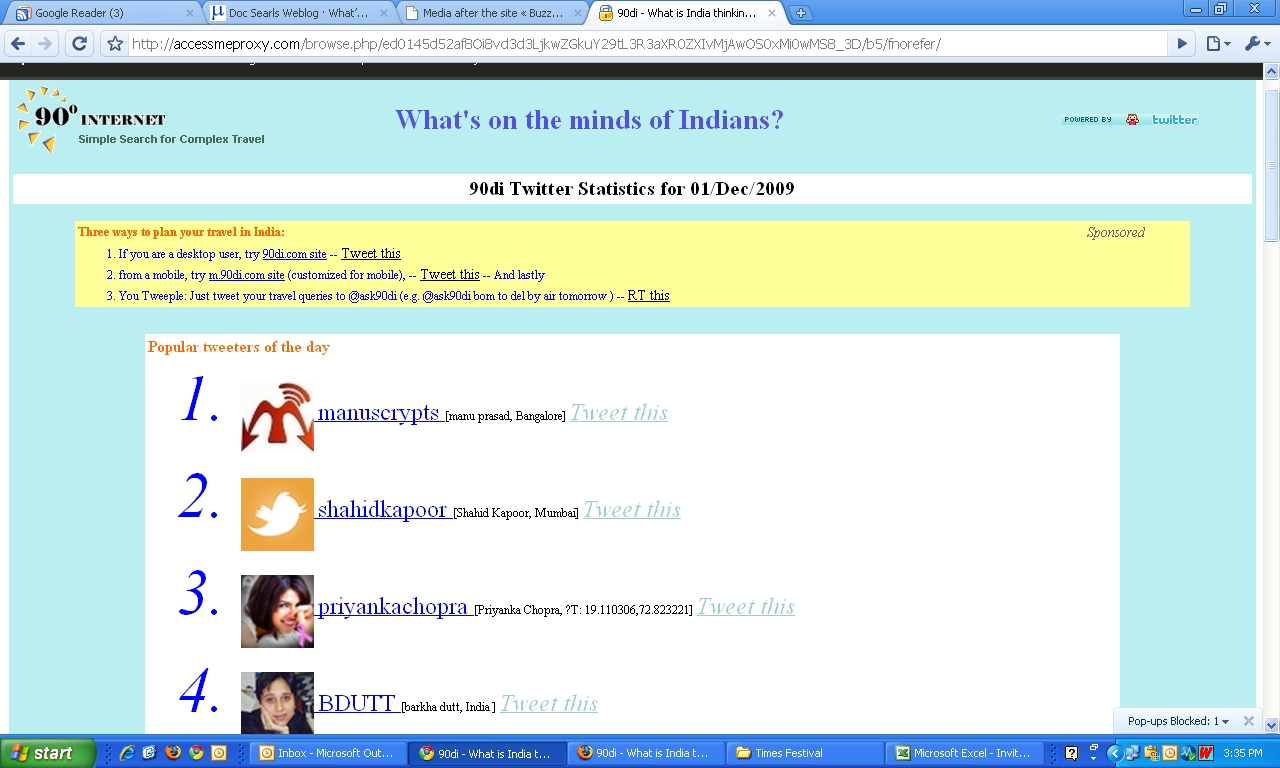
    And that little stunt led to the image being viewed some 2000+ times and my 15 seconds of fame as India’s most popular twitterer for a brief few hours, thanks to more than a 100 RTs from the twitterati. I also got a Samsung Galaxy from Tata Docomo. Ok, I made that last one up. :}

    Twitterer #1

    Yes, yes, don’t worry, I’ll still be posting here :p