
Category: Strategy

  • Facebook Groupie

    What kind of a blog would this be if we didn’t discuss Facebook’s new announcements. At a simplistic level, it would seem that Facebook learned a lot from that Google study. (via a conversation with Mahendra)

    Though i can’t access it yet, I’m very happy with the backup option, and hope that its a step towards portability. The new chat availability ‘visualisation’ seems slightly better than the old one. I can’t see the app dashboard yet.  But the other big announcement was the revamping of groups. I’d been categorising friends using lists for a while, but didn’t actually utilise them for anything specific. Though its easy to see this as a wall within a wall, from initial usage, I think the new Groups allow that one layer that needed to be added to generic ‘friendships’ – context, not to mention better control over who sees what. And from what I see, I don’t even have to be friends with a person to share things and have a great conversation on a topic both of us like. There are other advantages too. Of course, there are a a few issues, and as always, Facebook kept everything as public as possible (as default) but changes in this version is as inevitable as the waves of outrage that follows all Facebook announcements.

    I’m still debating whether I’d like the Groups to be integrated better in the newsfeed (with ways to filter as per importance) or whether its current location (sidebar) is a better approach. From a signal-noise perspective, perhaps it should stay the way it is. I’m not very convinced about looking at Groups as ‘Friendfeed going mainstream‘ or even Wave. But that does make me wonder whether the next version will also have a feed aggregator, directly, or indirectly – allowing apps like Networked Blogs. That might actually get RSS to go mainstream. 🙂 If that happens, I am also wondering about the implications on Google Reader, and actually any other network which serves as a content distribution/consumption channel.

    Groups can be made ‘Secret’, and I’m still not sure how ‘Open’ and ‘Closed’ groups will show up in Facebook Search. Also, since I still don’t have access to Places, I can only wonder whether ‘Location’ can also be made a group feature. I’m seeing both the above from a brand perspective. Would a brand, for example, be able to highlight a location specific group on their Page, as part of a local promo? Even if the brands do not get information about the groups, Facebook would still have it, and that would definitely help target ads better.

    Groups are not really a silver bullet, but I don’t think Facebook is aiming for that now either. Its just that they’ve not missed the starting gun, to slice and dice my social graph – that’s useful for me, as well as advertisers.

    until next time, group on 😉
  • Social Scaling

    The subject of this post has been visited before, thanks to an earlier note by Tac Anderson on the ‘3 types of social media strategy‘, and David Cushman’s excellent presentation the same topic.

    What made me revisit this are Tac Anderson’s post last week titled ‘Dam your social media strategy‘, which used an excellent analogy to present a 2 step approach to changing business strategy , and my own experiences in the last few months. In my first post that referred to the 3 types of social media strategy, I’d wondered whether it was possible to move from strategy 2 (optimising social media  for business) to strategy 3 (optimising business for social media), but my experiences later made me feel that it was perhaps (generalising) an inevitable approach, and this view has only been strengthened since then.

    However, the biggest roadblock I sense is in convincing an organisation and its internal stakeholders to look at the tools from beyond a ‘push communication’ marketing perspective especially after we start out on optimising social media. It is all the more difficult because this perspective is something they can identify with – just another channel, and one that’s ‘free’.  A twisted view that ‘Conversations are markets’. Just another place to sell your wares. 😐

    The challenge is to shift the focus from ‘media’ to ‘social, and from a purely brand centric view to one that encompasses the organisation’s internal stakeholders and consumers, and has a more holistic view of ROI. I wonder then, if it is actually better to start with something like ‘customer care’ or ‘operations’ and include ‘brand’ only at a much later stage in optimisation. Debatable. 🙂

    until next time, ambushing marketing on the brand team.

  • Culture Bridges

    There was much excitement when I saw that much talked about presentation that somehow seemed connected to Google Me and Google’s approach to social. But the sounds made recently by Darth Scmidt don’t really give cause for delight.

    While it doesn’t make sense to talk ill of something even before launch, the ‘social layer’ does sound underwhelming. It doesn’t help that Mark Zuck recently hinted that ‘social is not a layer you can add’. ( What is interesting though is he also said in the interview “We’re trying to build a social layer for everything”) He should know about what works in ‘social’, because whether you love or hate Facebook, it is definitely a creation (and creator) that demands respect, on various parameters.

    Somewhere towards the end of his post titled ‘The Forever Recession‘, Seth Godin, while talking of the ‘recession of an industrial age with its imperfect market communication’ paraphrases Clay Shirky and states that ‘every revolution destroys the last thing before it turns a profit on a new thing’.

    I thought about this statement in the context of Google and Facebook, and also remembered an earlier post at GigaOm which showed the difference  between the way Facebook and Google work. And that prompted me to wonder whether every age has a unique organisational and workforce culture that best fits it, and the entity that grasps it, succeeds.

    This is not just a Google-Facebook question, but one that I’d consider across domains and categories. The leader in an earlier era would try to capture that culture mojo and would most likely fail because it tries to add to what it has been doing so far, where a start from scratch is what is warranted. The interesting part is also that the time between ‘revolutions’ seems to be consistently decreasing, so how do brands and organisations carry their success across?

    until next time, a revulsion for revolutions?

  • Group Pwn

    I’ve never gotten around to trying group buying/deal sites until once recently, though I always thought that they were fulfilling a need for businesses and consumers. But when I read this ‘peculiar’ story titled Groupon’s Success Disaster, I found myself identifying with it (from a consumer perspective, we’ll get to that in a bit) and since the number of group buying sites in India is only a few numbers lesser than the number of social media consultants, I thought it made sense to spare a few thoughts on it.

    The (linked above) story is of a small business owner, who, after 3 months of using Groupon, discovered that the deals were hurting the business financially and then had to take $8000 out of savings to cover payroll. Considering that, I thought the Groupon reply has quite a cruel title – ‘Too much of a good thing‘, but it is well drafted.

    The win-win for business-consumer in this is because it gives the former a chance to spread the word on the service and probably get some feedback on it and the latter mostly gets a good deal. Like I mentioned, I used a site recently for what seemed like a good deal. Though the deal process was painless, I ended up spending more money than what I normally would, thanks to a mis-communication (and some carelessness on my part). It means that I won’t be a repeat customer. It ends up as a lose-lose. Now this is probably the exception to how it usually happens, but…

    It did make me think whether the business owners get into deals with a strategy in place. Not just in terms of finance, but also in terms of their expectations of buzz, their delivery capability as well as how they’d manage to make the customer return. When it is kept in mind that social platforms and deal sites are mostly interwoven, I think it’d make sense for the business to use their service delivery (assumed good) and connect it to their social presence. A “We hope you liked it. Here’s an x% discount for your next visit and we would really appreciate it if you could leave your comments on FB/Twitter” approach. Facebook would especially help the business to spread the word beyond the usual early adopter set. While on retail, its difficult not to mention Foursquare. Though I’d love it if Foursquare aggregated the deals themselves, the businesses definitely can get active on Foursquare and push their deals to users nearby.

    With the (limited) examples I’ve seen, I doubt whether this is being done. So it reminds me of a lot of advertising,  and most social media efforts. The former because the message and the product/service are rarely (generalising) in sync, and the latter because of the lack of strategy and the herd mentality.

    until next time, regroup!

  • Jump with a crowd

    ‘Jumping the shark’ is a phrase that has been jumping on to my face regularly, but something that got lost in the rigours of speed reading and processing. Thanks to Tom Fishburne’s excellent post on the subject in the context of brands, products and organisations, I got to think about it a little more. The quick definition would be (from the post), “the moment of downturn for a previously successful enterprise.” The problem with it? “The risk of jumping the shark isn’t getting eaten by the shark. It’s leaving your loyalists behind.”

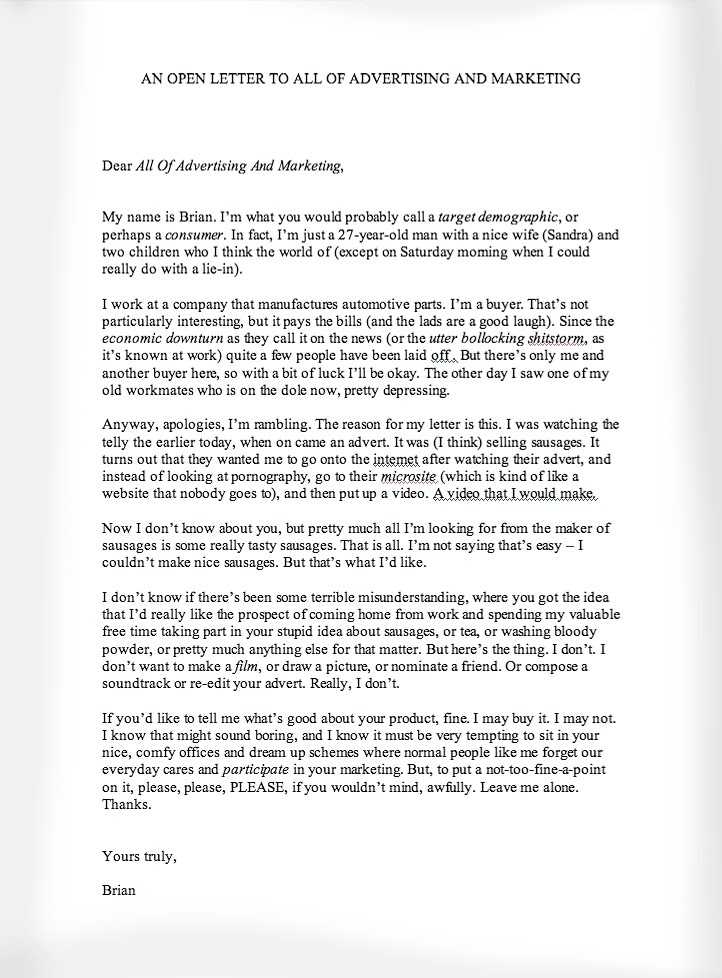
    I thought about it a bit, not in the context of brands or businesses, but more in terms of brand communication as a field, advertising specifically, and brands’ usage of the social web. Consumption patterns, media platforms available etc had pretty much created templates for creative agencies over a period of time. But the arrival of the web, social platforms and the democratization of media have managed to disrupt the ways of the one-way communication age. This post is a good one to read in that context, and talks about the change digital has made to campaigns, and the ‘role of the consumer’. But desperation, hype and the eagerness to get on board makes everyone concerned ‘jump the shark’. And unfortunately, the way I’ve seen many agencies and clients execute it (purely as a consumer), I’m quite inclined to agree with the author of this hilarious letter. (via PSFK)

    Clipboard01

    (click to enlarge)

    The job of the brand manager/creative agency is obviously a more difficult one now, and is made even more so thanks to the approach – of tool strategy. Like this (old but) excellent post states, ‘the technology that underpins social media is changing fast’, but its ephemerality ‘is a feature, not a bug’. It made me wonder whether brand communication/advertising, as a process (the way we see it now) had ‘jumped the shark’, mostly because the thinking process still sees  social platforms in the same light as traditional media and has not changed to be in tune with the former’s dynamics. In other words mistaking social media marketing for social media.

    Maybe they have to dig deeper, figure out the value that people are willing to pay for, and then find their ‘purpose idea + social object‘, and consistently. But that would mean a sea change in the way brands and creative agencies operate. Is adaption possible, or is complete disruption inevitable?

    I juxtaposed this thought with something that Seth Godin wrote recently, about the ‘red zone‘ – the joyless part of the learning curve. His graph also has a green dot, which represents ‘someone on the other side.. rooting us on, or telling us stories of how great it is on the other side’. Perhaps if brands can find from the existing consumer crowd a few who believe enough to play the ‘green dots’, they can adopt a more holistic approach to social platforms and carry the loyalists without it seeming like ‘jumping the shark’?

    until next time, safe jumping.