
Category: Strategy

  • While on contextual reputation…

    Though I don’t answer much on Quora, I am quite a gawker and vote up answers too. One feature of Quora that I found extremely interesting and useful (and tweeted about) is the way Quora gives contextual ‘reputation’ (while reading answers) using the person’s topic bio. The interesting coincidence (because he also RT ed this tweet) is that I noticed it thanks to Mahendra‘s answer to a ‘Google Reader’ based question, and right next to his name was “Daily, dedicated user. Subscribed to over 200 feeds, followed by over 700 people on Reader/Buzz”. I must admit, before I realised that it was a topic bio, my first thought was why Mahendra was ‘wasting’ his Quora bio on Reader when he had such a huge list of phenomenal things he could say about himself. šŸ™‚

    But yes, coming back to ‘contextual reputation’, I liked it because it gives a lot of relevance and credibility and adds a layer to an answer – you can better understand where thisĀ  answerer and his response is coming from, for example. Another nuanced way of helping the reader weed out noise. I also thought this was a good way for brands/organisations to develop credibility in their domain, and involve their users, using function specific spokespersons, (brand, HR, operations etc) since “brands are currently not supported on Quora“.

    And now we can go off on a tangent and check out a few brand experiences I had last week, all with oblique connections to contextual reputation, though lycra like they might seem šŸ™‚

    When Airtel changed its logo sometime back, though there were infinite debates on the need and quality of the new logo, their on ground management of the logo change was almost unequivocally appreciated. However,
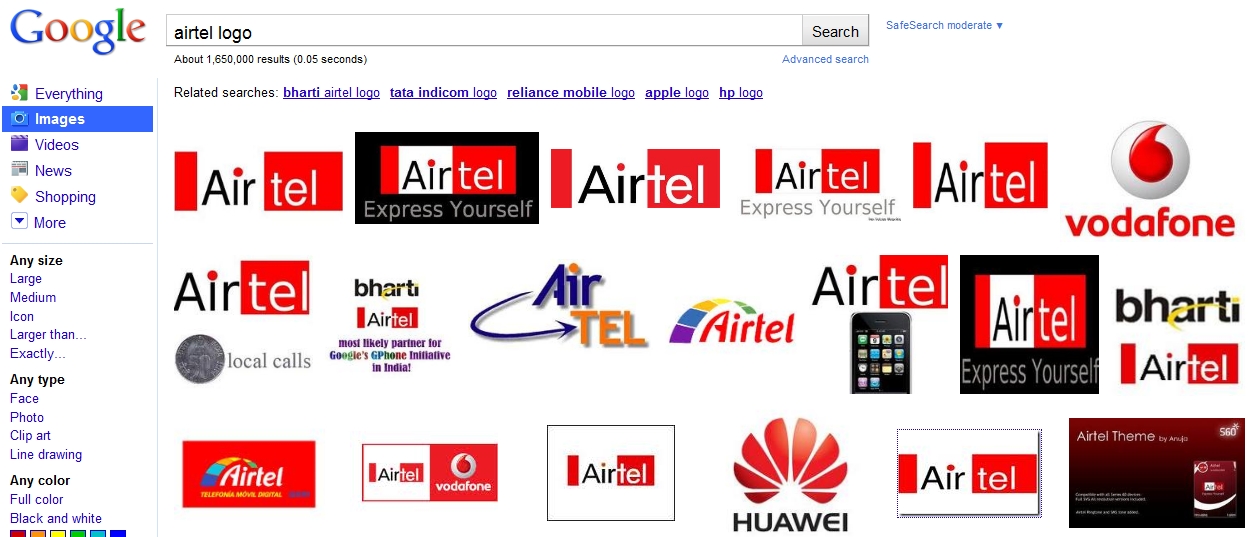
    To their credit, the ‘everything’ search, though has the old images, has the first link pointing to the new logo. But from an image perspective, ‘contextual reputation’ for logo change online gets a thumbs down.

    Cleartrip, quite a favourite brand for their ‘no nonsense. clear talk and action’ way of managing their product and online presence, has a new campaign ‘Every trip has a purpose‘. But favouritism unfortunately doesn’t stop me from wordplay and I tweeted
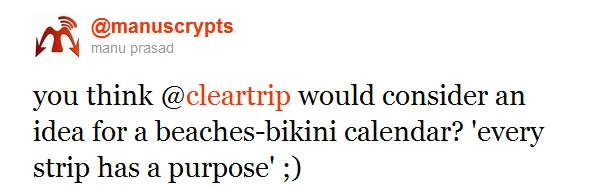
    Just as i was chided for provoking a brand, and was replying that I trusted Cleartrip to have a sense of humour, they replied with a ‘laughing hard’. Contextual reputation thumbs up. Hopefully they weren’t being sarcastic.

    The last experience was from Tanishq, whose new Blush campaign I came across last week. Like I tweeted then, immediately after the Quora tweet, I found it quite interesting and worth an applause that a brand was experimenting with a Firefox/Chrome plugin. Instead of me explaining how it works, I will, in my new found enthusiasm for imagery, give you a screenshot.
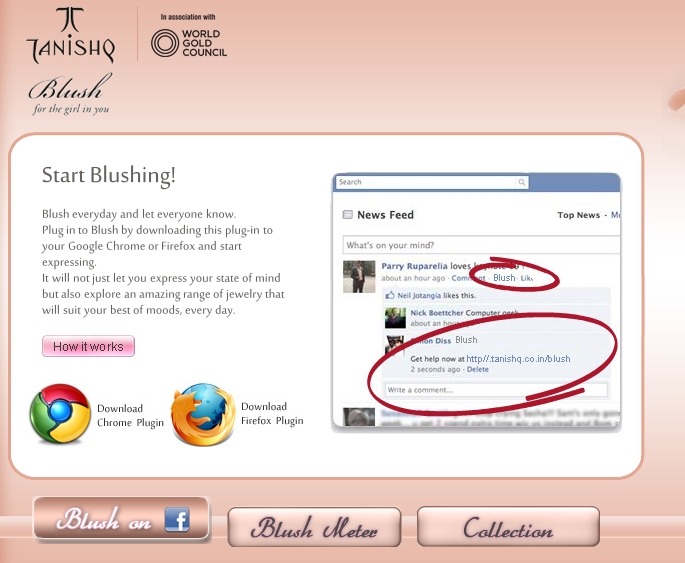
    As you can see, the plugin gives you, in addition to the ‘Like’, ‘Comment’ options you see after a Facebook status, a ‘Blush’ option, which when clicked, adds a comment with a link to the ‘Blush’ page. Hmm. I won’t get into a ‘app within FB vs outside website’ debate (there must be some reason, I assume). But unfortunately, boring that I am, I’ve never seen a jewelery that has made me blush. I can’t even see it in the Tanishq collection, assuming that I have the ‘where to wear it’ right. Maybe girls/women see it differently. So, why didn’t Tanishq just have a ‘Gold’ button, which would actually add to their ‘contextual reputation’ more than blush, and tie it to some sort of action that would actually get something tangible for all involved.

    For example, I install the plugin and start using it just because of the ‘show off’ value. What if they tied in an offer linked to the number of “Golds” I gave/received on statuses, and then communicated that in the comment that appears after I have ‘Gold’ed a comment. Or how about virtual gifts, a way to showcase the gallery, and then an easy app to add the virtual gift to a profile pic? I have an inkling that women are likely to have a “nice earrings/pendant. where did you get it from” conversation. They could even make this Like based contest i.e. if you virtually gift someone and get them to add it to their profile pic, and they get maximum likes (make a leaderboard) we’ll let you actually gift them for free. Do that on Valentine’s day, and it just might work.

    Meanwhile, I have a ‘reputation’ for longish posts, so I’ll just stop here.

    until next time, add to the context?

  • Appeasing consumers

    Last week, I had asked on twitter whether Indiatimes should consider buying/building a GroupOn clone and use its other media platforms to scale the business, especially since its also proxy advertising for their clients. In response, Shahid had wondered what prevented an Airtel from getting into it. The point (simplistically) being that, any platform owner with a ‘captive’ audience could get into the business.

    It made me think about the mobile as a platform, especially considering the app talk I’ve been doing on the blog for a while now. While appification across platforms is what I’d discussed last week, for the purpose of this post, I shall restrict my thoughts to mobile platforms. Even before I read and wrote about the appification across platforms, I had asked a question on qoura “Has any Indian bank considered a smartphone app?”Ā  (http://qr.ae/GETp) I got 2 answers, and though I was looking for Android, they were still helpful – Robin Samuel pointed me to ICICI (I think Gopi had also mentioned it on Twitter) and Aditya Sengupta mentioned a Nokia Money + YES Bank pilot.

    Citibank, whom I bank with, had a few Android apps, I noticed. The Citi Hong Kong app was specially interesting, since in addition to location of ATMs, they also display offers nearby. I’d obviously like an app which will also help me transact, and they have that too, elsewhere. (they are by no means, the pioneers or only ones, as a google search would tell you). The idea here, though is a ‘commodity’ service (banking) increasing user convenience, and making a shift to another bank less appealing. This isn’t an ad vs app debate, but spreading this information would be simple enough (without mass media) during consumer acquisition, as well as later through digital and social platforms. Maybe even tie up with a mobile manufacturer and offer to subsidise the handset for the consumer in return for publicity. The point, platforms are exploding and brands need to think of new ways to associate and partner. These apps could itself evolve into a branding vehicle.

    And since that point is made, we can broaden the scope beyond mobile as a platform. Just in case you thought brands might be constrained with that as the only option, how about TVs, kitchens, laundry rooms, cars, tables? Check it out.Ā  (via Avi Joseph)

    until next time, Applying minds šŸ™‚

  • All hands on deck

    Since tis still the season of predictions and ‘looking forward to in 2011’, and because I brought up the subject of brand agencies reshaping themselves for the future, I thought I’d share with you three of my favourite decks of insights from the many that I managed to scan in the last few weeks.

    We’ll begin with JWT’s ‘100 Things to Watch in 2011’. (via Surekha on Reader) While there are many things in this that you might already think is a trend, what I liked about it is its thinking outside of any specific prisms – brands, technology etc, but still managing to capture theĀ  essence of trends in human behaviour, culture, consumption, the shifts happening therein, and thus, a good reckoner for marketers.

    The second one I’d like to share is Edelman’s ‘Digital Trends to Watch in 2011’. Though there are a few commonalities with the JWT deck, this seems more focused. While this is definitely quite a sensible thing to do from a client perspective, I missed the “completely out of the blue, but damn, why didn’t I think of it?” moments that I usually associate with its creators. But that’s just a testament to my high regards for Armano and Rubel, more than anything else. What I liked most about this was the trend + best practice combining, that layering gives excellent perspective.

    The last one I’d like to share is Rohit Bhargava’s ’15 Marketing & Social Trends to watch in 2011′ (via Gauravonomics). There might be some overlap with the other two, but again, the idea of examples with each trend makes it a must-read, in addition to the overall quality of insights.

    While its easy to see that there are commonalities in these, I also noticed an interesting thread of thought thatĀ  resonated most with me.

    ‘There’s an app for everything everywhere’ is perhaps the underlying theme in #3 (Apps Beyond Mobile), #7 (Ubiquitous Social Computing, more specifically its best practice) and #9 (Appification of the web) in the JWT, Edelman and Rohit presentations. We then move on to ‘production of consumable content and experiences across platforms’Ā  that connects #93 (Transmedia Producers – faint connection), #4 (Transmedia storytelling) in the JWT and Edelman presentations respectively. And at last, we move on to how it can scale which is brought out through #3 (Developer engagement) in Edelman’s presentation and #7 (Crowdsourced innovation) and #11 (Employees as heroes) in Rohit Bhargava’s presentation.

    While I may not endorse a brand strategy only basis tools, the ‘appification’ across platforms actually throws open the door for marketers to not just satisfy their ‘short head’ consumers in better ways, but explore the ways to reach the ‘long tail’. It allows them to blend or distribute their ‘story’ across platforms and if done well, raise the interest level of their consumers. And an agency or brand manager cannot do it alone. While the idea of crowdsourcing is looked down upon by many, there are enough examples to show that if targeted well and executed with clarity, it can deliver results. More importantly, here, the ‘crowd’ is not consumers, but developers who can re-create the brand’s experience on multiple platforms, and employees who can create a human story that will resonate with others.

    If these possibilities for 2011 don’t excite you, I’ll try again next week, but I really don’t have any more of these awesome presentations to back me up.

    until next time, slide rules!

  • Social + Scale = #fail ?

    Remember the post on Social Media Explorer titled ‘Is Content Marketing the new Advertising?’ I had linked to earlier, while on the subject of content, media and distribution?

    To me, content marketing will indeed be a key player in a brand’s strategy – communication and otherwise, because with the explosion of content across various internet and even other delivery platforms, and the increasing number of stimuli that the typical consumer is subject to, sheer volume might be needed, in addition to context, and relevance.

    So, the thought then moved on to the creation of content. There are constraints to what UGC can achieve, and all brands may not have that luxury. So, what would be a good way to generate this in-house? Ā That’s when I looked at it from the perspective of last week’s post – on the evolution of ‘social’ as a concept and the software it entails, and the subject of how social media will scale?

    And not surprisingly, I arrived at culture. And a rewiring that will include changing roles in the various functions of the organisation. The two that come prominently to mind? HR, to not just use the tools at their disposal and hire people who have innate passion for the organisation’s domain, but also in being the torchbearer of the organisation’s new culture. Marketing, to harness this in-house talent, surface their creations – product or content or service processes, and see how it can be scaled and communicated.Ā This would not only connect people with a common interestĀ  internally but also empower them, make them feel responsible and enable them to communicate this to an external crowd using their own networks.

    These are only a couple of thoughts in a couple of functions, but even getting the rest of the organisation aligned around these might be a good start. More importantly, when this happens, the organisation might be then better equipped to engage with the crowd, culturally and operationally. ‘Social’ could then aim to scale.

    until next time, multiply and rule šŸ™‚

    For those interested in the subject

    Gautham’s post on social and scale

    Social Induction, my post last week on social software and the larger purpose.

    My last few posts on social and scale – 1, 2, 3, 4, 5

  • Social Induction

    ‘Disparate’ perhaps wouldn’t describe it best, but definitely 3 different posts in terms of scope and point of focus, but which I thought were in their own way, circling one of this blog’s favourite topics – how organisations can fundamentally become more social – not just from a usage of tools across its ‘silos’ but more from an ‘adding meaning to the individual and society’ perspective.

    Stowe Boyd’s post titled ‘Are you ready for social software‘ not only gave me perspectives on the subject of the post, and title – social software, but also gave me a way to connect these three posts. He starts of with challenging the belief that Sherlock Holmes used deduction to solve the mysteries.

    It turns out he (or better, Arthur Conan Doyle) was using induction, which is, according to Webster’s, ā€œthe act or process of reasoning from a part to a whole, from particulars to generals, or from the individual to the universal.ā€ In working from a paltry collection of clues to a full understanding of the actions and motives of the butler and his victim, Holmes/Doyle was, basically, developing a picture of the universe surrounding the crime from a few hints.

    He goes on to distinguish social software from software built for several purposes taken to mean ‘social’.

    Social software is based on supporting the desire of individuals to affiliate, their desire to be pulled into groups to achieve their personal goals. Contrast that with the groupware approach to things where people are placed into groups defined organizationally or functionally…..Traditional groupware puts the group, the organization or the project first, and individuals second….. Social software reflects the ā€œjuiceā€ that arises from people’s personal interactions. It’s not about control, it’s about co-evolution: people in personal contact, interacting towards their own ends, influencing each other.

    Its a fascinating read and he quotes Kenneth Boulding, the economist, humanist and social scientist,ā€œWe make our tools, and then they shape us.ā€ I thought that was an amazing way to look at it, and if you think for a moment on how tools have changed the way you behave, interact, consume, I’m sure you’ll appreciate it too.

    Amazingly, even without getting into software or technology, I saw an application of this thought process in Tom Fishburne’s Wiki Wall, a symbol of organisational creativity that could prove more useful than the traditional ‘brainstorm’. The wiki wall (a real whiteboard/surface)Ā  allows ideas to be shared, collaborated on, and evolve over a period of time beyond the silos that the organisation might have. Shared belief systems and thoughts around which people could group together.

    Which then brings us to the ‘larger purpose’ that an organisation exists for. This purpose is something that has popped up here many times in the recent past, the last being ‘A Social Culture‘. I found it expressed extremely well in Umair Haque’s post on the way ‘social’ needs to evolve.

    Social is significance. The real promise of social tools is societal, not just relational; is significance, not just attention. You’ve got to get the first right before you tackle the second — and that means not just investing in “gamification,” a Twitter account, or a Facebook group. It means thinking more carefully how to utilize those tools to get a tiny bit (or a heckuva lot) more significant, and starting to mean something in enduring terms.

    For now, most organisations are looking at social tools (including software) to meet their business ends, and not looking to make the business’ ‘reason for existence’ itself something people – both employees and consumers- would associate with. Hopefully, by the time they deduct the importance of this, it won’t be too late.

    until next time, elementary? šŸ™‚