
Category: Strategy

  • Consistency and cohesion

    Google’s Search Plus your World once again made me think about consistency, (in terms of a brand’s voice) a subject that finds frequent mentions here.

    Consistency in branding has been a golden rule for a long time. But by now, brands would be used to seeing their messages layered with the contexts and perspectives added by users on social networks. Considering the transient nature of the feed and search capabilities, and despite their inherently ‘viral nature, brands could still console themselves a bit about reach.

    After all, despite the march of the social networks, Google was (and is) still easily dominant when it comes to specific search, and brands could still play a few SEO/M games. But now, Google is accelerating its social fusion into search; the layering will happen here too, and the incumbent search gaming tools would start getting blunted.

    In this context, I wondered if brands should probably move from consistency to cohesion. Consistency was a good tool in a mass media era when one way distribution and a linear flow of information ruled. In this era of collaborative media, cohesion factors in context  – time/place/person etc to the brand’s message. It lends flexibility to the brand’s voice, qualifies it, and helps empower internal and external customers. So, rather than getting an OCD over exact phrases, colours etc, the brand custodians could work on how best to package the brand’s core DNA in different settings. Then, even if consumers don’t share as-is, at least the brand’s perspective would be context relevant. Your thoughts?

    until next time, consistently cohesive

    PS: My guest post on afaqs last year lists some advantages of this approach under “What happened after the TVC ended?”
  • Good cop, bad cop

    Identity in era of social media proliferation was something I brought up in last week’s post. Since then, my office has shifted, and I have to travel a little more to get to the new place. Instead of going below the elevated highway, I take a shorter route that gives me elevated views every 5 minutes thanks to ‘amateur’ humps. But the traffic is better. Traffic and violations – that’s the connection.

    A few months back, a video on the Facebook page of the Bangalore Traffic Police made headlines. The cops asked for help in finding the errant car driver. (I’m not sure if they did nab him) Since then, I’ve seen increased participation on the page, with users adding photos of traffic violations, ad campaigns on safety and questions being answered by the cops themselves, though that’s occasional. In many cases, numbers of vehicles are clearly visible and I’ve seen one in which the cops have noted a violation by a fellow officer, uploaded by a user. This, and the brouhaha over the London cops naming and shaming those involved in the UK riots last year made me think about individual identities beyond virtual social and in to real social.

    Though we are still at a stage where even a person’s social, let alone all online activities cannot be comprehensively tracked and measured, technology on that front is rapidly catching up. In the near future, real world tracking technologies will probably catch up too. We’re already seeing signs of the worlds colliding. It is then possible that the social identity of a person would include his real-life actions too and a ‘Klout’ would probably have a holistic ranking of an individual, one that includes traffic violations and philanthropy and so on. 🙂

    This is probably one area where brands will then have a head start, because naming and shaming them is something many of us already do via social platforms. I wonder if we will be more lenient towards them after we get a dose of identity warfare.

    until next time, coping with cops

  • Looking ahead

    The last post of the year is a mix of several things that caught my attention.

    Nick Bolton’s article “Disruptions: Wearing your computer on your sleeve” triggered a series of posts, and my favourite was the RWW version, because it brought out a variety of perspectives and potential use cases, ranging from glasses that act as guides for tourists to “consensual imaging among belief circles” and “to overlay a trusted source’s view of a given scene on mine”.

    In an increasingly social world, the above would seem a very obvious choice. However, there’s an interesting statement in the post, attributed to Mike Kuniavsky is “I feel people already ignore the complexity of reality too much and tend to live on parallel planes that exclude ideas that challenge theirs.” I saw a related theme in JWT’s 10 trends for 2012 – “Reengineering Randomness” (#7), which acknowledges that as our world and consumption becomes more customised, there will be a greater emphasis on reintroducing randomness.

    As we try to accommodate both randomness and customisation, the factor that will determine many facets of our interactions is privacy – the amount to which we allow services to tap into our social stream. And that would dictate whether I’ll see a brand giving me a customised offer, combining social information, augmented reality, NFC…

    That brings me to my favourite trends deck this year, by Ross Dawson, which captures not just the above, but also more far reaching ones like “Institutions in question” (#4), and the fitting finale “Transformation not apocalypse” (#12) which sets the tone for an exciting 2012.

    until next time, happy new yeAR 🙂

  • Enterprise, Consumer, Interface

    Facebook’s new Groups at [university] feature, which allows users to create groups that are only visible to those with the relevant and authenticated .edu address, is probably the social network’s hat tip to its roots and a way to show that it can still play at targeted sharing too. However, what it reminded me of was enterprise tools like Yammer which also use authenticated addresses to create closed networks. Add to that Facebook’s other new feature being tested – private messaging between users and Pages, and I wondered if the authenticated domain feature couldn’t be used for creating enterprise networks within Facebook, which could then interface with consumers using Pages. In fact, that would even go quite a way in solving a user’s work/life identities by allowing him/her to have separate (but connected publicly/privately) logins.

    With Google+ launching for brands and thanks to circles, allowing a relatively easy (and measurable) flow of information within and outside the enterprise (I’ve begun experimenting with this @ Myntra), linking employees, consumers, partners etc through not just sharing but also through live video interaction, Facebook does need to go beyond its current offering for brands and organisations.

    Though I’ve not seen it in action, Twitters new proposition for brands, with better profiles, a new twist to promoted tweets, self serving ads etc do sound interesting and should probably lead to more interesting brand activities on the platform.

    The first generation of social media tools have focused on monitoring, engagement and some measuring. They will obviously have to evolve with the platforms’ own feature set advancements. (not to mention new platforms) Meanwhile, I’ve seen at least two forms of this evolution. Salesforce, which has, with the acquisition of Rypple, entered the talent management sphere, continues its march towards being a one stop shop (Chatter for enterprise collaboration, Radian 6 for social media monitoring, engagement and others). On another front, Percolate is aiming to solve an interesting problem area that I can identify with – sustained communication with consumers across platforms that balances interesting content with business objectives.

    New platforms, new tools, decreasing attention spans, new hardware and technologies and a relentless pace of advancement – 2012 promises to be exciting.

    until next time, horizon tally

  • Branded Spikes

    While waiting for the cognitive teardown of the immensely viral Kolaveri (like this Angry Birds one) in the form of either ‘What we can learn from’ or ‘How to craft videos like’ posts and also wondering how long it would take my Twitter timeline to move back from RIP to make-fun-of when a celebrity dies, I read this very interesting post titled “The New Patterns of Culture: Slow, Fast & Spiky” (via)

    It offers fantastic perspectives on creation and consumption patterns of culture, and digital’s weighty role in the changes being wrought. The limited ‘spotlight’ options of an earlier era (mainstream media) now have to co-exist with platforms and mechanisms that are open to most. ‘Scale is no longer a guarantee of stability.‘ Consequently, attention is the more coveted prize. Another related phenomenon is that ‘Change no longer happens all at once for everyone‘. I remembered ‘IsItOld‘ when I read this. 🙂 I sense quite a few concepts agglomerating here. Small ideas, which I haven’t written about for a while now, and transmedia storytelling, for starters, and a reversal of polarity. (the last via Neil Perkins post, linked to earlier)

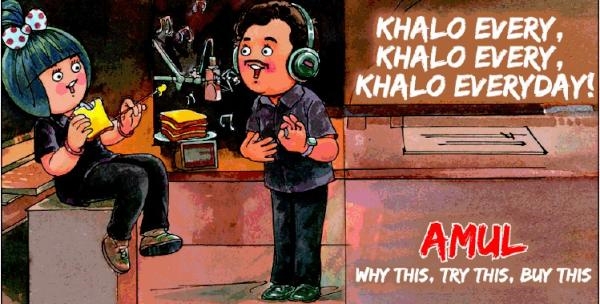
    Brands have always been using popular culture. One brand that I can immediately think of is Amul, and yet, I almost missed their Kolaveri ad. (via) Yes, not the greatest, but decent. The point here is that while they got the creation right, the distribution is still iffy. And that’s another challenge. Popular culture is more complex than ever before. With the abundance of content and platforms, keeping a watch on the long tail of culture, prioritising according to the audience-fit and then distributing it is not going to be an easy task.

    I have always liked (and hence, borrowed with credit in presentations) the analogy of bonfires and fireworks to social media and advertising. (respectively) The implications of this are not just in standard brand advertising but also in branded content. Brands now have to think of how the long-term story and the spikes can work together and ideally, complement each other, even while figuring out what role advertising and branded content play in each. Despite the seeming fit of social media to spikes, I wonder whether we will, in the medium term, see a role reversal – ‘mass’ media providing spikes and the internet dealing with the long term story, before settling into shared roles.

    until next time, get a spike mike