Category: Strategy

  • Life After Like

    That was the title of my presentation at Indian Social 2012, where I was one of the speakers (row 3, column 1) at a panel whose topic was ‘Measurement beyond Fans, Likes and Comments’. It was quite an amazing experience with some excellent speakers and panels. Ours was a power panel with a ’10 slides in 10 minutes’ guideline. (see the  presentations from other panelists here) Thanks to that, I was told by Dina, Surekha and Gautam, who were present during my talk, that an x/2 speed version of my presentation would really help. 😀 The slideshare embed and the scribd doc talk flow should help it move at whatever speed you are comfortable with. 🙂

    [scribd id=88357603 key=key-h1mc44428jwd4rafyu0 mode=list]

    So, that’s how it went – the wonderful experience of putting faces to names I’ve virtually known for a long time, meeting new people whom I’d like to stay connected with, and most importantly, being part of something that in my view will be (if it isn’t already) THE gold standard for social media events in this part of the world within the next couple of years. A big thanks to Rajesh Lalwani and the entire India Social gang for making it all happen.

    until next time, real socialising 🙂

    PS: Coverage on Exchange4Media

  • Purposeful

    Last week, my co-conspirator on the ‘culture’ discussions on twitter- Harish – shared a Forbes article on why top talent leave organisations. This was a distilled version of another article that had 10 reasons! So, “Top talent leave an organization when they’re badly managed and the organization is confusing and uninspiring.” As the author notes, the 10 reasons in the earlier article could be roughly divided into managerial and systemic reasons. My 2 cents is that bad managers exist because the system allows them, and sometimes even rewards them. When good professionals see ‘wrong’ behaviour rewarded, they realise it’s time to leave.

    The second of two pieces of advice that the author gives firms involves purpose and culture. Though it would seem that the former drives the latter, culture is capable of working towards or subverting an organisation’s purpose.

    As is becoming a regular occurrence, I had an article waiting for me on Reader – Umair Haque’s “Overthrow Yourself“, in which he draws out the fine nuances between an organisation’s vision and its ambition. The former is an egoistical version towards which resources toil, and the latter is a portrait of the human consequences that your enterprise (not just your “company”, but your ideas, effort, time, ingenuity) creates. Semantics, you might say, but I think ambition also acknowledges the sense of purpose of the individuals involved.

    To add to last week’s post, good professionals love to be empowered, and when they are, they love to be held accountable for the decisions they make, decisions that drive them towards achieving a purpose they can identify with. Probably every startup begins that way, but sometimes the vision takes over, just as in the case of social platforms.

    until next time, purpose.ly

  • Empowerment

    In ‘Is Kindness a Strategy?’, Jeffrey F. Rayport shares the story of an American Airlines employee who ingeniously helped a passenger catch a flight though he was late, by using the express lane for ‘invalid’ guests. He mentions that many colleagues of the employee might not be happy with her way of dealing with the passenger. He also writes about Ritz-Carlton’s use of “service recovery” – a company’s ability to respond quickly, decisively, and effectively to a service problem of its own making — is a powerful way to increase loyalty among existing customers. He rightly draws the distinction between the two approaches – they vary on who’s at fault, the customer or the company, and asks what any business might stand to gain if it oriented its associates to look out aggressively for opportunities to perform true acts of kindness for their customers.

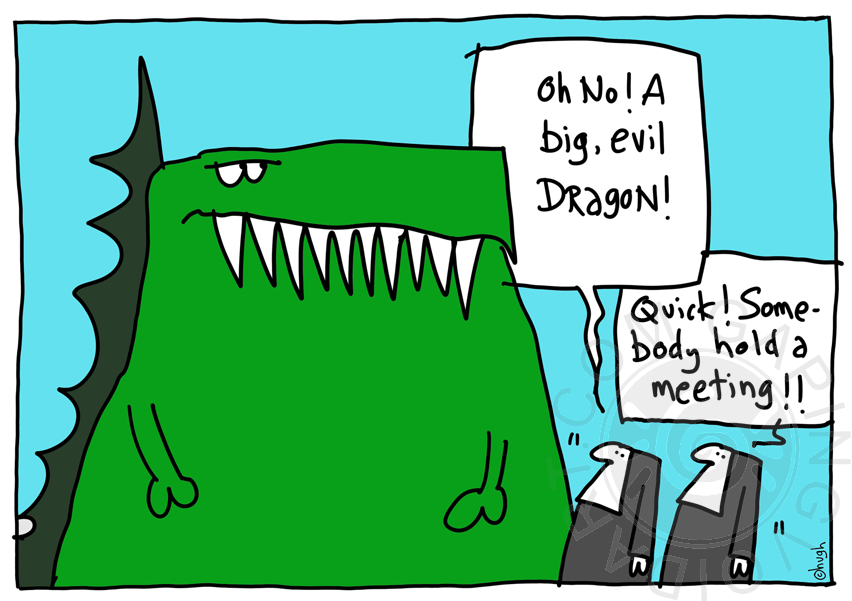
    In my mailbox, a few minutes earlier, I had seen this, in which Hugh MacLeod takes a (what I considered a) legit shot at meetings. As always, the toon says it all. When confronted with a business problem, (generally) the organisation’s first impulse is to meet, discuss, analyse and arrive at a consensus… probably 24 hours later. Yes, even when it involves a real-time platform.

    As I was writing last week’s post on culture, I was asking myself on the ingredients that make up a great organisational culture. Based on the above, I’d say Empowerment. When you have hired a professional to do a job that he has skills in, he/she should be empowered to apply his judgment to situations and not have to go through red tape or meetings involving people with minimal perspective on the matter. The first tenet of Zappos’ famous core values is “Deliver WOW through service”. In the same breath, Tony Hsieh also talks about “investing in a corporate culture that allows employees freedom and space” and follows it up with “If you get the culture right, then most of the other stuff, like great customer service or building a brand will just happen naturally.” On a related note, their unique hiring policy ensures that their sales staff don’t need scripts, they are trusted enough. It also ensures that an excellent culture is built by finding a fit between what makes the individual and the organisation tick. Empowering the employee so that he grows and so does the organisation.

    until next time, power trips

  • Culture.org

    For quite a while, I have believed that culture is the most underestimated and underutilised tool among the organisation’s means of gaining strategic advantage. A few like the much venerated Zappos have used this lapse to maximum effect and by assembling a group of passionate and aligned individuals generated profits and publicity, all while retaining a culture that continues to thrive. Remember “Anyone can do what we do, but nobody can be who we are.”?

    Last week, Maneesh wrote an excellent post titled ‘The Importance of Culture‘ that started off a discussion on twitter involving him, Harish and me. Having experienced a few instances when the influx of money into an organisation (not necessarily a startup) changed the internal landscape completely, I wondered whether scale (that many a time follows money) and culture are usually mutually exclusive. It’s not always so, but it takes not just a very skilled management team, but also an empowered employee bunch down the line to make it happen. It takes communication, rewarding the right behaviour and a lot of clarity to ensure that the culture is not lost. To quote from the post, “Culture is attitude, it is not behaviour. Everyone knows this, but we all get it messed up.

    When he linked professionalism and culture, I smiled because I remembered an incident from a couple of years back. That (very interesting) discussion, which prompted this post, was on whether passion or professionalism could better help the organisation scale. For various reasons, at that time, the two were mutually exclusive in the organisation. I argued for professionalism, because to me, it represented consistency and reliability. We both refused to accept the easy compromise of ‘both are necessary’. Towards the end, the management guru equated a professional to a mercenary. To me, the difference, was in alignment. In that sense, I agree with Maneesh that professionalism is practically non-negotiable. To quote from the post again, “You become a professional when you care. Your culture defines what you care about.

    A couple of days after this discussion, this tweet appeared on my TL

    Posts across years, across industries, across lines of work, but if you read them, you’ll sense the similarity.

    To me, culture is not a fancy set of perks and trappings that money can buy. It’s a sense of belonging, a feeling of being connected to a set of objectives and activities that give the individual a sense of purpose. A sense of enjoying the ride even when it’s a tough one, because you know there are many who will be your parachute in case you fall off a cliff that you didn’t anticipate. When that feeling is lost, the light in the cubicle is switched off. More often than not, permanently.

    until next time, culture counter

  • Pinning it down

    Though it’s almost been 2 years since it launched, the buzz on Pinterest has grown stronger in the last few months. This infographic should help you get a quick update. The ‘experts’ are polarised on this, and I have seen some digs on my twitter timeline, which remind me of the things I used to hear about Twitter on Facebook. 🙂 Will Pinterest grow that big? I don’t know, but it always helps to build one’s own perspective.

    This is one of those social networks which have not been easy for me to adopt. As the text-only posts here would indicate, I am not an ‘image’ person. 🙂 This was probably why delicious worked for me very well. But I did manage to find my own applications of Pinterest, most significantly, my infographics board, which is now nearing a 100 pins, and others that I enjoy – Angry Birds, Star Farce, and so on. One apprehension I have is whether it will go the way of all social platforms when they go more mainstream – from pinning ‘what I like’ to ‘what I think you want to see’ or ‘what I want you to see’. An extension of the carefully crafted persona.

    But meanwhile, over at Myntra, we have created an account and have been busy pinning and ‘boarding’. We’re in the process of experimenting with the platform, and as part of that, have also integrated it on our fashion blog. We have already found quite a few use cases for it, and I plan to consolidate that before moving further on boards.

    One of the most interesting stats in the infographic I shared earlier is that Pinterest has now beaten twitter as a source for referral traffic. From a brand perspective, this is indeed turning out to be an interesting tool, especially if the brand is related to e-com or fashion. Many fashion brands are already there. In fact, JustFabulous is even doing an extremely interesting Scrabble based contest there. I’d think that food, travel, and other visually appealing domains would also do well here. In fact there are over 100 brands across categories already on Pinterest.

    So, should you believe the hype? Not necessarily, but as a brand marketer or a social web practitioner, I think it’s probably a good time to take a long look at Pinterest and see if it can deliver value to your brand. It could be traffic generation, relationship building, or thought leadership, and these are just a few use cases. Unless you play, you won’t know. 🙂

    until next time, you could fancy this too 😉