
Category: Strategy

  • The price of influence

    Speaking of trust, between a corporation and consumers, one of the earliest controlled version of ‘outsourcing’ it was celebrity endorsements. I use ‘controlled’ because organic WOM is not really in the corporation’s control. Though it is still in vogue, the credibility is possibly dented thanks to abuse by the endorser, the endorsed and a media that creates more ways to make an a$$ of the end consumer. eg. passing off ads as content.

    In the era of social networks and lightweight interactions, the beneficiaries of this decline would be micro celebrities (MC from now) who have created their own circles of influence in specific domains. I remember writing about that – over 3 years back, and following it up later with influence cycles and the tool based influence calculations being used by brands for promotions. The platforms used by these celebrities could be any – twitter, blogs, Pinterest etc and it does allow the brand to customise their interactions basis the medium itself and with help from the MC, use the strengths of the medium to the hilt.
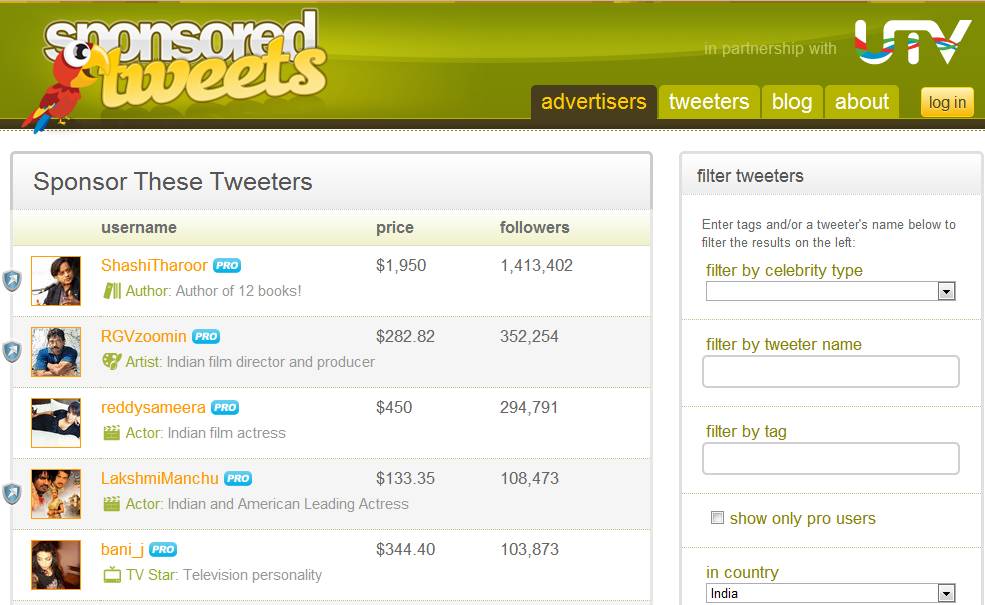
    I was hoping that it would evolve such that brands would identify MCs who would be connected to their own category and therefore would wield their influence among people interested in that category. But judging by the directions the platforms are taking, the equations seem to be becoming closer to the earlier forms of media, and ignoring the social aspect. When Vijay shared this and pinky-swore that he wasn’t playing an April Fool prank, I was even more convinced of the direction. Full circle. Hopefully the lessons will be fast, and the new cycle will begin soon. 🙂

    until next time, influenced?

  • Brand experiences

    Twitter’s event based hashtag pages (as opposed to brand based) made me think about brands as experiences. In another era, the ‘experience’ was restricted to a limited number of media vehicles (and I include non-social network WOM too) and the actual touch-feel, pre or post purchase, including retail outlets. But times have changed – social, media and technological platforms have increased the experience touchpoints manifold.

    A big fallout of this, with relation to brands, is the challenge they face on building a cohesive (no, not consistent) experience across these hugely varying platforms. We’re still at an early stage in this and though many brands like Starbucks have taken this challenge head on, others will probably take time to adjust to this flux that seems like a permanent state from now on.

    An interesting meta version of this, to me, is what is happening with Facebook. Product is more or less brand in this case. The Open Graph and the ubiquitous Like button had set a good stage for the network, but the recent business push (read Ads) and the “Mobile is to Facebook what social is to Google” death mumbles seem to be testing FB’s ability to adapt to the ever changing landscape. I am a very mild user of Path, but I sometimes wonder if it or others like it is the future because of its obvious comfort levels with the smartphone.

    But I also wonder if Facebook will split its services (like Messenger already – remember Beluga) and build specific value with an assortment of contexts eg. photography, (Instagram) location (Gowalla) and so on with the social layer working ‘quietly’ in the background. Facebook is also moving from the Like button, whose ‘meaning’ remains divided between marketers and consumers 🙂 , to (reported) Want, Purchased, Donate buttons that allow better consumer expressions and also allow brands (and FB) to contextualise experiences. These are only a couple of example of how Facebook is trying to evolve. In Facebook’s negotiation of its landscape, I think there will be lessons for brands -(whether FB succeeds or not) on adapting to platforms, consumption and technology itself, and creating a brand/product experience that uses these to its own advantage.

    until next time, advance booking

  • Deconstructing a viral

    Google’s Project Glass demo was the best product demo I’d ever seen. The sheer possibilities with such a device was amazing, but in essence, it was the theatrics that impressed. Everyone I shared it with shared it on.

    It made me think of the concept of a viral. From many murmurs I have heard around me, “Let’s make a viral” has only evolved, not died. The question of what makes a content viral is also asked when 2 or more marketers/social media practitioners are present. I find it a bit ironic that sometimes when ‘virals’ are named, I can’t recollect them. I first thought this was just me, until I figured out otherwise from other blank looks. But that’s not surprising, considering our increasingly fragmented consumption patterns across media platforms.

    I realised lately that if reach were the only parameter, then every TVC/newspaper ad, by sheer consumption, is a ‘viral’. So, a necessary caveat is that the reach has to be through peer sharing. But what good is an eminently enjoyable creative if it does zilch for the business? The viral is thus walking that exact balance between entertainment and brand objective. But would our current definition of a viral deem the Project Glass demo a candidate? I don’t think so. Nor would flipping on the Open Graph on a website and allowing multiple contextual actions to go across newsfeeds and Timelines.

    And that’s where the evolution is interesting – because technology is slowly moving from being an ‘enabler’ (euphemism for cheap means of distribution – YouTube/Facebook, I always felt) to being the best tool to weave in the brand story, and an inherent part of the experience. It goes beyond just social platforms and into Augmented Reality, NFC and other legacy/new technologies. I saw quite a few examples (via) – Buy the World a Coke, Red Tomato Pizza’s fridge magnet, even Amex-Twitter and one of my favourites for quite a while now – Nike+. Would we call these virals? I don’t know, but they were shared, seen, and tied in neatly with the brand experience. So probably what needs to evolve now is the marketer’s mindset on what he/she defines as a viral. The opportunity and the challenge is that when everyone’s a publisher, the marketer’s real job is to make it more share-worthy – conceptually and practically. That hasn’t changed. 🙂

    Since we’re on arguable territory here, do chime in.

    until next time, viral ‘producting’ as opposed to viral marketing?

  • Master Class

    Last week, I read a profoundly insightful post at Gaping Void, titled ‘On Mastery‘. The post seeks to answer (in Hugh’s own words) ““Suc­cess”. What does it take to be suc­cess­ful, pros­perous, happy, have a sense of pur­pose etc? What does THAT actually look like?” The answer, according to his post, is mastery. (do read his post for examples) When I shared this post on Twitter, Asmita related it to Chandni Chowk food vendors. Bingo. Around my own city – Bangalore- I can see examples of that. I can also see examples of when some of them have tried to scale and have fallen apart.

    Fame, popularity and money are by-products, but the master is not really dependent on that. In fact, he might even see it as undesirable side effects. As someone commented on Hugh’s post, it’s not even about the product, it’s the process. In Hugh’s own words “It’s something that truly belongs to you” and perhaps that’s why it’s so much more better, because there’s no dependency, unlike the by-products.

    It’s more of a personal learning for me, and it struck a chord as soon as I read it, as though I had the thought in my subconscious but lacked the cognizance to express it, even it to myself. In fact, I’d go on now to slightly disagree with Hugh MacLeod and say that for many people, mastery is success.

    Meanwhile, how does all this apply to business and brands? If I look at it through the prism of how things work now, I might be inclined to say that mastery cannot really scale, and I’d go back to my ‘Institutional Realignment‘ post and say that we’ll eventually get back to making mastery, a smaller ‘audience’, and a lesser scale the norm.  But in some ways, I can see examples of brands having mastered a culture and found a way to scale it – the much abused example – Zappos.

    However, if I had to look at it another way, I’d say that the web has made discovery much easier. Not in the traditional media way of ‘push the message to a mass and the interested ones will find you’ kind of a way, but the exact opposite. To use the data that people are sharing and through that, to find the right audience. The kind of audience who will appreciate the brand’s mastery, and who will then create good old fashioned community and word of mouth. The web offers tremendous opportunities to focus, but unfortunately we’re still in the early days of organised marketing and CRM data and most brands are busy losing focus and spamming themselves into oblivion, courtesy the lure of scale and its trappings.

    Of course, a part of me believes that mastery should have nothing to do with business, but as with many other things, the web might just change my perspective.

    until next time,  Master of Business Administration 😉