
Category: Strategy

  • Can media become social enough?

    A few days back, it was reported that Facebook now had a million active advertisers, and that LinkedIn has 3 million company pages. I’ll let that sink in, in case you hadn’t heard. Despite all the social-ness, I realised it’s impossible not to call it media. The wiki definition for media is “tools used to store and deliver information or data” That, for me, is a smartphone now! I also wondered how many media behemoths could boast of a million active advertisers. And that’s when it really struck me how much the traditional media we were used to have been sidelined – yes, they still get advertising revenue, but from a sheer reach perspective. Google, Facebook, YouTube and many more platforms get anywhere between a few million to a few hundred million visitors every day.  To put it all in perspective, TOI – the world’s largest English daily has a readership of over 7 million.

    Media and advertising have had a very intertwined life, unless of course the publication/channel has been on solely a subscription based model. I think the magic of Facebook (and Google, before it) and those that followed is that they have democratised advertising by not just making it something any small business could spend on according to their means, but also giving them the ability to advertise according to contexts – intent, interest, social etc.  Though Google, Facebook etc are still intermediaries, they never flashed their powers, though the latter has begun to, recently. As brands move away from a one-size-fits-all mode of advertising, these platforms give them more options of form and function, and changing the face of advertising. (Google’s exploits are known, here’s a pertinent read on Facebook)

    In such a scenario, what really does a traditional media channel have to offer to its consumers and clients? I’m not saying that they’re all going bankrupt next Sunday, but it’s clear which way the wind is blowing. One way, of course, is to use their brand value, and replicate (and grow) their audience on devices and platforms which better serve advertising interests. They can hone their value offerings by offering various contexts and their combinations – local, social, interests, and so on, and build business models for each. The early movers are already making big deals. But that is the red ocean that everyone is fighting for. How really can a player differentiate?
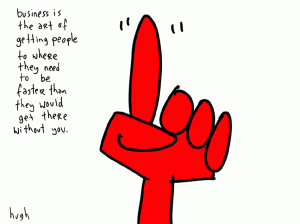
    Biz_Is_The_ArtI had a vague thought. Media’s original strength was its relationship with users and the trust involved. In the social media era, how can that be leveraged? Flipboard has already allowed users to become curators and create their own magazines. Is that the future, along with shared revenue on advertising? What if users can also curate the advertising their ‘subscribers’ can see? After all advertising is also news/information and has a certain value depending on the source. Traditionally, media  has been the middle man between advertisers and users, but what happens when everyone is media? Can media start aggregating influencers in every domain, including niches, provide them the material for curation, negotiate on their behalf to relevant advertisers, and share the revenue? Perhaps the next  disruption will be the platform that can handle the complexities involved. What do you think?

    until next time, mediator

  • Brands and the Personal API

    Lifestreaming and I go way back, at least 5 years. 2008 was when I wrote about it first, though the experiments had started earlier. Most of the services I’ve mentioned in the post are now defunct, but my interest in the subject never waned. From the perspectives of memories mentioned in that post to speciation to brands using their lifestreams to build communities around it, I have had several thoughts on the subject. That’s why I found this post at GigaOm, which was about Foursquare co-founder Naveen Selvadurai sharing data logs from his life (weight, sleep, activities) and hoping developers would hack his ‘personal API‘, very very interesting. There have been stories about people and the tons of lifestreaming data they have amassed, but I had never heard of an API, and therefore consider it pioneering work.

    Pioneering, less because of the novelty, and more because I think it has the potential to become mainstream, and even, the default paradigm of creation and consumption. Since the engagement @ scale framework refuses to let go of me, I immediately thought of the personal API in that context. With technological advances, I think it’ll become easier to create one’s own APIs and you can see several companies mentioned in the GigaOm post that are working on it. So I’d hope that its evolution is as fast as (or faster than) that of self publishing (on the web) which about a decade back was a relatively complex thing to do. So, in essence, we’re talking about huge amounts of data that are being generated and captured by individual users, and this is only going to be accelerated thanks to phenomena like wearable technology.

    The current way of looking at Big Data is to synthesise actionable insights from processed and unprocessed information from touch points related or unrelated to the enterprise. As I’d mentioned in my presentation (on engagement @ scale) this is then used to target users better or drive more efficiencies.  They don’t really operate at the higher levels of community/meaning/purpose. Now think of the personal API and the data it holds. What if we looked at this individual streams of ‘Big Data’ not from the enterprise’ perspective but from the user perspective? What if brands created platforms that  would allow people to upload data that they choose to so that the brands could solve their needs better? Like I wrote in my ‘maker’ post, with massive technology leaps happening in areas like 3 D printing, there are tremendous opportunities for co-creation. Brands could even aggregate data from these individual streams to find need gaps and package that for a larger market. In fact, I’d say that this is probably what Nike+ is doing already.

    But the real story is that these personal APIs could give great insights into the individual’s purpose in life, his priorities – in short, his life’s narrative. It gives brands the window to latch on to the narrative that they can identify with, and create value and meaning in the individual’s life. I think that’s what brands originally strove to do!

    Update: Thanks MJ, for pointing me to the Nike+ Accelerator!

    until next time, AP”I”

    PS: Over at Soylent, they’re creating the nutritional equivalent of water, an ubiquitous ‘meal’ that is customised for body types. Funding? Kickstarter of course! 🙂

  • On Medianama

    Converted the talk at the Social Business Summit into an article at Medianama. It’s long, but do read! 🙂


  • For brands to make it….

    At #SBS2013 Jeff Dachis posed an interesting thought, captured by Gautam in this tweet.

    Both Gautam and Haroon then shared interesting links in this context – content from Jeremiah Owyang and Loic Le Meur respectively. (had not seen the first one before) The ‘lunch conversation’ didn’t really happen around this, so I thought I’ll share my thoughts here. 🙂

    Jeremiah’s post also has a link that shows how fast this collaborative economy is growing. Recently, he also wrote a post on the ‘maker movement’, and his experiences at a fair he attended. It also had a short note on how brands could leverage the movement – become enablers, building a marketplace around themselves, and offer customised products directly to individuals.

    At #SBS2013, as part of my presentation on ‘The Currencies of Engagement @ Scale‘ I’d shared a rendition of Maslow’s Hierarchy of Needs to show how engagement should be scaled to (also) satisfy the needs (of a user from a brand) at the top of the pyramid. (slide 17 here) It had both collaborative consumption and co-creation listed as narratives because they traded in the currencies of community and esteem respectively.

    At this stage, I thinks brands have a great chance of being a significant part of the ‘maker movement’ if they can change the outlook of their business processes – from production to marketing. After all, they’re makers too, except that when they attained massive scale, they moved more and more towards a one-size-to-fit-everyone approach, pursuing efficiency @ scale. Again, it is not as though brands who do not change will suddenly cease to exist – it’s just that their narratives won’t be strong enough for any affinity. As I said in  the presentation, there is a limit to the currencies of efficiency narratives – cheaper, faster etc – because once a better player comes along, a switch is imminent.

    In the medium term, these brands will exist because not everyone has the same involvement with every category. Let’s take the example of an automobile. I still ride a two-wheeler, because for me the narrative is a very functional one – move from Point A to Point B. When I do buy a car, it will continue to exist in the functionality narrative, but I know several for whom the car is a reflection of their achievements in life. Just like the t-shirts I wear are a representation of my philosophies. For those several, a t-shirt might just be another garment they wear, or again, a representation of their material possessions – easily captured by wearing a costly brand with little involvement in the design. My belief is that in every domain, there’ll be enough consumers who buy a brand for the currencies they offer at lower levels, (price, convenience etc) and that will continue to be the short head. (in the long tail concept) But as time passes, the economics won’t work out because the resources a brand has to spend to keep its consumers would prove to be far more than the money it makes out of them.

    At this point, all the narratives at the higher levels of the pyramid (co-creation, collaborative consumption) are in the long tail, but brands will soon realise that with evolving technology dynamics, it will have to learn to cater to the long tail, where the currencies will be different. This is most definitely an evolution and not a sudden shift. For starters, brands would have to learn the new dynamics of production and distribution and the impact on their balance sheets. They will have to learn balancing acts. Imagine a branded retail store that allows you to buy their regular products as well as make your own versions (which are also branded – hello NikeID) at various levels of customisation. In terms of economies of scale, the former would be better off with traditional mass production and the latter with a technology like 3D Printing. The online version of this store would also have both, and probably the ability to buy the materials and print it yourself as well.

    It is not just the production side which will require a balancing act, think of what the brand stands for. It needs to speak different languages to different kinds of consumers – from the guy who wants a convenient off-the-shelf purchase to the guy who wants every-part-customised, so that both feel they’ll get value from the brand. There are nuances as well – sometimes my association with the brand is not because it allows co-creation or collaborative consumption, it is only because I identify and relate to other things they stand for – and my consumption of them deals with the currencies in community or esteem. In short, what does it mean for brands? Exactly what’s happening to everything else – massive disruption. The way to tackle it is to try and get a bearing of the narratives your brand should be part of, (oh yes, Big Data and predictive analytics can help) because no brand can compete for every consumer with every maker.

    until next time, break first, then make

    Bonus Read: Emerging Bets at the Intersection of Technology & Culture

  • @ Social Business Summit

    I was quite thrilled to be invited to speak at the Mumbai version of the Dachis Group’s Social Business Summit – not just because of my awesome co-speakers, but because this is a platform that has seen the likes of Tony Hsieh and John Hagel earlier this year! To confess, a little nervous too, since (as my friend Kavi Arasu, whom I met for the first time after years of knowing him online, put it) I was going to ‘open the batting’! But in the end, it did turn out very well, judging from the audience reaction. Here’s my presentation – The Currencies of Engagement @ Scale, with a talk flow right below since slides with Yoda and Spock could seem way out of context in the subject of Engagement @ Scale.

    The currencies of engagement @ scale

    It was a fantastic experience – the crowd, perspectives of co-speakers, meeting Gaurav, Haroon, Nadhiya for the first time outside of Twitter, catching up with Gautam, Sumant, Sanjay and Ideasmith, and being introduced to a whole bunch of people that I hope to be in touch with.

    But my biggest thrill was in getting this platform to share my ideas on an evolving domain that I am passionate about, and being appreciated by the likes of Jeff Dachis and Michael Jones. It was both exhilarating, and humbling.


    A few photos here, though my expressions make it seem more like ComicCon or a theatre workshop! :O

    I also wrote a more elaborate post at Medianama. Do take a look.

    until next time, #SBS2013 #ftw 🙂