
Category: Strategy

  • Social @ Myntra – Part 1

    [The intent in writing this is manifold – primarily my obsession for chronicling, and it being my way of expressing gratitude. But since this might be useful to other social practitioners, I have uncharacteristically added text highlighting and such, and also sought to bring some semblance of order as opposed to the regular free flowing text 🙂]

    Almost exactly a couple of years back – Autumn Winter 2011 – the blog had an update on a new assignment. I can only vaguely remember writing the post, but what I have not forgotten is the excitement at the opportunity – to experiment with concepts, ideas and hypotheses. I have been blessed with great bosses, they have wanted to hire me again. So the first hat tip is to S, not just for believing I could chart a social agenda for Myntra, but for using his auctoritas in the organisation to ensure I got a runway good enough to attempt a flight. The second hat tip is to Mukesh, Myntra’s founder-CEO, who nearly stumped me with his first question as I was about to begin my huge social roadmap presentation (towards the end of Oct 2011) – why does Myntra need ‘social’? It was a very fundamental question – it not only underlined what I had in mind, but also served as a subconscious beacon during my stint.

    We began with stating objectives. The idea was not to create a silo out of social, but to tie its objectives and strategy to various existing domains, and therefore business outcomes. This would ensure that social could create a strategic business advantage in the long run, and also meant that we could use domain specific metrics to track the progress of social investments.

    The best advice I got, again from Mukesh after the first presentation, was to prioritise, because there was so much we could do. Thus began the planning – focus areas, time frames, strategy, resources, measurable outcomes. Our focus areas were primarily four – Customer Connect, Brand, Product, and Sales, and everything we did had a link with business metrics in these.

    1. Customer Connect: Before anything else, this domain had to be addressed. The rationale was simple – until we resolved the issues that customers were sharing, there could be no conversation on any other topic. We began with a shared Google doc, taking complaints from Facebook and Twitter, getting them resolved internally, and then communicating back on the relevant channel. The objective of solving customer issues quickly could easily be measured by standard Customer Satisfaction indices around the number of issues resolved and average turn-around-time. By April 2012, the excel sheet process became crazy enough for us to opt for a more robust approach. After evaluating social CRM options at varying levels of complexity, we began using Get Satisfaction in April 2011, one of the first e-commerce companies in India to do so. It allowed us to seamlessly integrate with Facebook, and later Twitter, via Hootsuite. The metrics began looking much better since then!

    2. Brand: In the absence of consistent brand campaigns, social automatically becomes one of the few media platforms available to create a perception about the brand. There are many aspects to this, and among all focus areas, this is the domain which is evolving most rapidly, and in which there’s always something to do.

    Listening: Unlike broadcast media, social platforms have conversations – about the brand, to the brand. The best example in the Myntra context is the reaction to our first Lisa Haydon ad. (details) Before ORM became a buzzword and a zillion tools were spawned, the choice was simple for frugal social folks – Hootsuite vs Tweetdeck. We chose the former, and continue to use it even now. Though we did try out many tools, we couldn’t really reconcile the amount we would have to pay with the value we could derive from them. Finally, Unmetric has been brought on board because they manage to give a view of the brand vis-a-vis competition, and also actionable insights.

    Branded Content: I had been a blogger for 8 years when I joined Myntra, and have always considered it the original social platform. Style Mynt was my first major project at Myntra. (details) Born on December 1st 2011, with no further investments in manpower, (because there were people in various departments who were interested in, and could write well about fashion)  and costs that only included theme and hosting charges. It not only gave Myntra a platform to express fashion thought leadership and style advice with utilitarian value, but also provided content for social networks and served as a good medium to build relationships with partner brands. (eg. with behind-the-scenes brand focus posts) . End-to-end project management was fun, especially content planning and tweaking themes, and I was even de facto editor until April, when we saw that this kind of content creation had tremendous potential, and hired a full time editor. Later, the activities on Style Mynt also resulted in video content. On Twitter, we created lists and constantly curated them – one of the applications is the Myntra #LookGood Daily. The objective in all these efforts is to create a strong association between Myntra and fashion/style. There are many ways to measure this – blog subscriptions and visits generated to Myntra from the blog, questions in the brand track for evolved brands, and for others, the share of voice in relevant keywords which can be tracked using monitoring tools. Though not the primary objective, Style Mynt has been a contributor to revenue as well, and Thinglink needs to be mentioned in this context. (details)

    Social Media: Or rather, social as media. In 2011, Facebook and Twitter were the only platforms that were considered serious enough to be active on. We tracked platform metrics (Likes, PTAT, Followers) because they were surrogates that gave us an idea of the reach of our content and even brand salience to an extent, all the while conscious that they were a means, not an end. The content strategy on both were in a constant state of evolution, until it found its current version which aims to balance infotainment, (with creatives made specially for social) content marketing and selling pitches. Facebook Insights, though by no means perfect, gave us indicators of the efficacy of the content we were sharing. ‘Social as media’ is also where the much vilified hashtags on Twitter can play a part. All our hashtags have had a clear objective – to create some buzz around a tactical or strategic initiative. (examples) Their reach can be measured using free/paid tools. Also to be mentioned in this context – we are connected to over 60 of our partner brands on Twitter.

    We tried out an interesting Foursquare experiment as well, to emphasise the fashion destination positioning – leaving tips at retail outlets of partner brands on seasonal trends. Being a fashion brand, we got active on Pinterest and Instagram early too. We’re probably the first Indian e-com/fashion brand to have season collection videos on Instagram. We were present on Google+ because it had a rub off on SEO as well, but in addition, there is much potential for creating excellent branded content using Hangouts. (and its On Air version) On YouTube, we began with content curation until we got our own videos. But even given that, at this stage, I’d have to say that it is an under exploited channel.

    The value for the original two can now be measured in terms of reach metrics (brand) as well as revenue. The others are in a nascent stage, and will evolve rapidly, I’m sure. Earlier this year, Franchisee India gave us an award for the Best Use of Social Media & Communication Strategy. In terms of ‘vanity metrics’, when I started out, we had 5.8L Likes and 984 followers, and were non existent on the other platforms! Now, we have over 1.5m Likes, 13000+ followers on Twitter, more than a 1000 followers on Pinterest, 500+ on Instagram, 400+ on Foursquare, 600+ subscribers on YouTube and 3000+ on Google+.

    Corporate Brand: Style Mynt had taken off very well, and blogs were in tremendous favour within Myntra. 🙂 I pitched that a corporate blog would allow us to showcase values, culture, and build trust, within the organisation and among consumers. Myntra’s corporate blog is now a year old and continues to do exactly what I wrote it aimed to do in its About page.  The benchmark continues to be the Cleartrip blog, but this one is a labour of love at this point. I’m confident though, that having a place to air the brand’s side of the story can only do good in the long run. I’d also recommend the use of Quora – you cannot be present as the brand, but if you can get 2-3 management team members to be active, it could do a lot for you.

    Blogger Outreach: Fashion is a domain of specialisation for many bloggers, and we began associating with them pretty early. From guest posts to sponsored contest giveaways in the initial days to a more organised and rigorous blogger outreach program for reviews more recently, we have tried a lot of stuff. They’re invited to our events, their posts get promoted via twitter, we have a board exclusively with their posts on Pinterest, and they even get #fridayfollow tweets from us. We have built relationships and there are plans in the pipeline that for more concrete ways to take this further – providing value to both parties. These efforts help in associating Myntra with fashion, catering to the bloggers’ niche audiences, and generating positive buzz about Myntra.

    This has proven to be longer than I expected! Therefore, to be continued..
  • Manufacturer, Market, Media

    Sometime last year at Myntra, we were having a planning meeting and everyone was asked for their take on the future of (fashion) e-commerce in a 5 year time frame. I confessed that I had no idea, and asked the group whether they had heard of 3D printing. Since this was before the hype machine went into overdrive, none had. My perspective was that if I could print branded merchandise on my own, what would be the role of an intermediary? (interestingly, I read something on a similar note more recently)   I have no idea how mainstream this phenomenon will become, but 3D printers are already being sold online by Staples and Amazon. eBay also has an app that allows users to buy custom goods from three of the top 3D printing companies. (via)

    There are multiple themes which we can explore from here – the augmented human, the collaborative economy and social commerce – to name a couple. But since these are fairly obvious and have at least been kickstarted on the blog, I thought of connecting this to my post from last week – the future of owned media – in which I explored the possibility of a media marketplace which is tapped by businesses to create, curate and possibly even market content that is relevant to them. The journalism that brands want subsidising the journalism that society needs. I hypothesised whether Bezos’ purchase of WaPo was a vague start to this, given Amazon’s presence in multiple domains.

    It’s interesting that Bezos had invested in MakerBot, probably the original poster boy of 3D printer manufacturing, (via) but thinks the digitisation of physical goods is a while away. It becomes even more interesting when WaPo publishes a story on the business case for 3D printing in the context of e-com players’ need to minimise delivery time. The long tail would explode even more! The article also mentions how “Amazon’s giant fulfillment centers could be another place where just-in-time manufacturing and delivery come together.

    What role does media play in this? IMO, we’re increasingly moving towards interest based communities and our consumption of media is influenced by this. With Kindle, WaPo and several other components in the mix, Amazon could indeed be well placed to aggregate the long tail of not just creators and consumers of physical goods, but information (media) as well.

    until next time, the Amazon of news

  • The Future of Owned Media?

    Tech Crunch had a rather funny take on why Bezos bought the Washington Post, but the more thought provoking piece was on the Post itself. (via @nixxin) Its premise was that the predictive analytics perfected by Amazon could be used to provide Post subscribers with personalized news feeds based on where they live and what they have read before. People browsing The Post’s Web site or tablet app could be served ads tailored to their past purchases, and then could buy products with a single click. Ironically, the last paragraph actually ends up validating the TC post. 🙂

    It reminded of an earlier post of mine, in which I had wondered about the future of media in a social era, and though I did not use the words, asked whether a ‘marketplace’ kind of model for news creators and curators was possible. To be honest, I was still skeptical whether a business model could be worked out on this line of thought. But the entire WaPo purchase by Bezos, the subsequent discussions on the web, and this fantastic article at Forbes that brings out the radical shifts in management required for a firm to thrive in ‘the creative economy’, set me out on a new direction.

    Media and advertising, like I mentioned in the earlier post, have had an intertwined life. What if media cannot now exist as a business on its own – the primary reason being that the value it provides -news -is being disrupted by technological innovations including self publishing tools? Does it mean that  its role now has to be seen within the context of a larger business? We’re already well into the paid-earned-owned media cycle, and while paid is arguably on a decline, earned is now increasingly being controlled by the platforms. (FB’s Edgerank, for example) Does it not make sense for a firm to make relevant news part of its product offering, or part of a sales process? Of course, the dynamics would work different from a merchandise marketplace, but if news is a commodity, can’t its vendors be on a marketplace? Media corporations might not be able to sustain a business model with high overhead costs, but journalists could build a reputation and thrive, and the marketplace would decide their price!

    The WaPo purchase is probably just another kind of vertical integration. Much like an e-com company India would build its own logistics or payment gateway and then even white label it, the far-sighted Bezos might have just taken the first step in evolving owned media in a scale and direction no one has ever thought of before. Journalism has mostly been subsidised by commerce – I’d say this is just another evolutionary necessity.

    until next time, to each his own media..

  • That’s the plan for now

    This ‘what could have been’ post on FB Platform and the broader theme of ‘move fast, break things’ made me think about planning – brand as well as business, how technology is reshaping it, and the fine balance that is required to ensure business growth goes hand in hand with retaining the trust of the ecosystem.

    Brand planning has always been an interest area, and I’ve had the good fortune of knowing a few brilliant planners, and learning what I could from them. Still continue to. A simple search would throw up a number of planning frameworks, and many of the fundamentals would still hold.  However, technology is throwing open more options in terms of manifestation/output. I found some good perspectives in this article which is about that CMOs can learn from technologists. The fundamental theme is dynamism. But such are the challenges that they remind me of We are trapped in our inadequate mental models ~ John Edwarrd Huth (via)

    I’d think that brand narratives are (also) shaped by the story telling devices at their disposal. As Mitch Joel points out here, the nuances of marketing vs advertising need to be understood as brands struggle to transition from the mass advertising era. One-way media allowed a linear flow, but current platforms demand flexibility, and customised rendition across contexts and platforms. If consumers are the new media, the stories should be ones that they can identify with, fit into their personal narratives, and therefore inclined to share.

    Many of the familiar narrative devices have focused on getting attention, but that is increasingly difficult. It’s not that ‘awareness’ can be ignored, but not only is it not enough, but attention for the sake of itself cannot work. I really liked this post (again by Paul Isakson) where he encapsulates the thought in the title itself Adding Value > Getting Attention. The > works not just as ‘greater than’ but also as ‘leads to’. Or, in other words, Be the Company Customers can’t Live Without.

    In a highly fragmented media and consumption scenario, how does a brand/business know what to focus on and when to shift from it?A wonderful blog I have discovered recently is that of Paul Isakson. This post, for instance, throws light on the need for the brand to stay true to its own story, and therefore focus on specific audiences. Another of my favourite posts focuses on something that I have always believed in and liked – the back story, and its relevance for brands. What we are today comes from our thoughts of yesterday, and our present thoughts build our life of tomorrow ~ Buddha

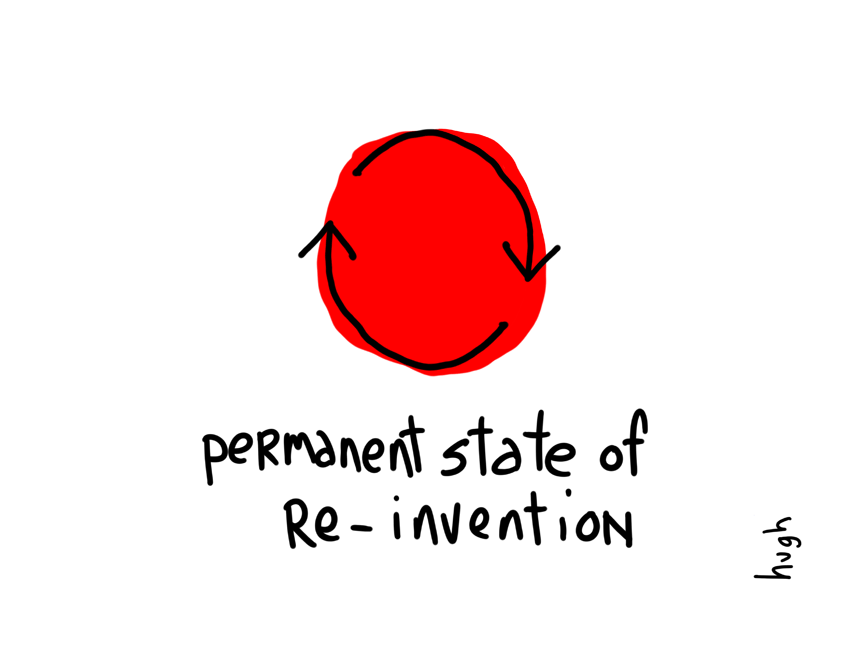
    To get there involves a cultural change, and tectonic shifts. I also think that this will force brands to think about scale. In a mass media world, a brand could get ‘reach’ by throwing money. That can still be done, even on social platforms, but when attention is not the only thing that matters, the challenge is to build relevancy and scale it – across time. That requires new planning frameworks, and possibly means a

    permanent_state

    (via)

    We started with FB, so let’s go full circle. Even as late as last year, there was massive skepticism around Facebook’s ability to adapt and thrive in the mobile space. In the last earnings call, they reported that mobile had contributed 41% to revenue. (read) It would seem that Facebook knew its story, what to focus on,  and stuck to it.

    until next time, refresh

  • The questions in Big Data

    In my last post that touched upon Big Data, I had mentioned how the seeming intent of Big Data is to synthesise actionable insights from processed and unprocessed information at touch points related or unrelated to the enterprise, and then use it to target consumers better. While this is probably true for the short-medium term, I read a wonderful perspective at GigaOm by Beau Cronin on its true potential – the path to building the equivalent of global-scale nervous systems. As I tweeted after I read it, it reminded me of something I’d written a couple of years back before I’d heard of #BigData – if we could actually use data to go beyond that to answer life’s profound questions. Before we go into the subject, here’s a nice video by OgilvyOne titled “Big Data for smarter customer experiences” (via) though it’s skewed more towards the experience rather than the data.

    Beau Cronin has mentioned several possibilities this would give rise to, and the post made me think if something like the hive mind concept would mesh into it as well – a sort of hybrid neural network. He has also pointed out the hurdles we would face while we get there – gathering, processing and conversion into actionable insights, and how phenomena such as priming,expectations, and framing matter so much in how we perceive our physical and social environments. In essence, a fascinating read.

    I was particularly intrigued by framing, and began thinking about it in the context of the unstructured data – tweets, posts, mails, videos – that is a major component of Big Data. The fundamental question being – is it unstructured because we’re framing it ‘wrong’? Based on the enterprise’ intent and not the users’? Ironically, I couldn’t frame the questions right until I met the ever-brilliant S, who has always maintained that the answer is easy to find once the question has been framed right. He has developed (Tulpa -to build or construct in Tibetan – is the concept he enlightened me on while we were discussing semantics) something that at a rough level mashes the MECE principle with Frame Semantics and the entity-relationship model. There’s IPR involved, so no more beans shall be spilled, but as always, I learned much from the conversation.

    In essence, structure can definitely be derived from what we currently call unstructured data, provided we frame the queries right. I can intuitively begin to understand that in the era of data abundance, the only way we can make sense of all of it is by focusing on an intent that is derived from a common purpose, so that the sources of data (users) will be more open to help solve the challenges of data collection. The processing and inferences that follow would yield the best results when the right questions are asked. I have a feeling that the questions asked by a business in an earlier era might not cut it.

    until next time, role models