Category: Strategy

  • To be a content brand

    I had a bit of an epiphany when I read this superbly written post on Snapchat and the nuances of storytelling. In my last post on the utility of a brand, I had pretty much glossed over ‘delivery’ because it was one part of a larger framework. (and a post that kept getting longer after I began writing!) While determining the larger purpose of the brand and its ‘job’ in a consumer’s life is important, it is also equally necessary to ‘deliver’ this to the consumer in relevant contexts, especially because we live in a world which has not fully learnt to combat  ‘filter failure’. I think ‘content’ strategy has a large role to play in this.

    The corporate narrative, referred to in the last post, is a constant work in progress and I fully agree that over a period of time, it will deliver all the advantages that the post mentions, but I do have a couple of different perspectives on the ‘narrative vs stories’ points in it. One, I think stories contribute to the larger narrative (either by collectively forming one or adding to an existing one) and probably don’t deserve to be separated from it. Two, I believe that stories are the devices which make the corporate narrative relevant to the consumer by adding context. This is even more pertinent because narratives are rarely linear in the way they are consumed now. Even not advertising is content that would influence perceptions.

    The brand narrative

    A brand’s narrative is no longer one that is broadcast to a user base that the brand considers its audience. In fact, thanks to the internet and then social, only a few contexts are now dictated by the brand, the rest of the narrative (in the consumer’s mind) is built by his/her ‘experiences and the best a brand can do is aim for cohesion. The consumer seeks/finds a need that the brand fills in his/her life. This need can be anything along Maslow’s hierarchy, and more. This, I think, is where stories play a crucial part, because the more the stories- from brands or other users – the more contexts a consumer finds to fit the brand into his/her life stream.

    The narrative of a brand in a consumer’s life is fluid, and it is cohesive stories that will define its evolution. It has probably always been so, but the explosion of self publishing has meant that brands have to not just get heard above competitors, but the user’s stream on various platforms too. The fluid narrative also means that the big idea every quarter (or year) is no longer enough. (or necessary, though that is debatable) It takes a ton of stories to build a perception and get a community to interact with the brand. But when they do, there is potential for magic. (ask Ikea) It also, only takes a whiff of controversy for it to be forgotten. This calls for an adaptive, agile methodology and some solid content structures that the brand can use to frame user contexts.

    Surprisingly, there is good news

    The good news is that social platforms do offer a better way to customise delivery according to a user need. That we still use these to broadcast and target according to pre determined audience segments is the beginning of bad news. But at some point when the race to mould the day’s popular social platforms to the existing paradigms of marketing segmentation ends courtesy saturation, hopefully ad tech will move more solidly towards delivering content and experiences that are an answer to the user’s needs. IBM’s trait tattoo based on tweets is a start. Further good news is that thanks to Facebook and Twitter, brands are slowly realising the need to create content that goes beyond broadcast. They are being forced to balance business agendas with the user’s needs.

    But, wait

    The bad news for marketers is that platforms are exploding and each has its own milieu. The content objectives and strategy are essentially different because user contexts change between platforms and even within it according to time. Right now reach trumps relevance thanks to the measurement parameters of an earlier era, but I’m guessing that will change soon as everyone begins to do the same thing on Facebook and Twitter. Further bad news is that marketing is not really structured or resourced for the changed communication scenario.

    Probably the worst news is the mindset and I have seen at least a few fundamental challenges to begin with, in addition to a few myths. One, brands still have the communication baggage of an earlier era. This manifests itself in a campaign based approach, the quest for perfection, the endless approval cycles, and a broadcast flavour to every piece of content, among other things. Two, thanks to Red Bull, everyone wants to get wings and start flying on the first day, as if there is a user waiting to hear the banality that is about to be uttered. It takes months to experiment and get a sense of the fitment of the content’s function (business needs with the objective to inform/entertain/inspire/persuade… the user), its form, (blog posts, tweet, FB post, videos, infographic, polls etc) flavour, (tonality) and frequency (timing) that will appeal to various users in various contexts – what is referred to as the ‘voice of the brand’. The last is the application of measurement parameters that were built for an earlier marketing framework.

    (via)

    However, all of this is part of the evolution, and given that the learning curve gets steeper by the day, brands will have no other choice but to catch up. The flip side is to be irrelevant, and no brand can afford it.

    until next time, discontentment

    P.S. function, form, flavour, frequency make 4 Fs. One more for F5. (refresh)
  • The utility of a brand

    After the ‘social product‘ post, the brand guy in me wanted to reconcile this evolution of the product with the brand story. After all, ‘network effects’, ‘purpose’, ‘community’ etc are essential parts of the brand story as well. But I thought of stepping back a bit before moving forward.

    The ‘tyranny of the big idea‘ is oft discussed here and the more I see platforms evolve, the more I feel the need (for brands) for nuanced strategy and propositions that are relevant in various contexts and take into account the radical change that is two-way communication. (as opposed to broadcast) I think this is an inevitability of consumption fragmentation as well as changes in attitudes/behaviour/expectations, and sustained nuanced propositions is one of the key ways to create ‘network effects’ across platforms.

    In this context, I thought the ‘Moving Forward’ section in this insightful post titled “Killing Big Strategy” captured it perfectly. Also, through it, I came across something that helped link the product-brand stories – “Finding the right job for your product“, a fantastic alternate perspective on traditional market segmentation, and some excellent lessons in defining competition and positioning. Not to forget this gem from Drucker “The customer rarely buys what the company thinks it is selling him.”

    So where does this all begin? Though ‘purpose’ is increasingly being used as a buzzword  and also espousing a corporate-centric view (unfortunately) I still get to see a lot of relevant literature that does more than lip service. At a broad level, this little framework of Purpose – Delivery – Resonance, for instance, is a good start. There are many needs that brands fulfill and many reasons why they are loved, and these could start as pointers for a brand to figure out its purpose. John Hagel’s “The Untapped Potential of Corporate Narratives” offers some excellent perspective on how user-centric narratives gets several ‘pull’ factors to work in tandem and offer numerous sustainable advantages. The examples include my usual favourite – Nike, and this is a subject I have touched upon earlier as well, (1,2) though not as eloquently. 🙂 If you think about it, this is also another way of ‘finding the right job for your product’.

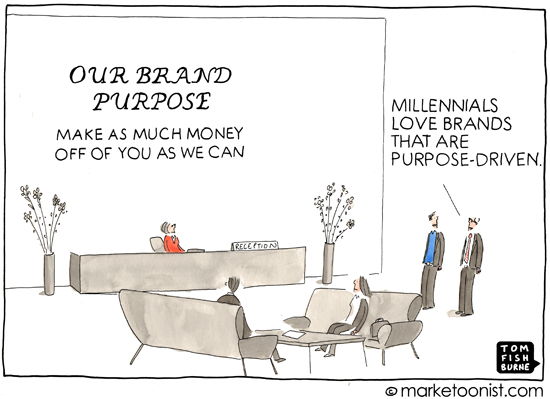
    brandpurpose

    (via)

    On delivery. Russell Davies’ “Activities not audiences” draws the distinction between users and user needs and calls for focusing on the latter. Again, another rendition of a product doing its ‘job’. This post, titled “Brands: One System Of Touch“, explores the misalignment of brands which view customer experiences in isolation, by channel, whereas customers of course view and grade their experiences cumulatively. This is a good starting point to think about what needs to be changed internally to deliver a cohesive, relevant and useful experience to the consumer.

    In the meanwhile, I came across quite a few examples of brands adopting the ‘product doing a job’ approach even though it might be an isolated exercise at this point –  Hermes’ silk knot app, Volkswagen’s and Audi’s Augmented Reality apps to repair/know the features of their cars. While they might seem too self serving to qualify for the concept under discussion, they’re definitely a step in the direction. Uber’s response to a bus driver strike with free rides might be a more evolved example. Another one might be Ford’s platform to ‘hack’ its car hardware and software. Many more examples of ‘branded utility’ can be seen here. I think that in the looming collaborative economy, platforms like Google Helpouts will help brands become a real time utility in their domains.  Interestingly there are also examples of brands (Citi, Kleenex) which are trying to create value beyond their core purpose/utility. Levi’s’ ‘School of Make our mark‘ is another example.

    The last bit in the framework (though the framework also mentions differentiation, I see it as something that needs to be built into purpose and delivery) I referred to earlier is resonance. I think these above experiments will not only help brands learn what it takes to build sustained resonance in various consumer contexts but also how to amplify this to potential consumers who might share similar needs. This will require learning and application beyond the conventional mass reach tactics employed currently. The corollary is that measurement paradigms would also need to change. I could see this being aligned to all the points mentioned in this superb post –  ‘The Future of Marketing‘ – messages to experiences, rational to passion, adaptive strategy, simulations, brands to platforms.

    To bring it all back to the link between the social product and the brand, I now (again) see technology (including social) as an enabler in the product and marketing road maps – working in tandem to deliver the brand’s purpose and help it augment resonance.

    until next time, utilising brands

  • The Social Product

    A few days ago, I read this post that cited studies on consumer sentiment (US, UK) about brands being present on social media. There are plenty of interesting perspectives and nuanced insights but one key takeaway is that consumers feel there is a glut of companies on social media, though it seems the younger age group feel that presence on social media adds to trust. Around the same time, I also came across the theory of peak advertising which begins with the decreasing effectiveness of online advertising and moves through various stages to suggest alternatives to the current business models that sustain the internet.  Collectively, it would seem as though the (generic) advantage of just being present on social is plateauing, or probably even going down. There are obviously brands that are using these platforms effectively, but increasingly, social is being used as media and this is easily replicated by other brands. At a larger level, the advertising barrage on social is also reducing effectiveness. That led me to think – before the utopia of social business, what opportunities does social have beyond the traditional marketing, advertising media based approach, enterprise collaboration, and social CRM?

    In the second Myntra post, I’d written about how I felt that ‘product’ was best placed to deliver sustainable business advantage. Though it was related to the website/features in that context, I’m now considering if this is applicable across the board – to physical products as well. Also, the more I see social evolving on customer care, marketing, advertising and sales, the more I think these are becoming hygiene. I have omitted marketing because I think there is scope to build a unique brand and thus some business advantage in the long run. However, I also think that this marketing will have to significantly integrated with ‘product’.

    In this context, I found this Forrester post titled “There is no Internet of Things” extremely interesting. Though we’re in the early stages of this phenomenon, I think it’s a good time for her to have raised the point of fragmentation and apps/brands working in silos. There are some excellent examples and scenarios in that post that make it a must-read. The conceptual answer to this is in the title of this HBR post – “The Age of Social Products“, and it makes a great point on ‘shared purpose’. “In an age of social products, competitive advantage comes not from product features but from network effects.” (though at this stage, I do think it’s both and not an either/or) Nike, as mentioned in the post, (and as usual) continues to be on the cutting edge. The common theme in their case is that the product + community (user+developer) offering only uses popular social platforms to augment, and is not dependent on them.

    The current approach to social (media) is either to use $ or influence. I’m not sure there’s enough importance given to the network and the effect that’s created over a period of time. As this superb post states on the subject of disruption and diffusion states, “It’s not the nodes, it’s the network” In that light, I feel social products might be able to do more justice to the promise of ‘social’ than its current avatars, especially social media. I did think the same way about social platforms earlier, but we live in hope!

    IoT

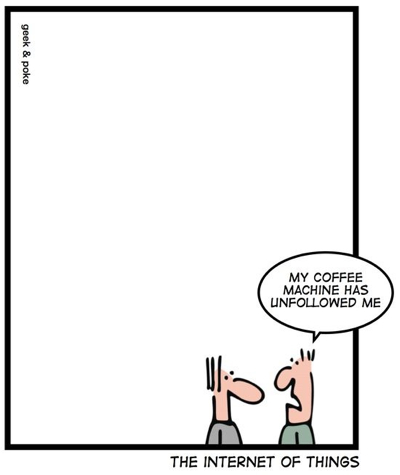
    (via)

    until next time, objectifying social 🙂

    P.S. I was reminded of a term coined much earlier – social objects. In that context, it was anything that could be a conversation starter, and the focus was more on its ability to connect people around a subject of common interest. Social products have the ability to take that connection and give it a platform where even people who are not in the same time and place can be part of the conversation. This is beyond its ‘utility’ not just as a product but also as a device that talks to other devices and makes itself more useful. I’m actually thinking of that ‘bottle of memories’ I mentioned in an earlier post, probably in a smarter avatar – like this or this – but also ‘tagged’ (say, using an augmented reality app) with the people who are part of the stories associated with it. Now, at some point, when I see the bottle, and get particularly nostalgic, I could use the same app to see what those people are up to, and quickly ping them to start a conversation about the good old times. In the collaborative and sharing economy, think of the possibilities! (If you’re interested in this sort of thing, you should like this post) When I think about it, what we probably need to accelerate this is a browser (what it does for the web) equivalent.

  • A culture of innovation

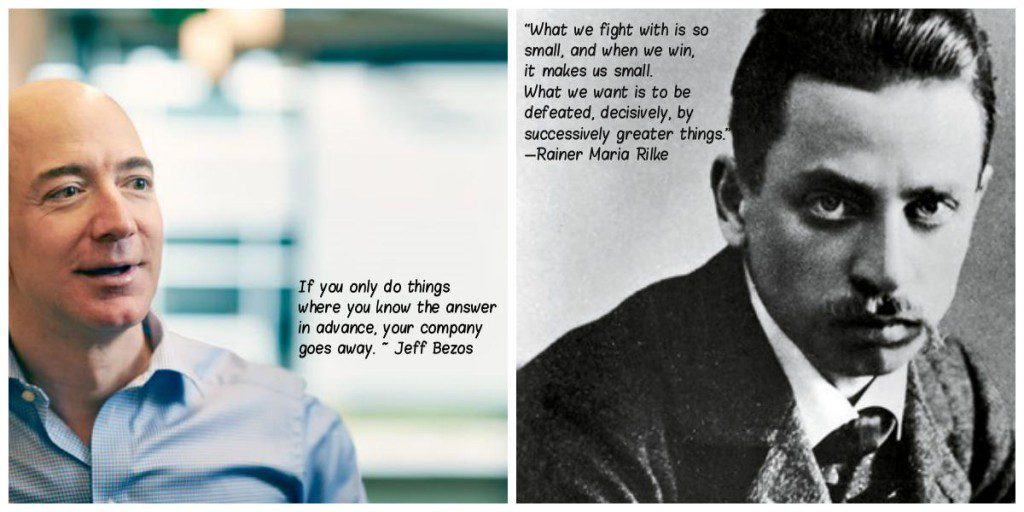
    More than four years ago, I’d written a post juxtaposing product and consumer life cycles wondering how products could evolve, yet be relevant to users at various stages of their usage maturity. Personalisation as a theme has advanced much since then, and web based services are definitely closer to cracking this. I also got a perspective from Jeff Bezos in this post All businesses need to be young forever. If your customer base ages with you, you’re Woolworth’s” though I’d take it with a pinch of context.

    But when disruption is the norm and technologies like 3D Printing and themes like the Collaborative Economy (and others) are poised to have an impact on an increasing number of business models, how does a brand pace its innovation? Branding Strategy Insider asked a relevant question on this premise – Can brands innovate too soon? The post quotes Michael Schrage in providing a good perspective “Your own rate of change is determined less by the quality or price/performance of your offerings than the measurable readiness of your customers and clients … Their inertia matters more than your momentum.

    This post I came across cites a research by Forrester which points out that most innovations remain incremental in impact, rather than being radical innovation..Companies often ‘innovate’ things customers don’t even want. The post suggests a simple cyclical framework of Learn (strategy) – Make (technology) – Test. (design) A more nuanced view (and framework) of innovation can be found at Digital Tonto. Bezos once again has a take on it “We innovate by starting with the customer and working backwards. That becomes the touchstone for how we invent.

    Social technologies provide multiple ways for an organisation to simulate scenarios and structure their innovation pathways in ways that will optimise customer benefits and business objectives. In fact, I believe that the responsive organisation (via) will soon become a strategic imperative. As quoted in that post “If the rate of change on the outside exceeds the rate of change on the inside, the end is near.” I also think that the biggest challenge in this entire movement is a mindset-culture lag. In a sense, all the so-termed disruptions happen because incumbents were not agile enough to adapt to a rapidly changing environment. There is some wonderful learning from the founder of Sonar in this post titled “Postmortem of a Venture-backed Startup” One of may favourites is “Think of culture as a cofounder that is present when you are not.” The thing is, it can work both ways! A cultural mindset to experiment, fail, pick yourself up and work harder, and win is probably what will define the winning institutions of the future.

    collage1

    until next time, “It is not the strongest of the species that survives, nor the most intelligent, but the one most responsive to change.” ~ Charles Darwin

  • Social @ Myntra – Part 2

    continued from Part 1

    Creating, correcting and maintaining brand perception and resolving customer issues were fundamentally the objectives when operating in the customer care and brand domains respectively. But this was not an end in itself. The end objective of the business is revenue, and that makes up the remaining story.

    3. Product: In this context, it includes the website itself, and the various features/enhancements/new products (eg. gift cards) that get introduced on a regular basis. Including social buttons on the home page and product pages were a given, though getting them above the fold was a mission I lost! The first major change was switching from FB Connect to the Open Graph. The potential applications, using social and interest graphs, are phenomenal, but we never progressed that far. At a basic level, I had slotted activities in this domain under acquisition and retention, and we have only implemented a small portion of the former. The easiest application of the social graph was using it for social proof. Kuliza’s Echo made that job relatively easy for us. It not only helped seamlessly amplify word-of-mouth, but also gave us a lot of data on consumption. One of the plans was to integrate this with Elevate, another Kuliza app – but inside Facebook, to try and beat FB’s throttling of organic reach. 🙂 Another application of Echo, which should soon see the light of day, is a Fab-like social feed. If a user has registered on Myntra using Facebook, he/she would see the actions (Likes, Purchases, Wishlist additions) of his/her friends on a separate feed inside Myntra. Our expectation is that this would prompt more social actions inside Myntra and accelerate word-of-mouth inside FB further. This was actually a Phase 1 of a larger plan I had in mind. Let me explain.

    While brand and customer connect can provide a strategic advantage on social, I’ve always felt that it was in the product domain that social could provide a sustainable strategic advantage. This came from my notion that ‘loyalty’ existed when the exit barrier for a customer to leave Myntra was high enough to beat any sustainable offering from a competitor. ‘Brand’ is one standard way to achieve it, but it is relatively less tangible, and in a commoditised marketplace, it would take more time. Generic discounting is not sustainable. I think, in this context, ‘Product’ can reach this ‘barrier’ in lesser time, and at lower costs. An ideal in my mind was using the social, intent and interest graphs of users from across various platforms to build a personalised experience, and through that, a gamified customer acquisition and retention architecture inside Myntra, (thereby minimising dependencies on other platforms) and then using social media to amplify relevant actions to further drive acquisition. But this approach has a high dependency on changes in the existing product and every new product/feature having relevant social features baked in (or at have it in the vicinity on its roadmap) to contribute to the larger agenda of the architecture. It also takes a mindset and backing. I did have a rough blueprint, but at this point in the e-commerce wars, this approach probably seemed a nice-to-have. 🙂

    4. Sales: Conventional notions claim that social media should not be used for sales pitches, but from my humble experience, I’d beg to differ. It’s just a matter of what-when-how, and how much. From generic product pitches on the Facebook Page as part of the larger content strategy, to custom links on Twitter, we have consistently shown and tracked revenue from social channels. Even Pinterest and Google+ are contributors! I must admit that in the larger scheme of Myntra’s monthly revenue, these are insignificant, but let’s just say that the total contribution are in double digit lakhs every month. In fact, it reached a point where we were given a budget to see if we could scale it. In this context, I have to mention this brilliant idea by S – she used customer generated product images from our Pinterest ‘Shopped from Us’ board every week to make sales pitches on Facebook! Works like a charm. 🙂

    The area where there were a few attempts, but didn’t really pick up was enterprise collaboration. We managed to build a fairly large community on Yammer, but what I’ve realised is that it needs champions at the highest level in all parts of the organisation using it on a consistent basis for it to be sustainable. I also had this grandiose vision of using Google+ and circles to connect customers, Customer Connect teams, Partner brands and employees in general, but this one was limited to a word document! This is an area that I believe to be a must-have as we evolve towards social business, but in the larger list of priorities, is still a few steps away.

    That gives a broad view of what I’ve been up to for two years. The generic point I’m trying to make through the two posts is that from basic business outcomes like customer satisfaction and sales to more nuanced ones like brand perception and sustainable strategic advantage, social can and should play an integral part. There will be differences in terms of scale, strategy, resources etc depending on the domain, maturity of the industry/organisation, target audience and so on, but the important part is to begin because the brand/organisation needs to evolve as well. Social media has shortcuts, I’m inclined to think that social does not. These are days of nascence, and social will continue to evolve – enterprise social networks, social business, big data, the Internet of Things (add buzzwords to taste) and more will all have their hype cycles and age of maturity. By all means, measure ROI, but remember, we spend on movie tickets, we invest in mutual funds. I think we’re clear on the expected time frame of returns in both cases.

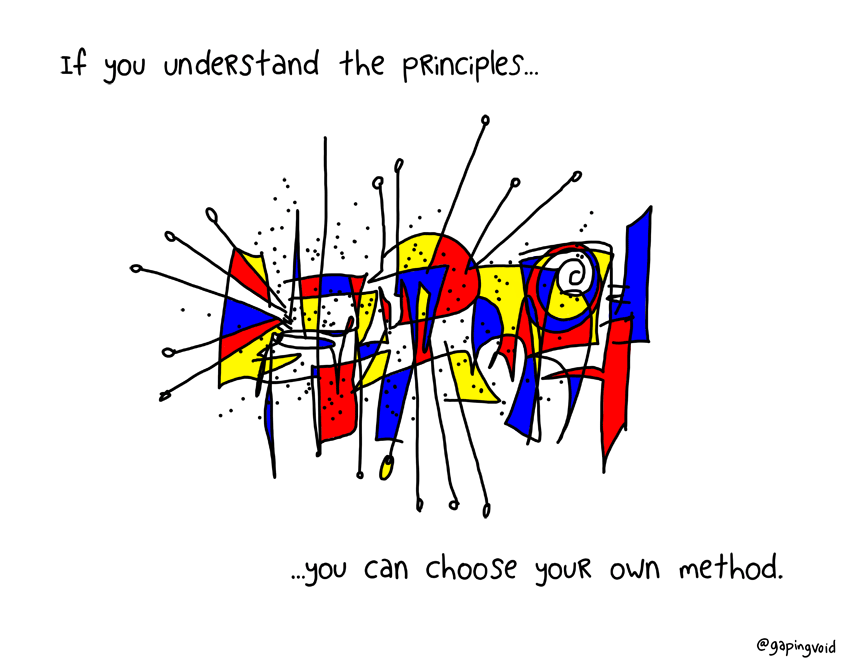
    understand_the_principles

    (via)

    Myntra will remain dear to me, like all the other brands I have worked on, but it will probably have a more lasting signature, because not since my days at GIM have I experienced such a rewiring of my worldview. This stint has given me oodles of confidence, friends whom I hope will last a lifetime, and relationships of trust that I will cherish.

    Before I end, the last hat tip – to the super S, who joined the team mid last year and has since then, proven time and again that she’s the best social ‘investment’ we made, and made this little social adventure a total joy! “I used to believe that we are here to teach what we know. Now I know that we are here to teach what we are meant to discover

    until next time, </ head – social media> 🙂