Category: Advertising

  • Early Bird Rewards

    At least two major virtual happenings, one that has massive implications on the future of the web, and the other, slightly more subdued, but not lacking in potential. The latter – Twitter Annotations, announced at Chirp, allowing developers to “add any arbitrary metadata to any tweet in the system.” You can take a look at the various possibilities here, here and here. The former – Facebook’s  Open Graph, unveiled at the f8 conference, and aimed at making itself the centre of everything that happens on the www. A  combination of  plugins, developer tools, new markups which can make the user experience on any site that plays along increasingly personal, social, semantic, from plain hyperlinks to layered information. Already, one small manifestation can  be seen at the bottom of this post – a Facebook ‘Like’ button, which will carry your liking of this post into your activity stream on Facebook. More and more data, not just what you do on FB, but outside as well, across the web. From what I read, smells like Google, perhaps worse, because the flow of information seems possible only through the Facebook conduit. A good round up of implications here.

    When I returned from he break, and read up on these developments, my first thought, which i also tweeted was
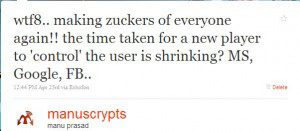
    1

    And that’s the point of the post. During the break, the only network I was hooked on to was Foursquare. One of the things that happened, thanks to long waiting times in the Kolkata airport was that I became mayor of the neat CCD outlet just outside the airport complex.

    CCD has completed the re-branding at this outlet (unlike the one inside the airport) and has done a decent job at establishing ‘conversations’ as the prime focus area, in terms of in-store design. The feedback posters, ‘snippets’ at each table and the ‘quotes’ design on the roof were nice touches. When I got back, I found a CCD account following me on Twitter. Seemed like a more synergistic effort after the earlier snafu.

    It made me think once again about how alert brands need to be in such a dynamic scenario. If CCD were an early adopter, would they have braved the earlier storm better? What if they become active on Foursquare now, experiment with the new services being built on top of it – friendticker, snacksquare etc, still in their nascent stages. Or at least acknowledge their outlets on Foursquare and engaging the users. “@xyz congrats on becoming the mayor of our abc outlet”, and then build on top of that relationship. Won’t that help them gain some crucial evangelists in a new medium? If not evangelists, at least someone who will listen to their side of the story when something nasty happens? Wouldn’t they get a headstart on ‘authority’ by being an early bird?

    Even the era of quick responses being a reasonable expectation seems to be blurring by fast. Perhaps brands are now required to have an advance scout mechanism, to test out new services, features, changes, understand the implications and see whether/how business and objectives needs to be realigned. Page Rank, Social Platforms at consumer and enterprise level, Social CRM, Location based services, tools and platforms keep shifting. Early adoption and balancing objectives with diverse ways and platforms of engagement may become an imperative. Multiple options, two way communication manifestos, its all changing real time. Hold on tight.

    until next time, service level disagreements
  • In duress

    A few days back, when I met Balu and Conall, we happened to talk about the lifecycles of services (Twitter and Foursquare was the context) and then discuss whether product lifecycles were being compressed too. It is interesting because let’s say an organisation has invested in a new technology and brought out a product. If they price it high, adoption will be slow, and it may never become mainstream. If they subsidise and price it low, they may lose out if a better technology arrives before they  break even. Mobile phones (feature compatibility and obsolescence), content storage devices (VHS to Blu-Ray) were some of the examples discussed.

    Dina wrote a couple of good posts (Part One, Two) recently on durability,and whether it is losing its power as a consumer driver. The plethora of brands advertising in the youth category would seem to agree (best expressed in Fastrack’s ‘Move On’ campaign), but as pointed out by Goutam Jain in the post, in many cases it would be intrinsic to the brand’s value. The rise of ‘good enough’ in the real time era is not helping the durability cause either. We could go from fidelity in devices to that in human relationships and the cause/effects in consumption, but maybe we should get Dina to do it later. 🙂

    The second post is also a great read and is based on the comments on the first, and introduces some excellent dimensions to the original thought.  Convenience + cost of exit, opportunity cost of not entering the next ‘upgrade’ are things that I’d like to add to that.

    Brand equity is something that falls naturally into the scope of this discussion. But what i was more interested in its impact on the content that brands create, including their communication. Look at say, print ads, whose physical durability is perhaps one day (equity created might probably last longer), or radio jingles and television commercials., with a slightly larger shelf life. On the internet, it can exist ‘forever’. But there are costs involved in all of these, and in terms of durability, they might not really deliver in this era of content abundance, fleeting attention spans, and the constant search for the next ‘wow’. Also, on a smaller scale, what happens when you design say, applications for a particular platform/device like a Facebook/ iPad, and it doesn’t prove to be durable? It is many ways, a gamble.

    So, when I read Clay Shirky’s amazing post ‘The collapse of complex business models‘, I sensed a tangential connection. To broadly summarise, the post uses Joseph Tainter’s ‘The Collapse of Complex Societies’, in the context of TV content producers’ inability to cut expenses below revenues, and explains how at some point, the level of complexity added to a system fails to add to the output, and becomes just a cost, because the different levels extract more value than the total output. Also, by this time, the system is too large and too interlocked for it to adapt quickly and change. Then ‘collapse is simply the last remaining method of simplification.’

    The post throws light on what is most likely the ‘tripping point’ for contemporary media. With increased connectivity between individuals thanks to various platforms, more ideas are being formed and honed. As new products and services arise, consumption patterns change, new needs are discovered and a disruption (which is perhaps another way of  describing simplification) always seems around the corner. I see this as a message to brands, many of whom have evolved their organisations, products and services on the basis of older ways of communication. How much has durability of products been a factor in the design and structure of communication and organisational processes? Or was it a result?  As durability ceases to be a major factor, is the new imperative flexibility?

    until next time, we still call it consumer durables 🙂

  • Brands – Interesting vs Popular

    These days, Reader is helping me find a balance that contains both ‘interesting’ and ‘popular’ content. I came upon a very interesting post on Reader via Mahendra Palsule, which was one exactly this topic – Would you rather be Interesting OR Popular by Justin Kownacki.

    For the purpose of this post,

    Interesting: Arousing or holding attention

    Popular: Regarded with favour/approval by general public

    To briefly summarise, Justin sees a clear dichotomy in ‘interesting’ and ‘popular’, and states that when something becomes popular, “it will simultaneously cease to be interesting.” The reason, and I would more or less agree to it basis my experiences, is that when it becomes popular, my relationship with the ‘interesting’ entity changes. Suddenly, it is an interest that has moved from a relatively private territory to a more public one. Like Justin notes, it creates dissonance with my self perception of being an interesting person. Meanwhile, money also has a role to play. “interesting sells, but popular sells a lot“, for various reasons.

    Meanwhile, like many many others, I subscribe to the uber popular (and interesting) Seth Godin, and on the same day, he wrote a post titled ” Driveby culture and the endless search for wow“. I felt that they were related, especially when Godin writes about the creation and consumption of culture.

    As the comments in Justin’s post indicate, there are entities which have successfully been both interesting and popular, but I’d say they are exceptions. I’ve always believed in ‘interesting’ (against ‘popular’) over a larger time frame, and if I go by Godin’s last paragraph in the post, I think he is on that side too. Which is why, I wonder with the massive changes that social platforms bring to creation and consumption of content, brands will have to choose between interesting and popular.

    To generalise, the era of mass media made ‘popular’ easy for brands. Like Godin says, money could buy an audience. And that’s exactly what happened when there was scarcity of content. The audience had, and paid, attention. A percentage consumed the brand, sales went up, more money bought more attention. The message  also often pandered to the lowest common denominator. Brands didn’t have to be interesting until they operated in the commodity space, and then it became a gimmick.

    When I started using the platforms of what is labeled as social media, I thought there was something that could change this cycle. I still do, in spite of this post (most of it justified, by the way) by Steve Hodson. I think what we’re seeing now is brands seeing social as just another media, and going the ‘popular’ way. The  majority of the audience too, is discovering popularity, and would like to have a share of that themselves. So their consumption and creation would be on that front. In a way, for now, one set of media is being replaced by personal brands.  But in spite of that, the basics of social platforms create opportunities for those brands with ‘interesting’ as their way to be, to have their say. While examples are few and far in between now, I think its just the learning curve taking its time. Maybe the examples are not so easily available precisely they are only interesting to a smaller audience set of users now. Maybe there never will be, because it IS difficult for popular and interesting to go hand in hand.  🙂

    I think ‘popular’ is going to be even more difficult to sustain, and not just in terms of communication, but organisational culture, scalability and so on. As content becomes even more abundant, and as technology permeates the lion’s share of our daily interactions, I think the audience will swing towards ‘interesting’, because in  it, I sense, is freedom, and opportunity. And that goes for brands too. However, it remains, as always, a matter of intent, and though I feel that it is indeed a question of ‘interesting’ vs ‘popular’, in the medium term, both kinds of brands will co exist.

    until next time, popularity chats in the comments then? 🙂

    P.S: Do you think Apple is interesting trying to be popular?

  • Newsmakers

    Its ironic that I have to start the post this way, but

    Disclosure: I work with The Times Group 🙂

    There was some amount of Twitter buzz a couple of days ago on the article carried in the (city edition) Times about Arindam C’s new book selling a lakh of copies in 10 days. This also appeared in a post at “Don’t trust the Indian media”, in the context of ‘paid-for news’. The post dealt with the TV medium primarily, but also noted that in the coming years, consumption will be not be medium specific.

    Like I’ve written before in the context of content marketing, the key factor, irrespective of platform, amidst the changing nature of advertisers, publishers and consumers and the relationships between  them is trust.  In a sense regular advertising is also paid-for news, but its form is such that one immediately knows its paid for. With the influx of advertorials and paid-for news, the lines began to blur fast, with  credibility beginning to suffer.

    In an increasingly user generated environment (almost all of social media is just that) advertisers (brands) now have a way to source positive content without paying obscene amounts for it. They can find relevant spokespersons who have their niche, but contextually relevant fan following. Of course, on the flip side, finding them is still a task. But they already have a name for it – ‘social influencer relationship management’ 😀 The other point is that even the nature of sharing – blogs/microblogs/statuses are in a constant state of flux. Meanwhile, like Shefaly pointed out in the comments, it is still relatively easy to get away with non-disclosure on the web.

    But despite all that, and the fact that I believe in the loop of objective-> idea/strategy-> medium, I’d say that the web is more advanced than other media in terms of content marketing, primarily because user generated content, and discontent, has been an integral part of its evolution. Users, potential users, all talk to each other, and trust evolves. A crowd is involved, conversations happen. Also, with more and more lives being lived with an audience in mind, and people becoming conscious of how they’re perceived online, hopefully it will ‘become too costly to be evil’ (non disclosure)

    And that’s why its erm, refreshing, when I see brands making a strategic commitment to the digital space. Pepsi recently junked Super Bowl for the first time in 23 years and has included $20 million in grants for the Pepsi Refresh Project. Some say, its a risk, but to me its about as risky as putting a 30 sec ad that might get trashed. Moreover, its not an isolated thing. I recently read about Pepsi using Foursquare to fund a youth mentoring program called Camp Interactive, which helps youth explore technology and environment. Consistent efforts like this will get them unpaid editorial space and buzz at least in the online space.

    Closer home, Nokia is using a digital dominated strategy for N97, in its first 4 months of launch. I liked it because of the reasons stated – “Digital media blends very well with the product features of N97 Mini. Also, the audience to be targeted is all available online.” That sounds like its reasoned out well, though I’d also like to see a similar approach to execution too. There are a couple of things I am hoping for in addition to the obligatory display advertising – that Nokia not make this a short term venture, because though this product might become non priority for them in a few months, the poor sod who bought it will still want to connect with them online. The second hope is that they experiment with content marketing, and go a little beyond the ‘over-the-counter’ blogger outreach stuff.

    In the case of Pepsi, its a concept, an idea. In the case of Nokia, they have a product based strategy. In both cases, there is a potential for natural buzz, which to me is the way it should be. Buzz should be a result of a good product/strategy, too many time it IS the strategy, and that is what has caused things like ‘paid-for content’. The bigger hope in all this, of course,  is that an increasing commitment to the evolving digital space will force advertisers and brands to be on the ball, and in that, a better mindset will evolve, one that believes in a two way communication approach, as opposed to blind advertising and paid-for content.

    Its interesting that on one hand, networks, brands and individuals are trying to carve out a niche based on trust, using digital media for reach, and on the other hand, we have the news media, the original custodians of trust,  despite guilt , oops,  guild feelings, using their massive reach to push one way communication.

    until next time, news making

    PS: See you in a fortnight 🙂

  • (Non) User Generated Content

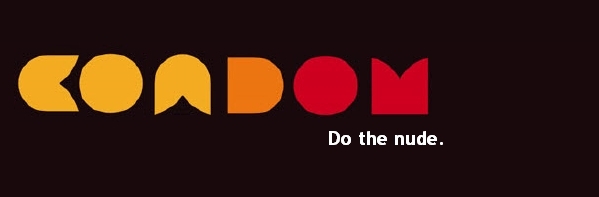
    World AIDS Day – a humble contribution

    condom

    Much to the brand’s credit, they RT ed my work, on Twitter.

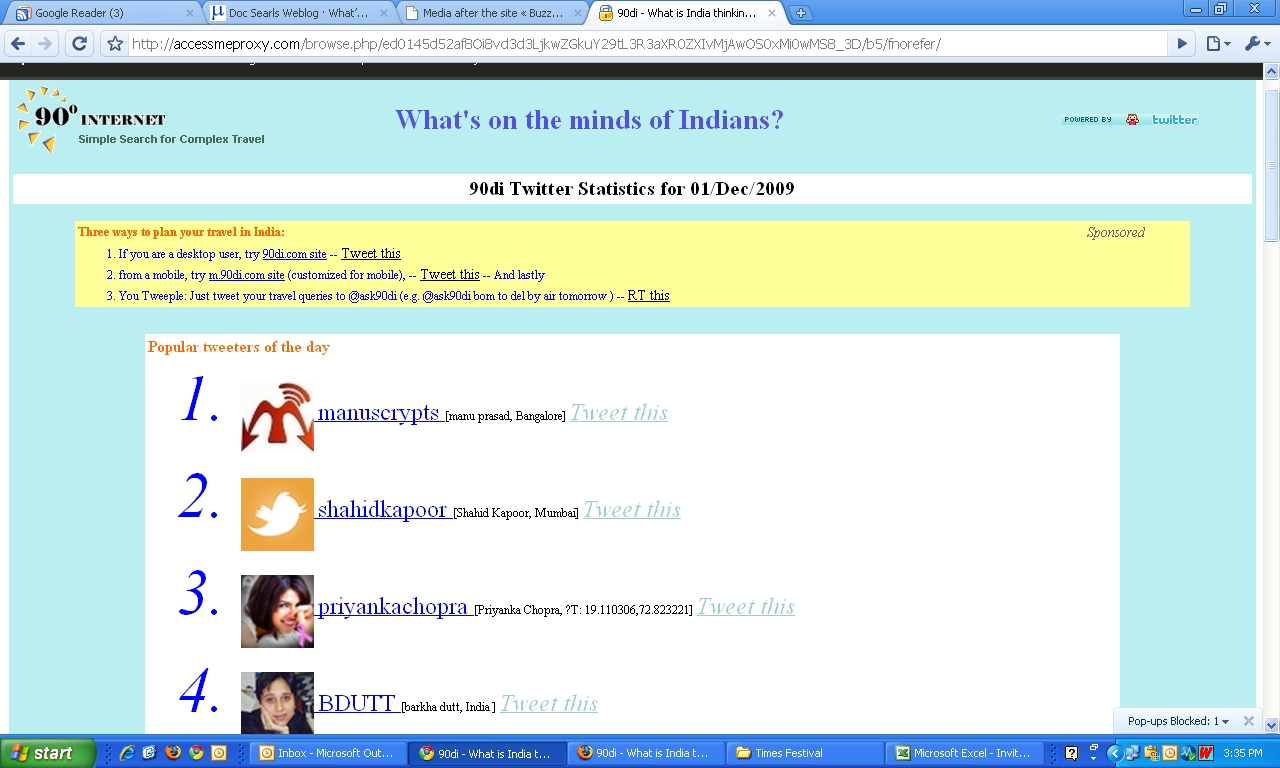
    And that little stunt led to the image being viewed some 2000+ times and my 15 seconds of fame as India’s most popular twitterer for a brief few hours, thanks to more than a 100 RTs from the twitterati. I also got a Samsung Galaxy from Tata Docomo. Ok, I made that last one up. :}

    Twitterer #1

    Yes, yes, don’t worry, I’ll still be posting here :p