Category: Advertising

  • Jump with a crowd

    ‘Jumping the shark’ is a phrase that has been jumping on to my face regularly, but something that got lost in the rigours of speed reading and processing. Thanks to Tom Fishburne’s excellent post on the subject in the context of brands, products and organisations, I got to think about it a little more. The quick definition would be (from the post), “the moment of downturn for a previously successful enterprise.” The problem with it? “The risk of jumping the shark isn’t getting eaten by the shark. It’s leaving your loyalists behind.”

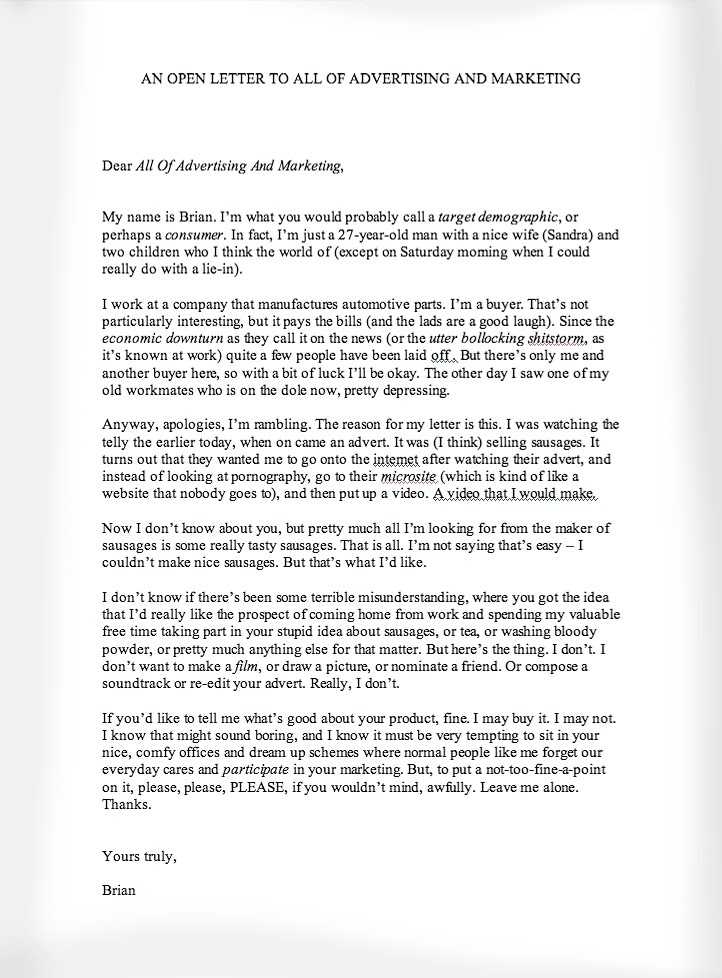
    I thought about it a bit, not in the context of brands or businesses, but more in terms of brand communication as a field, advertising specifically, and brands’ usage of the social web. Consumption patterns, media platforms available etc had pretty much created templates for creative agencies over a period of time. But the arrival of the web, social platforms and the democratization of media have managed to disrupt the ways of the one-way communication age. This post is a good one to read in that context, and talks about the change digital has made to campaigns, and the ‘role of the consumer’. But desperation, hype and the eagerness to get on board makes everyone concerned ‘jump the shark’. And unfortunately, the way I’ve seen many agencies and clients execute it (purely as a consumer), I’m quite inclined to agree with the author of this hilarious letter. (via PSFK)

    Clipboard01

    (click to enlarge)

    The job of the brand manager/creative agency is obviously a more difficult one now, and is made even more so thanks to the approach – of tool strategy. Like this (old but) excellent post states, ‘the technology that underpins social media is changing fast’, but its ephemerality ‘is a feature, not a bug’. It made me wonder whether brand communication/advertising, as a process (the way we see it now) had ‘jumped the shark’, mostly because the thinking process still sees  social platforms in the same light as traditional media and has not changed to be in tune with the former’s dynamics. In other words mistaking social media marketing for social media.

    Maybe they have to dig deeper, figure out the value that people are willing to pay for, and then find their ‘purpose idea + social object‘, and consistently. But that would mean a sea change in the way brands and creative agencies operate. Is adaption possible, or is complete disruption inevitable?

    I juxtaposed this thought with something that Seth Godin wrote recently, about the ‘red zone‘ – the joyless part of the learning curve. His graph also has a green dot, which represents ‘someone on the other side.. rooting us on, or telling us stories of how great it is on the other side’. Perhaps if brands can find from the existing consumer crowd a few who believe enough to play the ‘green dots’, they can adopt a more holistic approach to social platforms and carry the loyalists without it seeming like ‘jumping the shark’?

    until next time, safe jumping.

  • Hairsay

    So, the Old Spice man  increased the sales of the product. Now we can renew the debate on the efficacy of social media on the bottom line. We obviously won’t ask for correlation data. 🙂 The other side effect is that every brand manager will now want to replicate it – especially the viral and the ROI. Quite like a poster child (in India) of an era gone by – Sunsilk’s GangofGirls, which at that point had made many a  brand manager experimenting with digital media tell their agency “I want one too”. Damn virals work at meta levels!!

    I recently read Kapil Ohri’s article on afaqs, on the site’s makeover – the shift from blogs and gangs to trends and forums and the ‘mandatory’ buttons – Facebook and Twitter. Its early days, so it’d be unfair to make a comment on the numbers, even if they were to be considered a parameter of success/ failure. But while, on buttons, I think YouTube videos would’ve been a help. More on that in a bit. A revamped GoG, and the Pantene vs Dove war for hairspace being fought offline and on blogs (Karthik, L Bhat) gives me enough food for thought.. and opinion.

    Sunsilk Gang of Girls: GoG could have (like an industry person commented on the afaqs post) integrated Facebook in a much better way. Check out what Levi’s has done at their online store. Instead of separate registrations and profile, Facebook’s plugins could make life easier for the user and automatically bring in the ‘gangs’. It could get them to pull their own photos from Facebook for the ‘Makeover Machine’, suggest it to friends, and so on. Or build a Twitter app that uses the display picture. It could have perhaps thought bigger and had their ambassador (Priyanka Chopra?) interact with the users through her own identities on these platforms. Or used a location based tool like Foursquare (or FB Pages or later Google Places) to start building a resource for salons and tips at each place (think of a Burrp! for salons), maybe in sync with a YouTube channel for tips.

    Pantene: Good Morning! They obviously missed a little thing when they didn’t pay attention to the pwnage of DNA at the hands of the Times Group during the former’s launch campaign in Mumbai back in 2005 (?), or the more recent Airtel- Reliance DTH fun. Not to mention the cliche that after a certain point, the only person who gets teased is the brand manager. Ok, I won’t overstate, but c’mon this is a real-time era AND they did walk into a Dovetailed ambush. Since the internet already has made them un-mysterious (thanks for that info, Karthik), maybe Pantene should have just added those FB page and Twitter links to their mass media communication, and solved the mystery immediately online. Mind you, thanks to our dismal internet penetration, they could still demystify it again on mass media, later, after perhaps, adding the content from their online and offline activities. (think non market research agency 80%) That way, there would’ve been at least some buffer against a Dove’s sneak attack. Arguable, but possible.

    Dove: All of us should take the time and remember the controversy over the ‘campaign for real beauty’. But hey, they saw an opportunity and used it. Effects on long term goals are again arguable.

    A little note on ‘low involvement’. I wrote about brands, content and new media platforms in the last post, in the context of the Old Spice campaign, and also mentioned the importance of ‘intent’ and setting objectives. Once the ‘why’ is done, the relevant crowd can be identified, along with the platforms and activation strategies – ‘(to) who’, where and what. (Read Rohit Awasthi’s comment on Karthik’s first post) When the ‘right’ content is pitched to the ‘right’ people at the ‘right’ time (and the ‘right’ platform too), very few categories are low involvement.  (read Naina’s comment on that post) And that’s the beauty of the web in general, and the tools that social media have provided marketers. Old Spice could be seen as low involvement too, until they did this campaign.

    But having mostly seen communication as advertising (except arguably PR), creating content for social platforms is in itself quite a challenge for brand managers. Even if they were to  view ‘social’ as ‘media’, it requires a complete realignment of how media and content strategy is done, mostly because the mechanics of distribution are completely different. At a fundamental level, brands are dependent on users of platforms to create a buzz, and money doesn’t always work. At this point, tools can help with the ‘time’ (including location and other contexts) and ‘people’ (interest), and the way it works, if the ‘content’ is done right, people will get other people.

    Therefore brand managers need to make a more diligent effort. The fragmentation of traditional media does not seem to have made much of an impact on the costs involved in using them as distribution channels. So when ‘social media’  presents ‘free’ channels, brand managers see a value proposition and jump right in with a TVC and or/other weapons of mass mediocrity. Brands, I believe, need to invest a bit more on who they’re trying to reach, and then invest some more on building content and designing networks and constructs (irrespective of platform) that will drive the crowd to interact with the content and share it more. Content and people that will drive more connections, and help meet everyone’s objectives.

    But yes, until Augmented Reality allows me to scan a shampoo and tell me how many of my friends liked it, and think I should use it, (though my hair won’t last that long 😐 ) lets keep playing all the shampoo games we can play. 🙂 And while on using social platforms purely with a sales objective, I’m reminded of how Grandma uses her laptop. (vid below) Can it be used for those purposes? Of course! But is that its best case use? We can argue 😉

    httpv://www.youtube.com/watch?v=Vg6emajJmEo

    until next time, sometimes brand strategies can be real poo!!

  • Influence Cycles

    The term ‘influencer’ is a recurring one in social media. Mahendra had a tongue-in-click post last week on the subject, and Surekha and I ended up taking it on a tangent, and it reminded me once again of the way ‘influence’ is changing, for all parties concerned – influenced, influencer, the object that links them and the medium that connects them.

    It was relatively easy when the medium was one way – mass media. The number of influencers were limited and there was really no way to locate or measure the individuals who made up the long tail of influencers. Or at least few were interested in doing it. The web disrupted it. The influenced found an abundance of content, the influencer saw his power being diminished by millions of publishers. The object (including the service provider/brand/organisation/group etc) figured out that it wasn’t at the mercy of limited influencers, but discovered a huge list which had its own quirks, but had the power to influence a multitude. Yes, known stuff, just summing up for context.

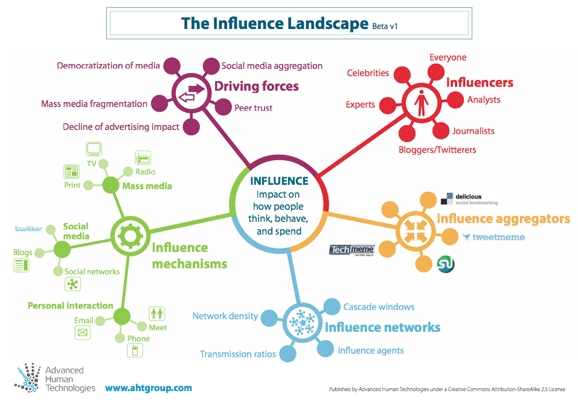
    I remember touching upon ‘social influencer relationship management’ (yes, there is actually a term for it) late last year, and the importance of trust. Influence, for me, has been a difficult thing to wrap my head around. There are so many factors erm, influencing it – time (specific and relative), context, trust (and objectivity) and the fast changing content platforms- each of which seems to add yet another layer. The complex structure has been well illustrated well in the chart below

    Influencer

    via ( a post similar to Mahendra’s, but more serious in tone 🙂 )

    At least in the medium term, I think its only going to get more complex, primarily because the platforms are only evolving – Quora, the service I mentioned in the comment to Mahendra’s post, for example, can help in establishing context specific expertise and therefore trust. Facebook, when its QnA service starts, will try to establish it within a known network. Twitter has already tried it too, but I agree with Surekha. I’ve noticed that with web platforms, after a certain scale is reached, the culture starts resembling that of mass (media) and the ‘influencers’ as well as ‘influenced’ begin a relationship that’s familiar from a mass media era. What also complicates is that the ‘object’ of the relationship sometimes discovers that it too has a voice or can hire a ‘voice’ and attempt influence. This is one of the ways it is trying to adapt to new platforms. But while there might be flaws in each approach, I do feel the direction is right.

    At this point in time, as a user, I’m still evolving in terms of the platforms I use to establish networks of trust. The tools available still don’t allow me the freedom to aggregate and disaggregate at will in different contexts. That’s probably something brands can identify with too, thanks to the plethora of platforms and influencers across networks. Its perhaps the difficult transition state when brands have to manage traditional communication outlets, new media barons, their own content management systems that need to evolve, and a long tail full of influencers. More importantly, brand processes (like advertising, PR etc) had evolved in a mass media milieu and a struggle to adapt to the disruptions brought around by a two way communication mechanism is what we see around now. We’ll keep that for another post, and quickly jump to an aspect that intrigues me from the four influence factors I mentioned earlier- that of time.

    Long back, I wondered how we could juxtapose product and consumer life cycles. Let me address it in this context. Different consumers will ‘reach’ the product/service at different points in its lifecycle. There is a ‘time divide’ that separates the different sets of users. The motivations of this set would differ and therefore , its influencers will also be different, as will their motivations. Brands (using it as a blanket term, includes services too) these days are constantly in the hunt for early influencers, which is why I found this article, which discusses why gadget manufacturers should target late adopters, very interesting. This could apply to platforms as well. I wonder how this thought can affect when and how brands try to influence on new media platforms. Does it make sense to wait till platforms evolve to an extent where they can work better for the brands or is technology moving way too fast and lifecycles of all concerned behaviours becoming too small to wait?

    Meanwhile, what if the millions who have never used Facebook are influenced by the movie? 😉

    until next time, in flux

    Bonus Read: I plan to riff on this soon, but in this context, you could check out pages 147-173 of this amazing document. (via Pluggd.in)

  • Banking on data

    There was an article recently at PSFK, which, in addition to the impending data explosion, also talks of the need for brands to invest in technology to mine, analyse and identify changing consumer needs and opportunities. Though probably, at a later stage, the automatic ‘sensors’ mentioned in the article would beat the self-expression media services as the largest data source, at this stage, the latter seem to be the biggest contributors.

    So what is the data that’s getting generated? As social networks evolve, the role that they play in the individual’s life is also evolving. While flow of information, and communication seem to find social networks as natural conduits, the networks are also now sources of entertainment for many. (study by Edelman) What does this entail for brands, their communication and the content they generate?

    Amidst the social network revolution, brands have been trying hard to eke out a place for themselves – to slide in easily into the conversations, and lives of individual users. Some have been successful, and some have not, the latter mostly when they try to use these as distribution channels for other media content alone. I read a few days back that the two official sponsors for the World Cup – Adidas and Coke, had been trumped by their competitors – Nike, and Pepsi, as far as WOM goes. Not surprising, both tell excellent stories. It makes us feel.

    httpv://www.youtube.com/watch?v=idLG6jh23yE

    httpv://www.youtube.com/watch?v=eQmu48sZohc

    There’s this excellent presentation by Rory Sutherland about intangible, and perceived value that brands create. A bit dated, but I happened to see it recently. It made me think about Maslow’s Hierarchy of needs and the tangibility of various levels.

    As civilisation advances and scarcities and abundance are rapidly traded, and as brands progress, don’t the lower levels of Maslow’s needs hierarchy become hygiene? So, would users prefer brands that help them in the esteem and self actualisation areas? It perhaps might be an example of ‘seeing the subtext you want to see’, but the Nike ad – ‘Write the Future’ seemed to be all about self actualisation and the Pepsi’s ‘Oh Africa’ seemed to be all about an ever-changing crowd that seems to be impossible to keep pace with. To quote Clay Shirky, “The category of ‘consumer’ is now a temporary behavior rather than a permanent identity.”

    Which brings me back to the data explosion. The challenge, I guess, is an old one. Finding motivations, sensing patterns out of all the data to understand why we ‘Like’, why we ‘share’, and so on, and then give us a value proposition. With rapidly evolving technologies, even the value needs to adapt much faster than before, because if the brand is late, there’ll be another that delivers. But then again, at higher need levels, when the individuality/uniqueness quotient increases, will the manifestation of needs show a collective pattern? Or will the individual’s behaviour pattern become more important for brands? Multiple data sets, multiple patterns, multiple challenges. Interesting times indeed 🙂

    Meanwhile, here’s one closer home. (via Gaurav) A very interesting project by Tithiya Sharma – The 100 Heroes Project. I’m sure it’ll be a wonderful story and if I were an airline brand or even a MakeMyTrip/Cleartrip or anything to do with travel, I’d take a look at the project.

    until next time, tripping on data

  • Go-to-social media

    A few weeks back, I’d mentioned Tac Anderson’s ‘3 types of social media strategy‘ . To quickly summarise, the first is the ‘toe-in-the-water’ approach (not really a strategy), the second is ‘optimising social media for business’ and the third is ‘optimising business for social media’. That happens to be the decreasing order in terms of current practices, probably because its also the increasing order, in terms of thought, effort and time required.

    I am quite a fan of the third approach and saw this excellent presentation by David Cushman, a few days back, which showed why ‘optimising business for social media’ is perhaps the best way in the long run. In fact, it does it in such a way that it almost seems like an afterthought. On the way, it addresses the much maligned combination of words – ‘social’ and ‘media’, and the subject of ROI.

    Like I said, I don’t require any convincing on the third approach too, but the more I interact with clients, I begin to understand that with all the hype, the expectations of social media are akin to the other forms of media, and the stereotyped Facebook page and Twitter account are much sought after in the strategy presentation. And that forces me to think whether we can start with approach 2, and move towards approach 3.  The feedback from open social channels slowly creating a change within the organisation and making it view everything with a different perspective. That’s quite a change from asking for perfect products and services which could ‘withstand’ social media. 🙂

    Meanwhile, I looked at it from another perspective when I chanced upon the new IndiGo Airlines ad, thanks to a post by L.Bhat. The spunky ad, which you can view here, is shot extremely well and showcases IndiGo’s dedication to being on time. Bhat raised a valid point that this punctuality might actually be beyond their control, in some cases. I completely agree, but like I commented, I’ve used IndiGo several times, and have never had a reason to complain. All the people who’ve commented on YouTube seem to agree.

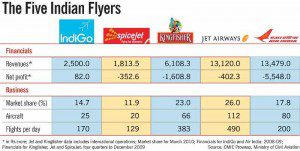
    I have to confess, there’s a style to Indigo that I’m quite a fan of. Right from the way they have communicated this data  below (do note the revenues, number of flights, market share, and compare)  inside the flight, to the menu items to their stickers and even their barf bag, they are quite unique, they have an attitude and are not afraid to show it.Check this out. (thanks @gkjohn)

    Clipboard01

    (Source: Outlook)

    DSC03160 DSC03161

    (Can’t remember other airlines, I know Spicejet has quite plain stuff, anyway I liked these enough to keep a copy 😀 )

    No, i wasn’t digressing. From what I read, IndiGo is hardly a major player in the social media space. But I think the TVC is a good way of approaching what would have been ‘strategy 2’, with a conscious design of reaching strategy 3. All that, without social media. A purely communication  (internal and external)+ organisational culture based approach to  creating a social business. That may not be Indigo’s strategic intent, but it does make me think. Is it possible? 🙂

    What can be done to this with social media, is a different discussion altogether.

    until next time, thoughts in the air

    Bonus: “Culture eats strategy for lunch” via Gautam Ghosh.


    httpv://www.youtube.com/watch?v=kiFMJfrCO_0