
Category: Advertising

  • While on contextual reputation…

    Though I don’t answer much on Quora, I am quite a gawker and vote up answers too. One feature of Quora that I found extremely interesting and useful (and tweeted about) is the way Quora gives contextual ‘reputation’ (while reading answers) using the person’s topic bio. The interesting coincidence (because he also RT ed this tweet) is that I noticed it thanks to Mahendra‘s answer to a ‘Google Reader’ based question, and right next to his name was “Daily, dedicated user. Subscribed to over 200 feeds, followed by over 700 people on Reader/Buzz”. I must admit, before I realised that it was a topic bio, my first thought was why Mahendra was ‘wasting’ his Quora bio on Reader when he had such a huge list of phenomenal things he could say about himself. 🙂

    But yes, coming back to ‘contextual reputation’, I liked it because it gives a lot of relevance and credibility and adds a layer to an answer – you can better understand where this  answerer and his response is coming from, for example. Another nuanced way of helping the reader weed out noise. I also thought this was a good way for brands/organisations to develop credibility in their domain, and involve their users, using function specific spokespersons, (brand, HR, operations etc) since “brands are currently not supported on Quora“.

    And now we can go off on a tangent and check out a few brand experiences I had last week, all with oblique connections to contextual reputation, though lycra like they might seem 🙂

    When Airtel changed its logo sometime back, though there were infinite debates on the need and quality of the new logo, their on ground management of the logo change was almost unequivocally appreciated. However,
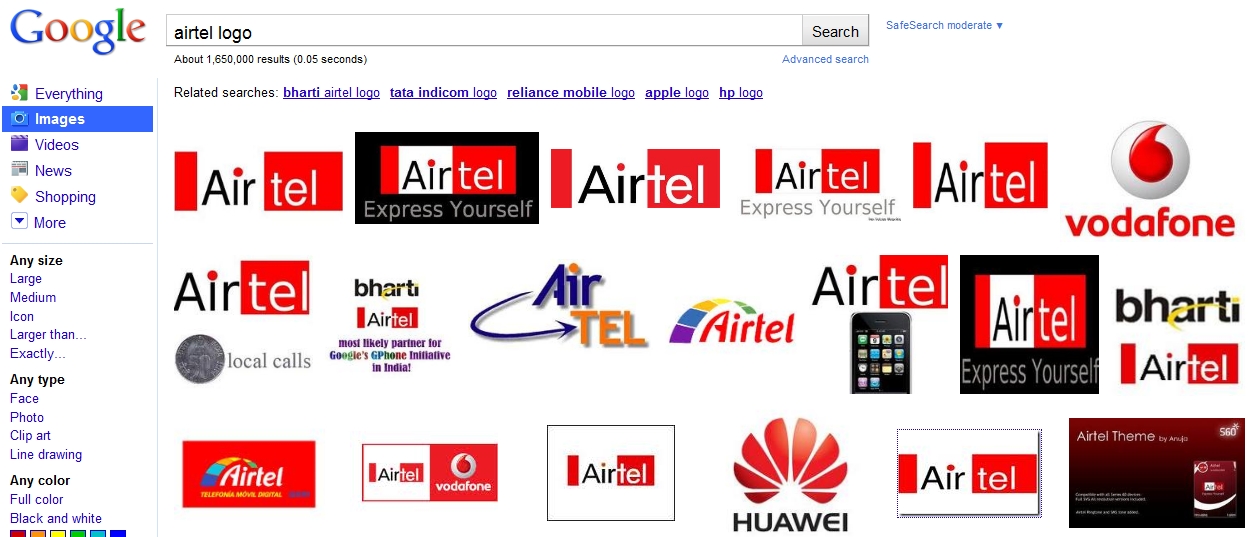
    To their credit, the ‘everything’ search, though has the old images, has the first link pointing to the new logo. But from an image perspective, ‘contextual reputation’ for logo change online gets a thumbs down.

    Cleartrip, quite a favourite brand for their ‘no nonsense. clear talk and action’ way of managing their product and online presence, has a new campaign ‘Every trip has a purpose‘. But favouritism unfortunately doesn’t stop me from wordplay and I tweeted
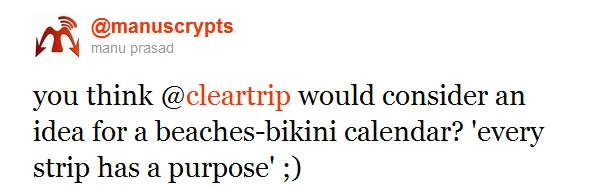
    Just as i was chided for provoking a brand, and was replying that I trusted Cleartrip to have a sense of humour, they replied with a ‘laughing hard’. Contextual reputation thumbs up. Hopefully they weren’t being sarcastic.

    The last experience was from Tanishq, whose new Blush campaign I came across last week. Like I tweeted then, immediately after the Quora tweet, I found it quite interesting and worth an applause that a brand was experimenting with a Firefox/Chrome plugin. Instead of me explaining how it works, I will, in my new found enthusiasm for imagery, give you a screenshot.
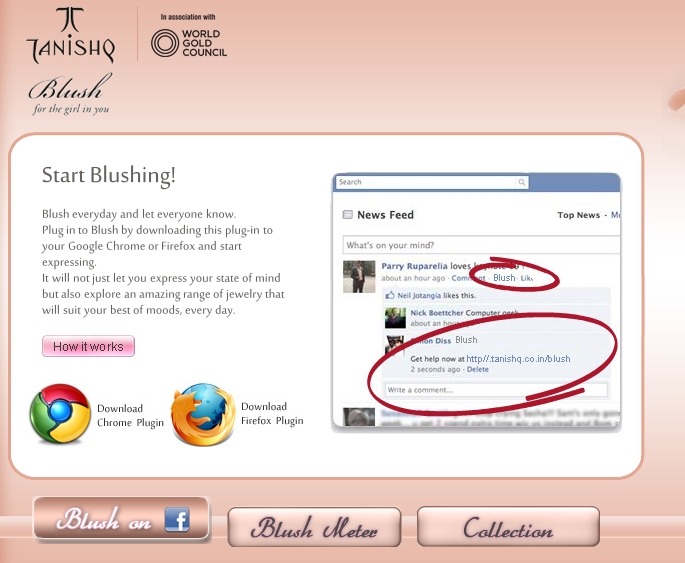
    As you can see, the plugin gives you, in addition to the ‘Like’, ‘Comment’ options you see after a Facebook status, a ‘Blush’ option, which when clicked, adds a comment with a link to the ‘Blush’ page. Hmm. I won’t get into a ‘app within FB vs outside website’ debate (there must be some reason, I assume). But unfortunately, boring that I am, I’ve never seen a jewelery that has made me blush. I can’t even see it in the Tanishq collection, assuming that I have the ‘where to wear it’ right. Maybe girls/women see it differently. So, why didn’t Tanishq just have a ‘Gold’ button, which would actually add to their ‘contextual reputation’ more than blush, and tie it to some sort of action that would actually get something tangible for all involved.

    For example, I install the plugin and start using it just because of the ‘show off’ value. What if they tied in an offer linked to the number of “Golds” I gave/received on statuses, and then communicated that in the comment that appears after I have ‘Gold’ed a comment. Or how about virtual gifts, a way to showcase the gallery, and then an easy app to add the virtual gift to a profile pic? I have an inkling that women are likely to have a “nice earrings/pendant. where did you get it from” conversation. They could even make this Like based contest i.e. if you virtually gift someone and get them to add it to their profile pic, and they get maximum likes (make a leaderboard) we’ll let you actually gift them for free. Do that on Valentine’s day, and it just might work.

    Meanwhile, I have a ‘reputation’ for longish posts, so I’ll just stop here.

    until next time, add to the context?

  • Brand agencies redux

    One of the ways to measure brand communication is to view it through the prisms of effectiveness and efficiency. I sometimes get the feeling that with time, mass media became more of an efficiency game. Then social technologies came along and forced the marketer to acknowledge (the forgotten) effectiveness criterion. That would explain the resistance to adoption, since communication strategy would have to change to accommodate it.

    A brand manager would ideally like a balance of both though. Meanwhile, somewhere on planet Quora, I voted up our friend Gautam Ghosh’s answer on ‘influence’. Apparently, an old HBR article (2005) had defined influence as a factor of two aspects – visibility and credibility. Considering that a brand is also aiming for influence, I found the connection between visibility/credibility and efficiency/effectiveness very interesting.

    I think the ROI debates are also a manifestation of seeking efficiency, though very few distinguish between cost and investment (I). The good news is that once tools are developed to address this, (I hope) brand custodians will focus on effectiveness too. I was very happy to read Jason Falls’ post about tools that are beginning to address scale too. (Expion and other social media tools to manage franchisee operations) While these tools would most likely scale themselves to accommodate new platforms and technologies that arise later, the bad news is that effectiveness is still something that can be judged only by someone who understands the brand as well as the platform in question.

    A quick detour. I recently started playing ‘Restaurant City’ just to get a feel of social games, and found Coke doing a pretty decent branding exercise there, that integrated well with the game mechanics and experience. The entire social gaming arena is already exploding. Farmville is passe, and Cityville is king. And that’s just one platform. How does a brand manager keep himself in the loop on all this, and experience enough to have reasonably good perspectives? So the idea of filtering experiences in multiple platforms to get perspectives on effectiveness is something I think only an agency can scale. And the more I think of this, the more I feel that this is the opportunity area for agencies – both communication (PR, Advertising) and media buying. I will state the obvious by saying that this is not likely to happen in their current avatars though. Your thoughts?

    until next time, agents of change

  • Content, Media, Distribution

    I read an interesting post at Social Media Explorer titled ‘Is content marketing the new advertising‘. More than the specific subject itself, which I write about occasionally, it made me wonder about the various entities that seem to be vying for the marketer’s attention. So even if we do limit ourselves to the thought that brands (and businesses) would create their own content, how does the distribution work?

    I remember writing about this a few weeks back, and asking whether content is merely a titular king and distribution is the real power. Its ironic because much of the power of the web’s second wave is in the ability to create content and distribute it fast. But over a period of time, the platforms we use for sharing have undergone a consolidation. The presence of traditional media outlets and brands on these platforms validate this.

    Now if we zoom out further and consider the various other things that are making their presence felt – social gaming, location based services (check out the Foursquare-Pepsi and SCNGR-Coke deals, and the new contexts of advertising they’re creating), group buying; apps on iPhone/ iPad (Murdoch and Branson are making a newspaper/magazine specifically for iPad) and Android. (do add on) This is in addition to the terrains that the incumbents – Google, Facebook, Apple, Twitter will discover and develop at least for some more time, and the technological possibilities that will arise. (eg. Augmented Reality, and the return of QR codes) Each of them are building their own distribution systems, and its difficult to bundle all the ‘content’ that appears on them under one umbrella. And that’s only the digital world.

    All of this also makes me think of destination sites. I can count mine on one hand. Every other consumption is via Reader/Twitter/Facebook and occasionally email. When the web (and its consumption) is rebuilt around people and their connections, what value does a destination site (belonging to a brand) add? How does the brand deal with fragmentation? The good news for the brands is that there are many more options than ever before. Not every campaign needs to be a TVC, radio spot, newspaper ad, site banner. There are smaller, more scalable and more flexible options. The challenge is to find them, and develop things that enable them to connect with the consumers. We live in interesting times indeed.

    until next time, many kings and many thrones

  • Group Pwn

    I’ve never gotten around to trying group buying/deal sites until once recently, though I always thought that they were fulfilling a need for businesses and consumers. But when I read this ‘peculiar’ story titled Groupon’s Success Disaster, I found myself identifying with it (from a consumer perspective, we’ll get to that in a bit) and since the number of group buying sites in India is only a few numbers lesser than the number of social media consultants, I thought it made sense to spare a few thoughts on it.

    The (linked above) story is of a small business owner, who, after 3 months of using Groupon, discovered that the deals were hurting the business financially and then had to take $8000 out of savings to cover payroll. Considering that, I thought the Groupon reply has quite a cruel title – ‘Too much of a good thing‘, but it is well drafted.

    The win-win for business-consumer in this is because it gives the former a chance to spread the word on the service and probably get some feedback on it and the latter mostly gets a good deal. Like I mentioned, I used a site recently for what seemed like a good deal. Though the deal process was painless, I ended up spending more money than what I normally would, thanks to a mis-communication (and some carelessness on my part). It means that I won’t be a repeat customer. It ends up as a lose-lose. Now this is probably the exception to how it usually happens, but…

    It did make me think whether the business owners get into deals with a strategy in place. Not just in terms of finance, but also in terms of their expectations of buzz, their delivery capability as well as how they’d manage to make the customer return. When it is kept in mind that social platforms and deal sites are mostly interwoven, I think it’d make sense for the business to use their service delivery (assumed good) and connect it to their social presence. A “We hope you liked it. Here’s an x% discount for your next visit and we would really appreciate it if you could leave your comments on FB/Twitter” approach. Facebook would especially help the business to spread the word beyond the usual early adopter set. While on retail, its difficult not to mention Foursquare. Though I’d love it if Foursquare aggregated the deals themselves, the businesses definitely can get active on Foursquare and push their deals to users nearby.

    With the (limited) examples I’ve seen, I doubt whether this is being done. So it reminds me of a lot of advertising,  and most social media efforts. The former because the message and the product/service are rarely (generalising) in sync, and the latter because of the lack of strategy and the herd mentality.

    until next time, regroup!

  • Multi purpose content

    This post over at GigaOm, titled “Apple doesn’t target markets, it targets people” sparked a tiny debate between Mahendra and me, on the effects of ‘antennagate’ on Apple fanboys, though the article itself had little to do with this line of thought. I wondered, like I’d written here earlier (last two paras), whether the continuous dissing in the media and the product flaw itself would create skepticism among the fanboys and affect future purchases, Mahendra didn’t think so.

    The subject of influence has cropped up here earlier, but the focus was on new media platforms and people. The above conversation made me think about the challenges that brands face on content that’s created on multiple media platforms.

    Even as traditional media platforms are being unfavourably compared to new media thanks to their constraints, the abundance of content – the media tsunami, on the latter does make one wonder how much of consumption by the intended crowd really happens. Meanwhile, despite the constraints,  technically, the reach of the traditional media platforms is still significant. A brand’s consumers exist on/consume these media.

    That really poses interesting questions on the notions of brand imagery, consistency etc, which have been holy cows of a previous era. Take this video, for example. Its a massive hit on Facebook and YouTube

    httpv://www.youtube.com/watch?v=cTl3U6aSd2w

    “Where’s the Gillette logo?!”, if this were a traditional TV spot, and what’s the message here? A close shave? 😉 But at 5 million + views, surely this must count for something. But what? This fuzzy nature of social media content and the media on which its propagated is exactly what raises difficult  but important questions on brands’ participation in social media.

    The answers are obviously not simple ones, and would have to be adapted to each brand’s needs. But as these lessons from Old Spice would suggest,  an important requirement is to understand objectives and define roles for each platform. The challenge then would be to create a content strategy that not only uses the inherent strengths of the different media, but also understands the motivations, consumption habits and preferences of the different kinds of people who use them. Instead of blind adaption across various platforms, exploring content options and finer segmentation is perhaps the order of the day.

    Perhaps Apple’s success is because of what the original post says “It focuses on users. And Apple lets them decide how and where they’ll use its products.” I wonder how many brands use that kind of understanding in their communication and brand strategy.

    until next time, iWash 😉