
Category: Advertising

  • Social grows up to be media

    On the first page of BG Verghese’ “First Draft”, he talks of The Times front page on the day he was born -21 June 1927. The paper was priced at one anna and “only carried advertisements on its cover page as was the general practice.” This was how traditional media companies had always worked. They had probably begun as journals, and later had sponsored information. (ads) In an era of information scarcity, this was probably required and appreciated. Even if they were not, the complaints would spread only as WOM. More importantly, while they took money from readers, their real survival (generalising) depended on advertisers. In the case of radio and television, it is even more evident. Then came the internet, and a story that has oft been repeated. We’re not going there.

    Though from email to BBS to Geocities to Friendster and beyond, everything can be considered social media, it began for me in the form of blogs (in 2003) became social networking via Orkut and really took flight with Twitter (May) and Facebook (July) in 2007. By this time, ads had begun to be ‘noise’ as media platforms proliferated. Twitter as well as FB served different purposes. As the cliche goes, “On Facebook, you connected with people you went to school with, and on Twitter, with people who you wished you went to school with.” In fact, such was my affection for Twitter that I even walked the talk. 🙂

    Why this long winded narration now? Because what I’d considered social is now very clearly becoming media that happens to have a social past. Facebook’s Promoted Posts will now reach people who have not Liked the brands as well, and it is working on measurement systems that resemble GRPs. From its options – a real time cloud API company and a media company, Twitter has clearly chosen. It has now started throttling the third party apps that made it the rockstar it now is. In their chosen line, this is an inevitable step to protect the ‘value’ it sells. Promoted tweets can now be targeted on the basis of interest.

    The disappointment, even if I reconcile myself to the fact that social is media, is the extent of evolution, or rather, the lack of it. Of the two, I have better hopes for Facebook now. Mark Zuck, despite the IPO, still controls it and from whatever he has spoken thus far, it seems this is not just a business for him, and though the ‘Promoted’ stuff on Facebook has now taken centre stage, the potential of the Open Graph remains and if it does evolve (as mentioned in an earlier post – last paragraph) it will continue to be interesting. Twitter? Oh well, Google’s AdWords is a megabucks one-trick, and it has Android. In the Google-like path it has chosen for itself, I can only hope that Twitter has a vision beyond being “sponsored”. If there is anything that media history has taught us, it is that irrelevance is just one service away.

    until next time, growing pains
  • Branded Spikes

    While waiting for the cognitive teardown of the immensely viral Kolaveri (like this Angry Birds one) in the form of either ‘What we can learn from’ or ‘How to craft videos like’ posts and also wondering how long it would take my Twitter timeline to move back from RIP to make-fun-of when a celebrity dies, I read this very interesting post titled “The New Patterns of Culture: Slow, Fast & Spiky” (via)

    It offers fantastic perspectives on creation and consumption patterns of culture, and digital’s weighty role in the changes being wrought. The limited ‘spotlight’ options of an earlier era (mainstream media) now have to co-exist with platforms and mechanisms that are open to most. ‘Scale is no longer a guarantee of stability.‘ Consequently, attention is the more coveted prize. Another related phenomenon is that ‘Change no longer happens all at once for everyone‘. I remembered ‘IsItOld‘ when I read this. 🙂 I sense quite a few concepts agglomerating here. Small ideas, which I haven’t written about for a while now, and transmedia storytelling, for starters, and a reversal of polarity. (the last via Neil Perkins post, linked to earlier)

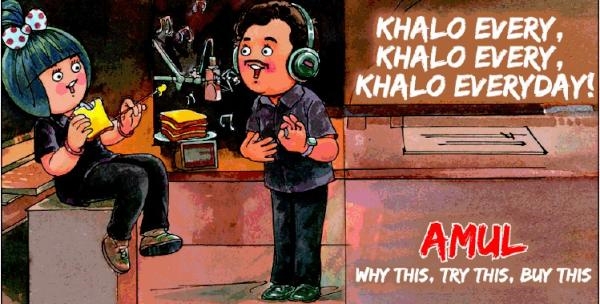
    Brands have always been using popular culture. One brand that I can immediately think of is Amul, and yet, I almost missed their Kolaveri ad. (via) Yes, not the greatest, but decent. The point here is that while they got the creation right, the distribution is still iffy. And that’s another challenge. Popular culture is more complex than ever before. With the abundance of content and platforms, keeping a watch on the long tail of culture, prioritising according to the audience-fit and then distributing it is not going to be an easy task.

    I have always liked (and hence, borrowed with credit in presentations) the analogy of bonfires and fireworks to social media and advertising. (respectively) The implications of this are not just in standard brand advertising but also in branded content. Brands now have to think of how the long-term story and the spikes can work together and ideally, complement each other, even while figuring out what role advertising and branded content play in each. Despite the seeming fit of social media to spikes, I wonder whether we will, in the medium term, see a role reversal – ‘mass’ media providing spikes and the internet dealing with the long term story, before settling into shared roles.

    until next time, get a spike mike

  • Coffee and brand stories

    One of the best Indian brand stories I have seen in recent times is Chetan Bhagat. He has pretty much nailed the product, price and promotion, and gets better with each release cycle. Place? Bookstores, Twitter, Newspapers…… He has loyalists and haters, online and offline, and most people I know have an opinion on him. I religiously read every book that he brings out, not because I think he is a literary genius, but because he’s a reasonably good storyteller, and like it or not, he has the pulse of the nation’s youth, or at least a significant portion of it. I do avoid his columns because I can’t handle that brand of humour on Monday mornings.

    I read his latest work Revolution 2020, and though it wasn’t quite the ‘Revulsion 2020’ that many made it out to be, I didn’t think it was a great piece of work either. (my review) But that’s not the story here. On page 108, a Cafe Coffee Day wove itself into the story, as the protagonist tells his father, “There is a Cafe Coffee Day opening in Sigra. It is a high-class coffee chain…..” I wouldn’t have thought more about it if I hadn’t remembered a story last year on how Chetan Bhagat had become CCD’s special friend, as part of their rebranding strategy. CCD makes another appearance in Page 116, and then several more later, as it becomes a routine rendezvous.

    Inserting a product into a story is not a new thing. Product placements in movies are now taken for granted. I still remember the time I worked on a project in the early days of this phenomenon – WorldSpace (my employer then) and Lage Raho Munnabhai. But these days they are mostly a force fit and all the brands involved try to one-up each other through their own promos. No one wins.

    But I haven’t seen a product placement in a book yet. To be fair, a few other brands like Frankfinn, Ramada, Taj also make appearances, but CCD gets top billing in Revolution 2020. Ah, billing. Maybe I’m reading too much into it, and it’s the author’s way of making the reader identify a little more with the story. CCDs are now, after all, ubiquitous. But if this is indeed an official tie-up, I think it’s quite a neat job by CCD. In the era of storytelling, when every brand tries to engage their audience via everything from TVCs to social media platforms, getting themselves into a guaranteed bestseller is a coup. CCD has always relied on its own stores than media campaigns for its storytelling, so this fits in. But if it’s indeed an official tie-up, and not a “what’s a few mentions between friends” arrangement, I’d have liked a disclosure from the author. It would’ve done his brand story’s credibility a world of good.

    until next time, a plot can happen over coffee…

  • Brands, Identity and Consistency

    So, Google+ kindly consented to host brands and organisations on the platform (announcement) and immediately gave examples of pages already available. These include Pepsi, WWE, Burbery and so on. The typical ways most brands have approached their new Google+ page is to use the features of the network (mostly Hangouts) to reasonably good effect, in addition to using the platform for content distribution and in a few cases, even displaying their employees. This last one was an interesting use case and has potential, I thought, and better than Facebook’s fanpage Admin version.

    When I read the announcement, I immediately thought of brand identity. In the initial days of Google+ launch, the circles feature that allowed users to compartmentalise their different identities created a little flutter. It helped that, at that point, Facebook’s options for achieving the same ends were pretty well concealed. The visual identities of the brands on Google+ remain consistent with other online and offline platforms and so far, so do the tone and activities.

    I have a different identity for different sets of people I deal with. Work, Friends, Family, Acquaintances, Twitter connections etc. How I behave with them and what I share with them varies too. (though there are overlaps)  I thought about this from a brand’s perspective. My relationship with a brand is different from the one that another person has. (use cases, context etc) And if I do have to share this relationship, what I’d share and the way I would share it would also vary among my own different audience sets.  In a world where the consumers are moving towards a fluid identity, do brands have to consider one too?

    In the real world, brands sometimes tweak their identity according to geography. This was reasonable and worked fine in an era of mass media. With the internet, the whole world would easily see the changes across geography. And the end consumer could ask questions too. He/she even expects the brand to communicate like a human. If we consider different networks as different geographies, with peculiar consumption patterns (of information, for starters), does the consistency that brand currently focuses on become a constraint? Considering that different platforms have different advantages and are used for different objectives, how fluid can the brand and its communication be, on the web and off it?

    until next time, identity crises

  • A Brand’s new story

    Brands have always been storytellers, but new platforms bring with them opportunities and complexities that warrant a tweaking of the craft. Welcome to transmedia storytelling. And you can read the rest of my article on afaqs.  (Just this once, don’t mind) 🙂