Category: Advertising

  • Communities and Brandstreams

    Last week, I’d written about transparency in organisations, and touched upon something that’d force transparency on them – conversations about them. While conversations can happen on the organisation itself, I believe the brand will also act as a starting point in many conversations. A transparent organisation will transfer some positive equity to the brand and vice versa. What comes first is a good chicken-and-egg question. Whether they can exist independent of each other is also a good thought.

    Since I have written on organisations, I’ll veer towards the brand this time. There is a good article here on what brands should consider before jumping into the ‘create communities’ game. But then, brand associations should never be restricted to communities, it can be as basic as listening in on conversations that happen not just on the brand itself, but the specific and generic categories it belongs to.  Moreover, communities don’t need to be very rigid in the way they operate. Check out Dell’s efforts here. The second half of this article also succeeds in conveying this fabulously. In a convenience driven, information overloaded consumer’s mind, it is difficult for the ‘four times a year’, ‘when we feel we have to communicate something’ TVC-print-outdoor campaign that many brands follow, to find a place.

    So, what are brands doing? From small businesses that give ‘prewards‘, to FMCG giants that attempt buzz marketing, everything is being tried. Some succeed, and some are questioned. What the last link, Nike shows is that brands cannot escape now with lip service. They have to be true.

    Which brings me to possibilities. Quite sometime back, I’d read this post about user generated advertising and product wikis, a sort of the brand’s lifestream, if you will. I found it a very refreshing thought, even thought Heekya (via Mashable) might be a good tool to start the journey, and was happy to read a tangential post  here. Please note that, though the second article uses ‘brandstreaming’ it is more to do with engaging the community through social media. Its still interesting though.

    But the best read I saw on this subject would be this post by Chris Brogan. I think it offers a great way for brands to balance their ‘official’ presence online with all the user generated stuff that’s bound to exist. But I’d still say community building has to start at home, i.e. organisation.

    until next time, start your brandstream..
  • Face it

    After the not-so-great response to Facebook’s Beacon ads, it was interesting to watch how Facebook would deal with the advertising and the issue of privacy. In an Indian context, according to the latest Comscore figures, Facebook ranks sixth in terms of the online search market in India. So, in an increasingly contextual world, where there are also fears of user data misuse, advertising has to play a balancing act.

    I’ve come across quite a few attempts at this. To start with, as part of the new design, you might have noticed the thumbs up/down on many ads. On clicking it, it asks you to choose from options as to why you like/don’t like the ad. It gives Facebook some great data that would help it target its ads much better. It makes sense – if I like the ads that appear on the pages I visit, and find it interesting, there are better chances of me clicking on them. As a user, I’m happy to get information/offers that are of use to me. So, positive user experience with ads. Facebook’s advertising options seem to be working well for them, if we go by Mashable’s poll, done last month.

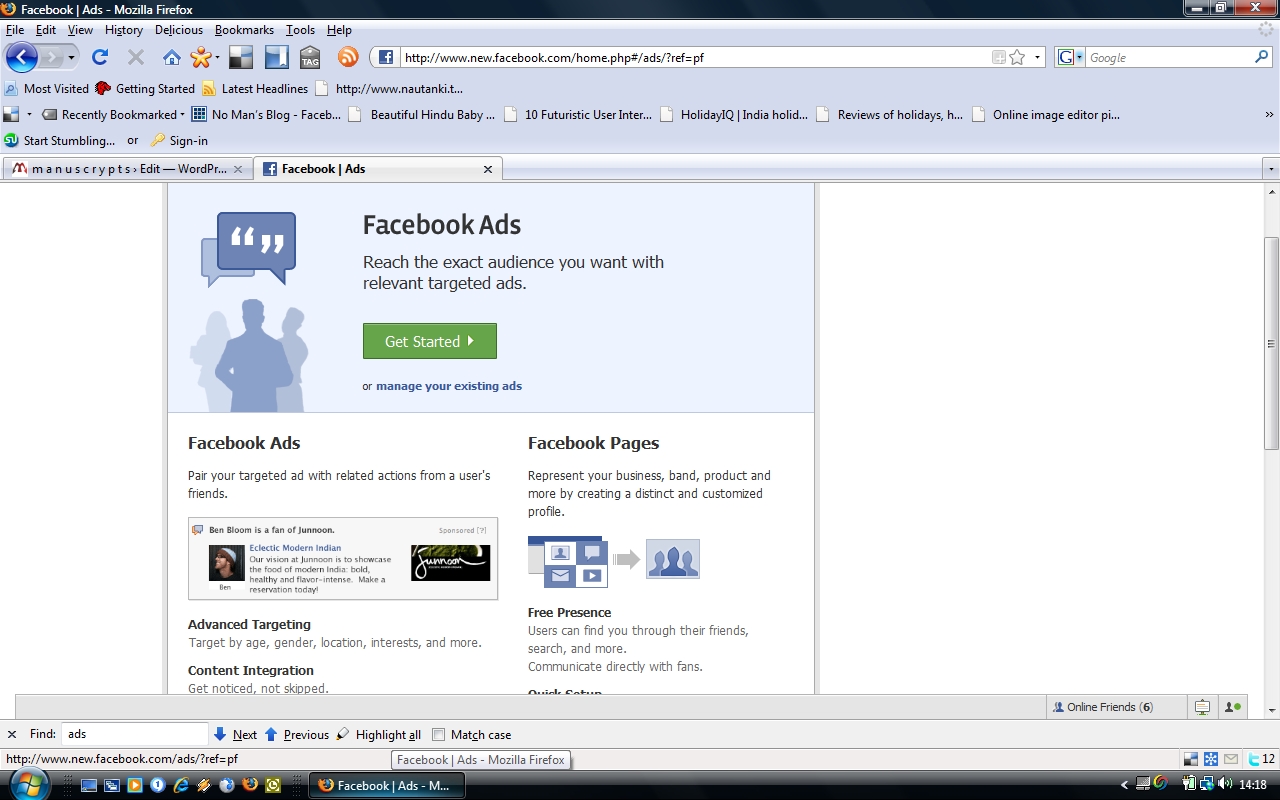
    You might have also noticed the welcome screen below, which help advertisers create ads on Facebook. (click to enlarge)

    Minekey uses the ‘targeted ad with related actions of a friend’ a lot. You might have seen the ‘XYZ has added the Minekey application’. But those won’t have the thumbs option. Also, check out some work done earlier by Career Builder. Its very interesting.

    Another communication I saw was the usage of a user’s action by brands to communicate their offering. So, (to use the example given in the article) if you see me saying ‘I loved The Dark Knight’, Warner Bros might have had a hand in it being shown to you. I hope brands will use this in moderation.

    But the really interesting piece of news I saw was Facebook’ way of social ads – Engagement Advertising. This allows users to leave comments on the ads they see. I wonder how brands will react to this, since it allows users to just diss their communication. It also forces brands to treat their message as secondary, relevance and fit to the community being the primary criterion. But its a great opportunity for brands to truly embrace transparency and a new way of communicating. More about it here.

    In essence, brands are getting newer ways to use social media, and even thread it with their offline activities. There’s more activity happening, check out the application that Microsoft has released on Facebook –Collabio. With users increasingly deciding what happens to brands in social media, it is imperative that brands understand how to present and represent themselves. Meanwhile, here’s some good data on fan trends in Facebook.

    until next time, add socialising to your ads

    PS. Am I the only guy feeling the eeriness of Obama Bi den… Osama Bin Laden ? 😉

  • Leaps of faith

    The new Samsung TVC, starring Aamir Khan has been airing for sometime now, and I’m still trying to figure out exactly what it means. I’m okay with a brand aiming for the best, and looking out for cutting edge technology, but what’s with the tagline – ‘Next is what?’ Is that a question to me? Are you trying to keep me guessing?

    When I see AK jump in the last scene of the TVC, it is, to me, a leap of faith, something which I might be willing to take when its Nokia we’re talking about. But, at this point in time, Samsung has yet to prove to me, its technical superiority, its aesthetic sense or any of the other parameters like value for money that I consider when I make a mobile purchase decision. What Samsung has successfully communicated to me, with this TVC, is that they themselves are not sure what’s going to happen next, and maybe I should wait sometime before I pick up a Samsung handset.

    When a brand reaches the zenith in whatever category it is in, it is sometimes smart to ignore the #2 totally, and start positioning itself to be beyond all the mundane new feature/market share/pricing strategy/tactic that it might have resorted to in the past. But, how smart is it when you’re a distant #3 in the market? It  makes me wonder if brands also should follow a tweaked version of Maslow’s hierarchy, find out where they figure (in the consumer’s mind) and design communication accordingly. Yes, i agree that brand and people occupy multiple levels at the same time, but at least there would be some method in the communication madness.

    When I saw a ‘Next is the spirit of the Olympics’ ad, I couldn’t help but remember this wonderful article. I quote from it “Modern branding has evolved. From its roots creating detailed guidelines for enforcing corporate logos it has become a sophisticated effort to define the compelling and differentiated value that an organization or product offers its customers. And it aspires to create experiences of that value across all interactions. It goes beyond design, messaging, websites and advertising. It touches product development, recruiting, customer service, sales, and it drives and emanates from the very core of every business: culture. That’s where these campaigns miss the mark. They tell me who they are, but not why I should care. They provide an introduction, but can’t sustain the conversation. And I don’t have much attention for brands without substance.”

    I’d have been less acerbic, if I’d seen at least a semblance of involving users in this entire positioning exercise. A developer’s community which takes feedback from users on what they want to see in the next samsung mobile model, updating consumers on what they are working on, building some interest around it, and so on. To be fair, they have done something, though the community link took me here. 😐

    Tell you what, here’s a free idea, go ahead and sponsor the second season of Bigg Boss. The last season, I always used to wonder, ‘next is what?’ !!!

    Which takes me to another premise, I thought a slightly more interesting one. If brands were really gutsy, they would do some product placement in Bigg Boss. From paste, soaps and shampoo, washing soaps to Real Good chicken, tea and coffee brands, apparel brands, exercise equipment, Veneta Cucine kitchens,  every damn thing that we use in daily life could find its way there (of course keeping in mind the rules of the show, so no TV, mobile etc) Yes. MDH Masala too!! In fact, the contestants shouldn’t be told in advance what the brands are, so no rigging. Have competing brands also. Yummy!! What you get is a real chance of ‘celebrity’ endorsement. Imagine Rakhi Sawant saying ‘Tide makes washing so easy that I wish I’d more clothes’. Ok, cheesy, but you get the idea 🙂

    But that requires absolute faith in the product, and having the maturity to accept criticism and ensure you never make the mistake again. We still have a long way to go before brands can handle reality television, or reality.

    Meanwhile, next is WAT too, who’ve got an absolutely cool new design. Go check it out.

    until next time, WordPress has a ‘next’ button too 😉

  • Copy Paste

    There was an interesting piece I read about the way Cuil, the new search engine I’d written about earlier. In that post, the author compared Cuil to toilet paper, no offence meant because it has nothing to do with the engine’s features. It has more to do with how Google as a search engine is so ingrained in your head that there is no thought process involved when you have to choose a search service, much like the toilet paper decision. So the lesson was that if you’re challenging the market leader, you need to have some really strong firepower.

    And while that insight involved an online entity, which provided a free service, it also got me thinking on purchase decisions regarding low cost ‘real’ items, like say, matchboxes or sometimes, even toothpaste. To justify the latter, I don’t make a decision before I go shopping, we check out the stuff available at the retail outlet, but within a set of brands we normally use.

    And coincidentally, I saw the latest online effort from Colgate, via their Facebook app. The Facebook app is based on a game they have on the site – Kayak. You can read a review of the effort here. I will not get into  checkbox marketing, I’ve been doing that for over a year now, the earliest rant being this. The site is connected via a contest with the TVC that’s being aired currently (which also advertises the site) and stars Bruna Abdullah. As for the contest, if you win, you have a chance to get fresh with Bruna. Woo!! (okay, i made that up because i couldn’t resist the maxfresh name connection, but yes, you do get a date with Bruna) 😉

    Someone’s got the right intentions, because this is not Colgate’s only attempt to rally the internet. I chanced to see this sometime back. (via Medianama). I liked the dental expert touch, and am happy for the efforts, though I have a different perspective. For example, though MaxFresh is a youth brand, the primary benefit is dental care and a cool Facebook App could very well be built on that parameter. But yes, while the net is definitely useful, very few brands have learnt to use it to their advantage.

    So, what’s the way forward for ‘commodity’ brands? One is to pretend that the internet doesn’t exist and continue trying to shout the loudest and get the customer’s attention. Two is to include digital in the marketing effort, but as an adaptation of the Print creative. Three is to devise a digital strategy, that’s in line with the overall brand strategy but not an adaptation. I would love to see brands that take the last route, because I see a great sync with the way social media is working.

    What if brands go back to Step 1 and start looking at the product? Isn’t that where the differentiation can be brought in, rather than from a communication that will stay in the consumer mind only till a louder one from the competitor or anyone else looking for the same consumer’s mindshare, comes along? Use the internet to gather insights from people who are interested in your brand, create stories around the brand, utilise those insights to make the product better, to make variations and satisfy the niches that lie hidden in the long tail, to make your communication more appealing. That’s what the internet allows you to do. Obviously, each brand would have its own criteria of critical mass that even a niche should have for it to operate in that space, but the good news is that we operate in India, and sometimes 1% of this market would be the population of a country. And while on India and retail, would love some info on what exactly these guys are doing – Blinkmagic. Everyone who i chatted with, among those who attended the recent edition of Proto only had good things to say about them.

    Meanwhile, what happens when the ‘commodity’ brand’s variations start hitting the market? Obviously, existing retail space cannot handle all of this. And if the tail wags the dog, it could have really bad results as Al Ries has observed here. But where I disagree with the article is that the rampant flavour proliferation is a bad thing, or is a reason to junk the ‘long tail’ way of thinking. I see it as a challenge that retail and brands need to address. I’m sure someone will find a way to tweak the traditional distributor-dealer network to address the needs of the tail. After all, technology is definitely making its way into retail, in a big way, in India. 🙂

    I wonder how internet brands will handle ‘commoditisation’ when it happens to them, I can already see it happening in a few areas. Will they need another media to help them out?

    We started with a search engine, so we’ll end with one. Check out a new search engine I came across – Viewzi

    until next time, be refreshingly original

  • Any Ideas?

    Reading this post today, on how Tata Sky and Dish TV have both partnered with matrimony portals -Bharat Matrimony and Shaadi.com respectively, in the space of a single day, I realised how fickle competitive advantages really are. It also reminded me of a much debated post on Scobleizer yesterday on tech blogging, and where it’s at. While the initial premise of that post was how focus was now more on the biz part of it than the mutual discovery of stuff, it then moved on to fleeting attention spans and the quest for the latest shiny object on the www. And how every tech blog out there is trying to beat each other in reaching the latest news first.

    Which essentially makes news the commodity and ways to reach the audience first the competitive advantage. Pretty much the same game as what our TV channels are upto these days. When I look around, i see commodities happening all around, to all sorts of product categories, and brands ending up aping each other so that they don’t miss the bus. So whether its reality shows or strange four letter acronyms for shampoos or features in mobile phones, remove the brand name and you won’t notice the difference. And to me, thats a problem, because in a commodity led culture, quantity led factors like volume, reach etc take precedence, mediocrity tends to become the norm, and no one thinks that they should figure out a better way to reach the consumer than the bus.

    And that led me to think of ways and means of how brands can fight it. While I’ve been thinking of clear positioning as an obvious starter, I also realised there were some brands that not only created the big idea and ended up making a verb out of it – xerox, google, to name a couple, they were so radical either in thought or execution that they never actually positioned themselves. And before I go further, I apologise for taking you on this stream of consciousness trip. Now, not all brands can be lucky enough to get a not-easily-copiable idea or a drastic new way of executing it.

    And that brought me to the potential of a brand which has taken a great first step in leveraging its brand name very well in the absolutely commoditised market of telecom- Idea. I’m sure you must’ve seen the TVC by now. While the campaign is indeed good, what I’m more impressed with is that now that they can actually focus on the innovative uses of utilising a mobile for the betterment of the individual and the society he lives in, and do a lifetime’s supply of campaigns, built around different ‘Idea’s. It offers a way to create a positioning that’s beyond communication. I think that this approach has the potential to build a superbrand. From a new media perspective, and considering that the mobile is almost ubiquitous now, think of the conversations that this could create, obviously around ideas.

    That said, any ideas on how brands can beat commoditisation?

    until next time, an idea and change