Category: Advertising

  • Mind your language?

    Aachi Masala’s ad – Malayalam transliteration from Tamil – has been providing unintentional humour for a while now. It reminded me of Karthik’s post on Quartz a while back- “How brands are hurting themselves with pan-India “Hinglish” ads“. 

    The crux of the post is marketing effectiveness and how, by not communicating in the language the audience uses every day, the communication is losing its effectiveness and its ability to persuade. “Advertising is not mere communication. It’s persuasion” is a reasoning that’s hard to argue with. The common justification given my marketers are apparently “everyone knows Hindi” and “cost”. I wondered though – can marketers be that callous? Could there be other reasons? A brief thought exercise followed.  (more…)

  • Nike: Big shoes to fill

    It has been just over a year since Nike celebrated the  30th anniversary of its “Just Do It” campaign with a series of ads, featuring athletes including Colin Kaepernick, and triggered a controversy. I wrote then, about Nike’s “skin in the game” approach to brand messaging, and argued that it was perfectly placed to polarise and reap dividends in a world of attention-scarcity. But..

    Woke might make you broke!

    One year later, a (rightfully) sharp post on Pando alerted me to how the NBA got embroiled in the Hong Kong protests conversation, thanks to Daryl Morey, General Manager for the Houston Rockets tweeting his support. China vs NBA resulted. The NBA apologised. Nike pulled its Houston Rockets merchandise from five stores in Beijing and Shanghai (via). It didn’t stop there. LeBron James, refusing to be left out, waded in by stating that Morey was misinformed. Thanks to Nike’s $1 billion lifetime association with LeBron, that dragged the brand further into it. As per USA Today Nike’s business in China from June 1, 2018 to May 31, 2019 is upwards of $6 billion, and has doubled in the last 5 years, while remaining flat in the US. The stakes are high. (more…)

  • Can media become social enough?

    A few days back, it was reported that Facebook now had a million active advertisers, and that LinkedIn has 3 million company pages. I’ll let that sink in, in case you hadn’t heard. Despite all the social-ness, I realised it’s impossible not to call it media. The wiki definition for media is “tools used to store and deliver information or data” That, for me, is a smartphone now! I also wondered how many media behemoths could boast of a million active advertisers. And that’s when it really struck me how much the traditional media we were used to have been sidelined – yes, they still get advertising revenue, but from a sheer reach perspective. Google, Facebook, YouTube and many more platforms get anywhere between a few million to a few hundred million visitors every day.  To put it all in perspective, TOI – the world’s largest English daily has a readership of over 7 million.

    Media and advertising have had a very intertwined life, unless of course the publication/channel has been on solely a subscription based model. I think the magic of Facebook (and Google, before it) and those that followed is that they have democratised advertising by not just making it something any small business could spend on according to their means, but also giving them the ability to advertise according to contexts – intent, interest, social etc.  Though Google, Facebook etc are still intermediaries, they never flashed their powers, though the latter has begun to, recently. As brands move away from a one-size-fits-all mode of advertising, these platforms give them more options of form and function, and changing the face of advertising. (Google’s exploits are known, here’s a pertinent read on Facebook)

    In such a scenario, what really does a traditional media channel have to offer to its consumers and clients? I’m not saying that they’re all going bankrupt next Sunday, but it’s clear which way the wind is blowing. One way, of course, is to use their brand value, and replicate (and grow) their audience on devices and platforms which better serve advertising interests. They can hone their value offerings by offering various contexts and their combinations – local, social, interests, and so on, and build business models for each. The early movers are already making big deals. But that is the red ocean that everyone is fighting for. How really can a player differentiate?

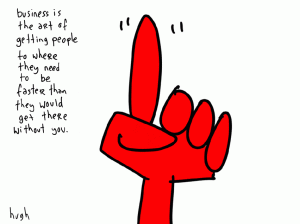
    Biz_Is_The_ArtI had a vague thought. Media’s original strength was its relationship with users and the trust involved. In the social media era, how can that be leveraged? Flipboard has already allowed users to become curators and create their own magazines. Is that the future, along with shared revenue on advertising? What if users can also curate the advertising their ‘subscribers’ can see? After all advertising is also news/information and has a certain value depending on the source. Traditionally, media  has been the middle man between advertisers and users, but what happens when everyone is media? Can media start aggregating influencers in every domain, including niches, provide them the material for curation, negotiate on their behalf to relevant advertisers, and share the revenue? Perhaps the next  disruption will be the platform that can handle the complexities involved. What do you think?

    until next time, mediator

  • All ideas are equal, some more equal than others…

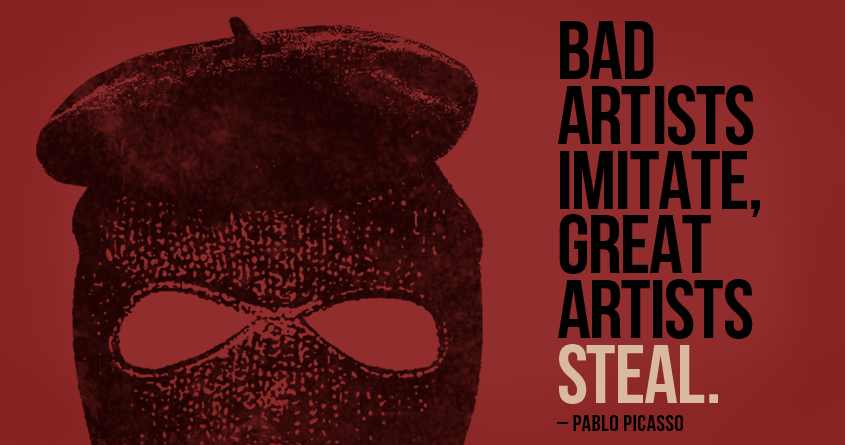
    (via Threadless)

    A conversation in office on an unrelated topic led me to ask this question on Twitter.

    ..and @atulkarmakar gave me his perspectives


    Just like Atul mentioned, I had first considered whether it was because creative ideas were considered more personal  and a business idea/model an impersonal, corporate entity. But my starting point had been advertising, to which this does not really apply. Compare the reactions of Company A replicating Company B’s business model/idea versus them being ‘inspired’ by their advertising. In the case of advertising, both agencies might get paid and both clients might benefit. But in the case of a business, the second player could benefit from the mistakes (strategy/execution) of the pioneer and build a more successful business. That would be really unfair to the first guy whose business idea might have been a really creative solution to some need. And yet, it’s more likely that the aping of ads would spark a larger debate and the business cloning would be ignored. Am I missing something? Any perspectives you want to share?

    until next time, game of clones

  • The more things change….

    Just a couple of weeks back, I’d written about influence and context, and last week the twitterverse had some excitement delivered courtesy Disney. I couldn’t experience it first hand, but got quite a lot of perspective thanks to Karthik’s post and the comments that followed.

    Personally, instances such as Disney serve as a great filter for keeping track of the trust quotient. I don’t expect agencies/brands/celebrities to be unbiased or disclose, but once upon a time, it was natural for regular twitterati to do that. But times have changed, and all of this is personal philosophy, so I’ll move on.

    On hindsight, and when comparing the patterns of evolution of traditional and social media, the current scenario seems inevitable! Platform – Community – Audience -Brand – Ads (hashtags) – and when ads became noise, brands differentiate by bringing in a fresh voice. (celebrities/micro celebrities) Where we are now is with an army of mini TOIs, relatively more genuine-sounding, and significantly less costly. There are quirks, of course. For instance, brands don’t have to pay the platform to be present, and can incentivise the community to provide publicity. On the flip side, brands are also ‘being held to ransom’ (previous post) by ‘influencers’ and we’ll probably see guns for hire being used by rival brands pretty soon. [Just last week, we saw a tweet from a person working at a competitor stating that she liked shopping at Myntra. One of the various scenarios we considered was a #conspiracytheory – that the moment we used the tweet in some way, the person would prove to be a non-employee and we’d be accused of playing dirty]

    At one point, I really thought (or hoped) social would be new wine, but it has more or less ended up a new bottle. If we continue the evolution pattern, the future is easy to imagine. Context will disappear, and noise will magnify, until the next disruption. But I still have some hope, because the nature of the platforms (and the tools that are getting built) are such that a user can, at least to an extent, mould it according to the way in which he wants to consume it.

    That does take me back to what I said in the last post – people will actively build their own trusted sources. And the real opportunity for brands is still to become a trusted source. Yes, I do think it’s possible, and we have a relaunched buzzword on cue – social business. In fact, there are probably brands doing it already, spending resources to build the foundations so that the hashtag (or its equivalent in the future) is not manufactured for its own sake, but is organically and genuinely built by contextually relevant influencers who can be publicly rewarded for helping the brand meet its business objectives.

    But wait, that was where social platforms started too. Which leads me to wonder if the future of brands and media will always work in cycles, and end up near square one!

    until next time, the more they remain the same…

    zp8497586rq