Category: Advertising

  • Even distribution

    The per second and per character billing wars happening in the Indian mobile space now, made me consider whether its beyond a price thing – a need for consumers to slice and splice until they get exactly what they need. I see a parallel in the flow of content too, something I discussed earlier.

    Which explains why I tweeted that I was still watching with great interest, the results of Murdoch’s arachnophobia, though it will take months. (despite having some fun with irobot.txt, and Walled Street Journal 😉 ) Now that’s a subject on which everyone’s had an opinion, so I’ll refrain. (though I’ll share the interesting Bing Theory) The other part of his announcement, where he wants to be paid for content, will obviously depend on the quality of content he can give, and whether it can be found elsewhere for free.

    Meanwhile, as a believer of the link economy, I should’ve logically said that News Corpse was the future, but I refrained. The reason was that for me, the complete mechanics of content distribution is still in an evolution stage. I wrote about brand content distribution last week, and I’m exploring similar thoughts on information in general, especially when i see studies on sharing trends like these (via Social Media Explorer), which I still think is a good indicator despite the inherent skews in sample/methodology it might have. The specific part that interested me being the low shares of Google channels and Twitter, and the larger understanding (reminder) that the web is much bigger than the social media savvy crowd. While Google News has become a great aggregator, there might be other distribution mechanisms that can be developed, keeping a paid model in mind.

    Media has long served as a distribution platform for brand communication, so its obvious that any effect on media would also force brands to think differently from what they’ve done so far. It means seeking and understanding various smaller ecosystems that are bound to develop, where media itself would be different from what we see now. In essence, brands would have to slice and splice their content to reach various audiences. Again, one can’t completely rule out the possibilities for Murdoch with niche specific audiences.

    Meanwhile, I had a good debate recently with Surekha on social media’s usage by brands- product/brand centric vs communication centric approaches. This great post (via Surekha) sums it up quite well. My contention was that ‘buzz’ (for lack of a better term) could be generated without a communication centric agenda, if brands/products were serious about social media and approached it from a business design perspective. Communication centric approaches would tend to see networks as broadcast platforms and the focus would be on ideas and execution, which may quite often be platform centric, with less thought on how sustainable it is in the long run,  especially if all parts of the organisation are not aligned to a different way of working that’s required. Also, in addition to the spurious ROI methods which are evolving, my issue with communication – centric approach is best described by Godin in Hammer Time (every function (PR/Advertising all bring their own hammers to nail social media) and Rex in “If Advertising is your middle name, your surveys will always suggest the solution is….

    (Update: Thanks Dina, for sharing this)

    It led me to wonder if brands’ usage of  FB, Twitter etc as broadcast platforms, also contributes to the way these platforms are evolving – from the concept of digital sub-prime crisis that Umair Haque has written about recently to the kind of hiring that brands do. (In this context, the Ad Contrarian’s 3 Distinctions post is also worth reading) Taking it further, is that why (simplistically put) instead of collaboration and easy interoperability, there is the scenario that Tom Reilly very interestingly describes in ‘The War for the Web‘ – war between natural monopolies  (search, social networking, classifieds etc) for adjacent areas.

    I’m hoping that like with all things web 2.0, the community will turn both the fights in a direction that is beneficial to itself, and we won’t be left replacing one system with another that develops with the same principles.

    until next time, choosing sides 🙂
  • Twitter lists, Social Search and brand content distribution

    So its been quite a while since Twitter lists launched, and the ego seems to have stopped trending now. The open API means that we can hopefully see a some interesting apps/services (eg.directories like Listorious or alert systems like Listiti) soon. In fact, Twitter has already made an interesting widget, which you can see in action on the left side, at the bottom. Its a list of people who create/share content/have an interest in the Indian web space.

    Meanwhile, though Twitter lists will add a new dimension to search – people, content etc, like I mentioned in the last post, and create perceptions about people (basis lists they appear in), there are already directions which make me feel ambivalent (country lists, and I agree largely with this take). Even as they try to balance utility with threats like spam, I wonder what features Twitter will add to lists – feeds of lists, search (and advanced) within list tweets or add this option in existing search, one click DM to all members of a list (at least by the creator for starters),  or at least a way to send a tweet to only a list (so that I can be more pertinent to specific kinds of users – eg. there are those who hate my godawful puns, but like the links I share 😀 )

    (Let me know if these exist in some form – even on apps, and add on the features you can think of)

    Another line of thought occurred to me while on Twitter lists – brand communication. It started off by me wondering whether we’d now see brands occupying Twitter backgrounds of relevant lists (considering the web interface is still the most used source of tweeting) say, Star World on a a Heroes/Lost fans list, Kingfisher on a beer fans list. (all of you brands pay Twitter and the list creators, please) Taking that further, would we have brands create lists? Hopefully, not just something as vanilla as their fans, but say, a relevant common interest topic. 🙂

    This led to a larger picture of how brand communication’s distribution would evolve. This also fit into last week’s post – aggregation of content and serendipity. How would brand communication fit into the varied methods of content consumption, aggregation and discovery?

    Even as new distribution and consumption patterns develop rapidly, the identity of the traditional distribution means i.e. mass content creator-aggregators (newspapers, TV. and even web entities) as just a platform for vanilla advertising (and that includes ‘innovations’ like force-fitted editorial) has been changing for a while now. For example, Yahoo, even as it takes steps in creating and curating content, is also making deals “to help marketers creatively incorporate their brands into original online programming. The programs will appear exclusively throughout Yahoo!’s network of leading media properties including News, Sports, Finance and Entertainment.” ESPN Sports Center worked with Toshiba to create advertising that illustrates specifically how ESPN fans could use Toshiba TV sets and laptops. But all that’s still only creating more context. Seemingly seamless content and advertising, tricky territory, that.

    To compare it with say, Twitter lists, the latter already have the context and the audience in one place, and these are created by the audience themselves. Isn’t that at least a step ahead. Meanwhile, there’s another way of looking at it – the Google way, using Social Search, and that includes not just Google’s own services like Reader, Profiles (and that means all your other service details you shared there and your respective networks), Mail contacts, but also Twitter. That means, when a person is searching for information, Google can now give him socially layered real time results, quite a good start to a man+spider filtered way of search. I have to wonder (again) how long the SEO way of making sure the brand website appears on top will work.

    All of the above – traditional content platforms, social platforms, search are different kinds of people and content aggregators, and options for brands to create/share content (self created or UGC) in. While it might look challenging, it offers enormous possibilities of tailoring content according for the brand’s different audiences and their needs. They have varying sets of positives and negatives, several parameters will decide the medium, but as far as the message goes, interesting content is now, increasingly and thankfully mandatory. 🙂

    Brands have always been experiences. Brand communication has sought to build/reinforce/manage perceptions. In an unconnected world, the audience had to rely on the communication, and the small set of experiences that they knew of – their own, and those of their circle of friends, relatives etc. In a connected world, the audience will experience in many more ways, and the content they create will be shared and distributed in ways they deem fit, across a much larger audience. Perhaps, now, the experience is the message, and the audience is the medium.

    until next time, medium, message and mob mastery 🙂

  • The next content aggregator

    There was a good ‘debate’ at the McKinsey debate zone on whether people will pay for content, in the context of newspapers. An old debate by now, and one whose conclusion is being seen around, with very few exceptions (the reasons for the relative success of the Big 3 of fee-for-content services—the FT, the Economist, and the WSJ are also dealt with), but made interesting because of its succinctness. Clay Shirky writes about the ‘high price of charging for content’, and starts with a very interesting line – “People will pay for content if it is necessary, irreplaceable, and unshareable.”

    [Before we go further, I have to share this amazing read (or listen) with you – Clay Shirky, at the Shorenstein Center on the Press, Politics and Public Policy. (also read the first 3 links to the commentaries on the web, the fourth is a twitter feed)]

    I’ll attempt a summary because the context is needed for the post. He talks about the temporary arrangement that had allowed accountable journalism to create an advertising based business model, and how in the internet era, specialist information sources have disrupted that model and allowed advertisers many more, and better options. He talks about how the newspapers’ way of bundling content, where readers and advertisers subsidised the content they didn’t want, doesn’t work now, and the aggregation has now moved from the ‘server-side’ to the ‘client-side’. He sees “the newspapers’ ability to produce accountability journalism shrinking”, and is convinced that “those changes are secular, monotonic, and irreversible, rather than being merely cyclic and waiting for the next go around.”  He also points out a major and adverse side effect of this disruption – the absence of newspapers as a bulwark against civic corruption. (While there are other media and their ‘sting ops’, I’d still say that the role of newspapers in this regard is still important). This is something I remember debating a few months back over at Iq’s blog, when he wrote on this issue.

    He believes that newspapers are irreplaceable in accountability journalism, and sees three kinds of experiments happening in the new media landscape – market based (commercial, the traditional advertising model of publishers), public (funded by income other than revenue – like non-profit models) and social (crowdsourced models). The internet makes the first difficult to sustain, the second easier, and the third, easiest.

    In a recent post, Umair Haque writes about the open ‘mediaconomy’, which offers tons of soda, but good wine too, and that’s the reason why most old media companies are in trouble now – ‘they’ve been for long producing generic soda, instead of distinctive kinds of wine.’ And in an economy where supply of soda far exceeds demand, how long will people continue to pay for it? As Umair points out, its not just about media, but any industry that’s doing the same.

    Now, a few days back, when I was searching for some information for a holiday, I went to my list of regular suspects – a  few Indian hotel/destination review portals and a few travel portals. I did find information, but was given a choice of hotels that I wasnt too happy with. I had opened another tab for the traveler advice on WikiTravel, and happened to come across options in the ‘Stay’ section which I hadn’t seen anywhere else. In fact it gave me more options than I’d have liked and I was forced to choose from two equally good places, whose websites had all the information I wanted.

    WikiTravel is free, created and curated by users, who take the time out to update and add information. They will obviously incur costs when doing this, and spend some time. They obviously are supported by a revenue model (personal) that allows this, a revenue model that most likely is part of the old economy (commercial, unlike public or social) And that’s what makes me worried about the transition period, the part when the old economy is too weak to support the new, and the new doesn’t have a way to support itself.

    The other point is that the content is out there, but the soda and wine are all mixed, and I’m yet to figure a model where I’m sure I’m not missing something. Yes, there is Reader, Twitter and perhaps a couple of other places, but these do have a tendency to evolve into an echo chamber every now and then. Serendipity does lose out a lot when I put systems and processes in place. Newspapers were aggregators in their time. I can customise tools to give me the news on only those categories I’m interested in. (Rarely) Sometimes people add the serendipity. In many cases, when I’m searching for specific information, the tools (search) and the humans (crowdsourcing) have failed me. I have ended up ‘discovering’ new resources – sites/tools/people and then sharing it. Its not as organised a way as I’d like, but I guess we’re still evolving.

    There is quite some work happening though. Google Reader recently added some ‘Magic’ which helps users discover interesting content faster. The new ‘Explore’ section has a generic popular items as well as recommended sources suggested basis the reader trends and web history (if opted in). Feeds can also now be sorted by ‘magic’, again basis the history of ‘like’ and ‘share’.  Twitter lists will add a new dimension to discovering users and content, and with the deals with Bing and Google, search is going to be more real time, and more importantly, involve a human filter – using the lists layer to deliver better, more relevant search results. The impact on SEO should be fun. TweetMixx is a site I came upon recently, and looks interesting in this context.

    Where will it land up? Is it possible to create an aggregator whose context is subjective preferences, but that will still bring in serendipity? (people who liked this also liked?) What kind of content aggregator will evolve that can either sustain itself without revenue, or convince me to pay for it? Or perhaps that single-entity era is over. It does make me wonder if at some point in time, everyone will be Hiro Protagonist like characters, paid for each piece of information they add into the overall system. 🙂

    until next time, infobesity

    Bonus Read: A very good read on ‘Why the great Indian media companies will fail on the internet

    Update: Set up Parse.ly Lets see what it delivers. 🙂

  • Brand equity in real time

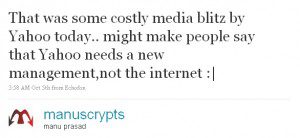
    Media Post reports that Yahoo’s latest campaign caused its perception among U.S. adults to fall steeply – apparently, YouGov’s BrandIndex, which tracks daily consumer perception of brands, found that Yahoo’s buzz score had tumbled from 35.4 on Sept. 22 to 25.5 as of Monday. Acknowledging India’s growing significance, the $100 million (global) “It’s Y!ou” campaign was rolled out in India too – y!ou couldn’t have missed the “disruptive” frontpage takeover of multiple mainstream dailies or the TVCs. My views on it were expressed in <140 characters

    Clipboard02

    Before you take me for some kind of Yahoo hater, I’m not. (Actually, I’m quite a fan of the Carol Bartz style of no-nonsense management – typified by the last few lines here) In fact my irritation with them stems from their relative disinterest towards a few tools that were original pathbreakers and that they’ve had for a long time – most importantly ‘delicious’, but I’ve written about that earlier, and some work on that service has happened since. So, anyway, Yahoo, this is not about you, you were simply a prolongued prologue, and a good example.

    A couple of weeks back, when writing about Wave, I’d wondered  “is brand equity an excuse/surrogate for thin value, and exist only in theory, or until the last good product?” This entire activity above somehow reminded me of that. Brand equity, and the lord knows there’s no shortage of definitions. (ignore the newspaper brand references)  So why did I think brand equity is now a surrogate/excuse for thin value?

    Every brand that enjoys good equity now must have provided ‘thick value’ at some point of time, to its audience. At some point though, did the ‘brand’ take over, and the focus become more on perception management, rather than as an aid to retaining/attracting customers. Is that the reason why brands in many industries cannot find a way past the disruption they’ve been facing – because they’ve been focused on creating brand equity basis communication and superficial value additions, and sticking way too close to the specifics, like competition, and not bothering about the generic fulfilment of a need?(classic example, newspapers and news delivery) Somewhere did brand and marketing communication start dominating the proceedings, at the cost of the basics – a product solving a need/a distribution that increases convenience/the factor that built the equity in the first place? And then did they shortchange consumers by putting a premium on the brand’s equity without delivering value? While trying to build the emotional connect and create a value perception beyond the commoditisation, did the means become the end?

    Take Yahoo for example. By an unfortunate coincidence, last week, GMail replaced Yahoo Mail as the most popular email service in India. I can imagine why. Like many others, I have multiple Gmail ids, and a Yahoo id too. While I open Yahoo because of a couple of e-groups, GMail is my primary communication centre. It has never been static, features and tools have been added to a point where I wonder how I worked without them. (try operating in basic HTML for a while) I checked Yahoo out again, with as fresh a perspective as i could, and didn’t find anything that could make me consider a shift. I still use Delicious a lot, and it still has a lot of equity (in my mind) going for it. Yahoo’s brand campaigns have nothing to do with it.

    Maybe the concept of brand equity had some merit when the audience didn’t talk to each other, but as WOM keeps getting bigger,  push brand communication is bound to become more meaningless. As consumption patterns change, needs change, distribution systems change, as real-time becomes the norm,  and exit barriers and costs for consumers come down, relying on a static and uni dimensional concept of brand equity is bound to be harmful. Also, with fragmenting media, fragmenting audiences, and an increasing importance for ‘my experience’, brand equity will be different things to different people at different times, and even the hazy setof objective measurements in vogue today, would be rendered ineffective. (Yes, it might have been the same before, but in an earlier era, consumers did not talk to each other, and it was easy to push the brand’s equity on to consumers). (Generalising, but) Take a look at the communication and taglines adopted by brands, their superficiality, the efforts that go into forcing the tagline’s emotion/value into the actual value provided, and thereby build/increase brand equity and you’ll see what I mean.

    Clipboard02

    Perhaps, product equity will be the only measure that matters, and brand equity will be earned and burned real time, as consumers share feedback and rely on their trusted sources for updates, and historic performances will decrease in significance. (when the Fail Whale comes out on Twitter, evangelists become bloodhounds, or whatever..you know what I mean) And so perhaps, from a brand perspective, its about time that meaningless communication took a back seat, and we went back to the basics of brand equity, that may mean redefining the roles and responsibilities of everyone associated with ‘brand’ as a function. Because if you’re good, they’ll talk about you, and if you’re bad, they’ll talk more about you 🙂

    But you know what, I had more fun when i thought about a parallel. Thought leaders. Replace ‘brand equity’ with ‘thought leaders’ (or personal brand equity) and tell me what you think. 🙂

    UPDATE: Yahoo hires a new agency, tells Ogilvy “It’s not Y!ou”.. Damn, that was fast!!

    UPDATE 2 Meanwhile, a homepage redesign gives them 9% more page views and 20% more time spent.

    until next time, equitable solutions..

    Bonus Reads:

    Braggarts take over the web

    Almost unrelated, but an excellent read – Jerry Yang’s Advice in Interesting Times (via @mukund)

  • Social Inside

    There’s quite a funny video that has got almost 50,000 views by now on YouTube. It is titled ‘The Social Media Guru’, and in case you haven’t seen it by now, you should take a look, though you might want to keep the audio levels down thanks to the language

    httpv://www.youtube.com/watch?v=ZKCdexz5RQ8

    While the video does generalise and could cause some heartburn among some who work on social media and do good work, the reason I found it funny was because I see around me, a lot of what is shown in there – a preoccupation with the tools/platforms in vogue, and the lack of something as basic as an objective. As always, the tools are less important than the philosophy of sharing, collaborating, and 2 way communication that’s happening not just on social media sites, but across the web, though the former, because of their inherent nature, have taken it to a different level altogether. The combination of a client who has decided his brand needs to be on twitter, thanks to some article he read somewhere (or an even more vague reason) and the social media guru whose answer to any client is a templated Facebook page + twitter account + you tube, is quite lethal – to two sets of people – the agencies/individuals who are doing/interested in some genuinely useful work on the social media platforms and the brands who decide not to take the plunge basis the results of the poorly thought through/executed programs of other brands. It doesn’t help that the medium is still in its nascent stages and everyone is still learning.

    While social media practices and practitioners might be fewer in India, as compared to the US, the challenges faced show very little such skew. I read two posts recently on the subject. Karthik wrote about ‘selling social media engagement in India‘, where, with the experience of working in a PR firm and pitching social media, he looks at the changes he’s seen in the acceptance of social media among clients over the last couple of years, and the key attributes for making the sale. He mentions how an existing communications partner has a ‘door opener’ advantage as compared to say, an exclusive social media agency, which helps them get the right  people from the client side involved in the pitch, and the need for proper articulation and simple guides which could be used by the client team to sell to their bosses.

    In another extremely interesting post, Sanjay writes about “Advertising Agencies and Social Media: The Challenges“. He notes fundamental differences in the way an advertising agency looks at communication, and how communication actually happens in social media. The observations on ‘campaign’ focus, the obsession with perfection (copy), the mechanics of how communication is rolled out, are all spot on, and something that I too have experienced several times while dealing with creative agencies. He ends by mentioning that in the current scenario, agencies keep treating these platforms as broadcast media. That last thought is something I keep deploring regularly here, so I completely agree.

    Now the thing is, while these are all perfectly valid points, I was looking at it from a different perspective. I wonder if, in the entire spiel, social media’s proximity to marketing/communication/brand as a function completely overshadows the cultural transition required by the client organisation. Does it get discussed at all? Even in my post rant some time back, I had only emphasised the usage of social media in the PR, research, advertising disciplines and the different stages of the product life cycle – including sales, customer care etc, and barely mentioned the culture change.

    The subject of a shift in culture is something I have written about in several contexts – from basic thoughts on transparency in organisations and controlling employee communication internally and with the outside world, to the need for organisations to understand themselves and the value they provide before going overboard with listening and acting on consumer feedback, to whether the size and scale of the organisation dictates its culture and its internal and external communication processes,  and the necessity to tackle business problems and look at it as something that needs to be addressed at an enterprise level too and not just at a brand level. The Dachis Group presentation – ‘Social Business by Design‘ illustrates this extremely well.

    I examined it further in the framework of the Awesomeness manifesto, which i regard as an excellent set of fundamentals for organisations, if they want to operate profitably in the evolving business scenario, and in all four of its pillars, I could see the need for a more holistic approach to social media. Its obviously easier said than done. It involves a vision, the zeal and guts to translate that into internal and external business practices- from environment to employee friendliness, training of personnel, readjustment of business goals, hiring people who understand this new design – like say, P&G’s technopologist, who can operate across functions to evangelise it and help apply it in different contexts. And that’s just a few things. Look at an application of this across your organisation, and you’ll see how massive an endeavor it is. Maybe only a few organisations are thinking about it now, but I think it might become an imperative very soon, decided by external forces beyond the organisation’s control. Whether this is spearheaded by the organisations themselves or an external agency would be a decision based on several subjective parameters. Maybe then, organisations will be able to figure out the ‘gurus’ better. 🙂

    So while, it is good to see great social media efforts from brands, I wonder whether more needs to be done to integrate it more fundamentally within the organisation.

    until next time, social nirvana 🙂

    Bonus Reads:

    Customer Twervice by Social Media Explorer (10 examples of companies using social media for customer service)

    Social Media Policy Database (Via Six Pixels of Separation)

    Why its time to do away with the Brand Manager 🙂