Lawrence James
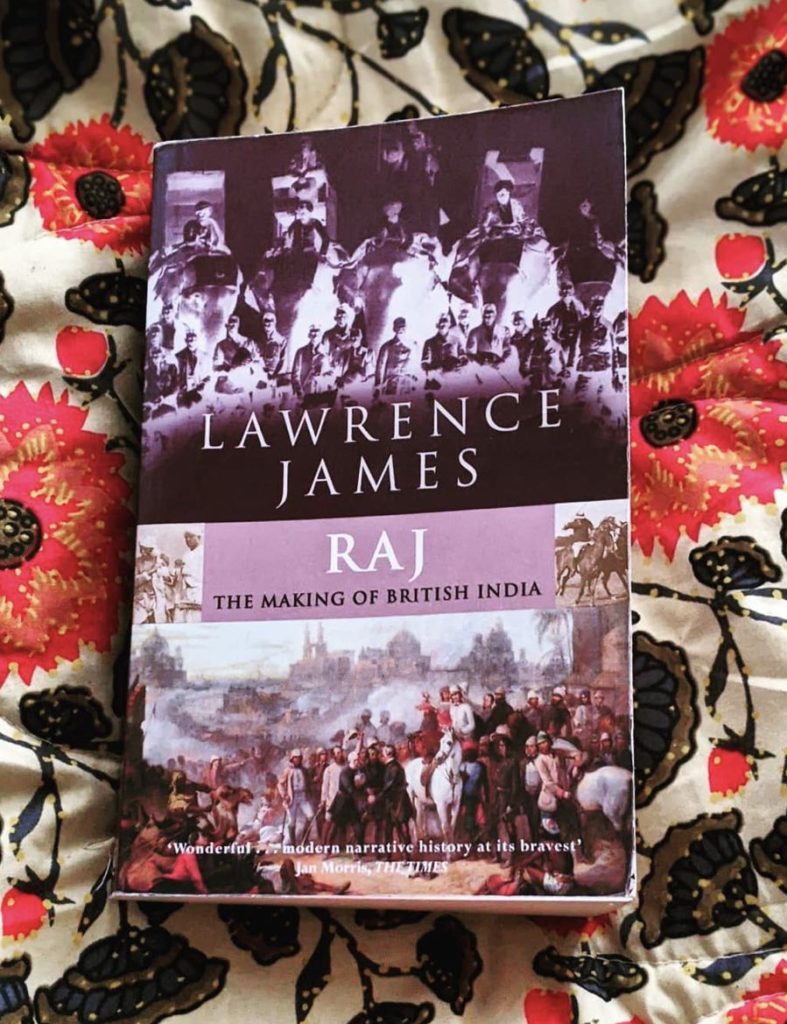
Well, well, history isn’t what it used to be! At least not when I juxtapose this book against what I was taught in schools. As Lawrence James notes in the Epilogue, a past shaped by foreigners reminds a nation of its submission, and doesn’t really bode well for pride or self-confidence. So we lionise our own efforts and heroes and shape a new narrative. And that is what goes into the history books.
The good news is that India did become free from British rule on August 15th 1947. The original deadline was June 1948, but as with most everything else in India, the astrologers had the final say. But everything else, from the time the British first arrived on Indian shores, to this event, more than a couple of centuries later, is seen through a lens that tries hard to be objective, but is also inevitably tinted a bit by the bias of the author, who is an English historian. But at least, his bibliography is extensive enough to support it.
The book begins with the ideal prologue – the sunset years of the Mughal empire, and then covers the first century of British presence in the first 250 pages. This includes not just the skirmishes with the French down south, but also the East India Company’s battles in Bengal, and Clive’s victory in Plassey, which apparently assumed a supernatural significance and was seen by some Hindus as the starting point of a predestined historical cycle that would last a century. No coincidence that rumours of this was in full flow in 1857, right before the mutiny. Between Plassey and the Mutiny, there was the gradual expansion of the Company’s land assets, helped to a large extent by the infighting and lack of unity among Indian rulers. The Company wanted the freedom to trade, and everything else that happened seems to be a byproduct!
The mutiny itself seems to have been a throughly disorganised series of skirmishes and battles, with every move by the sepoys being led more by circumstances than by design. At some point, the last Mughal Emperor was seen as a good idea to rally around, and he was forced to play his part reluctantly. The leaders whom our version of history has designated as the first freedom fighters – notably the Rani of Jhansi and Nana Saheb – were at best tactical leaders more interested in the sovereignty of their kingdoms, since they were the losers in the prevalent Raj system. And there was very little impact down South, or even the West for that matter. Having said that, it did give the British a fright.
From then until World War 1, there are interesting sections around The Great Game, the main theatre being the frontier and Afghanistan. This was also the time when Anglo Indians started organising themselves, and Indians too began understanding, and thus demanding Home Rule. A Russian invasion was on the minds of folks on both sides, and largely that was only where it was. But this did lead to a lot of intrigue and the Afghan wars. Also interesting is how many of these incidents made its way into popular culture via books, and then movies.
1919 was a decisive year, and it is fascinating to read about the granular circumstances that drove men to take certain actions. Case in point – Dyer, his chronic discomfort and pain from old war injuries, the hype that a huge uprising was in the offing, and finally the Jallianwala Bagh. Gandhi first rose to prominence in 1919, just after the Spanish Flu hit Indian shores, and specifically thanks to the Rowlatt Act in March 1919, against which he first experimented with the satyagraha. The book isn’t very flattering to him, and talks about his numerous failures in organising mass movements, which got away from his control very fast. “Gandhi was also a consummate showman and a shrewd politician, with a knack of projecting himself in such a way to attract the greatest possible attention in India and abroad”. In essence, very good at political stagecraft, but the cult of Gandhi was so popular that it was sufficient to give the Congress, which had its tentacles everywhere but didn’t really have a plan, a dominant status in the provincial assembly elections. Some villagers actually sent messages to Gandhi in the ballot box!
By the 1930s, the Hindu-Muslim rifts were growing wider, and the cult of Jinnah was becoming popular. Another rising personality was Bose, whom Gandhi did not trust. Bose considered Gandhi’s moves against the British mild, and it finally took him away from the Congress, and then a ricochet across alliances which finally led to very little. The story is depressing every time I come across it.
The final years of the Raj actually highlights the in-fighting and intrigue among the country’s top politicians. To note that if the Labour party hadn’t come to power after the Second World War, and Churchill was still in power, the story of India would have been very different. Attlee, and his party, were more supportive of India’s self-governance. The winding up job was left to Lord Mountbatten, even though the book portrays his predecessor The Viscount Wavell as being the more capable man. In fact, Mountbatten is shown to be everything but impartial and detached. Edwina’s flirtation with Nehru didn’t help either. His lack of understanding on how princely states were coerced into accepting Indian suzerainty also led him to buckle under Nehru’s pressure.
In essence, the book shows everyone involved in a completely new light from what I (as an Indian) had seen thanks to my history lessons. I think we tend to regard our leaders as men with clear and objective plans, but it seems there were just ordinary men sometimes tossed into extraordinary events and trying to do what they thought was right. Strange, but historical figures are people too. 🙂
If you’re interested in history, this is a must read. It meanders a bit, but persist and you will be rewarded with a very different picture from what you know.