Category: Philosophy & Worldview

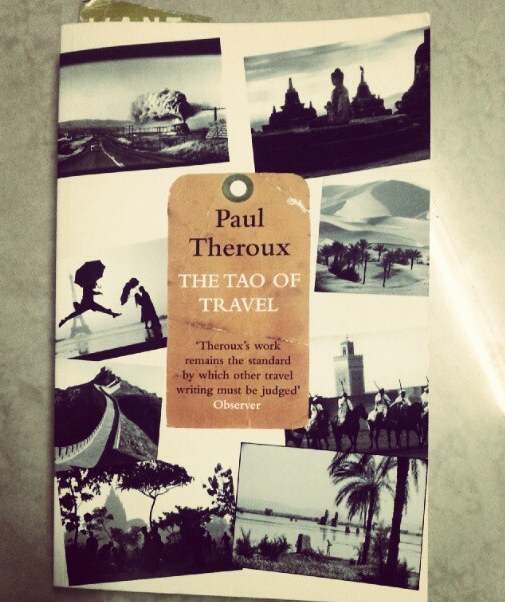
  • The Tao of Travel: Enlightenments from Lives on the Road

    Paul Theroux 

    Whenever I take a vacation, I arrive as a tourist and like to think that I leave at least partly converted into a traveler. I am forever envious of travelers, many of whose journeys serve as a purpose in itself. This book is an excellent little guide to what the author mentions in the preface – paraphrasing the Buddha – “You cannot travel the path before you become the path itself”, and how travel is also a way of living, and thinking.

    In addition to excerpts from various works by different travel writers and adventurers, classified by unique and amazing themes from Railways, time spent in travel to Murphy’s laws, to imaginary journeys, how places are different from what they sound like and so on, the book is peppered with Travel Wisdom from various authors.

    There are gems hidden in the pages – little quotes that somehow tell you that the spirit within each wanderer is essentially the same. The description of places and times by masters are splendid enough to transport you to locales across to world from Alaska to Africa and Russia to South America….And it’s not just the places, but the people who live there, the way they think, and one can sense the cord that invisibly connects humanity.

    In 275 pages, the author manages to indeed provide a Tao of Travel across time and space. Must read.

    Clipboard02

  • An Ordinary Person’s Guide To Empire

    Arundhati Roy 

    Arundhati Roy continues right from where she left off (actually she never has) in The Algebra of Infinite Justice. This time, contexts and facts get repeated in essays, and that might put you off, but that should not take away from the messages.

    An Ordinary Person’s Guide to Empire, published in 2004, a couple of years after the other book, consists of 14 articles written between June 2002 and November 2004. The theme of the book is the working of the Empire, not the traditional imperial one built on a smattering of trade and an all powerful military, but the more modern, relatively more subtle one with many simultaneous strategies – ‘neoliberal capitalism’ aided by the IMF, World Bank etc, corporate globalization spearheaded by multinational corporations, and finally a healthy dose of good old state sponsored military might. As Roy writes, add oil and mix. Not to forget the media that makes the entire effort come out smelling of roses. “In this era of crisis reportage, if you don’t have a crisis to call your own, you’re not in the news. And if you’re not in the news, you don’t exist. It’s as though the virtual world constructed in the media has become more real than the real world.”

    A lot of the conversation is around Iraq, where the latest version of the above drama is being played out, but in many essays there are historical references of how the US has honed its ‘process’ through various wars it has fought. Creating, funding and then making a huge hue and cry over eliminating armies/heads of state who step out of line. Saddam being the latest. A series of acts that had spawned and now fuels a global threat – terrorism. Two opposing camps feeding off each other. “Al Qaida vs Al Fayda”.

    But the story is global, from the police in Kerala displaying the tribals’ bows and arrows as dangerous ammunition to encounter killings from Mumbai to Kashmir to Andhra Pradesh and indiscriminate and illegal uses of POTA to state sponsored terrorism in Gujarat and hunting down Maoists in Jharkand. The story is also of how democracy is just a process of ‘cyclical manipulation” We really have no choice.

    It gets scary when she writes how “Modern democracies have been around for long enough\ for neo-liberal capitalists to learn how to subvert them. They have mastered the technique of infiltrating the instruments of democracy-the “independent” judiciary, the “free” press, the parliament-and moulding them to their purpose. The project of corporate globalization has cracked the code. Free elections, a free press, and an independent judiciary mean little when the free market has reduced them to commodities available on sale to the highest bidder.”

    And somewhere in all this, is the thread of the slow attrition of the concept of justice, especially for the poor and the powerless. “… for most people in the world, peace is war – a daily battle against hunger, thirst, and the violation of their dignity.” The saddest one is about the man in Hasud, a town that was supposed to be ‘relocated’ entirely, courtesy a dam. The man was given a cheque of Rs.25000 as compensation for demolishing his hut. Thrice he went to the town in a bus to cash it. Then his money ran out, and he walked, miles and miles, on his wooden leg. “The bank sent him away and asked him to come after three days.”

    Roy has her critics, and she might have many faults, but it is when she brings out such incidents that I feel she is doing justice to the written word and her skill with it. For this reason, do take time to read it.

  • Old Path White Clouds: Walking in the Footsteps of the Buddha

    Thích Nhất Hạnh

    The story of the Buddha, through a couple of narratives – one that of the cowherd turned monk Svasti, and the other, probably that of Buddha himself, which moves back and forth to also tell us about Siddhartha’s early life, before and during his enlightenment. The book also lays a lot of stress on the teaching of the Tathagata, while also documenting the political and socio-cultural milieu that existed across the 80 years that the Buddha lived.

    The book, drawn from over 24 sources across multiple languages, also has a lot to offer beyond the teachings themselves. The Buddha’s own experiments on attaining enlightenment, based on the prevalent practices, followed by his own thinking that took him beyond them, his relationships with the kings of his time, and the influence of his teachings over them and how they ruled their kingdom, the way that the sangha was politicised even during his own lifetime, how religion slowly crept into the path, though the Buddha stressed that the community was only for supporting those who were trying to attain enlightenment, and how the religion tried to influence the politics of the time. It seems as though things haven’t changed at all in this part of the world.

    The simplicity of language while explaining the teachings, is worth a mention here, though quite obviously, it is easier read than done. Despite the changes the world has seen in the centuries that have passed, I could instinctively feel that just as the Buddha had said – enlightenment was within every person, and the teachings can at best serve as a raft – “the finger pointing at the moon is not the moon itself.” The next time I see the monks, across the multiple sects, I will wonder how many follow the eight fold path and the 200+ precepts that their spiritual teacher had pointed out. The book paints a picture of a human, who through his own efforts and practice, showed others how to attain enlightenment. Not a doctrine, but a life lived.The last chapter, when Svastti recollects how it all began and understands that the true way to respect the Buddha is to implement his teachings in daily life, is probably the best summary of the book, and the most moving, as well.

  • The Algebra of Infinite Justice

    Arundhati Roy

    For a few years now, I have heard everyone – from sections of media to people in my social stream call Arundhati Roy everything from a Naxalite lover to a development hater to a deranged person, the last instance during the happenings in Kashmir. In fact, these days whenever there’s an issue of national interest with a scope for polarised opinions, I find many people asking about her take, just so they can heap more ridicule. And though I have never really been a fan of her award winning work of fiction, I have admitted to myself, and to a few of my friends, that I have found it difficult to objectively fault her arguments. After reading this book, I have realised why it is easy to hate her – she holds up a mirror in front of us, the kind of mirror that tells us how our apathy and desire to follow the path of least resistance is responsible for the larger problems we see around us.

    And she does that not just in some moral high ground, philosophising sort of way. She does so with historical perspectives and economical contexts and most importantly, hard data. And therefore, it is not easy to ignore her when she talks about the Narmada Bachao Andolan, the costs of what we call progress and the greater common good, the background games played behind the ‘developmental’ activities we see around us, America’s war against terror, the beginnings of fascism in India and how all of these are linked. The writer in her is in full flow, using sarcasm and wit to telling effect, to (ironically) show the seriousness of the issue. There is something very vulnerable about her when she talks about her dislike for the ‘writer-activist’ label.

    So the next time, I hear something said against her, I am going to ask the person if he/she has read this book. They may not agree with her, but at least this will give them perspective and basis their interest, they can look for counter arguments. What I seek from them is exactly what I seek from myself – an acknowledgment of one’s own role in the issues of today and developing the strength to not look away.

  • The Lady and the Monk: Four Seasons in Kyoto

    Pico Iyer

    In the autumn of 1987, Pico Iyer begins his journey into Japan, one that would last a full cycle of seasons. Depending on the prism you choose to see it through, the book could be many things.

    It could be a travelogue, though quite different from any I have read yet, and yet one that not only dispels any ‘second-hand’ notions (eg. the Japanese’ take on Kurosawa was surprising) but also captures the nuances of a place unknown to me, in a very sensitive manner.

    It could be the journey and yearning of one human being to understand and experience a culture alien to him/her. Him, from the perspective of Pico in Japan, whose original wonder and positive bias changes into a more pragmatic view as time passes, and her, from the perspective of Sanchiko, a vivacious Japanese lady with a husband and two children, whose heartfelt desire it is to escape the confines and constraints of her culture and upbringing.

    It could be a glimpse into the world of Zen – its monasteries and about living in the moment, without the baggage of the past or the future.

    It could be a relationship between cultures – not just east and west, as shown between the author and Sanchiko or other nuances captured through various other characters, but also within Japan itself – the free spirited Sanchiko versus her friends and family who are against this freedom she desires and wants her to just make the best of her marriage and the duties it entails.

    Or it could be an elegant love story, with Japanese poetry and beautiful descriptions of nature, and in the way of Japanese, one with a poignant ending, just like the story which seems to be the inspiration for the title.

    A wonderful read, and an armchair journey that has given me much to think about.