Category: Travelogue

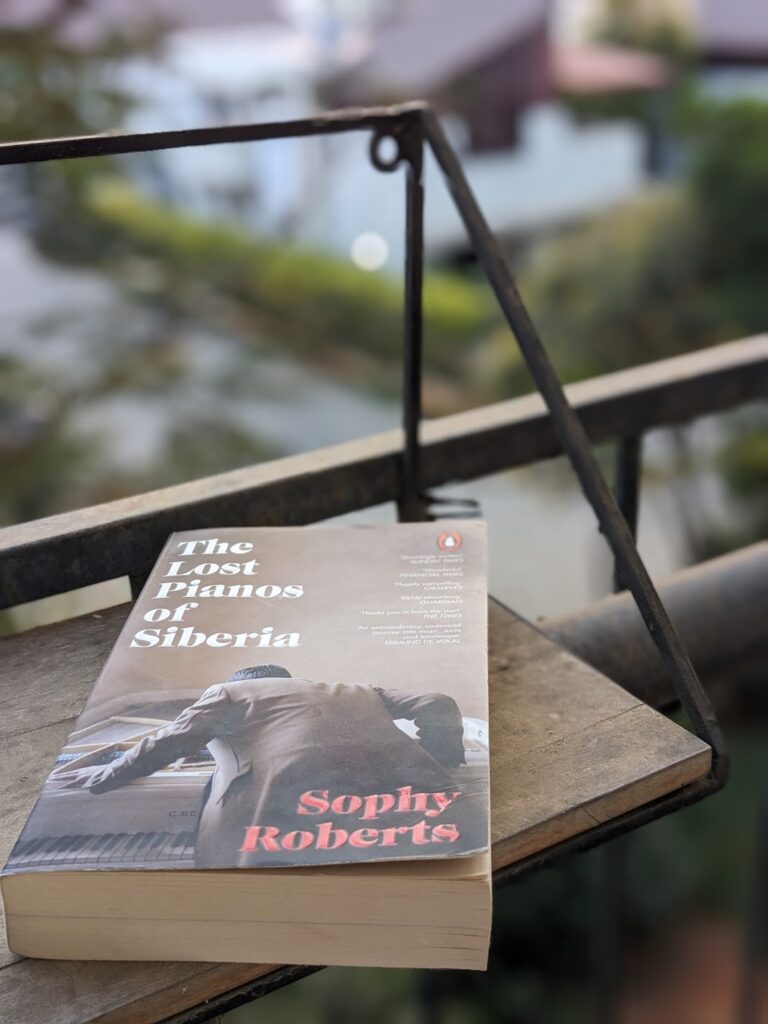
  • The Lost Pianos of Siberia

    Sophy Roberts

    In the epilogue of The Lost Pianos of Siberia, Sophy Roberts quotes Fyodor Tyutchev – “You cannot fathom Russia with the mind… You can only believe in it.” Once you really pay attention to the map and figure that it has Finland and Ukraine on its western borders and China and Japan in the south/east, it is easy to nod in agreement. For a lark, I tried to calculate the distance/time taken from Moscow to Vladivostok, and gave up on any dreams – 7 days, 7 time zones, 30 cities and almost 10000km!

    Sophy Roberts’ Siberian journey is the hunt for a piano for her friend Odgerel in Mongolia, but for a reader if offers far more – a fantastic trip through time and space in one of the remotest parts of the world. The book is divided into three portions – 1762-1917 (from Catherine’s the Great’s ascension to the February revolution when Tsar Nicholas II abdicated and was taken to Siberia with his family), 1917-1991 (when the Soviet became the Russian federation) and 1991 – present. We see the region not just through the political changes, but primarily through the lens of music and culture. In fact, the music remains the constant.

    Siberia is 1/11th of the world’s landmass, with the Urals, the Pacific, the Arctic Circle and Mongolia serving as its borders. The Tsars made it a penal colony early on, and it played host to a variety of famous folks – politicians to writers to artists. But it was also home to pianos, starting from the nineteenth century, thanks to Catherine the Great’s penchant for collecting new technologies. Chasing these lost pianos, we go across Siberia from Tobolsk and Irkutsk and Tomsk to Sakhalin, Harbin (now in China, but with a very Russian past), the Dead Road (one of Stalin’s crazy projects where the track was being built in temperatures 50 degrees below zero and where people’s hair froze on to their neighbour’s skin when they slept close for warmth), Kolyma, Akademgorodok and Kamchatka, Kurils and Khabarovsk. Names on a map, but now rich in my mind with character.

    But what makes this all come to life are the people and their poignant stories. A family that retreated into the Siberian taiga in 1945 , living in total isolation in the Sayan Mountains, until someone discovered them in the 70s. They only possessed a spinning wheel and a bible and refused to believe the moon landing. Dmitri Girev, who had accompanied Robert Scott to the South Pole. The ordinary yet moving story of Lidiya in Duė Post, where the infamous coal mines used to be. Anatoly Lunacharsky whose efforts made sure pianos weren’t completely lost during the Revolution, the last days of the Romanov dynasty, the 2500 year old Ukok princess’ mummy in the Atlai mountains.

    Leonid Kalsohin, an Aeroflot navigator who gave up that life to settle in a remote village called Ust-Koksa, where he is trying to build a concert hall. “The world is very remote. We are at the centre“, he says with a twinkle in his eye. The stunning concert during the Leningrad siege, when people braved the cold and the enemy fire just for the music. The Lomatchenko family in Novosibirisk, whose room in the basement of the Opera House contained musical treasures (‘It’s not much“, said Igor, ‘but it is my life.’) Mary, the 80-year-old birder, whom Sophy meets on a cruise to Commander Islands (‘neither of us had come for the certainties, but for the outside possibility that a little marvel might appear‘).

    You don’t need to enjoy music to love The Lost Pianos of Siberia. Because this is about places and people, who even in this hyperconnected world are outside the radar of most of us. Sophy Roberts’ prose is vivid and deeply moving, and takes us on a fantastic tour of a unique part of the world.
    The Lost Pianos of Siberia
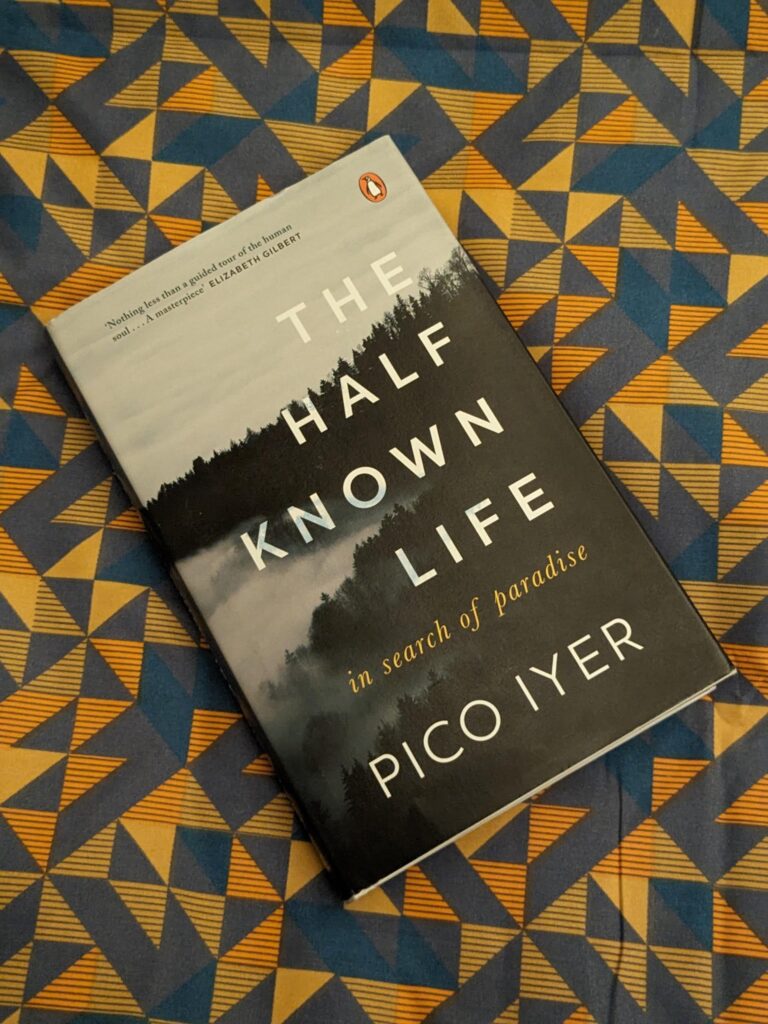
  • The Half Known Life: In Search of Paradise

    Pico Iyer

    I always have a bias for Pico Iyer’s writing, and many a time I end up reading his books at times when I need an alternate perspective. In The Half Known Life: In Search of Paradise, the search is for what different people define as paradise – a place with no worry or anxiety. Except, for some it is a particular place, for others a moment in time and something that can be accessed if we put our mind to it, and for some others it can only be enjoyed after death.

    From Jerusalem to Benaras, and Japan to Ladakh, Pico explores these concepts and the people who believe in the different definitions. As is usually the case with his writing, it is as much introspection as it is travel, and written in wonderful prose. He blends his personal experiences with philosophical musings seamlessly. Through the people he meets, and his encounters with those from varied backgrounds, he reflects on the nature of life, and its many meanings.

    In solitude and contemplation, he reaches out to thinkers before him- from the Stoics to William James to Henry David Thoreau, in an effort to decipher the complexities of our existence. Each essay is a meditation, and amidst the noise and chaos of this busy world, I’ll probably pick it up again later in life to get a different rendition of the half-known truths that lie deep inside all of us.

    The Half Known Life
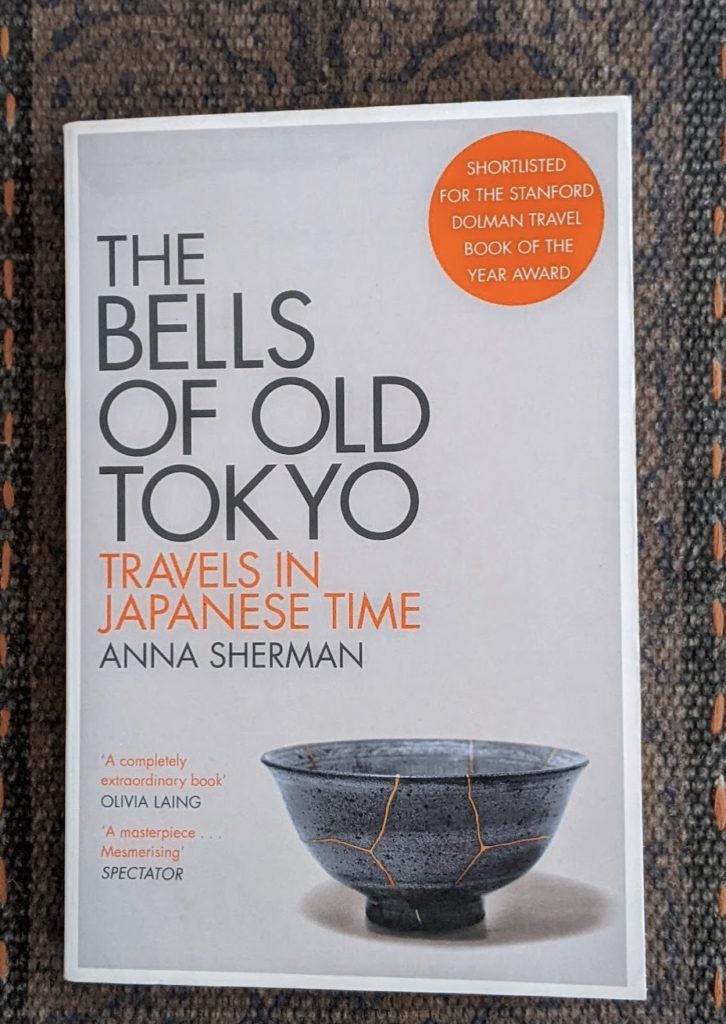
  • The Bells of Old Tokyo

    Anna Sherman

    I don’t know if I (sub)consciously avoided travelogues since 2020 because I would miss travel even more. But irrespective of that, there was something very poignant about the title itself, so I just had to pick it up. The good news is that it lived up to its promise. Anna Sherman does in this book what my favourite books about places do – let me travel in time and space. 

    The second part of the title – Meditations on Time and a City – gives a very good idea of the book’s focus. It talks about both the changes in Edo (before it came to be called Tokyo) with time, as well as its changing relationship with time itself. Like many other concepts, the Japanese have many words for time according to the context. Before its citizens started using manufactured devices to tell time, Edo’s time was told by the ringing of bells. At first, there were three, but by 1720, as the population touched a million, six more were added. And these bells are what the narrative follows. 

    With each, there are stories attached. Origin stories of the locality and the bell, and its journey through times good and bad – victories, wars, earthquakes, fires and so on. Nihonbashi – the Zero Point has its prison stories (prisoners let out during a fire would voluntarily return because they’d be found and killed otherwise). Asakusa has its beauty and murder story. Akasaka has the smallest bell, and love-hotel rooms which cater to any and all fetishes, with protocols that outsiders will find difficult to understand. Mejiro is home to the stone that honours the rebel samurai Chūya Marubashi. Nezu has a fascinating tale of clockmaking and how time shifted from personal to shared, and ‘the idea of time became mechanical.’ Ueno, where the battle in 1868 marked the end of the Tokugawa shogunate. A few months later, Edo would start making way for Tokyo. Where the bell-ringer knows he is probably the last of his kind. Kitasuna, where more than 700,000 bombs landed on 9-10 March 1945, and caused the deaths of more people than in Hiroshima and Nagasaki. 

    The book did a fantastic job of transporting me to the time and place. The words somehow gave me a visceral feeling of the place, the emotions of the different people who lived there, their daily existence, the events they have gone through, and sometimes I tended to see the place as a person too – changing, shifting, sometimes slowly and sometimes suddenly. It was like walking through the lanes. The one thing that I wish the book also had was maps so I could also get a better directional sense of where these places are.
    I think, after this book, when I do visit Tokyo (Edo), I will see it through new eyes and old stories.

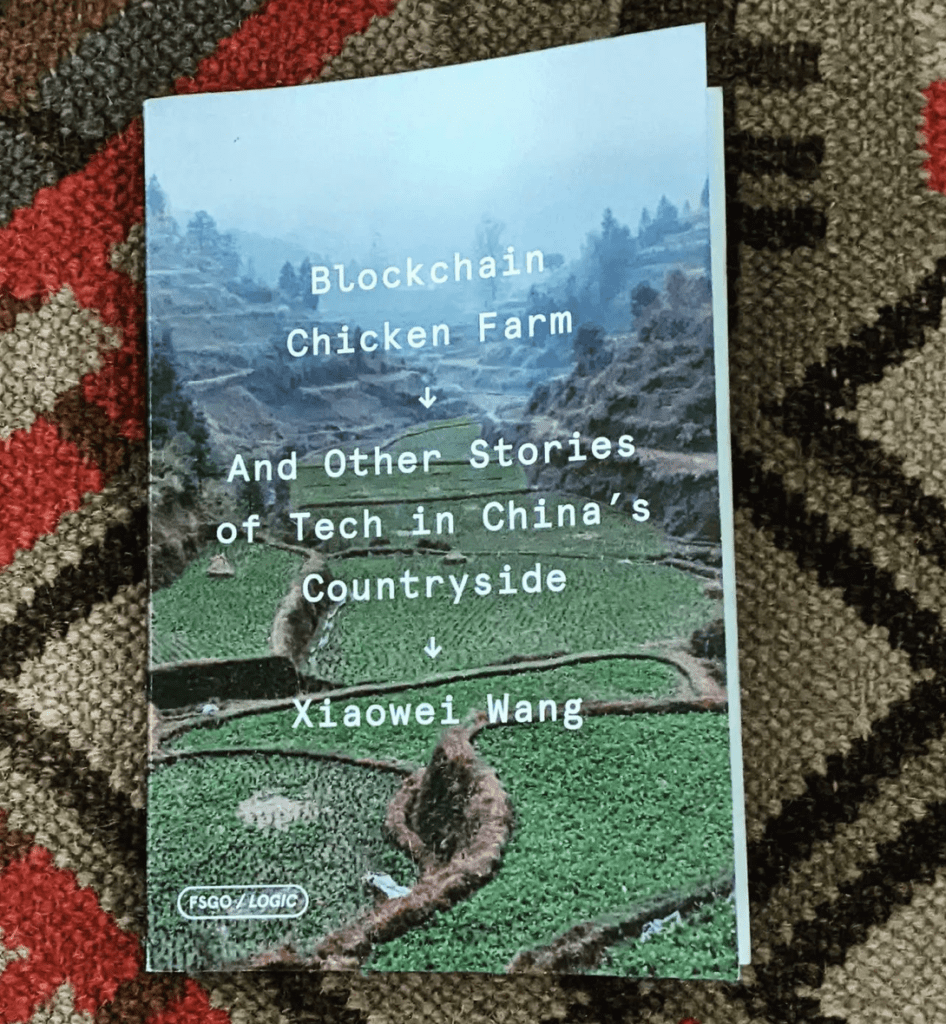
  • Blockchain Chicken Farm: And Other Stories of Tech in China’s Countryside

    Xiaowei Wang

    I bought the book because it had two keywords that interested me – blockchain and China. But as the ‘stories’ went from swine to finally pearls, I realised that the title probably doesn’t do justice to the multiple themes that surface in the book and makes it, a rich and nuanced read. 
    The introduction points us to ‘metronormativity’ – the idea that rural people and culture are ‘backward, conservative and intolerant, and that the only way to live with freedom is to leave the countryside for highly connected urban oases.’ Further, that internet, technology and media will educate and save them by allowing more experiences and chances of a better livelihood. The book is a challenge to all parts of this construct. It also pushes back on binary classifications we employ – digital/physical, natural/man-made and so on. 

    ‘Ghosts in the Machine’ sets the context as we read about how under Deng Xiaoping in the 1980’s, the country began imagining a uniquely Chinese future, and set the ball rolling for the rise of companies like Huawei and Alibaba. In parallel, there’s the rise of TVEs (Town and Village Enterprises) over the prevalent SOEs (State Owned Enterprises), and a potential ‘agrarian transition’ that would result in industrialised agriculture, which would need lesser manpower. This would have social, environmental and political ramifications. 

    ‘Blockchain farm in the middle of nowhere’ touches upon the surveillance state, non-explicit censorship, and ‘the shadowy unease that looms over public conversations.’. It begins with the foodsheds in Shanghai and moves to the contrast (or not) between the dangers of cost-cutting in the food industry, and the gloss of ‘blockchain chicken’ (Bubuji/GoGoChicken). The latter uses ‘a chicken Fitbit of sorts’ on the ankle of chicken which allows a buyer to know the provenance of a chicken, and even see streaming live footage that can be accesses via a QR code! But despite this, the future is uncertain because the tech is on hire, and overhead costs are high. Can blockchain make food safety records tamper-proof by creating a distributed system? Perhaps, but there are many challenges including legibility and thus, access. 

    In ‘When AI farms pigs’, we are introduced to Alibaba’s ET Agricultural Brain that aims to transform agriculture to ‘help create China’s pork miracle’. It brings out how, despite AI’s potential to radically help humans, the current economics of AI makes it a corporate AI model that is all about scale and efficiency. 

    ‘Buffet Life’ explores the alternate careers that Chinese youth are taking up. Case in point – drone operators. This is backed by a (state backed) system that is now bridging the gap between urban and rural education, creating the infrastructure for it and thereby also providing new means of livelihood.

    In ‘Made in China’, there is a very insightful take on what ‘innovation’ means and how it is predominantly evaluated through a Western lens. China is forging its own path in ‘innovation’, trying to break away from cheap products at industrialised scale. ‘Shanzai’ is changing its earlier connotation to an ecosystem that’s open source, and operating at hyper speed, steamrolling through the IP version favoured by the West, and forcing conversations on access and civility. The agricultural version of this approach is Rice Harmony, and its method of collective, organic rice farming. There is also the fascinating tale of Naomi Wu, a self-proclaimed cyborg, and an internet star. 

    ‘No one can predict the future’ is as much about policing as it is about community and identity, and the difference between ‘safety’ and ‘security’. It is interesting how many people working in the domain view surveillance as a technical problem to be solved without thinking of the related consequences. There is also a mention of ‘criminal villages’, the Chinese version of India’s Jamtara. 

    ‘Gone shopping in the mountain stronghold’ relates how ‘Rural Revitalisation’ relies on technology and the internet to build rural entrepreneurship ecosystems. The rural playbook of Taobao is a phenomenon, one that is transforming the rural landscape, literally and metaphorically. Others like JD.com and Pinduoduo are replicating this too. And thanks to this, there is a reverse migration to the village. But many of these platforms are unregulated, resulting in safety issues – everything from getting sick from food purchases to a cab driver raping and killing a passenger. 

    ‘Welcome to my pearl party’ is the one I found most poignant. While the story is about pearl farming in China leading to an MLM sales machinery in the US, the underlying socio-cultural dimension of it – the human need for belonging and care – is what makes it an affecting read. This also features a ‘subversive’ version of Peppa Pig, or rather it becoming a mascot for those who are rebelling against the part of society which has everything and sets the rules – shehui ren culture. 

    While these are all set in different parts of China, there are themes that I could see were universal – ‘…the plague of being old and lonely. As younger generations leave villages, hometowns and even the country to chase after careers and jobs, and the tightening noose of inequality squeezes leisure time, the elderly are left to their own devices.”

    Blockchain, and fantastic perspectives of China were indeed part of the mix, but Xiaowei Wang delivered far more. Travelogue, technology, culture and community, future and sometimes even a bit of contemplative philosophy, I really wouldn’t want to slot this book in any particular genre, and that’s probably what makes it a compelling and fulfilling read.

    P.S. In the penultimate page, the author, sitting in a HongKong bar, amidst the protests, writes about reports of a zootonic disease from mainland China causing flu-like symptoms in humans causing unease because the memory of SARS still being recent!

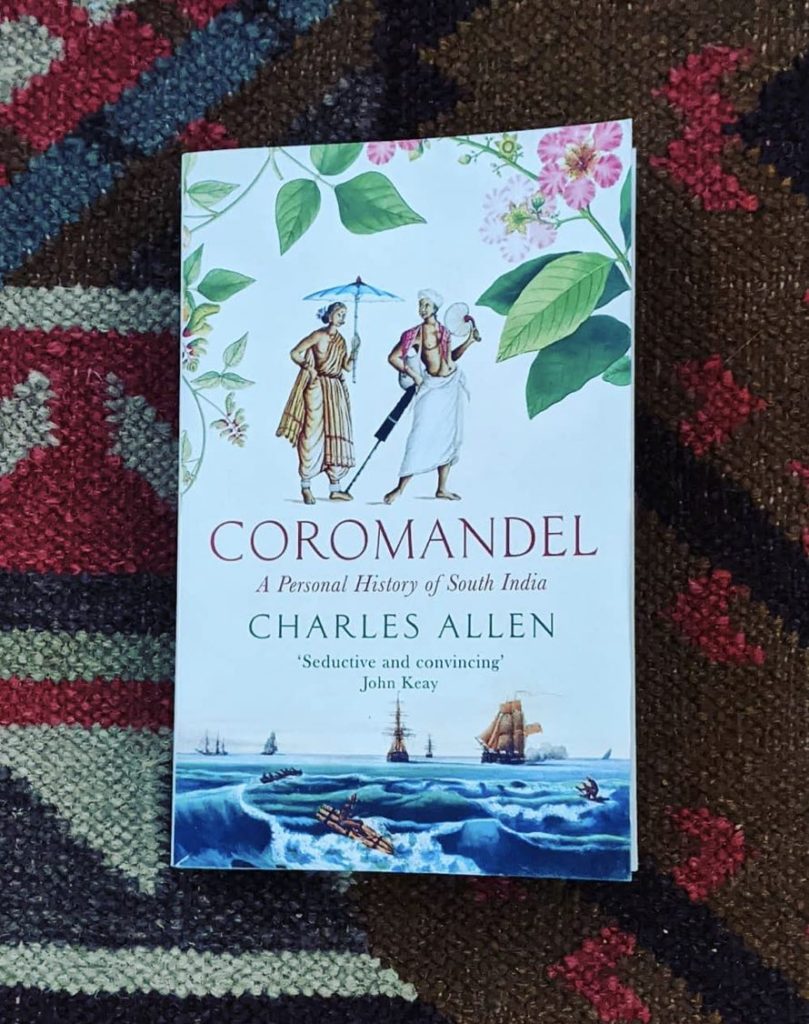
  • Coromandel

    Charles Allen

    For once, I’d judge the book by its cover, because the multiple themes, the detailing and the overall quaint, charming imagery are a good representation of what the book will deliver. While the title of the book is an indication of its focus, it actually does more in terms of coverage, and provides a fantastic narrative of South India – historical, social, societal, cultural and political facets. 

    Over a period of time, history becomes stories, then legend, and finally myths. This is the journey that Charles Allen undertakes, and while he smartly calls it a “personal history” to avoid religious minefields, it is a comprehensive and erudite discussion. 

    He begins at the end of the subcontinent – Cape Comorin (Kanyakumari) and traces the tectonic shifts that created the Indian Plate, which we know as the Deccan, and its rock walls on one side – the Western Ghats, with Palakkad providing the only gap until the railways were built in the nineteenth century. The rest of the first chapter provides a good summary of the hunter-gatherer populations that resided in this part of the world in the Mesolithic era. 

    There’s then a detour – to the North and the Harappans. It also contains a clear, scientifically backed commentary of the Aryans, the location of the Saraswati and the connection to the Zoroastrians, the historical account of the Vedas, and the epics – Mahabharata and Ramayana. 

    We then return to “Agastya’s country”, early Tamil literature and the sage himself, who is credited with bringing Sanskrit to the South. The chapter clarifies and rebuts the paradox of him (also) being the person who brought Tamil to the South! This chapter is also interesting because it touches upon the origins of Vishnu and Shiva in mythology. The next few chapters were quite an eye opener for me, because it showed how both Jainism and Buddhism were dominant in the south, including Kerala. To the extent, where even Sabarimala, Ayyappa’s abode, has its origins in Buddhist shrine. Dharmashasta’s devotees chanting Swamiye Saranam Ayyappa seen side by side with Buddham saranam gacchami. Fascinating! It also captures the reasons behind the migration of Jains to the South, whose ranks include the first great emperor of India – Chandragupta Maurya. Speaking of empires, the Chola, Chera and Pandya dynasties were the result of a three way split between brothers who didn’t want to share power. 

    A following chapter throws light on one of the most under-acknowledged dynasties in India, who ruled for almost five centuries – the Satavahanas. Muziris finds a mention too, as the primary trading port for Romans. In other international voyages, we find Bodhidharma, the South Indian monk who exported Mahayana Buddhism to China – which became Chan and finally in Japan, Zen. But contrary to pop culture, Shaolin kung fu wasn’t something he introduced to China. 

    “Juggernaut” covers the origins of Vishnu (including the avatars) and Shiva in greater detail, and is made even more interesting by the suggestion that the lord of Puri was (again) originally a Buddhist shrine. Apparently ‘palli’ was the original term for ‘vihara’ and in Kerala, it became the common term for any non-Hindu place of worship. This section also covers Adi Shankara and his role in resurrecting Hinduism. Chapter 8 finally gets us to the title, which is appropriate from a historical perspective too – its first appearance was only in 16th century maps. That also brings us to Vasco Da Gama’s terrorism, and the slow but steady entry of European powers in the Deccan. The next chapter is a deep dive into Malabar and Kerala in general, and I learned a lot – the origin of the Nambudiris and Kerala’s caste order, the context of Vivekananda calling Kerala an asylum, and that Narayana Guru had a quarrel with Gandhi during the Vaikom satyagraha. The final chapter is named after Tipu, and it also covers the rise of Islam in the South. 
    The endnote is a must read, and shows how nationalist forces have been trying to reshape historical narratives for a while now. It also contains a good perspective on how the cleansing of textbooks in the early 80s and their glossing over of communal clashes actually provided ammunition to those who reverse engineer history to meet their interests. 

    What I really loved is the systematic deconstruction of mythology into its historic components, with an amazing amount of detail. As a person who loves both mythology and history, it was an absolute treat!I am quite miffed at myself for not having read Charles Allen earlier, but plan to rectify that for sure! If you’re interested in history, this is a book I cannot recommend enough.