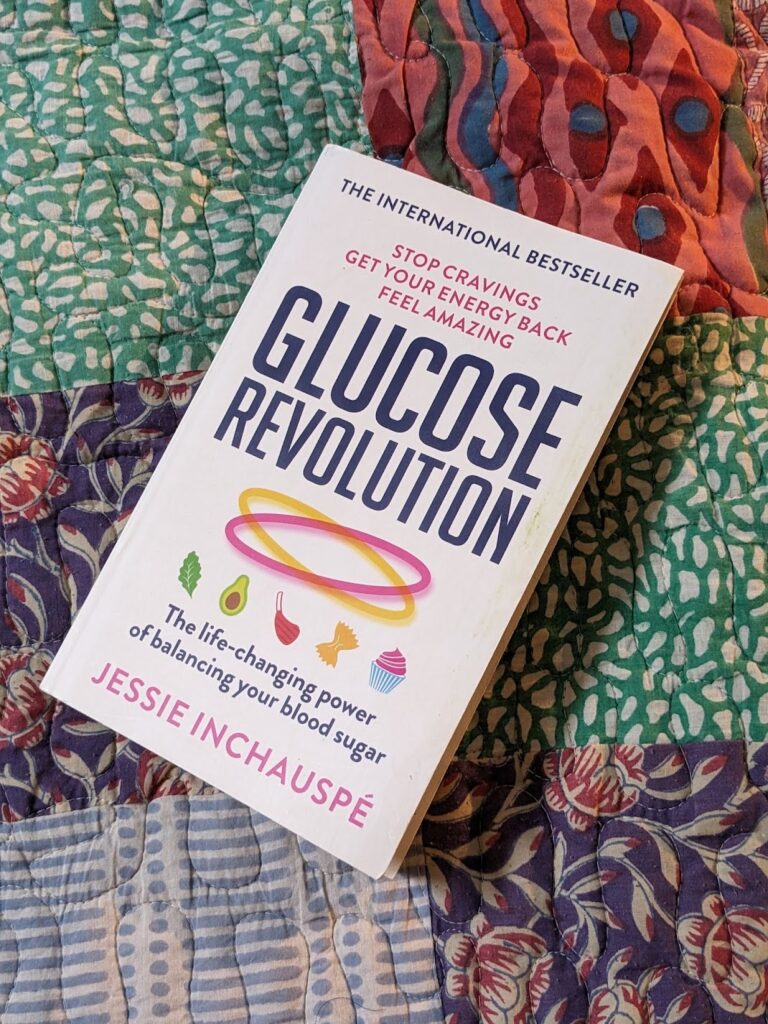
Glucose Revolution is another one of those books that I wasn’t even aware of, but came in via a referral, and I believe will actually make a difference in my life. Jessie Inchauspé, also known as Glucose Goddess, does a fantastic job of showing a way out of the clutches of glucose imbalances which are an underlying cause of many health issues – from cardiovascular diseases to PCOS to acne and even mood swings.
The reason why I loved this book are many. One, it’s not just a lot of theory. She combines lived experiences (of herself and others in the community), scientific research, and experiments (to validate) to show how it works. Two, she layers that with the overall science behind why they work that way. Three, she does so in the most accessible manner. And finally, she doesn’t just point out the problems, she also provides solutions and paths to address them.
The book is divided into three parts. The first explains the origins of glucose and why it is important. While we colloquially call them all carbs, glucose, fructose, sucrose, starch, fibre are all varied forms and have different impact.
The second describes how dysregulated glucose levels and glucose spikes affects us in the short-term and the long-term. From hunger pangs at one end to worsened cognitive function at the other. During glucose spikes, the mitochondria quickly get more glucose than they need, some glucose gets converted into fat, and more importantly, molecules called free radicals are released into our system. When there are too many of these, it results in oxidative stress, a driver of heart disease, Type 2 diabetes etc. Glucose also glycates other molecules, damaging them forever. Wrinkles, cataracts etc. The combination of all these result in inflammation, and chronic inflammation is the source of most chronic illnesses we get.
When we have excess glucose in our body, the pancreas sends out insulin to store it and keep it out of circulation. Liver, muscles and conversion into fat are the three ways it is done. That last bit is how we gain weight. The stored glucose is used when mitochondria needs it, and when glycogen (the glucose in the liver and muscles) gets diminished, our fat reserves come into play. But this cannot happen when insulin is high. (read notes for more on this) There are explanations for why and how each kind of disease related to this happens.
Part 3 is a set of ten (simple) hacks to flatten the glucose curves (reducing glycaemic variability). The first and most useful hack is the order of eating your meal. Veggies (fibre) first, proteins and fats next, and starch/carbs last. Fibre reduces the action of alpha amylase, the enzyme that breaks starch into glucose, it slows down gastric emptying, and creates a mesh which makes it difficult for glucose to get into the bloodstream. My second favourite hack was #7 – drinking apple cider vinegar before eating sweets. Acetic acid in vinegar temporarily inactivates alpha amylase.
Glucose Revolution is a fantastic book because of its actionable insights and the accessibility. Highly recommended. Having said that, I have also recently read some critique which you might want to consider before picking it up.
P.S. My own experience after nearly a year of trying this is that first, I got an immediate reduction of HbA1c from 6.3 to 5.9 and was able to sustain it for about 8 months. Since then, it has gotten back to 6.3 but there are many variables and I am still trying to eliminate them one by one.
Notes 1. Any food made from flour has starch 2. We like sweetness because back in the Stone Age the taste of sweetness signalled foods were safe (there are no foods that are sweet and poisonous). It gives us a dopamine hit. 3. Mitochondrial stress causes cells to lose their smooth shape. The lining becomes bumpy and fat particles get stuck more easily. LDL (B) does exactly this. If an when cholesterol gets oxidised (happens when more glucose, fructose, insulin are present), it creates plaque. Triglycerides become LDL (B). A good measurement is triglycerides/HDL. If it’s less than 2, great 4. Insulin treatment brings down glucose temporarily but is harmful in the long run. 5. Sugar is sugar, whether it comes from fruit or table sugar. Relatively the first is better. 6. Similar story with whole grains. Dark bread/ seed breads are relatively better.
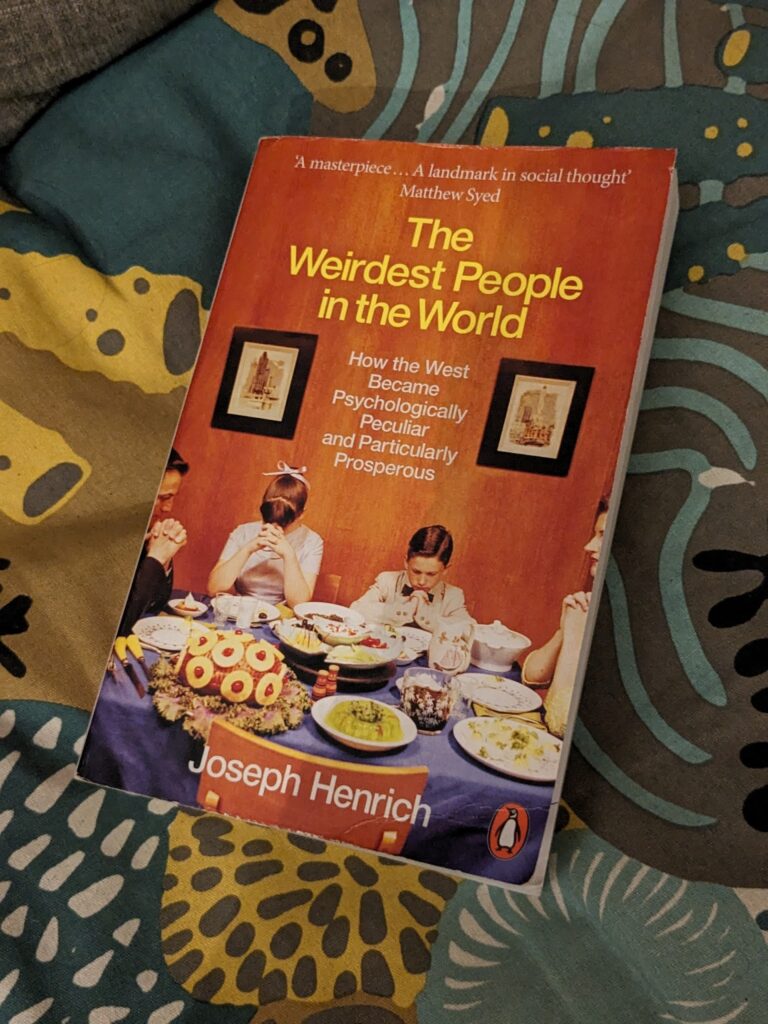
As an anthropologist, Joseph Henrich realised that much of the published work (and hence commentary) on human psychology (and social sciences at large) were based on work with experimental subjects who were based in or around Western universities. And when attempts were made to replicate these results with people in Africa/Asia, some of them even elites, it came to light that the subject pool was biased. They were WEIRD – Western, educated, industrialised, rich, democratic – and though only a small part of the species, are disproportionately represented in culture and thinking. How did this happen? That’s what The Weirdest People in the World is all about.
He sets the stage with the influence of Protestantism in this. Its credo of the individual’s personal relationship with God spurred the belief that a person should read the Bible (sola scriptura), increasing literacy in the process. But beyond this, he points out that religious convictions shape decision-making, psychology, society and culture at large.
But what is the WEIRD psychology? Broadly individualism and personal motivation (self focus, guilt over shame, dispositional thinking – based on intent not context, low conformity, self regulation and control and patience, time thrift, value of labour, desire for control and choice); impersonal pro-sociality (impartial principles, trust, honesty and cooperation with strangers and impersonal institutions, emphasising mental states in moral judgment, not revengeful but willing to punish third parties for not sticking to principles, reduced in-group favouritism, free will, belief in moral truths like physics principles, linear time), and perceptual and cognitive abilities and biases (analytical over holistic thinking, attention to foreground and not surroundings, endowment effect, overconfidence on own abilities)
To understand how people became WEIRD, he brings up the importance of cultural learning in evolutionary psychology. “Unlike other animals, we have evolved genetically to rely on learning from others to acquire an immense amount of behavioural information, including motivations, heuristics, and beliefs that are central to our survival and reproduction.” From our own motor patterns to projectile technology and food processing to grammar and social norms. Cultural learning adaptively rewires our brains and biology to calibrate them for navigating our culturally constructed worlds. This is cumulative cultural evolution.
It started off with kinship altruism, which other primates too possess, and extended to pair bonding and marriage, which is the most primeval of the institutions we have created. Preferred sexual access and a guarantee of paternity in return for protection and providing for the family. This paternity certainty and norms to cement it is where we start differing from most other primates. This also creates in-laws (affines) forming connections with more people who are not genetically related. From there on, basic communal rituals like dance, drills etc also bind people together with “mind hacks” through mimicry and a suggestion that others are like us and have an affection for us.
The next big shift was agriculture, which necessitated securing and holding lands. This needed co-operation and gave an edge to those communities with more social norms – rituals, beliefs etc. Fierce competition between groups generated a coevolutionary interaction between agriculture and societal complexity. And so, though farming was less productive and even less nutritious than hunting and gathering at an individual level, between sedentism and productivity of the unskilled (young) labour, farmer communities just reproduced more quickly and removed/assimilated hunter-gatherers.
Further inter-group competition led to clans which were kin-based institutions. These then became chiefdoms and premodern states. Built on norms and beliefs. And then non-kin based institutions developed between the elites and others to create stratified societies. e.g armies, tax collection. In the meanwhile, religion, based on our supernatural beliefs and worldviews, started scaling cultural evolution by creating ‘doctrinal’ rituals – prayers, hymns, parables etc and being transmitted by successful people – prophets and community leaders. These gave people a sense of unified commitment (conforming) and further evolved with identity markers- dresses, ornaments, taboos etc. By powerfully shaping behaviour and psychology, religion played a key role in forming higher-level political and economic institutions.
Thus begins another central point in the book – the role of the Church (and its MFP – Marriage and Family Program) in creating WEIRD people. The Church systematically started breaking the foundational kin-based societies using prohibitions and canon laws (marriage, adoption, divorce, polygamy, wills etc) over many centuries in Europe, ‘threatening’ people with divine retribution (in the afterlife) and excommunication (immediate). By allowing rich patrons to ‘pay’ with money and church-building, the Church continued to grow at the expense of the kin networks.
With more and more people marrying and working outside the kin network, cultural evolution started favouring a psychology that was more individualistic, analytically-oriented, guilt-ridden (as opposed to shame – guilt depends on one’s own standards and self-evaluation while shame depends on societal standards and public judgement) and intention focused (in judging others) as opposed to being bound by tradition, elder authority, and general conformity.
An important part is how monogamy became a norm though logically polygynous works for both men and women (because women could be second wife to the best hunter rather than only wife to an average hunter). It evolved because it can give religious groups and societies an advantage in intergroup competition. By suppressing male-male competition an altering family structure, monogamous marriage shifts men’s psychology in ways that tend to reduce crime, violence, and zero-sum thinking while promoting broader trust, long term investments and steady economic accumulation. Basically a testosterone-suppression system to reduce intra group competition. Between this and suppressed fertility (increased age of marriage, no pressure from kin, education for women) nuclear families started to focus on investing in their child – nutrition and education.
These changes also led to urbanisation as people travelled to places where they could find mates, vocation etc and expanded impersonal networks (trust in strangers as opposed to interpersonal kin networks) based on interests and worldviews, leading to universities, guilds and charter towns, who competed with each other to attract people. A pre cursor to the transition to political parties in later centuries. Another factor at play was wars. Though intuitively, one might think it derails progress, it actually builds intra group bonding and spurs technological advancements.
A rising middle class started demanding more rights, freedoms and privileges, leading to refinement of ideas, and acceptance of concepts like ownership and laws. Between this, impersonal networks and commerce, attributes like patience, time thrift (fascinating how clocks developed and changed the notion of time – wages per hour, need for efficiency, common market hours, contracts), self-regulation and positive-sum thinking (everyone can gain by advancements, I don’t need to be selfish or envious) began being appreciated as qualities one would want in self and other people, in order to distinguish themselves and prosper. These mindsets explains the kind of representative governments, laws, and the innovation and economic growth since then. The Industrial Revolution, for example, was fuelled by the expanding size and interconnectedness of Europe’s collective brain. In the political sphere, Protestantism, also a part of the larger religious cultural evolution, encouraged democratic institutions. Unlike the hierarchical Church, it requires communities to develop self-governing religious organisations using democratic principles. The cultural evolution can also explain things like patent concentration (in countries and regions) and economic characteristics at large in the contemporary era.
I can now easily see how the same principles apply to even India in the last say, five decades – better connectivity, educational institutions, urbanisation, reduction of kin bonds, and how that makes the 1% in the country closer to WEIRD than their own ancestors. This is a fascinating book supported by a ton of data and studies, and my only complaint is that like many other academics, Henrich too succumbs to the tendency of extensive usage of the latter at the risk of the narrative flow (instead of an appendix). But I’d still recommend it and between this, “Being You” (reality as a controlled hallucination and the brain only seeking to survive/control), and “The Master and His Emissary” (the hijacking of the narrative by the left brain especially since the Industrial Revolution), there emerges a phenomenally insightful view of the brain, its motivations and the interaction with cultural evolution. I really must repeat all these three soonest!
The Weirdest People in the World is a fascinating read and is in my favourite reads of 2024.
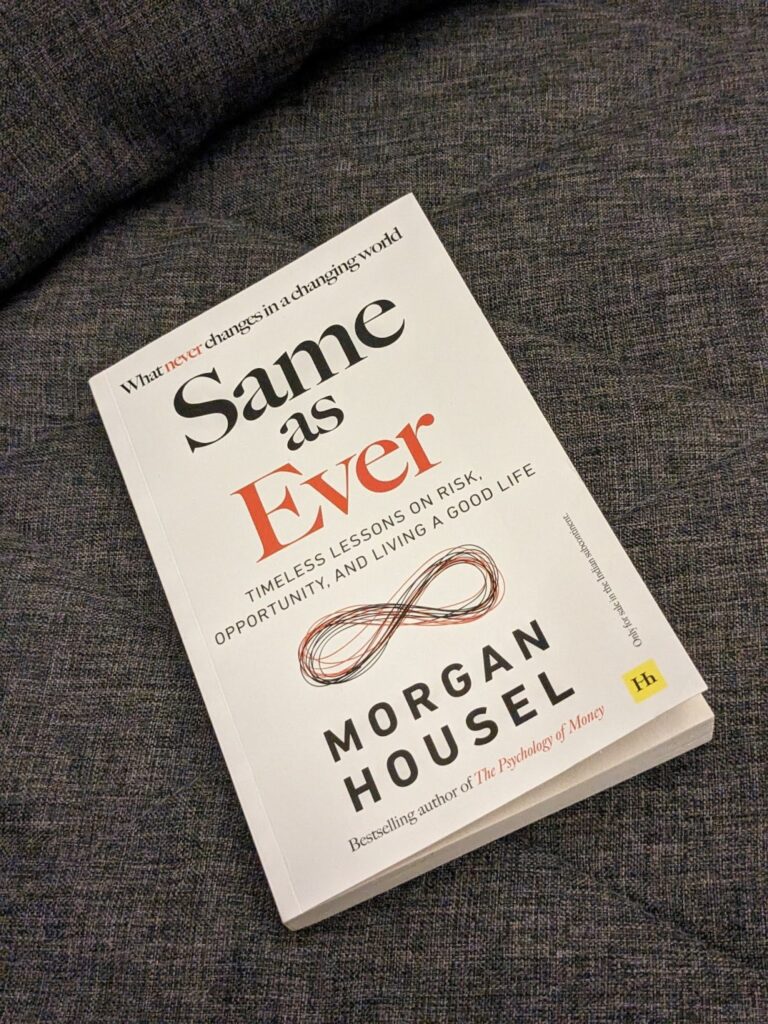
“The Psychology of Money” is acknowledged as a game changer. It gave me fresh perspectives, validation, and the confidence to continue on the path I had set out on financially. So it wasn’t surprising that I was looking forward to Same As Ever.
To begin with, I think you shouldn’t expect the refreshing sense you’d get from the previous book. This is even more so if you’ve been reading the Collab Blog. The book’s cover promises ‘timeless lessons on risk, opportunity, and living a good life’ and to some extent, delivers on all. There are many extremely good insights and the pithy ways in which Housel articulates profound truths continue to be a source of ‘aha’.
What I missed though was the smooth flow of the previous book. It doesn’t help that many of the chapters seem to be force fitted into a narrative, and many anecdotes and other content are from the blog. Housel does go for a structure but I think it might have helped if this were presented as just a series of essays. He does say that these are standalone but then also proceeds to try connections at the end of each chapter. The overall experience therefore is a little jarring.
Having said that, Same As Ever is a useful book to read, with some great but lesser-known anecdotes, and indeed, timeless insights.
Notes and Quotes “Risk is what’s left over after you think you’ve thought of everything” ~ Carl Richards “Invest in preparedness, not in prediction” ~ Nassim Nicholas Taleb Money brings happiness the same way drugs bring pleasure: incredible if done right, dangerous if used to mask a weakness, and disastrous when no amount is enough. “The majority of Americans were likely than their descendants to be dogged by the frightening sense of insecurity that comes from being jostled by forces – economic, political, international – beyond one’s ken. Their horizons were close to them.” ~ Frederick Lewis Allen (1900) People don’t want accuracy. They want certainty. If you have the right answer, you may or may not get ahead. If you’ve the wrong answer but you’re a good storyteller, you’ll probably get ahead (for a while). If you’ve the right answer and you’re a good storyteller you’ll most certainly get ahead. “Humour is a good way to show you’re smart without bragging” ~ Mark Twain “The higher the monkey climbs a tree, the more you can see his ass” ~ T. Boone Pickens “A mind that is stretched by new experience can never go back to its old dimensions” ~ Oliver Wendell Holmes
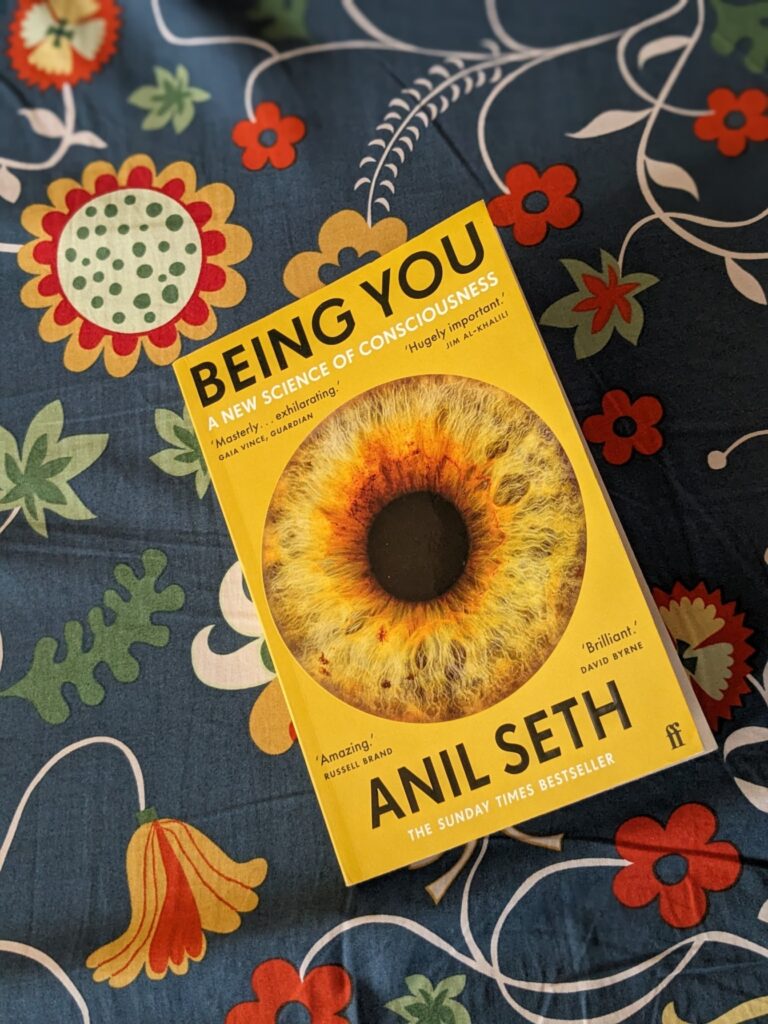
I have to confess, I will need to read this again. I also want to. For two reasons. First, the subject is something I feel is important – understanding consciousness through the lens of a scientific method. Second, grasping all of the material in Anil Seth’s fascinating exploration, I feel, is impossible with a single read. Having said that, the first read of Being You is indeed enlightening.
Being ourselves is not something we are always conscious of.* Anil Seth sets out to explore how billions of neurons within the brain end up creating a conscious experience – a uniquely personal, first person experience. Being You is divided into four sections – defining the ‘problem’ and showing the approach to the scientific exploration of consciousness, looking at it through how it relates to ‘content’ and external phenomena, and then going inwards to the experiences of conscious selfhood, and finally applying the learning to non-human entities – animals and AI.
In the first section, Seth brings up the ‘hard’ and ‘real’ problems of consciousness. The first (David Chalmers) is focused on how consciousness happens, how it is related to our biophysical machinery and how it is connected to the universe at large. On the other hand, the ‘real’ problem is how the ‘primary goals of consciousness science is to explain, predict and control the phenomenological properties of conscious experience.’ i.e. why is a particular experience the way it is, and what is its relation with what is happening with the brain and body. In other words, deeply understanding the connection between mind and matter. The latter approach would need measurement.
This begins with understanding ‘conscious levels’ – complete absence (e.g. coma) to light sleep to waking states. Conscious content is what we are conscious of – sights, smells, emotions, moods, thoughts, beliefs – all sorts of perception. There is a very interesting part on how psychedelic states are at a conscious level well above waking state, and have the maximum algorithmic complexity (a measure of the diversity of signals). Another interesting proposal is how all conscious experiences are informative and integrated, (red ball vs red and ball separately) leading to the integrated information theory (IIT) of consciousness, an axiomatic approach that starts with theories and use them to support claims on what properties the mechanisms underlying the experiences will have.
The next section is about conscious content and then the experience of a conscious self. Here’s where the idea of perception gets upturned. Perception is a ‘controlled hallucination’ (phrase by Chris Frith), an active construction as opposed to a passive registering of an external reality. The brain constantly makes predictions about the causes of its sensory signals through a Bayesian process in which the sensory signals (also) continuously rein in the brain’s various hypotheses. Perception is a continual process of prediction error minimisation (reducing the difference between what the brain expects and what the signal provides).
Reality is an interpretation, and the entire process is not optimised for accuracy, it is designed for utility. ‘We perceive the world not as it is, but as it is useful to us.’ A mechanism of making it seem real so we respond to it. Not to know the world, but to survive it! There is the fascinating part on colour – an object is not objectively ‘red’, redness is just the way in which it reflects light, and how the brain perceives it. And this applies to all of our perceptions. Mind effing bending! A great distinction here (John Locke) is on why that train is not just a perception and you shouldn’t jump in front of it. Objects have primary qualities that exist independently of an observer (e.g. space it occupies, movement, solidity), and secondary qualities that depend on the observer (e.g. colour)
The self, as shown in the next section, is also a perception, a controlled hallucination. To begin with, selfhood is divided into an embodied (being a body), perspectival (having a first-person perspective), volitional (having ‘free will’) and narrative (personal identity and deep emotions), social (how I perceive others perceiving me). The link between perception and the body and its physiological processes exist in all these forms. When we flip the learning from the previous section inwards, we understand that we do not perceive ourselves to know ourselves, we do it in order to control ourselves’. The entire panorama of experience and the mental life and thus its perceptions and cognitions stems from a deep-seated biological drive to stay alive.
I found the part on why we think we are stable and unchanging over time, very interesting. Perceptual inference is about finding out things about the outside world. Interoceptive inference is about controlling things – physiological regulation. In the latter, the prediction error minimisation happens by acting to fulfil top-down predictions of the brain. The brain, for survival, desires predicted ranges of physiological viability and thus the need for strong, precise and self-fulfilling predictions. And if it comes to that, the brain will (and does) systematically misperceive.
The end of the section also brings in the complex but fascinating FEP (free energy principle) and specifically how it applies to living systems and consciousness. In this context, it boils down to this – being alive means being in a condition of low entropy. Any living system, to resist entropy, must occupy states which it expects to be in. Free energy here approximates sensory entropy, and apparently, it amounts to the same thing as prediction error. Broadly, that connection with physics and the universe, and the brain’s regulation of the perception of the worlds outside and inside! Appealing, but they’re still ironing out many wrinkles.
I found the last parts – free will, and consciousness in animals and AI to be areas which are still under much (more) debate, and therefore more descriptive than insightful. That is not to say that it does not merit a read! It is just that the 200+ pages before were so rich and intense that on a purely relative scale, this seemed less so.
As I said, Being You is most definitely not an easy book, but it does such a fantastic job of providing that glimpse and promise that we might actually get answers to our most basic and profound questions that one automatically cheers for the understanding that each chapter provides. Also the kind of book that makes me wish I were smarter – to really grasp the entirety of it! It also made me think of how science and spirituality seem to converge – the latter’s approach to reducing wants and desires, and increasing mindfulness as a means to prediction error minimisation. 🙂
This was part of my Bibliofiles 2024 list, and in fact, my favourite read of the year.
Notes and Quotes “The essence of selfhood is neither a rational mind nor an immaterial soul. It is a deeply embodied biological process..” “Wherever there is experience, there is phenomenology, wherever there is phenomenology there is consciousness.” Deductive (reaching conclusions by logic), inductive (extrapolating from a series of observations) and abductive reasoning (the best explanation from a series of observations)
*now that I have read the book, I am analysing this sentence!
If you’ve read Asimov’s Foundation series, you’d know psychohistory – the ‘science’ that predicts the future of humanity at large. Peter Turchin’s End Times is on a similar path, though he does call out the underlying methodology of psychohistory as pseudoscience and in his version, attempts to do it with a lot of data and actual science. The field is cliodynamics, focusing on political integration and disintegration, and state formation and collapse. He and his colleagues have discovered recurring patterns in history over the last ten thousand years, and some common underlying principles on why this happens.
The book begins with a look at the sources of power and its correlation with wealth. The former is of at least four types – force, wealth, bureaucratic, and ideological. It then takes a quick look at contemporary America, and specifically the reasons for the rise of Trump. I found the parallels with the 1850s, Lincoln, and the Civil war that his election triggered, quite insightful. (it really wasn’t just about slavery, the business and economic interests were the much broader canvas)
And how does this power dissipate? From his research, the lessons history teaches is that there are four structural drivers of instability – popular immiseration (impoverishment of the working class) leading to mass mobilisation potential; elite overproduction (too many elites vying for too few seats of power and wealth) leading to intraelite conflict; Failing fiscal health and weakened legitimacy of the state; and geopolitical factors. The second is the most reliable predictor.
With this context, he delves into each of these factors in the subsequent chapters. An interesting point in the popular immiseration is the impact of immigration – how it drives down wages because of the overabundance of labour. In the second- elite overproduction, he quotes Guy Standing on the so-called ‘precariat’-
It consists of people who went to college, promised by their parents, teachers, and politicians that this will grant them a career. They soon realise they were sold a lottery ticket and come out without a future and with plenty of debt. This faction is dangerous in a more positive way. They are unlikely to support populists. But they also reject old conservative or social democratic political parties. Intuitively, they are looking for a new politics of paradise, which they do not see in the old political spectrum or in such bodies as trade unions.
And David Callahan –
As the ranks of the affluent have swelled over the past two decades, so have the number of kids who receive every advantage in their education. The growing competition in turn, has compelled more parents to spend more money and cut more corners in an effort to give their children an extra edge. Nothing less than an academic arms race is unfolding within the upper sections of U.S. society. Yet even the most heroic – or sleazy – efforts don’t guarantee a superior edge.
He then points to how the two parties in the US have moved away from their original audience and stance, and how ideological fragmentation has progressed so far that any classification has become impossible. And we’re now dominated by radical politics. America is now a plutocracy – economic elites who are able to influence policy with its “structural economic power”. The issues in which they are in disagreement with the common folks always get decided in the elites’ favour. Plutocrats are able to create a vulnerability in democracies because they use their wealth to buy mass media, to fund think tanks, and handsomely reward those social influencers who promote their messages. A three part way of controlling public perceptions of practically anything! The chapter ‘Why is America a plutocracy’ also has an insightful section on why the US didn’t turn out like Denmark despite being at roughly the same place at the beginning of the twentieth century.
In the last section, he looks at history to understand the possible outcomes for the US in the future- how the trajectory of post USSR Slavic states – Ukraine, Belarus – and Russia differed. He also goes further back to look at examples of states that have survived by taking measures to prevent collapse – England in the Chartist period, Russia in the Reform period. In the US now, the Democratic Party is a now of the 10 percent and the 1 percent. And the 1 percent is losing its traditional vehicle – the Republican party, which is increasingly being taken over by right-wing populist factions. Once upon a time, American elites successfully adopted reforms to rebalance the social system. It’s either that or they get overthrown.
While Turchin does get technical, the narrative is coherent and insightful. It also brings science to the many signs of decay we see around us. Overall, an excellent read, if you’re interested in the broad subject.
Notes 1. George RR Martin based Lannisters in GoT on Lancasters in the 1400s 2. Just as physical contagions were a driver in empires collapsing, idea contagions are in today’s environment (Arab Spring) 3. After the Civil War, there was Reconstruction, and then the Gilded Age (excess) followed by the Progressive Era (reforms). For two generations after the 1930s the elite proactively did things for improving the conditions of the masses, but from the 1980s, the concentration of wealth began again.