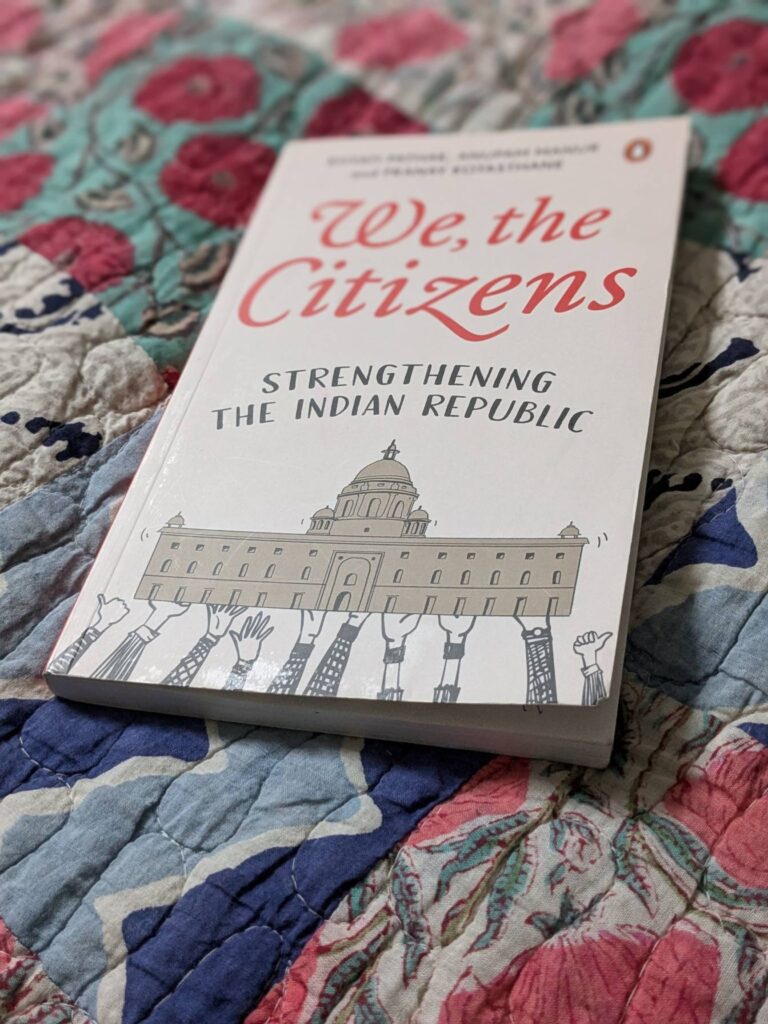
Every day we look around and blame the government for not doing the things they are supposed to do, and for being overbearing on things like taxation. We The Citizens is a wonderful little book (176 pages) that explains why things are the way they are. Full of wit and wisdom on subjects we don’t think about enough, but are important. I think the authors have done a great job of making the complex interplay of state, market, and society understandable, and that includes the illustrations that elevate the narrative many a times. A graphic narrative that decodes how public policy works (and could work) in the Indian context.
The state is good at employing force, but isn’t very efficient. The market is good at driving efficiency, but is not concerned with ensuring equity. Society is best suited to deal with behavioural changes, but it is prone to majoritarianism. The entire system is a maze of checks and balances to achieve progress while not allowing any of the elements to go out of control. The book delves into how each of these function, and should function.
The state, for instance has a toolkit of at least eight things from doing nothing to nudging to playing umpire to marginally/drastically changing incentives and so on but doesn’t always employ the right one. Munger’s “Show me the incentives and I’ll show you the outcome” brilliantly manifests in these explorations. The book provides an excellent framework to think about this based on axes of extent of intervention and state capacity. The government can fail in many ways, and the taxpayer pays for these mistakes. The best part about the book is how it uses examples to (literally) illustrate these mistakes, and how they can be avoided. All delivered with some fantastic humour.
Why are we a democratic republic and not just a democracy? Because while democracy gives the state legitimacy on coercion, the republic (constitution) guarantees the rule of law. What is the difference between a nation, state and government? The nation is an imagined community, where people don’t know each other but are still willing to sacrifice for. On the other hand, a state is a political entity. The government is the temporary manager of the state. What are public and common goods? Public goods are goods that are non-excludable and non-rival. (e.g. a lighthouse which everyone can use and its usage by one person doesn’t mean another cannot use it) On the other hand, common goods are non-excludable but rival (e.g. fish in the sea). This is why only the government produces public goods. These are the kind of significant nuances that the We The Citizens uncovers.
I cannot stress how accessible this book is. Plain English, relatable examples, and frameworks that can be applied even in other contexts. Like many good things in life, I discovered We The Citizens courtesy the better half. I’d highly recommend this to anyone even remotely curious about how the ‘system’ works. If you’re not, this can actually get you interested.
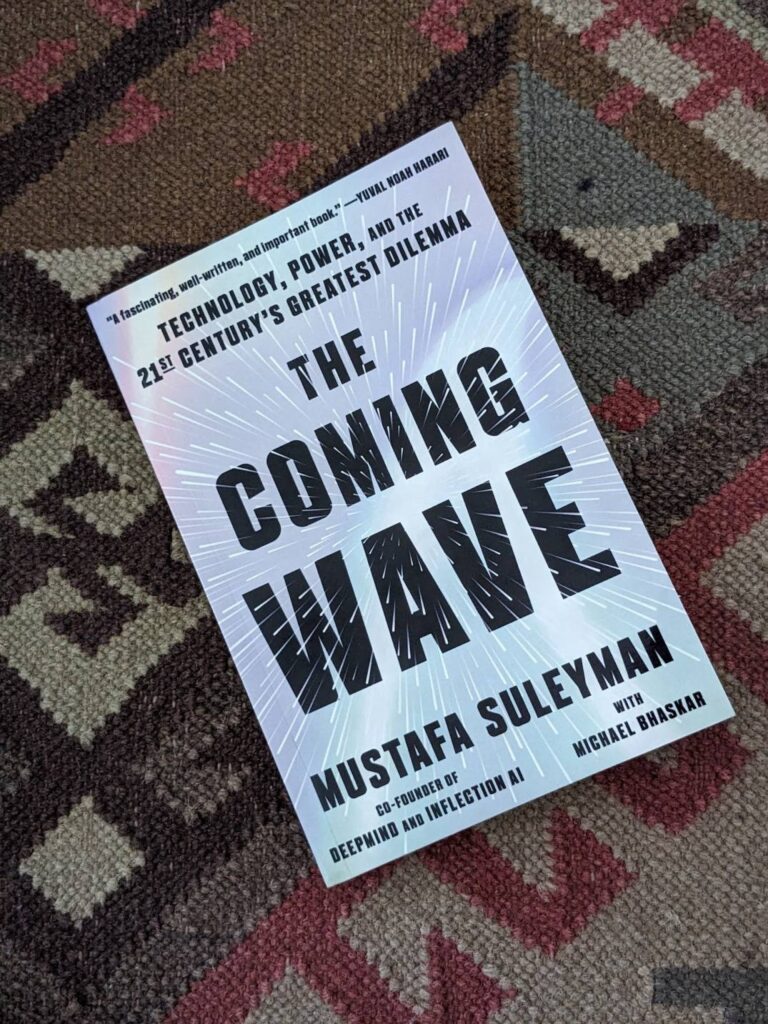
Co-founder of first DeepMind (the company behind a couple of massive leaps in AI – AlphaGo, AlphaFold, acquired by Google), then Inflection AI and now (before the book published, I think) CEO of Microsoft AI, I think there are few better people than Mustafa Suleyman to write about AI. And I suspect there will be few better moments than now. The Coming Wave was a book I was looking forward to reading, and it didn’t disappoint.
The book is divided into four sections. The first looks at the history of technology and how it spreads. The second gets into the detailing of the coming wave – two general purpose technologies – AI and synthetic biology, and associated technologies like robotics and quantum computing. This section also goes into the features and incentives that drive them. Part 3 takes a side step into the political implications of this on the nation state, the only institution that can temper the wave. The last section looks at what is the ‘containment problem’ – a wave of technology is near impossible to contain, history has ample proof, but can we still take a shot at it.
In the first section of The Coming Wave, Suleyman shows how technology has a clear, inevitable trajectory: mass diffusion in great rolling waves. New discoveries are used by people to make cheaper food, better goods, more efficient transport etc. As demand grows, competition increases, the technology becomes better and cheaper, and easier to use. From farming to the internet, history has enough examples. A big challenge is that the inventor has no way of knowing the nth order consequence (the ‘revenge effects’ of technology – fridge makers didn’t start out with the intent to punch a hole in the ozone later), and once a technology is out there, there is very little we can do to contain it. From fossil fuel emissions to opioid abuse to space junk, this is the story. The only partial exception is nuclear weapons.
There is a fascinating story in the beginning of the second section on DQN, an algorithm the DeepMind team created to play the game Breakout, and it discovered a strategy that most humans didn’t think of. The trailer for AlphaGo. The section also goes deep into synthetic biology and robotics. Apparently, one can buy a benchtop DNA synthesiser for $25k.
But this section is even more important because it brings out the four intrinsic features of this wave that compound the containment problem. One, it has a hugely asymmetric impact. Which this has happened before (cannon vs a large set of people) it has been scaled massively with the internet and now AI (a single algorithm can hold massive systems to ransom). Two, they are developing fast – hyper-evolution – providing very little time to react, let alone regulate ((look at cars vs the frequency of the versions of GPT). Third, they are omni-use (AI can be applied in multiple domains, and can come up with compounds for cure or as poison). And fourth, its degree of autonomy is beyond any previous technology.
Add to that the incentives and the containment problem just gets magnified. Geopolitics and the power involved, a global research system that has rituals rewarding open publication – curiosity and the pursuit of new ideas, financial gains, and the the most human one of all – ego.
The third section of The Coming Wave is on the impact of all this on the nation state. He calls out that technology is not value-neutral, and quotes Langdon Winner, “Technology in its various manifestations is a significant part of the human world. Its structures, processes and alterations enter into and become part of the structures, processes and alterations of human consciousness, society and politics.” From the printing press to weapons, tech has helped build the nation state. My favourite chapter in this is ‘Fragility Amplifiers’ – from robots with guns to lab leaks to 3d printing everything, even people with good intent can cause things to go wrong. “What does the social contract look like if a select group of ‘post humans’ engineer themselves to some unreachable intellectual or physical plane?”Add to it massive job displacement, and other social issues and the nation state faces challenges far beyond the standard issues of the day. The possibilities are a continuum from an extremely powerful nation state to completely decentralised groups of individuals.
In the last section, he looks at nine ways, working in cohesion to provide some sort of containment. Technical safety, audits, using choke points, maker responsibility to build in controls from the start, aligning business incentives with containment, helping governments build tech to regulate tech, international alliances for regulation and mitigation, a culture of sharing errors and learning from them, public input to make this all accountable. The tenth point he makes is that there is no silver bullet that will take us to any permanent solution. It is a narrow path which humanity must walk on. That probably is the biggest lesson.
I found The Coming Wave full of great insights and perspectives, and written in a way that makes it accessible to those outside tech. An important book for everyone to read since it’s a pragmatic look at what the future holds for the species. Part of my 2024 favourites list.
Notes 1. (Life + Intelligence) x Energy = Civilisation 2. Liverpool’s MP William Huskisson was killed under the wheels of the locomotive during the opening of the Liverpool – Manchester line, the first passenger railway because the crowd had no idea of the machine’s power! 4. How the stirrup changed everything. Fused the rider to the horse, and the ability to power through. It became a leading offense strategy, and changed Europe. Horses – church land for rearing- ties to the kingdom – feudalism. 3. Today, no matter how wealthy you are, you simply cannot buy a more powerful smartphone than is available to billions of people 4. Primum non nocere – “first, do no harm”. (Hippocratic Oath)

Glucose Revolution is another one of those books that I wasn’t even aware of, but came in via a referral, and I believe will actually make a difference in my life. Jessie Inchauspé, also known as Glucose Goddess, does a fantastic job of showing a way out of the clutches of glucose imbalances which are an underlying cause of many health issues – from cardiovascular diseases to PCOS to acne and even mood swings.
The reason why I loved this book are many. One, it’s not just a lot of theory. She combines lived experiences (of herself and others in the community), scientific research, and experiments (to validate) to show how it works. Two, she layers that with the overall science behind why they work that way. Three, she does so in the most accessible manner. And finally, she doesn’t just point out the problems, she also provides solutions and paths to address them.
The book is divided into three parts. The first explains the origins of glucose and why it is important. While we colloquially call them all carbs, glucose, fructose, sucrose, starch, fibre are all varied forms and have different impact.
The second describes how dysregulated glucose levels and glucose spikes affects us in the short-term and the long-term. From hunger pangs at one end to worsened cognitive function at the other. During glucose spikes, the mitochondria quickly get more glucose than they need, some glucose gets converted into fat, and more importantly, molecules called free radicals are released into our system. When there are too many of these, it results in oxidative stress, a driver of heart disease, Type 2 diabetes etc. Glucose also glycates other molecules, damaging them forever. Wrinkles, cataracts etc. The combination of all these result in inflammation, and chronic inflammation is the source of most chronic illnesses we get.
When we have excess glucose in our body, the pancreas sends out insulin to store it and keep it out of circulation. Liver, muscles and conversion into fat are the three ways it is done. That last bit is how we gain weight. The stored glucose is used when mitochondria needs it, and when glycogen (the glucose in the liver and muscles) gets diminished, our fat reserves come into play. But this cannot happen when insulin is high. (read notes for more on this) There are explanations for why and how each kind of disease related to this happens.
Part 3 is a set of ten (simple) hacks to flatten the glucose curves (reducing glycaemic variability). The first and most useful hack is the order of eating your meal. Veggies (fibre) first, proteins and fats next, and starch/carbs last. Fibre reduces the action of alpha amylase, the enzyme that breaks starch into glucose, it slows down gastric emptying, and creates a mesh which makes it difficult for glucose to get into the bloodstream. My second favourite hack was #7 – drinking apple cider vinegar before eating sweets. Acetic acid in vinegar temporarily inactivates alpha amylase.
Glucose Revolution is a fantastic book because of its actionable insights and the accessibility. Highly recommended. Having said that, I have also recently read some critique which you might want to consider before picking it up.
P.S. My own experience after nearly a year of trying this is that first, I got an immediate reduction of HbA1c from 6.3 to 5.9 and was able to sustain it for about 8 months. Since then, it has gotten back to 6.3 but there are many variables and I am still trying to eliminate them one by one.
Notes 1. Any food made from flour has starch 2. We like sweetness because back in the Stone Age the taste of sweetness signalled foods were safe (there are no foods that are sweet and poisonous). It gives us a dopamine hit. 3. Mitochondrial stress causes cells to lose their smooth shape. The lining becomes bumpy and fat particles get stuck more easily. LDL (B) does exactly this. If an when cholesterol gets oxidised (happens when more glucose, fructose, insulin are present), it creates plaque. Triglycerides become LDL (B). A good measurement is triglycerides/HDL. If it’s less than 2, great 4. Insulin treatment brings down glucose temporarily but is harmful in the long run. 5. Sugar is sugar, whether it comes from fruit or table sugar. Relatively the first is better. 6. Similar story with whole grains. Dark bread/ seed breads are relatively better.
As an anthropologist, Joseph Henrich realised that much of the published work (and hence commentary) on human psychology (and social sciences at large) were based on work with experimental subjects who were based in or around Western universities. And when attempts were made to replicate these results with people in Africa/Asia, some of them even elites, it came to light that the subject pool was biased. They were WEIRD – Western, educated, industrialised, rich, democratic – and though only a small part of the species, are disproportionately represented in culture and thinking. How did this happen? That’s what The Weirdest People in the World is all about.
He sets the stage with the influence of Protestantism in this. Its credo of the individual’s personal relationship with God spurred the belief that a person should read the Bible (sola scriptura), increasing literacy in the process. But beyond this, he points out that religious convictions shape decision-making, psychology, society and culture at large.
But what is the WEIRD psychology? Broadly individualism and personal motivation (self focus, guilt over shame, dispositional thinking – based on intent not context, low conformity, self regulation and control and patience, time thrift, value of labour, desire for control and choice); impersonal pro-sociality (impartial principles, trust, honesty and cooperation with strangers and impersonal institutions, emphasising mental states in moral judgment, not revengeful but willing to punish third parties for not sticking to principles, reduced in-group favouritism, free will, belief in moral truths like physics principles, linear time), and perceptual and cognitive abilities and biases (analytical over holistic thinking, attention to foreground and not surroundings, endowment effect, overconfidence on own abilities)
To understand how people became WEIRD, he brings up the importance of cultural learning in evolutionary psychology. “Unlike other animals, we have evolved genetically to rely on learning from others to acquire an immense amount of behavioural information, including motivations, heuristics, and beliefs that are central to our survival and reproduction.” From our own motor patterns to projectile technology and food processing to grammar and social norms. Cultural learning adaptively rewires our brains and biology to calibrate them for navigating our culturally constructed worlds. This is cumulative cultural evolution.
It started off with kinship altruism, which other primates too possess, and extended to pair bonding and marriage, which is the most primeval of the institutions we have created. Preferred sexual access and a guarantee of paternity in return for protection and providing for the family. This paternity certainty and norms to cement it is where we start differing from most other primates. This also creates in-laws (affines) forming connections with more people who are not genetically related. From there on, basic communal rituals like dance, drills etc also bind people together with “mind hacks” through mimicry and a suggestion that others are like us and have an affection for us.
The next big shift was agriculture, which necessitated securing and holding lands. This needed co-operation and gave an edge to those communities with more social norms – rituals, beliefs etc. Fierce competition between groups generated a coevolutionary interaction between agriculture and societal complexity. And so, though farming was less productive and even less nutritious than hunting and gathering at an individual level, between sedentism and productivity of the unskilled (young) labour, farmer communities just reproduced more quickly and removed/assimilated hunter-gatherers.
Further inter-group competition led to clans which were kin-based institutions. These then became chiefdoms and premodern states. Built on norms and beliefs. And then non-kin based institutions developed between the elites and others to create stratified societies. e.g armies, tax collection. In the meanwhile, religion, based on our supernatural beliefs and worldviews, started scaling cultural evolution by creating ‘doctrinal’ rituals – prayers, hymns, parables etc and being transmitted by successful people – prophets and community leaders. These gave people a sense of unified commitment (conforming) and further evolved with identity markers- dresses, ornaments, taboos etc. By powerfully shaping behaviour and psychology, religion played a key role in forming higher-level political and economic institutions.
Thus begins another central point in the book – the role of the Church (and its MFP – Marriage and Family Program) in creating WEIRD people. The Church systematically started breaking the foundational kin-based societies using prohibitions and canon laws (marriage, adoption, divorce, polygamy, wills etc) over many centuries in Europe, ‘threatening’ people with divine retribution (in the afterlife) and excommunication (immediate). By allowing rich patrons to ‘pay’ with money and church-building, the Church continued to grow at the expense of the kin networks.
With more and more people marrying and working outside the kin network, cultural evolution started favouring a psychology that was more individualistic, analytically-oriented, guilt-ridden (as opposed to shame – guilt depends on one’s own standards and self-evaluation while shame depends on societal standards and public judgement) and intention focused (in judging others) as opposed to being bound by tradition, elder authority, and general conformity.
An important part is how monogamy became a norm though logically polygynous works for both men and women (because women could be second wife to the best hunter rather than only wife to an average hunter). It evolved because it can give religious groups and societies an advantage in intergroup competition. By suppressing male-male competition an altering family structure, monogamous marriage shifts men’s psychology in ways that tend to reduce crime, violence, and zero-sum thinking while promoting broader trust, long term investments and steady economic accumulation. Basically a testosterone-suppression system to reduce intra group competition. Between this and suppressed fertility (increased age of marriage, no pressure from kin, education for women) nuclear families started to focus on investing in their child – nutrition and education.
These changes also led to urbanisation as people travelled to places where they could find mates, vocation etc and expanded impersonal networks (trust in strangers as opposed to interpersonal kin networks) based on interests and worldviews, leading to universities, guilds and charter towns, who competed with each other to attract people. A pre cursor to the transition to political parties in later centuries. Another factor at play was wars. Though intuitively, one might think it derails progress, it actually builds intra group bonding and spurs technological advancements.
A rising middle class started demanding more rights, freedoms and privileges, leading to refinement of ideas, and acceptance of concepts like ownership and laws. Between this, impersonal networks and commerce, attributes like patience, time thrift (fascinating how clocks developed and changed the notion of time – wages per hour, need for efficiency, common market hours, contracts), self-regulation and positive-sum thinking (everyone can gain by advancements, I don’t need to be selfish or envious) began being appreciated as qualities one would want in self and other people, in order to distinguish themselves and prosper. These mindsets explains the kind of representative governments, laws, and the innovation and economic growth since then. The Industrial Revolution, for example, was fuelled by the expanding size and interconnectedness of Europe’s collective brain. In the political sphere, Protestantism, also a part of the larger religious cultural evolution, encouraged democratic institutions. Unlike the hierarchical Church, it requires communities to develop self-governing religious organisations using democratic principles. The cultural evolution can also explain things like patent concentration (in countries and regions) and economic characteristics at large in the contemporary era.
I can now easily see how the same principles apply to even India in the last say, five decades – better connectivity, educational institutions, urbanisation, reduction of kin bonds, and how that makes the 1% in the country closer to WEIRD than their own ancestors. This is a fascinating book supported by a ton of data and studies, and my only complaint is that like many other academics, Henrich too succumbs to the tendency of extensive usage of the latter at the risk of the narrative flow (instead of an appendix). But I’d still recommend it and between this, “Being You” (reality as a controlled hallucination and the brain only seeking to survive/control), and “The Master and His Emissary” (the hijacking of the narrative by the left brain especially since the Industrial Revolution), there emerges a phenomenally insightful view of the brain, its motivations and the interaction with cultural evolution. I really must repeat all these three soonest!
The Weirdest People in the World is a fascinating read and is in my favourite reads of 2024.
“The Psychology of Money” is acknowledged as a game changer. It gave me fresh perspectives, validation, and the confidence to continue on the path I had set out on financially. So it wasn’t surprising that I was looking forward to Same As Ever.
To begin with, I think you shouldn’t expect the refreshing sense you’d get from the previous book. This is even more so if you’ve been reading the Collab Blog. The book’s cover promises ‘timeless lessons on risk, opportunity, and living a good life’ and to some extent, delivers on all. There are many extremely good insights and the pithy ways in which Housel articulates profound truths continue to be a source of ‘aha’.
What I missed though was the smooth flow of the previous book. It doesn’t help that many of the chapters seem to be force fitted into a narrative, and many anecdotes and other content are from the blog. Housel does go for a structure but I think it might have helped if this were presented as just a series of essays. He does say that these are standalone but then also proceeds to try connections at the end of each chapter. The overall experience therefore is a little jarring.
Having said that, Same As Ever is a useful book to read, with some great but lesser-known anecdotes, and indeed, timeless insights.
Notes and Quotes “Risk is what’s left over after you think you’ve thought of everything” ~ Carl Richards “Invest in preparedness, not in prediction” ~ Nassim Nicholas Taleb Money brings happiness the same way drugs bring pleasure: incredible if done right, dangerous if used to mask a weakness, and disastrous when no amount is enough. “The majority of Americans were likely than their descendants to be dogged by the frightening sense of insecurity that comes from being jostled by forces – economic, political, international – beyond one’s ken. Their horizons were close to them.” ~ Frederick Lewis Allen (1900) People don’t want accuracy. They want certainty. If you have the right answer, you may or may not get ahead. If you’ve the wrong answer but you’re a good storyteller, you’ll probably get ahead (for a while). If you’ve the right answer and you’re a good storyteller you’ll most certainly get ahead. “Humour is a good way to show you’re smart without bragging” ~ Mark Twain “The higher the monkey climbs a tree, the more you can see his ass” ~ T. Boone Pickens “A mind that is stretched by new experience can never go back to its old dimensions” ~ Oliver Wendell Holmes