Steven Pinker
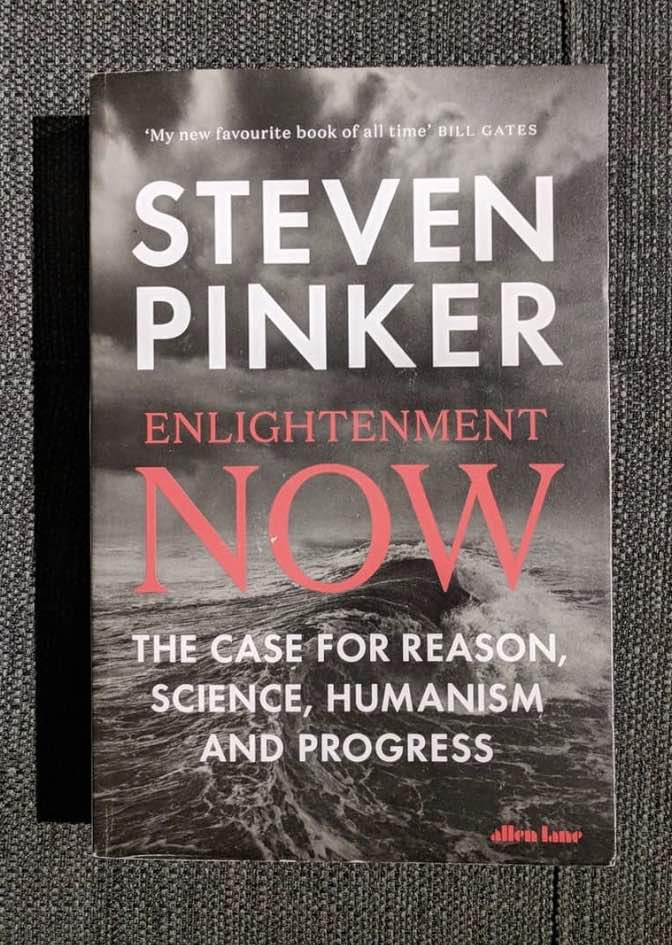
“The case for reason, science, humanism and progress” – a part of the book’s title, did make me wonder whether there is a use case for this book at all. Especially 450 pages. After all, isn’t this self obvious? Evidently not! I haven’t read “The Better Angels of Our Nature”, the book the author wrote before this on the same premise, but apparently this book works as a rebuttal against all the criticism raised against the former. To note, “Enlightenment Now” works completely fine as a standalone work, one that needs to be read.
The author begins on a very philosophical note, a question raised by a student during a lecture – “Why should I live”? He gives a brief answer that touches upon not just the opportunities available to an individual to progress and flourish, but because of her/his sense of empathy, also allow her/him to help others do the same.
What enables this are the four concepts I mentioned in the first sentence. They are what the author calls the ideals of the Enlightenment, and through this book he aims to restate them in the context of the present.
In the first three chapters the author writes about what Enlightenment is, what drives it, and what the forces acting against it are. One among them is this – even though one might agree to it in principle, one would never agree that it would work in practice. I have to admit, I am one of those.
But before getting to that, some praise for the next seventeen chapters, which are all about the remarkable progress that we have achieved as a species. From life itself (mortality, life expectancy rates) to economic growth and reduction in poverty to the environment to wars to human rights to life satisfaction, the author uses reason backed by data to show how this is indeed the best time to be, and how it’s only going to get better. The data in itself does seem irrefutable, though to borrow from Ronald Coase, I do not know how much it has been tortured to confess.
Even if I assume the data represents the whole picture, I cannot ignore the malaise of angst that I see around me, really and virtually. Is that an availability bias? Quite possible, but why is it increasing if the world is consistently improving?
Is it really accurate to depict the Trump election as an aberration when across many democracies, the tide seems to be the same. Even if the high tide of economies helps all boats rise, not all of them will rise equally. Would they compare themselves to their own past or the current circumstances of those around them?
And I think that forms the crux of my skepticism for the book – the individual experience. Our hopes, our attachments, our relationships are not always represented in the indices of society’s progress as a whole. Also, we are measuring the past with parameters we have now thought up, who knows what kind of indices later generations will think of. The graphs then might show that while we had collectively progressed as a civilization, we had failed on other fronts.
In summation, I am reminded of the nuanced difference between the two kinds of victories – vijaya (victory over others) and jaya (victory over self). While the data shows the first against the collective ills that torment us, the second is probably what will give us the enlightenment that will finally make us happy.