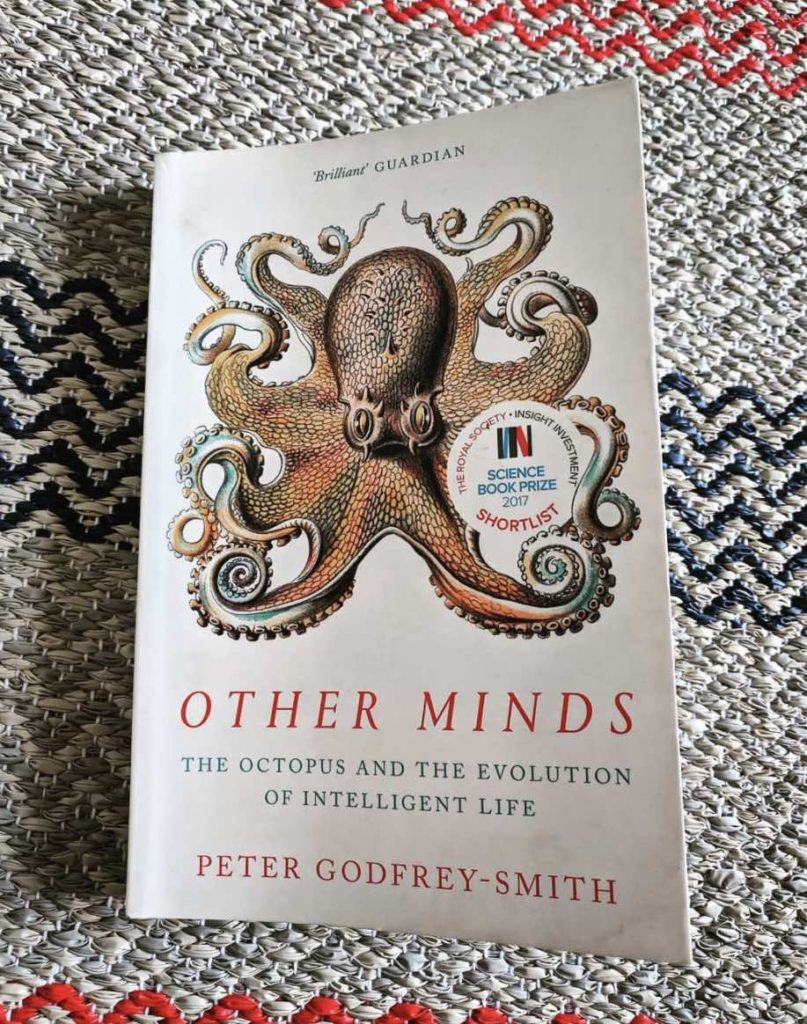
A subject that has not ceased to fascinate me is Darwin’s theory of evolution by natural selection. I read the book less due to the octopus and more for the evolution of intelligent life.
I found the first few pages of the book very encouraging. The author notes how the cephalopods (which include the octopus) were an independent experiment by nature in the evolution of large brains, nervous systems and complex behaviour, and thus it is possible that this is the closest we will come to meeting an alien. Also, as we move further in the study of the mind’s evolution, it begins to touch upon philosophy, and I enjoy reading a “science book” which understands this mix. Later in the book, the discussion around subjective experience, sentience and consciousness was exactly this, and I relished the few pages that were devoted to this.
In the book’s second half, a section I enjoyed was around the entropy of living beings – a tree vs a cephalopod vs a human. How do they have fundamentally different lifespans? The explanation around mutations and how nature’s machinations result in different ways of living, reproducing, and dying were excellent perspectives that aided my understanding of evolution.
What didn’t work for me though was (what I thought) a lack of coherent structure. That resulted in multiple detours from the subjects at hand, some of which, especially if you’re not fascinated by octopus and cuttlefish, would make you wonder when we’d get back on track.
References to Principles have been appearing in many of my favourite blogs and newsletters for a while now, and all the bits and pieces I managed to pick up from them were thought-provoking. The blurbs feature Bill Gates and Tony Robbins. So, expectations from the book were sky high, and I was looking forward to reading it!
Did it deliver? Yes, in parts. Speaking of parts, the book is divided into two – life and work, with more pages devoted to the second. The book begins though, with a “Where I’m Coming From” section that gives the reader a background of the author’s life and does a good job of setting context for both the life and work sections. (more…)
I have always loved history, especially in the context of a particular city. But despite Kochi being my hometown, I must admit to complete ignorance on the place’s history. That’s why I was very excited about this book.
In about 4.5 sq km in Fort Kochi and Mattancherry, there are around 30 communities! This small area is also host to the social and religious institutions of these various communities. The variety of people and the origin stories are simply astounding. From Portugal and Yemen to Kutch and the Indus Valley, and many places in between, there have been migrations that happened decades and in some cases, even centuries ago, creating a mosaic of different cultures. A lot of credit goes to the traditional kings of Kochi who were generous with their grants to migrants. It has to be said that this has been repaid manifold by the benefits to trade and the economy in general. (more…)
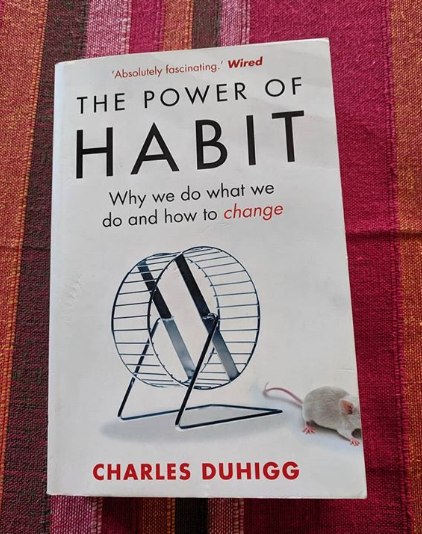
There is something meta about me reading this book. I have my own book-reading habits – genres, number of books on the to-be-read shelf, and such. It is an example of the fundamental premise of this book – cue, routine, reward. Under normal circumstances, I reckon that this book might have landed up on my list 3-5 years down the line. But thanks to my wife D, it not only got into my shelf, but gave me a favourite book as well! Same cue, changed routine, same reward – the exact process to lose a bad habit and pick up/better a good one!
Towards the end of the book, the author quotes William James – “All our life, so far as it has definite form, is but a mass of habits – practical, emotional, and intellectual – systematically organized for our weal or woe, and bearing us irresistibly toward our destiny, whatever the latter may be.” As a creature of habits, I wholeheartedly agree. Habits form character, and character forms destiny.
The book can be helpful to anyone seeking to improve the self, whether it is in life or at work. From losing weight to raising children to building great teams, the importance of habits (individuals) and routines (groups), and the fundamentals of changing/bettering them do not change. The author demonstrates that in separate sections dedicated to individuals, companies and societies. Michael Phelps’ habits and routines, Howard Schultz’s (CEO, Starbucks) processes that have transformed not just how the organisation works, but employees’ lives, and Martin Luther King’s successful civil rights movement, all showcase a pattern that can be used to radically alter trajectories.
I think the success of the book is also due to the excellent storytelling that converts what could have been a dry subject to one that is not just enlightening but entertaining too! I suspect there is some understanding of a reader’s cue-routine-reward mechanism here, because I was hooked soon as I started! 🙂
There are a couple of wonderful analogies for habits at the end of the book – both using water. It captures the essence of the book beautifully, and encourages us to believe that we can choose our path, and swim wherever we want to.
Pick it up. Now!
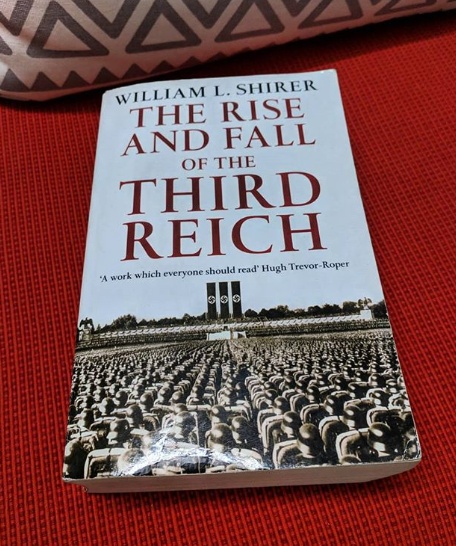
What a fascinating read! The second world war was one of the most defining events of the contemporary era, and The Rise and Fall of the Third Reich provides a fantastic view of what happened in Germany between 1930 and 1945, chronicling the ascendance of Hitler and the Nazi Party and its eventual demise.
Hitler’s dream was to establish a Reich that would last a thousand years, though it finally managed just about a dozen. But in those few years, he managed to give the world the kind of shock it had probably never experienced before.
The book actually begins much earlier, and traces Hitler’s early life, his disenchantment with the socio-political environment prevalent in Austria and Germany, and his entry into regional politics. Through smart thinking, astute use of the economic depression, a lot of outmaneuvering of politicians far bigger in stature than him, and quite some luck, he took himself to a position where the nation was practically begging him to seize control. It is amazing to see the number of instances long before he gained power when a small change would have led to a different history than the one we are familiar with.
His baby steps into expanding Germany’s borders through cunning and then brute force, his affection for the largely ineffectual Mussolini, the poor judgment and horrendous miscalculations exhibited by the European powers, Stalin’s greed, all led to a state of affairs that made war inevitable. Germany dominated the early period, the Blitzkrieg tore through defenses, and it is astonishing to see how close they came to taking over all of Western Europe early in the war, in addition to Scandinavia and Eastern Europe. Through the mid to late 30s, what is also evident is Hitler’s own iron will, determination and political astuteness using which he outplayed his opponents over and over. But in Stalin, he met his match, and he underestimated the man and his country’s military strength. A costly mistake.
At some point, Hitler’s megalomania took over, and his downfall began. His allies, the Japanese, didn’t help the cause much by drawing the US into the war. He repeated history by disastrously opening two fronts in battle. He also misread the importance of North Africa and the Suez. But it is chilling to note that with a little patience and by sticking to strategic alliances, he might not have lost the war at all. The Rise and Fall of the Third Reich also covers the role played by several inept leaders of the German armed forces in bringing and keeping Hitler in power, and their inability to stand up to the dictator, even as they realised that he was leading their country into disaster. Also described in detail are the several plots that were hatched to assassinate Hitler, including Operation Valkyrie.
This is a commendable piece of work – not just for chronicling an important piece of history, but for the painstaking research that must have gone into it, and the control on a narrative with so many moving parts, all of which are important.
At 1100+ pages and the smallest possible font, The Rise and Fall of the Third Reich is not an easy read. But if you have any interest in history, and the war that shaped the modern world, this is a book you should definitely invest in.