Category: Mind

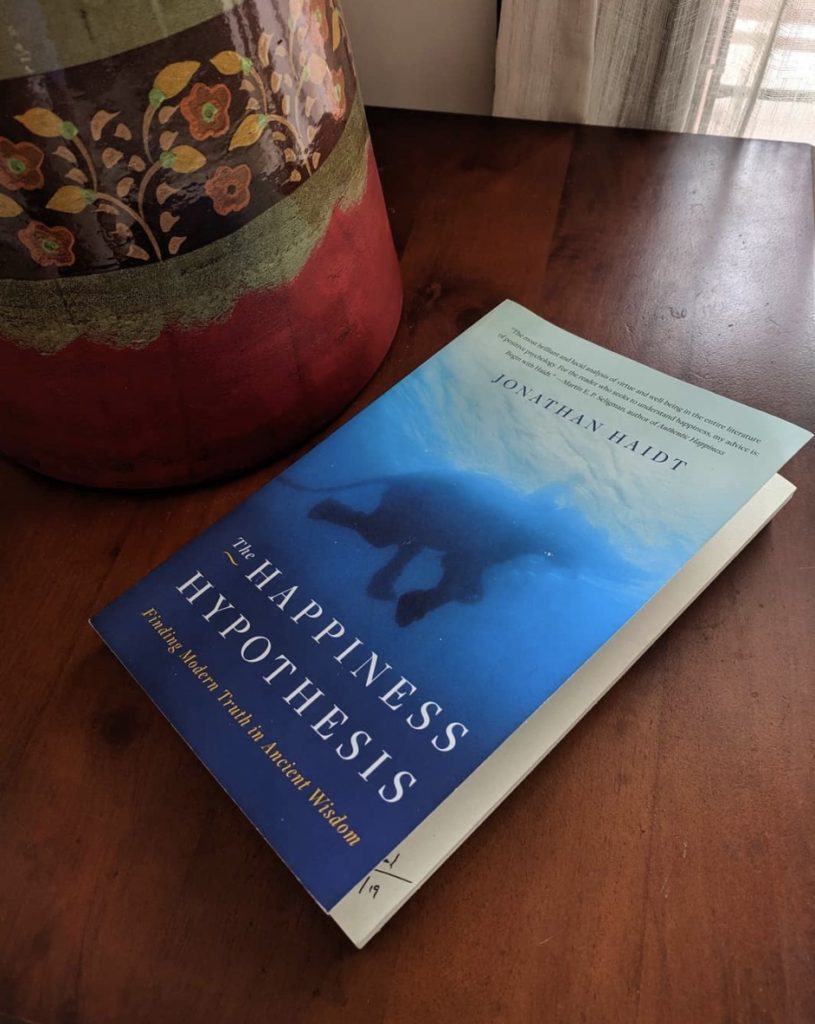
  • The Happiness Hypothesis

    Jonathan Haidt

    I don’t remember how I discovered this book, but when it arrived, I really liked the title. Mostly because of the word “hypothesis”, because it signals a scientific approach to a challenge. And that’s exactly what the book sets out to do – take ten of the best ideas/concepts from history, religious texts and philosophers, and scrutinise it through a science filter. Positive psychology is the genre.

    The author begins with the idea of the divided self, and then goes deeper. Into the inbuilt “affective style” that plays a huge part in one’s personality and how that can be changed, the role of reciprocity, and our tendency towards hypocrisy – seeing the small faults in others while ignoring our own bigger ones. At a third of the book, we even come across a formula for happiness, which makes a lot of sense when viewed rationally.

    My only concern with the book started around this point. The author seemed to have reframed the original thought (happiness) and moved it to meaning, and he didn’t let me in on the reasoning. He tries to bridge this in the last chapter, but to me it seemed forced.

    If that is set aside, the rest of the book does an excellent job of parsing the “meaning of life” into two parts and answering the more important one. The author actually spells out the parsing only towards the end – “why are we here” and “how can I find meaning”? But the chapters before that do give a bunch of perspectives on the second – love and attachments, virtue, adversity, and divinity (agnostic of God).

    There are several ideas that I could take away from the book. Though the metaphor of the elephant and the driver is not original, the idea of approaching them in tandem and making them work towards a harmony has been elaborated well. It also serves as a good reminder that evolution is only interested in our “success” (survival) and happiness is only a nice-to-have. The framing of questions as metaphors is also something I found useful. e.g. What is life? Life is like a journey.

    Another very interesting concept was the the three layers of personality – basic traits, “characteristic adaptations” and “life story”. To me, it provides a clear actionable on how to approach meaning and happiness. The related concept of “arête”, as well as the nuanced difference between character and personality were also good finds.

    It takes a lot of intellect, experience and effort to get the Bhagavad Gita, St.Paul, Confucius, Marcus Aurelius, Buddha, Nietzsche, Benjamin Franklin, Epicurus etc to align in a book that’s only 240 pages. The good news is that the book does this quite well.

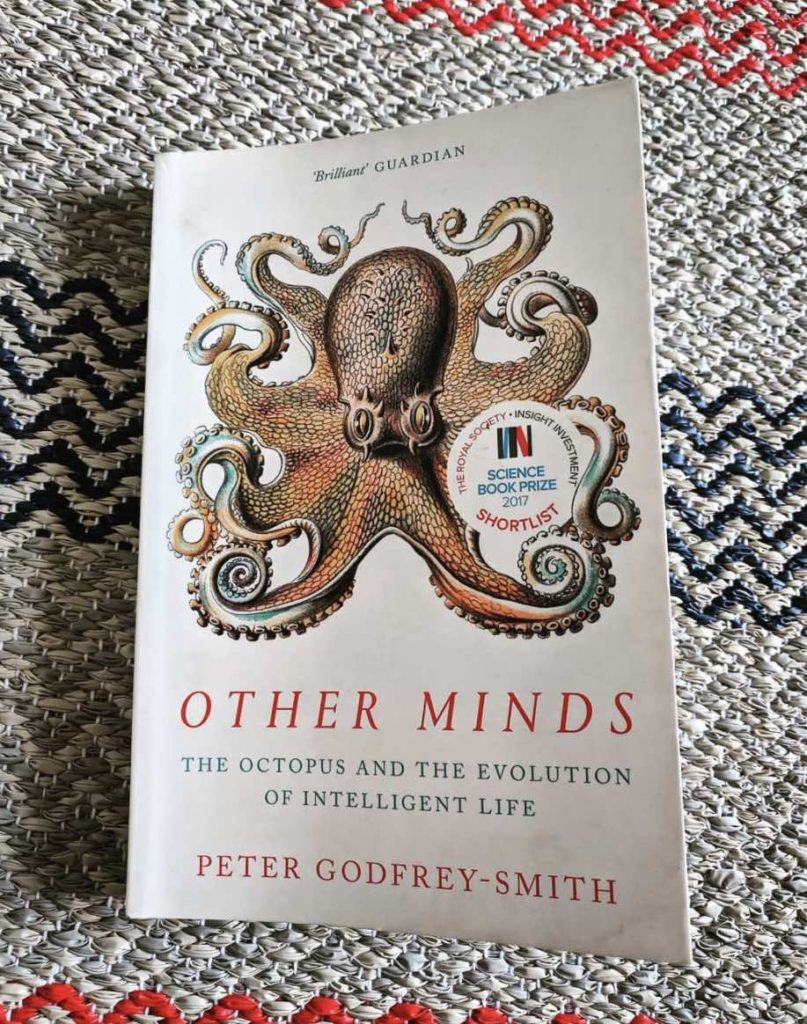
  • Other Minds

    Peter Godfrey-Smith

    A subject that has not ceased to fascinate me is Darwin’s theory of evolution by natural selection. I read the book less due to the octopus and more for the evolution of intelligent life.

    I found the first few pages of the book very encouraging. The author notes how the cephalopods (which include the octopus) were an independent experiment by nature in the evolution of large brains, nervous systems and complex behaviour, and thus it is possible that this is the closest we will come to meeting an alien. Also, as we move further in the study of the mind’s evolution, it begins to touch upon philosophy, and I enjoy reading a “science book” which understands this mix. Later in the book, the discussion around subjective experience, sentience and consciousness was exactly this, and I relished the few pages that were devoted to this.

    In the book’s second half, a section I enjoyed was around the entropy of living beings – a tree vs a cephalopod vs a human. How do they have fundamentally different lifespans? The explanation around mutations and how nature’s machinations result in different ways of living, reproducing, and dying were excellent perspectives that aided my understanding of evolution.

    What didn’t work for me though was (what I thought) a lack of coherent structure. That resulted in multiple detours from the subjects at hand, some of which, especially if you’re not fascinated by octopus and cuttlefish, would make you wonder when we’d get back on track.

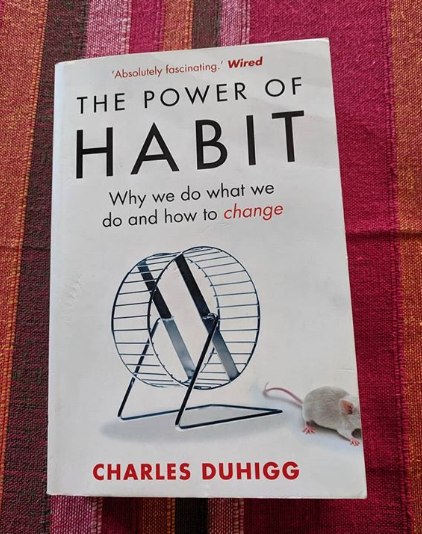
  • The Power of Habit

    Charles Duhigg

    There is something meta about me reading this book. I have my own book-reading habits – genres, number of books on the to-be-read shelf, and such. It is an example of the fundamental premise of this book – cue, routine, reward. Under normal circumstances, I reckon that this book might have landed up on my list 3-5 years down the line. But thanks to my wife D, it not only got into my shelf, but gave me a favourite book as well! Same cue, changed routine, same reward – the exact process to lose a bad habit and pick up/better a good one!

    Towards the end of the book, the author quotes William James – “All our life, so far as it has definite form, is but a mass of habits – practical, emotional, and intellectual – systematically organized for our weal or woe, and bearing us irresistibly toward our destiny, whatever the latter may be.” As a creature of habits, I wholeheartedly agree. Habits form character, and character forms destiny.

    The book can be helpful to anyone seeking to improve the self, whether it is in life or at work. From losing weight to raising children to building great teams, the importance of habits (individuals) and routines (groups), and the fundamentals of changing/bettering them do not change. The author demonstrates that in separate sections dedicated to individuals, companies and societies. Michael Phelps’ habits and routines, Howard Schultz’s (CEO, Starbucks) processes that have transformed not just how the organisation works, but employees’ lives, and Martin Luther King’s successful civil rights movement, all showcase a pattern that can be used to radically alter trajectories.
    I think the success of the book is also due to the excellent storytelling that converts what could have been a dry subject to one that is not just enlightening but entertaining too! I suspect there is some understanding of a reader’s cue-routine-reward mechanism here, because I was hooked soon as I started! 🙂

    There are a couple of wonderful analogies for habits at the end of the book – both using water. It captures the essence of the book beautifully, and encourages us to believe that we can choose our path, and swim wherever we want to.
    Pick it up. Now!

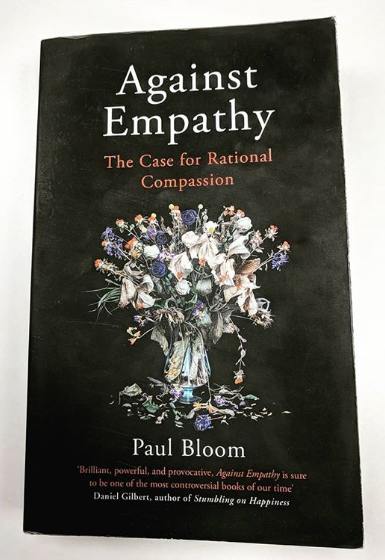
  • Against Empathy

    Paul Bloom

    As far as the title goes, he was preaching to the choir. My thoughts on empathy have been shaped over the last few years based on some excellent books like The Selfish Gene, The Moral Animal, Thinking Fast and Slow, Who’s in Charge? and even How Adam Smith Can Change Your Life, which is quoted by the author quite a bit. These thoughts are not kind to empathy being the best guide for decision making of the moral or even sometimes the day to day kind. They also favour rational compassion. So, theoretically, this book should have worked for me, especially because it has been recommended by some of my favourite thinkers.

    But it didn’t to the extent that I had hoped it would. This, I think, is largely because the premise of “against empathy” required little validation for me, it was the case for rational compassion that I was more interested in. After all, disproving one thing is not always automatic proof for another, even if the “another” is part of the title of the book! Unfortunately, the book spends just spends the last 10 pages (of 241) on rational compassion. Or at best 25, if one extends a benefit of doubt to occasions where the author argues for it in related contexts.

    I did come across a few interesting things though. Some framing for example – how both folks for and against gun control/immigration are possibly driven by empathy. The only difference is who they are empathetic to. And quotes – this one being my favourite – “Scratch an altruist, and watch a hypocrite bleed” ~ Michael Ghiselin. (I really believe in this one, and the selfish interests that drives erm, selflessness) I realised that I was in the august company of Thomas Hobbes and Abraham Lincoln in this. There are also interesting concepts like the moralization gap – how we discriminate between the immorality of acts done to us and done by us (exaggerate the first, downplay the other).
    The arguments are a mixed bag, but the writing style is witty and accessible and I would recommend it to folks who are intrigued by the thought of being against empathy. If you’ve already arrived at it via thinking/reading, this could help you in validation, but only on the first part of the title.

  • Who’s in charge?

    Michael S. Gazzaniga

    Our notion of the mind is a single “me” that consciously acts and reacts on/to stimuli. But a more accurate description would be several modules that work in tandem to define and dictate what we could call the mind/consciousness. A lot of this mind’s activities is dictated by factors that have been built into us by evolution and environment. I had just about been converted to biological determinism and started disbelieving the notion of free will! I think I’ll have to change my mind again!

    While the blurb might seem like a case for determinism, (and thus against ‘free will’) I thought the actual content of the book, especially towards the last third, swing more towards a “we don’t know yet”. The idea of it, though, starts earlier in the book – “Just as traffic emerges from cars, traffic does ultimately constrain cars, so doesn’t the mind constrain the brain that generated it?” (more…)