Category: History & Politics

  • We, The Citizens: Strengthening the Indian Republic

    Khyati Pathak

    Every day we look around and blame the government for not doing the things they are supposed to do, and for being overbearing on things like taxation. We The Citizens is a wonderful little book (176 pages) that explains why things are the way they are. Full of wit and wisdom on subjects we don’t think about enough, but are important. I think the authors have done a great job of making the complex interplay of state, market, and society understandable, and that includes the illustrations that elevate the narrative many a times. A graphic narrative that decodes how public policy works (and could work) in the Indian context.

    The state is good at employing force, but isn’t very efficient. The market is good at driving efficiency, but is not concerned with ensuring equity. Society is best suited to deal with behavioural changes, but it is prone to majoritarianism. The entire system is a maze of checks and balances to achieve progress while not allowing any of the elements to go out of control. The book delves into how each of these function, and should function.

    The state, for instance has a toolkit of at least eight things from doing nothing to nudging to playing umpire to marginally/drastically changing incentives and so on but doesn’t always employ the right one. Munger’s “Show me the incentives and I’ll show you the outcome” brilliantly manifests in these explorations. The book provides an excellent framework to think about this based on axes of extent of intervention and state capacity. The government can fail in many ways, and the taxpayer pays for these mistakes. The best part about the book is how it uses examples to (literally) illustrate these mistakes, and how they can be avoided. All delivered with some fantastic humour.

    Why are we a democratic republic and not just a democracy? Because while democracy gives the state legitimacy on coercion, the republic (constitution) guarantees the rule of law. What is the difference between a nation, state and government? The nation is an imagined community, where people don’t know each other but are still willing to sacrifice for. On the other hand, a state is a political entity. The government is the temporary manager of the state. What are public and common goods? Public goods are goods that are non-excludable and non-rival. (e.g. a lighthouse which everyone can use and its usage by one person doesn’t mean another cannot use it) On the other hand, common goods are non-excludable but rival (e.g. fish in the sea). This is why only the government produces public goods. These are the kind of significant nuances that the We The Citizens uncovers.

    I cannot stress how accessible this book is. Plain English, relatable examples, and frameworks that can be applied even in other contexts. Like many good things in life, I discovered We The Citizens courtesy the better half. I’d highly recommend this to anyone even remotely curious about how the ‘system’ works. If you’re not, this can actually get you interested.

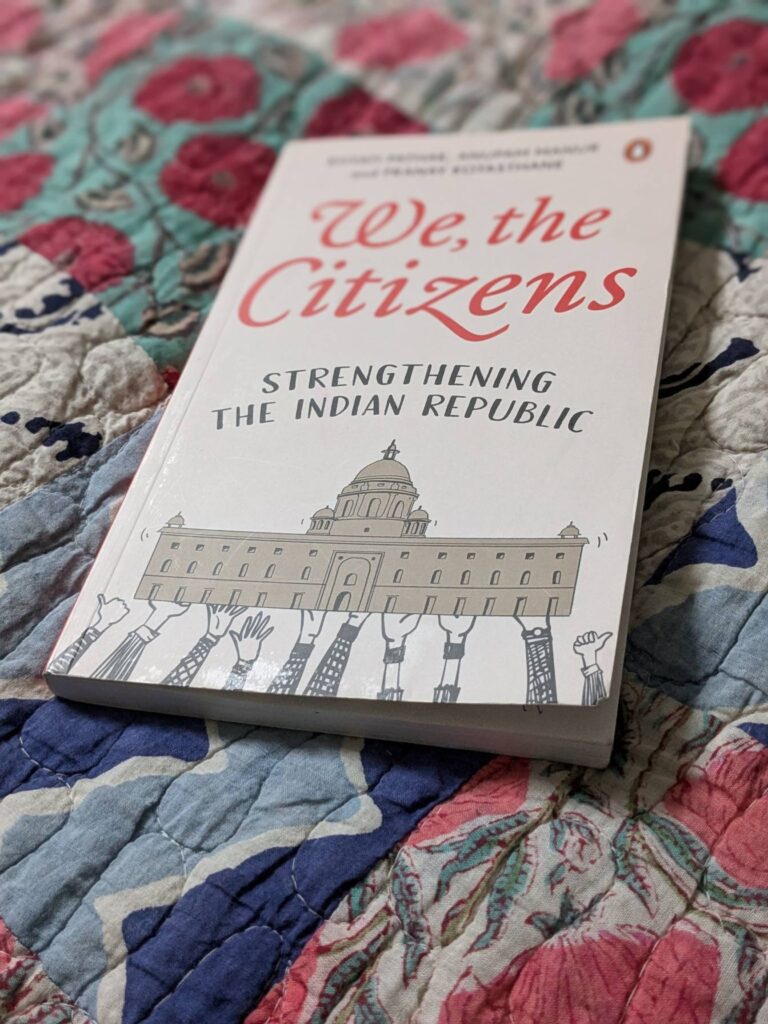
    We, The Citizens
  • The Weirdest People in the World: How the West Became Psychologically Peculiar and Particularly Prosperous

    Joseph Henrich

    As an anthropologist, Joseph Henrich realised that much of the published work (and hence commentary) on human psychology (and social sciences at large) were based on work with experimental subjects who were based in or around Western universities. And when attempts were made to replicate these results with people in Africa/Asia, some of them even elites, it came to light that the subject pool was biased. They were WEIRD – Western, educated, industrialised, rich, democratic – and though only a small part of the species, are disproportionately represented in culture and thinking. How did this happen? That’s what The Weirdest People in the World is all about.

    He sets the stage with the influence of Protestantism in this. Its credo of the individual’s personal relationship with God spurred the belief that a person should read the Bible (sola scriptura), increasing literacy in the process. But beyond this, he points out that religious convictions shape decision-making, psychology, society and culture at large.

    But what is the WEIRD psychology? Broadly individualism and personal motivation (self focus, guilt over shame, dispositional thinking – based on intent not context, low conformity, self regulation and control and patience, time thrift, value of labour, desire for control and choice); impersonal pro-sociality (impartial principles, trust, honesty and cooperation with strangers and impersonal institutions, emphasising mental states in moral judgment, not revengeful but willing to punish third parties for not sticking to principles, reduced in-group favouritism, free will, belief in moral truths like physics principles, linear time), and perceptual and cognitive abilities and biases (analytical over holistic thinking, attention to foreground and not surroundings, endowment effect, overconfidence on own abilities)

    To understand how people became WEIRD, he brings up the importance of cultural learning in evolutionary psychology. “Unlike other animals, we have evolved genetically to rely on learning from others to acquire an immense amount of behavioural information, including motivations, heuristics, and beliefs that are central to our survival and reproduction.” From our own motor patterns to projectile technology and food processing to grammar and social norms. Cultural learning adaptively rewires our brains and biology to calibrate them for navigating our culturally constructed worlds. This is cumulative cultural evolution.

    It started off with kinship altruism, which other primates too possess, and extended to pair bonding and marriage, which is the most primeval of the institutions we have created. Preferred sexual access and a guarantee of paternity in return for protection and providing for the family. This paternity certainty and norms to cement it is where we start differing from most other primates. This also creates in-laws (affines) forming connections with more people who are not genetically related. From there on, basic communal rituals like dance, drills etc also bind people together with “mind hacks” through mimicry and a suggestion that others are like us and have an affection for us.

    The next big shift was agriculture, which necessitated securing and holding lands. This needed co-operation and gave an edge to those communities with more social norms – rituals, beliefs etc. Fierce competition between groups generated a coevolutionary interaction between agriculture and societal complexity. And so, though farming was less productive and even less nutritious than hunting and gathering at an individual level, between sedentism and productivity of the unskilled (young) labour, farmer communities just reproduced more quickly and removed/assimilated hunter-gatherers.

    Further inter-group competition led to clans which were kin-based institutions. These then became chiefdoms and premodern states. Built on norms and beliefs. And then non-kin based institutions developed between the elites and others to create stratified societies. e.g armies, tax collection.
    In the meanwhile, religion, based on our supernatural beliefs and worldviews, started scaling cultural evolution by creating ‘doctrinal’ rituals – prayers, hymns, parables etc and being transmitted by successful people – prophets and community leaders. These gave people a sense of unified commitment (conforming) and further evolved with identity markers- dresses, ornaments, taboos etc. By powerfully shaping behaviour and psychology, religion played a key role in forming higher-level political and economic institutions.

    Thus begins another central point in the book – the role of the Church (and its MFP – Marriage and Family Program) in creating WEIRD people. The Church systematically started breaking the foundational kin-based societies using prohibitions and canon laws (marriage, adoption, divorce, polygamy, wills etc) over many centuries in Europe, ‘threatening’ people with divine retribution (in the afterlife) and excommunication (immediate). By allowing rich patrons to ‘pay’ with money and church-building, the Church continued to grow at the expense of the kin networks.

    With more and more people marrying and working outside the kin network, cultural evolution started favouring a psychology that was more individualistic, analytically-oriented, guilt-ridden (as opposed to shame – guilt depends on one’s own standards and self-evaluation while shame depends on societal standards and public judgement) and intention focused (in judging others) as opposed to being bound by tradition, elder authority, and general conformity.

    An important part is how monogamy became a norm though logically polygynous works for both men and women (because women could be second wife to the best hunter rather than only wife to an average hunter). It evolved because it can give religious groups and societies an advantage in intergroup competition. By suppressing male-male competition an altering family structure, monogamous marriage shifts men’s psychology in ways that tend to reduce crime, violence, and zero-sum thinking while promoting broader trust, long term investments and steady economic accumulation. Basically a testosterone-suppression system to reduce intra group competition. Between this and suppressed fertility (increased age of marriage, no pressure from kin, education for women) nuclear families started to focus on investing in their child – nutrition and education.

    These changes also led to urbanisation as people travelled to places where they could find mates, vocation etc and expanded impersonal networks (trust in strangers as opposed to interpersonal kin networks) based on interests and worldviews, leading to universities, guilds and charter towns, who competed with each other to attract people. A pre cursor to the transition to political parties in later centuries. Another factor at play was wars. Though intuitively, one might think it derails progress, it actually builds intra group bonding and spurs technological advancements.

    A rising middle class started demanding more rights, freedoms and privileges, leading to refinement of ideas, and acceptance of concepts like ownership and laws. Between this, impersonal networks and commerce, attributes like patience, time thrift (fascinating how clocks developed and changed the notion of time – wages per hour, need for efficiency, common market hours, contracts), self-regulation and positive-sum thinking (everyone can gain by advancements, I don’t need to be selfish or envious) began being appreciated as qualities one would want in self and other people, in order to distinguish themselves and prosper. These mindsets explains the kind of representative governments, laws, and the innovation and economic growth since then. The Industrial Revolution, for example, was fuelled by the expanding size and interconnectedness of Europe’s collective brain. In the political sphere, Protestantism, also a part of the larger religious cultural evolution, encouraged democratic institutions. Unlike the hierarchical Church, it requires communities to develop self-governing religious organisations using democratic principles. The cultural evolution can also explain things like patent concentration (in countries and regions) and economic characteristics at large in the contemporary era.

    I can now easily see how the same principles apply to even India in the last say, five decades – better connectivity, educational institutions, urbanisation, reduction of kin bonds, and how that makes the 1% in the country closer to WEIRD than their own ancestors. This is a fascinating book supported by a ton of data and studies, and my only complaint is that like many other academics, Henrich too succumbs to the tendency of extensive usage of the latter at the risk of the narrative flow (instead of an appendix). But I’d still recommend it and between this, “Being You” (reality as a controlled hallucination and the brain only seeking to survive/control), and “The Master and His Emissary” (the hijacking of the narrative by the left brain especially since the Industrial Revolution), there emerges a phenomenally insightful view of the brain, its motivations and the interaction with cultural evolution. I really must repeat all these three soonest!

    The Weirdest People in the World is a fascinating read and is in my favourite reads of 2024.

    The Weirdest People In The World | Joseph Henrich
  • End Times

    Peter Turchin

    If you’ve read Asimov’s Foundation series, you’d know psychohistory – the ‘science’ that predicts the future of humanity at large. Peter Turchin’s End Times is on a similar path, though he does call out the underlying methodology of psychohistory as pseudoscience and in his version, attempts to do it with a lot of data and actual science. The field is cliodynamics, focusing on political integration and disintegration, and state formation and collapse. He and his colleagues have discovered recurring patterns in history over the last ten thousand years, and some common underlying principles on why this happens.

    The book begins with a look at the sources of power and its correlation with wealth. The former is of at least four types – force, wealth, bureaucratic, and ideological. It then takes a quick look at contemporary America, and specifically the reasons for the rise of Trump. I found the parallels with the 1850s, Lincoln, and the Civil war that his election triggered, quite insightful. (it really wasn’t just about slavery, the business and economic interests were the much broader canvas)

    And how does this power dissipate? From his research, the lessons history teaches is that there are four structural drivers of instability – popular immiseration (impoverishment of the working class) leading to mass mobilisation potential; elite overproduction (too many elites vying for too few seats of power and wealth) leading to intraelite conflict; Failing fiscal health and weakened legitimacy of the state; and geopolitical factors. The second is the most reliable predictor.

    With this context, he delves into each of these factors in the subsequent chapters. An interesting point in the popular immiseration is the impact of immigration – how it drives down wages because of the overabundance of labour. In the second- elite overproduction, he quotes Guy Standing on the so-called ‘precariat’-

    It consists of people who went to college, promised by their parents, teachers, and politicians that this will grant them a career. They soon realise they were sold a lottery ticket and come out without a future and with plenty of debt. This faction is dangerous in a more positive way. They are unlikely to support populists. But they also reject old conservative or social democratic political parties. Intuitively, they are looking for a new politics of paradise, which they do not see in the old political spectrum or in such bodies as trade unions.

    And David Callahan –

    As the ranks of the affluent have swelled over the past two decades, so have the number of kids who receive every advantage in their education. The growing competition in turn, has compelled more parents to spend more money and cut more corners in an effort to give their children an extra edge. Nothing less than an academic arms race is unfolding within the upper sections of U.S. society. Yet even the most heroic – or sleazy – efforts don’t guarantee a superior edge.

    He then points to how the two parties in the US have moved away from their original audience and stance, and how ideological fragmentation has progressed so far that any classification has become impossible. And we’re now dominated by radical politics. America is now a plutocracy – economic elites who are able to influence policy with its “structural economic power”. The issues in which they are in disagreement with the common folks always get decided in the elites’ favour. Plutocrats are able to create a vulnerability in democracies because they use their wealth to buy mass media, to fund think tanks, and handsomely reward those social influencers who promote their messages. A three part way of controlling public perceptions of practically anything! The chapter ‘Why is America a plutocracy’ also has an insightful section on why the US didn’t turn out like Denmark despite being at roughly the same place at the beginning of the twentieth century.

    In the last section, he looks at history to understand the possible outcomes for the US in the future- how the trajectory of post USSR Slavic states – Ukraine, Belarus – and Russia differed. He also goes further back to look at examples of states that have survived by taking measures to prevent collapse –
    England in the Chartist period, Russia in the Reform period. In the US now, the Democratic Party is a now of the 10 percent and the 1 percent. And the 1 percent is losing its traditional vehicle – the Republican party, which is increasingly being taken over by right-wing populist factions. Once upon a time, American elites successfully adopted reforms to rebalance the social system. It’s either that or they get overthrown.

    While Turchin does get technical, the narrative is coherent and insightful. It also brings science to the many signs of decay we see around us. Overall, an excellent read, if you’re interested in the broad subject.

    Notes
    1. George RR Martin based Lannisters in GoT on Lancasters in the 1400s
    2. Just as physical contagions were a driver in empires collapsing, idea contagions are in today’s environment (Arab Spring)
    3. After the Civil War, there was Reconstruction, and then the Gilded Age (excess) followed by the Progressive Era (reforms). For two generations after the 1930s the elite proactively did things for improving the conditions of the masses, but from the 1980s, the concentration of wealth began again.

    End Times by Peter Turchin
  • Doppelganger

    Naomi Klein

    Quite eerie that I read this immediately after I read Carol Roth’s “You will own nothing”. Here’s why. Doppelganger’s starting premise is how the author (Naomi Klein) gets confused for Naomi Wolf, both being ‘white Jewish women’, increasingly helped by the overlap in the subjects they comment on. The former is a left-leaning writer and social activist while the latter is a third wave feminist who turned from centre-left to becoming a right wing conspiracist. It is fascinating how Roth’s views largely align with Klein (Davos, Big Tech) but also agree with Wolf in others (Canadian truckers, for instance)

    In her new avatar, Wolf’s argument – with a full endorsement from none other than Steven Bannon (once Trump’s chief strategist) – during Covid was that vaccines and public health measures were a conspiracy by a global cabal to sterilise, and in general, undermine the constitution. People increasingly began believing that these were Klein’s views. At one point, after it goes beyond being just a joke, Klein decides to dive into the rabbit hole of the universe that Wolf inhabits – the Mirror World is how Klein describes it.

    While this is where the book starts, and also spends pages drawing out the different worldviews, approaches etc, the narrative then expands its scope to cover the title – Doppelgangers – in general. Not just at an individual level but a societal level. For instance, today the simplistic left vs right categorisation is almost devoid of meaning. Even the horseshoe theory of left and right being similar the extremes isn’t nuanced enough. With big tech, Covid lockdowns, and a plethora of social media influencers, most people have very little trust in anything mainstream media, or what politicians say or do. The difference is only in their own perspectives of who is lying and for what. Wolf and Klein, for example, agree on Bill Gates being a force for evil. While the former goes on about tracking people, the latter is against how he sided with big drug company patents on life-saving Covid medicines.

    Klein decodes how issues remain the same but how Bannon & Co spin it to stoke common underlying tensions and use it to further their agenda. For example, blue collar workers who felt betrayed by Democrats when the latter signed trade deals that accelerated factory closures, Bannon pitched Trump as a radically different Republican who promised to make the rich pay. This modus operandi was an echo of what I had read in Peter Pomerantsev’s ‘This is not propaganda’, in which he pointed out how Trump and his ilk could create coalitions of people who agreed on some topics, while the left/liberals would argue on the tiniest of nuances. There is a name for the former – diagonalism.

    There is also an interesting section on how our personal brands are our doppelgangers – what happens to our self when we create for social media? What is real, and what is for camera? “Which of our opinions is genuine, and which are for show? Which friendships are rooted in love, and which are co-branding collabs? Which collaborations don’t happen that should because individual brands are pitted against one another?” What doesn’t ever get said, or shared, because it’s off-brand?” What does it do to our capacity for internal dialogue and deliberation?

    The focus on doppelgangers allows Klein to apply it to diverse contexts – wellness influencers who became anti-vaccine propagandists, parents of autistic children (and their belief that this was something that had to be cured instead of accepting the child and its unique ways), to Nazis (and the fascinating view that European colonists had been on genocide sprees long before Hitler, and that it was only the scale and more importantly, that it happened in Europe that shocked the West into retaliating; also how the Australian Aborigines League saw this coming way back in 1938 and wrote a protest letter against persecution and handed it to the German Consulate) to Israel (and how the Palestinians had become the victims’ victims).

    Towards the end of the book, the narrative switches back to personal, with lovely anecdotes on how Klein was originally inspired by Wolf, and also how today, with Wolf uttering all sorts of things in public, Klein believes she is freed from her own public self and how it’s an “unconventional Buddhist exercise in annihilating the ego”.

    This is a fascinating read which prompts us to look within ourselves and at the society we inhabit, forcing us to acknowledge the doppelganger within us at both levels.

    Quotes
    “Ms. Wolf is the moral equivalent of an Armani T-shirt, because Mr. Gore has obscenely overpaid for something basic” ~ Maureen Dowd

    “The accelerated need for growth has made our economic lives more precarious, leading to the drive to brand and commodify our identities, to optimise our selves, our bodies, and our kids” Naomi Klein

    “In the Mirror World, they… rile up anger about the Davos elites, At Big Tech and Big Pharma – but the rage never seems to reach those targets. Instead it gets diverted into culture wars about ant-racist education, all-gender bathrooms, and Great Replacement panic directed at Black people, nonwhite immigrants and Jews.” Naomi Klein

    Doppelganger
  • Strange Rites: New Religions for a Godless World

    Tara Isabella Burton

    Strange Rites is another book I discovered only thanks to a podcast. I found it a fascinating exploration of how the (almost) post-religion United States is evolving. Folks who call themselves Christians have been steadily decreasing, and ‘Nones’ who claim no affiliation to any organised religion is the fastest growing group. One-third of millennials (and one fourth of all adults) have no affinity to religion. Tara Isabella Burton tries to find out who (or what) is filling the God-sized hole.

    She begins with her personal experience at the McKittrick Hotel, home to the British theatre company Punchdrunk’s production – Sleep No More, an experiential phenomenon that she describes as “equal parts video-game, voyeurism and religious pilgrimage”. It’s a retelling of Macbeth but every part of it is subject to interpretation by the performers and the audience, with the latter also having the option to be part of the ‘play’.

    This serves as a preview of the world of SoulCycle, Korean beauty routines, Gwyneth Paltrow’s juice cleanse, Crossfit, Internet fan fiction, Headspace, and so on. A long list of options from which people can mix their own religious cocktail of spiritual, philosophical, aesthetic and experiential dimensions. It influences not just individual lifestyle but societal politics too.

    The author broadly classifies the non-affiliated into SBNRs (Spiritual but not religious), Faithful Nones (who hunger for something larger than themselves) and Religious Hybrids (who practice a portion of their religion, and supplement it with things outside it). All of them (and us) are looking for what religion originally delivered – meaning, purpose, community, and ritual.

    She then spends a chapter on the war that has been fought on religion within America – the institutional (centred around Church and society) vs the intuitional (centred around the person). And that progression and the heterogenous mixes that happened reflects in the changes in culture and mindset within society during the 60s, 70s and so on.

    And thus, while the new forms of religion aren’t new, the author cites three factors that makes this era different and likely to stick around – the absence of wider demographic pressure, the power of consumer capitalism, and the rise of the internet. While millennials are caught between their lack of belief in their parents’ religion and the political conservatism on societal issues, capitalism finds a way in, helping them create identities and tribes. It will sell us meaning, brand our purpose, custom-produce community, tailor-make rituals and commodify our humanity. That includes a spiritual entrepreneurship course at the Columbia Business School!

    This new age version of religion (spiritualism) has an interesting parallel – the role that the printing press and the spread of mass literacy played for Protestantism is what the internet is doing today for new age movements. From Yahoo Groups for The X Files and Xena to Harry Potter and World of Warcraft, people were no longer bound to their geography to find their tribe. Fan fiction boomed. The author cites two watershed moments which show how ‘fans’ started taking ownership – the call for Rowling to step away from the Harry Potter universe after her fall from grace, and Gamergate, when there was a backlash against a section of gamers who wanted video games to address the interests and concerns of minority players. Though it wasn’t the first of its kind, the movement was the first to get into a large cultural conversation. Many of the players on the reactionary side (against the demand) would later become alt-right/alt-lite celebs.

    Another evident phenomenon is wellness culture, which focuses on self improvement and commoditises self care. It has the fandom and the ‘theology’ of purpose and meaning to back it. The philosophy of SoulCycle, Goop etc have their roots in New Thought, one of America’s earliest spiritual traditions that blended liberal Christianity with Transcendentalism, and the path includes folks like Norman Vincent Peale (The Power of Positive Thinking), and the discourse in the contemporary era even included self care as a revolutionary act against Trump’s America! The other phenomenon that the author brings up is the revival and rise of witchcraft. The number of adherents are over a million. Here too, Trump served as a nemesis, with the larger narrative connecting the rituals of witchcraft to a higher social and spiritual purpose – dismantling toxic and oppressive structures associated with patriarchy, white supremacy and other unjust hierarchies.

    Another massive shift is in social-sexual identities. Though swapping, kink etc existed in the 1900s, many interests and groups were in the closet are now lifestyles accepted by the mainstream. A key role was played by the internet in transforming the modes and rituals of these communities too, accelerating access and consumption. Simultaneously monogamy is receiving a pushback. The 1970s and 80s were the peak time for divorces in the US, that means children growing up then have a fairly dismal view of marriage.

    74% of American millennials now say that “whatever is right for your life or works best for you is the only truth you can know”. While fandom, wellness, witchcraft, sexual utopias all play out, are there organising thoughts that can take the place of religion? The author works out three of them. The first is ‘social justice culture’ – a progressive mix of self care, moral determination through lived experience, and a fight against racism, sexism and other forms of bigotry and injustice. The second is a Silicon Valley based version who work towards an optimised self. Libertarian techno-utopians, rewriting biology and society through ‘hacking’. Despite their cosmetic differences, both groups have much in common. They both have a disdain towards society’s mores, maxims and rules. And both seek self actualisation. And yes, both are viable consumer categories for capitalism. Wokeness, self care and more!

    However it is the third that the author considers the most viable contender, and the most dangerous. Authoritarian, reactionary, materialist, and one that valourises submission to a higher political or biological truth. They find spiritual and moral meaning in primal, masculine images of heroes past. Yes, mostly white. They believe that biological determinism, gender binary, and natural hierarchies are what leads to progress. Not progressivism and political correctness. Jordan Peterson is one of the high priests, and r/TheRedPill forum is an active shrine of the movement. They provide a sense of brotherhood. Meme magic in 4chan, Pepe and Kekism all were connected to the Donald Trump campaign. Many mass shootings and other acts of violence are by graduates of this school of thought.

    Religion and politics have been connected throughout history, but is remarkable to watch the narrative in the contemporary era unfold as the author connects the pieces and lights up the path that got us to where we are. But then again, to learn of something and to learn from something are two different things. In my favourite reads of 2023, and highly recommended if you have any interest in modern society and/or religion/ and/or culture.

    Notes
    1. In 1890, a businessman Elijah Bond patented a “talking board” for mass use. That’s the Ouija board.
    2. Apparently Fifty Shades of Grey started out as fan fiction – based on Twilight’s lead characters!

    Strange Rites