Edited by by Ian Watson, Ian Whates
Category: Science & Speculative Fiction
-
The Mammoth Book of Alternate Histories
The idea of “what if?” has never failed to fascinate me, especially in the context of history. What if the Roman empire had survived, what if Christianity never became a religion, what if the Caliphate was victorious, what if the bombs weren’t dropped in Japan, and so on. Since this was a collection of stories, I knew that I’d like at least some of them, and that’s exactly what happened. These are my favourites from the collection.Sidewinders explores the popular concept of parallel universes, with a few people possessing the ability to travel between them. Dispatches from the Revolution is a very interesting take on an alternate America, ironically one that features a “madman” in the White House, but in the past. Another take on the subject is His Powder’d Wig, His Crown of Thrones, in which the British won the War of Independence and the idea of America ironically lives on in the underground culture inhabited by American Indians! Speaking of Indians, The English Mutiny is a reversal of India’s first rebellion against the empire in 1857. India is the ruling force against whom the English mutiny! -
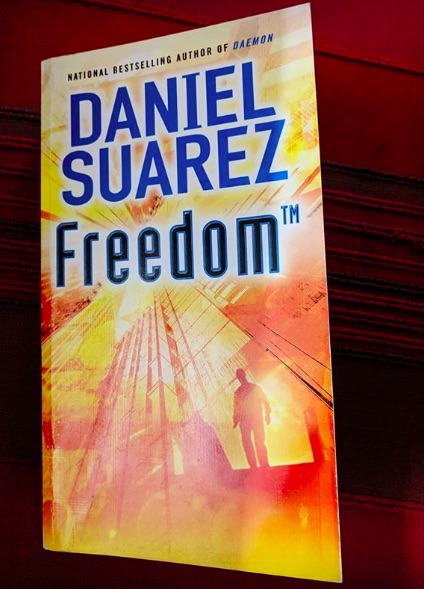
Freedom
Daniel Suarez
If you’ve read Daemon, I suspect it’d be very difficult to not read its sequel. If you haven’t, you know where to start!
Freedom picks up right where Daemon left off with the kind of intense action that dominated the last portion of the latter. Even as the Daemon systematically tears apart the corporations and financial systems that rule the world, its enemies prepare to launch a counter attack. What makes it all interesting is that the different players in the game have divergent agendas.It is also interesting that the book brings to life at least a few concepts that I have read in non-fiction in the context of how unemployment, extreme capitalism and the wealth divide will cause fundamental shifts in civilised society. Neo-feudalism, trust based community networks, and the irrelevancy of state borders are a few examples. In doing that, it also shows the possibility of how new systems could end up just like old systems because the basic human tendencies remain constant.
The narrative sets a scorching pace, and one is tempted to just zoom forward a few pages just to know how a plot point is going to end. Excellent read!
P.S. I somehow felt that it was written with a movie or two in mind. Almost like a screenplay.

-
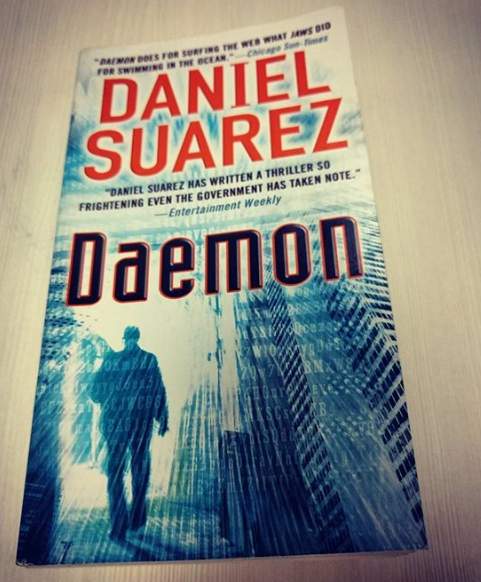
Daemon
Daniel Suarez
OMFG! That was one fantastic ride!
An obituary of a genius gaming tycoon gets published, a program, or rather a complex logic tree system, is activated, and it begins its not-so-slow journey of taking over the world! The concept of a person infiltrating and controlling (and even micromanaging) people, events and corporations, after his death, doesn’t seem as far fetched once you get on this roller-coaster of a book.
The immense tech knowledge that the author clearly possesses, meshes with a worldview that I definitely could relate to, and is nuanced with some very humane moments. It is as much a commentary of technology’s impact on society and individuals as it is an absolutely racy thriller that paces itself superbly. Pretty much an MMORPG set in the real world! What’s interesting is that at a certain point, it becomes very difficult to decide what the villain is – the Daemon or the government-military-industrial-corporation nexus that it seeks to destroy. The characters that fight for and against the Daemon are also an interesting bunch, with their own complex backstories, and sense of loyalty.
I thought this would be classified as cyberpunk, but apparently there is a thing called post-cyberpunk. Whatever it is, I can’t wait to read the second part of this amazing story!P.S. Somewhere in between, the author also manages to explain the reason for evolution deciding on sex as a means of reproduction! Fantastic stuff there too!

-
Dark Matter
Blake Crouch
(only broad level spoilers)
Of all the known and unknown phenomena in science, the multiverse theory is probably one that lends itself most easily to fiction. And yet, this is the first time I am encountering it. Largely, a pleasant experience.From a science perspective, I like how the author connects it to the brain and consciousness. Seems to lend it more credibility and therefore make it more believable. It isn’t really elaborated on, but I found it good enough for the purpose of the book. A 100 pages away from the end, I wondered how the author could possibly finish it without sacrificing logic. But he did find a way, even if it leaves things a little open ended.